
Saazora may earn a commission if you sign up through links on this page, at no extra cost to you. · Facts checked on emergent.sh, its help center and Trustpilot, October 1, 2026
Emergent has one of the most divided reputations of any AI app builder. On Trustpilot, 38% of its 634 reviews give it five stars and 48% give it one star, with almost nobody in between. The company is also one of the fastest-growing in the category: it reported more than 5 million users and over $50 million in annual recurring revenue when it raised a $70 million Series B in January 2026.
This Emergent review explains both sides. In short, Emergent is a capable prompt-to-app builder that writes, tests and hosts a full-stack app for you, but its credit system punishes people who do not plan their budget. Read the credit math section before you pay for anything.
Why are Emergent reviews so split?
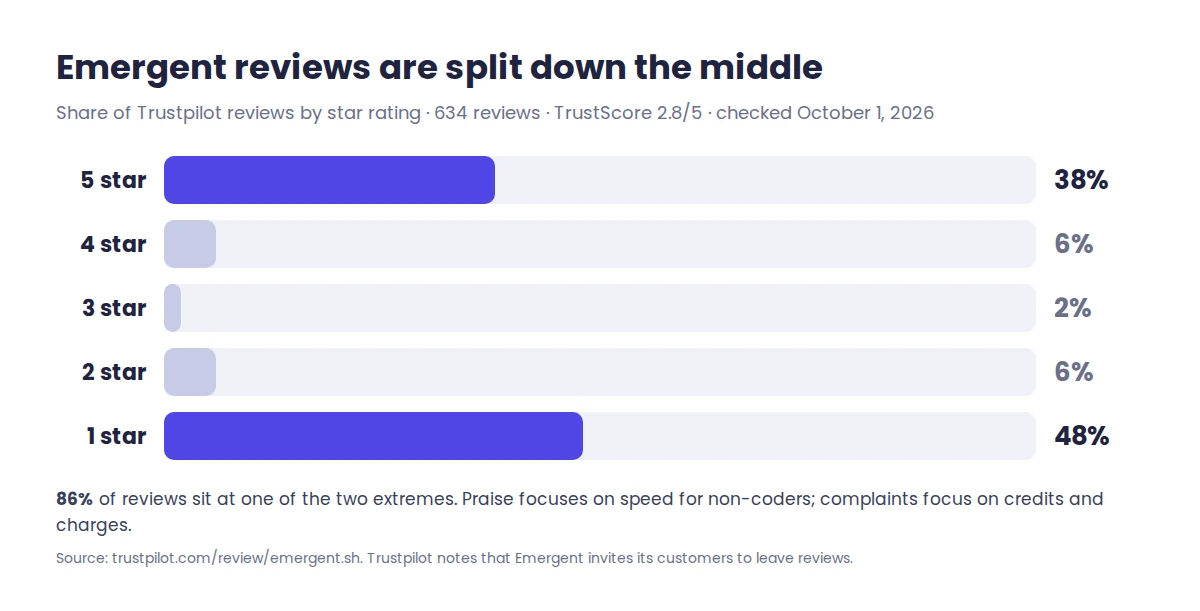
Read the reviews side by side and a pattern appears. The five-star reviews praise how fast a non-coder can describe an idea and get a working app, and several mention helpful support. The one-star reviews are mostly about money: credits running out faster than expected, errors that cost credits to fix, and charges people did not expect.
Both groups are describing the same product. Emergent bills for effort, not results. Its terms of service say credits are consumed whatever the result, including when the output is wrong, incomplete or has to be regenerated. If your first prompts are vague and the agent goes in circles, you pay for every loop. If your prompts are specific and your app is modest, the same credits go much further.
Note that Trustpilot labels Emergent as a company that invites customers to review it, and that the overall TrustScore is 2.8 out of 5.
What does Emergent actually build?
Emergent is made by Emergent Labs, founded by CEO Mukund Jha and his brother, with offices in India and San Francisco. You chat with AI agents, and they plan, code, test and deploy the app. Unlike many website builders, the output is a real codebase you can push to GitHub.
| What you choose | What Emergent uses |
|---|---|
| Web app | React and Next.js front end, Python (FastAPI) back end, MongoDB database |
| Mobile app | Expo (React Native) front end with the same FastAPI and MongoDB back end |
| Not supported yet | Flutter, Kotlin and Swift |
| AI features inside your app | A "Universal Key" that calls GPT, Claude and Gemini models, billed in Emergent credits |
Emergent's FAQ lists four agents. E1 is the default for stable, production-ready builds with full testing. E1.1 is a faster, modular option for back-end-heavy projects. E1.5 handles advanced, structured builds and is aimed at Pro users. The Mobile Agent builds iOS and Android apps with Expo. The help center also documents ready-made integrations including Stripe, Razorpay, Supabase, Airtable, Slack, Twilio, SendGrid, Resend and ElevenLabs.
From prompt to live app: how Emergent works
- Describe the app. You write what you want in plain language, or use voice mode. The more specific the first prompt, the fewer paid correction rounds you need.
- Pick an agent. E1 for a complete app, E1.1 for API-heavy work, the Mobile Agent for phones.
- Let the agent build and test. It writes the front end, back end and database, runs tests and shows a live preview.
- Save to GitHub. Paid plans can push the code to your own repository. Emergent recommends saving between milestones, and you can roll back or fork a task if a change goes wrong.
- Deploy. One click puts the app online with automatic SSL and an optional custom domain. This is the step that changes your credit budget.
The credit math to do before you pay
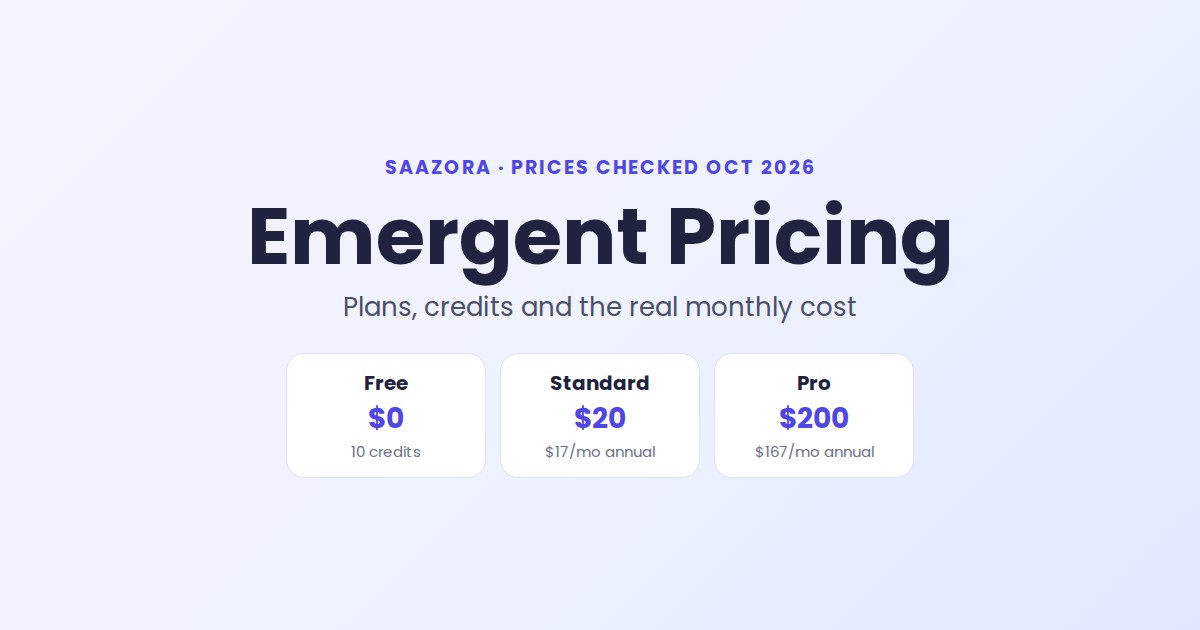
Emergent's pricing page shows the plans clearly: Free with 10 credits a month, Standard at $20 a month with 100 credits, and Pro at $200 a month with 750 credits. What the plan cards do not show is the running cost of keeping an app online. Emergent's help center states that each deployed app uses 50 credits a month.
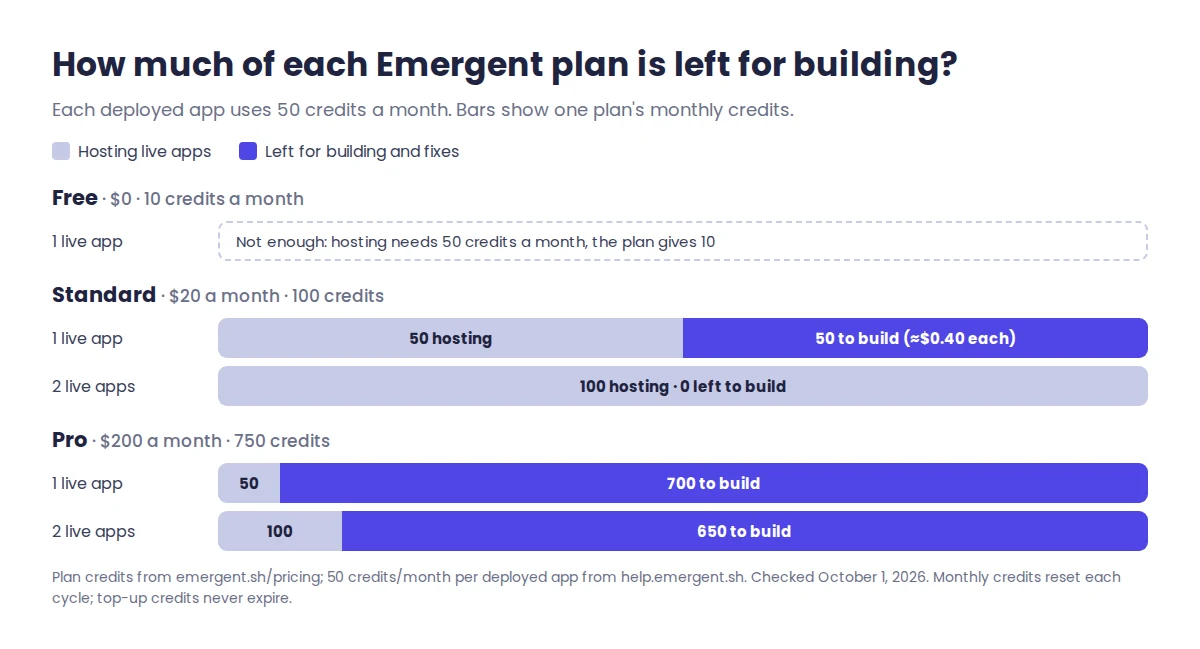
- Free (10 credits): enough to start a small project and see the preview, but the allowance alone cannot cover the 50 credits a month a live deployment uses.
- Standard (100 credits): one live app takes half your credits, leaving 50 for building and fixing. Two live apps take all 100. In practice, with one app online you pay about $0.40 per building credit, double the $0.20 headline rate.
- Pro (750 credits): one live app leaves 700 credits, so hosting stops being the main cost. Pro is priced for people running several apps or heavy builds.
Two more rules shape the budget. Monthly subscription credits reset at the end of each billing cycle and do not roll over, while top-up credits bought separately never expire. Emergent does not publish how many credits a typical build uses, because it depends on the size of the app and how many correction rounds you need.
One warning: Emergent's own help center is not consistent. On October 1, 2026, its FAQ page still listed a 5-credit free plan and a $10 Starter plan that no longer appear on the pricing page. Trust the live pricing page, and check what your checkout screen shows before you pay. Our Emergent deals page lists the current verified prices and annual savings.
Where Emergent is strong
- It ships a full stack, not a mock-up. Front end, API, database, tests and hosting come from one conversation.
- The code is yours to keep. GitHub sync means you can move the project to a developer or another host later.
- Web and mobile from one place. The Mobile Agent produces an Expo app from the same workspace you use for web projects.
- AI features are built in. The Universal Key lets your app call GPT, Claude or Gemini without setting up separate API accounts.
- Privacy terms are clear. Emergent says your code is private, encrypted and not used for AI training.
Where Emergent struggles
- Unpredictable cost. Credits are spent per effort, failed attempts included, and there is no published cost per task.
- Strict refund terms. Payments are non-refundable except for cases such as billing errors or duplicate charges, and consumed credits are not refunded unless Emergent decides otherwise.
- Hosting eats the budget on Standard. Each live app takes 50 credits every month it stays online.
- Fixed technology choices. If your team works in Flutter, Swift or a SQL database, the generated stack will not match.
- Outdated documentation. Conflicting plan details in the help center make it harder to know what you are buying.
Emergent compared with Lovable, Bolt, Base44 and Replit
Each of these tools prices its usage differently, so compare the entry paid plan and the unit you are buying, not just the dollar figure.
| Tool | Entry paid plan | What you get | Worth noting |
|---|---|---|---|
| Emergent | Standard, $20/month ($17 billed yearly) | 100 credits a month | Each live app uses 50 credits a month; mobile apps via Expo |
| Lovable | Pro, $25/month | 100 credits a month | Unused credits roll over for one month |
| Bolt | Pro, $25/month | From 10M tokens a month | Unused tokens roll over to the next month |
| Base44 | Starter, $16/month billed yearly | 100 message credits a month | 20% off for yearly billing |
| Replit | Core, $20/month ($18 billed yearly) | $20 of monthly usage credit | A full online coding environment as well as an AI agent |
Prices were checked on each vendor's pricing page on October 1, 2026. The rollover rules matter: on Lovable and Bolt, credits you do not use carry over for a while, while Emergent's monthly credits reset every cycle.
Should you build your app on Emergent?
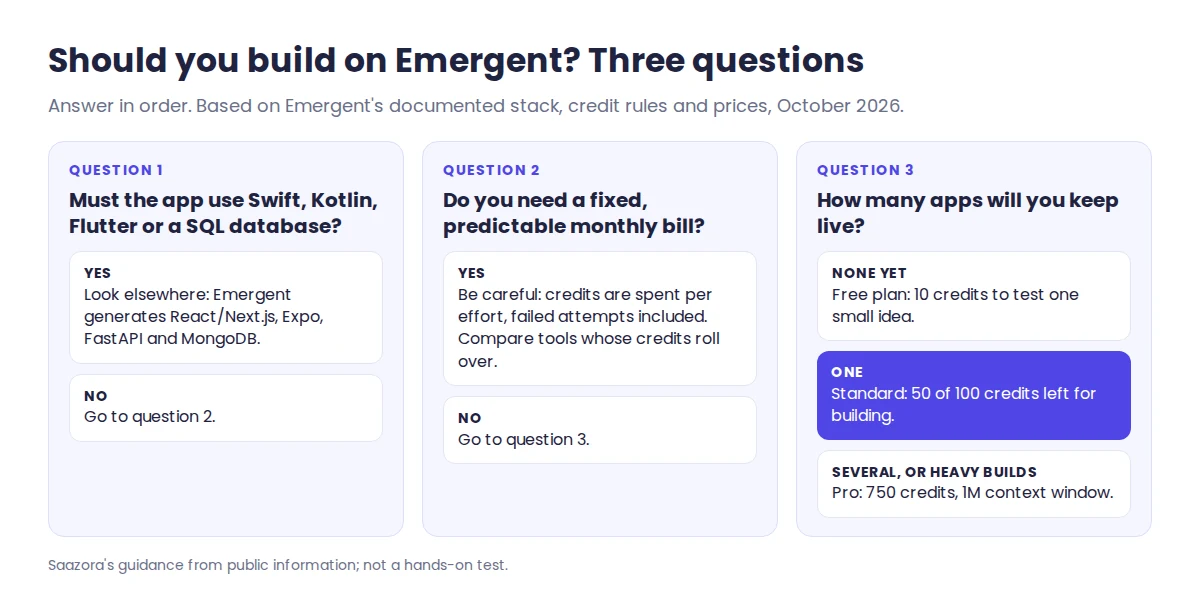
Emergent is a good fit if you are a founder, product manager or agency that wants a working web or mobile prototype without hiring a developer, you are comfortable with React, FastAPI and MongoDB as the stack, and you will keep only one or two apps online.
Look elsewhere if you need a fixed, predictable monthly cost, your team builds in Flutter, Swift or Kotlin, or you are building a mission-critical product where a failed generation that still costs credits is not acceptable.
Test Emergent before you commit
The free plan gives you 10 credits a month, with no credit card needed.
Start building on Emergent freeOur advice: start on the free plan, write one detailed prompt for a small feature, and note how many credits it uses. That single number tells you more about your real monthly cost than any review can. Only then decide between Standard and Pro, and consider yearly billing once you know you will keep using it.
Emergent review FAQ
Is Emergent legit?
Yes. Emergent Labs is a venture-backed company: it raised a $23 million Series A led by Lightspeed in September 2025 and a $70 million Series B led by Khosla Ventures and SoftBank Vision Fund 2 in January 2026. Its mixed reviews are mostly about credit costs and refunds, not about the company being fake.
Is Emergent free to use?
Emergent has a free plan with 10 credits a month and no credit card required. That is enough to try the builder on a small idea and see a live preview. Keeping an app deployed costs 50 credits a month, so publishing a finished app usually needs a paid plan or top-up credits.
Can you export your code from Emergent?
Yes, on paid plans. Emergent's GitHub integration lets you save your project to your own repository and pull changes back. Once the code is on GitHub, a developer can keep working on it outside Emergent or host it elsewhere, since it is a standard React, FastAPI and MongoDB project.
Can Emergent build mobile apps?
Yes. Emergent's Mobile Agent builds iOS and Android apps with Expo, a React Native framework, using the same FastAPI and MongoDB back end as its web apps. Native Swift, Kotlin and Flutter projects are not supported as of October 2026, according to Emergent's FAQ.
Does Emergent use your code to train AI?
No, according to Emergent. Its FAQ states that your code is private, encrypted and not used for AI training, and that project data is hosted on Emergent's own cloud infrastructure. If you handle sensitive customer data, also review its privacy policy and data processing agreement before you build.
Why do Emergent credits run out so fast?
Credits pay for every action the agent takes, including failed attempts and fixes. A deployed app also uses 50 credits a month. Vague prompts, long correction loops and several live apps drain a 100-credit Standard plan quickly. Specific prompts, small tasks and saving to GitHub between milestones help the credits last longer.
How we researched this Emergent review
This is a research-based review: we have not yet run our own test build on Emergent, and we will add hands-on results when we do. Every figure comes from Emergent's pricing page, help center, FAQ and terms of service, Trustpilot's public rating page, and each competitor's own pricing page, all checked on October 1, 2026. Funding figures come from Emergent's September 2025 announcement and SiliconANGLE's January 2026 report. See how we review software, and browse more AI app builders.
Source: Emergent's official site, checked October 1, 2026.