
Last checked October 2, 2026 · News explainer, no sponsored links
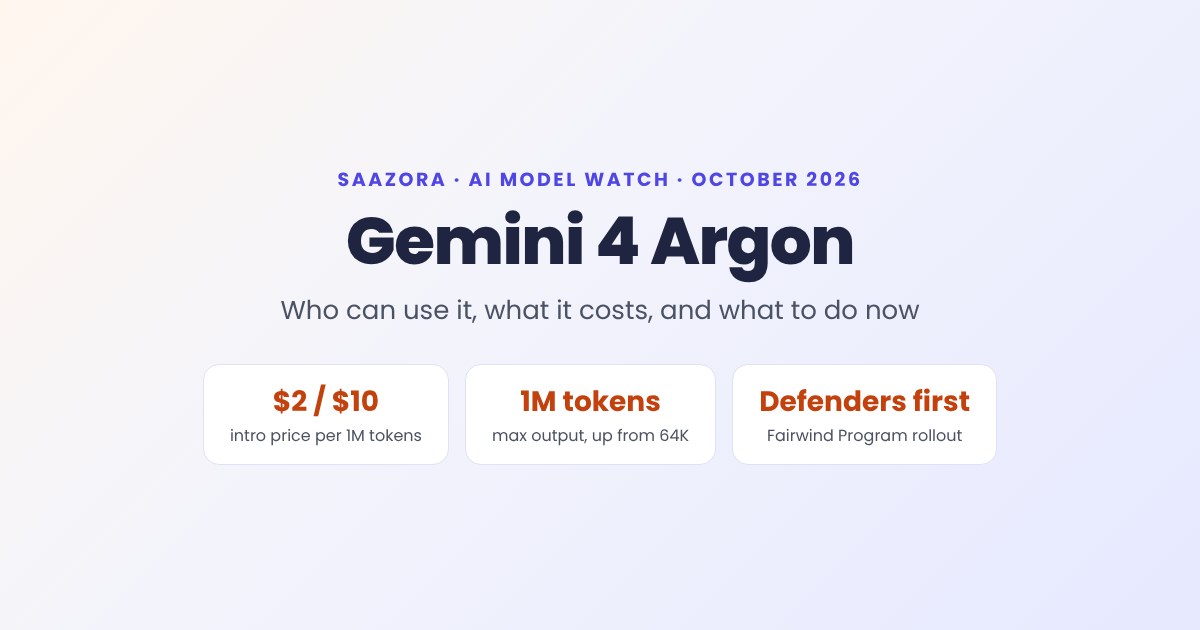
Can you use Gemini 4 Argon today? Almost certainly not. Google announced Gemini 4 Argon on September 30, 2026, as its new top model for coding, enterprise knowledge work and cyber defense. But the first wave is limited to trusted security teams in Google's Fairwind Program. Paid API customers and Google AI Ultra subscribers are next in line, and Google has not given a date. What is public is the Gemini 4 Argon price ($2 per million input tokens and $10 per million output tokens at launch, doubling later) and a 1-million-token output limit. Here is what that means for your budget and your plans.
Who has access right now, and who is next
Google describes the launch as a staged release. In its announcement, the company says Argon is "rolling out to a set of trusted cyber defenders through our Fairwind Program" and that broader access for developers, enterprises and consumers will follow, "starting with paid API customers and Google AI Ultra subscribers." Coverage from TechWire Asia puts the Fairwind group at more than 650 partners worldwide.
The reason for the slow start is the model's security skill. Google says Argon can find, validate and patch software vulnerabilities on its own. Defenders in the program get the model for that work with fewer cyber restrictions. Everyone else will get a version with safeguards that block harmful uses, and Google says it is also taking part in the U.S. government's voluntary pre-release testing process.
Google also dropped its previously planned Gemini 3.5 Pro, according to TechWire Asia, so Argon now sits at the top of the Gemini family.
What this means if you are…
- A developer on the paid Gemini API: you are in the first public group. Watch the Gemini API changelog and Google AI Studio's model picker rather than third-party "access" offers.
- A Google AI Ultra subscriber: you are also in the first public group. Ultra has cost $100 a month in the U.S. since Google cut the price at I/O in May 2026.
- On the free Gemini app or Google AI Pro: no announced path yet. Expect to wait for the broader release.
- A security team: the Fairwind Program is the only route today. Ask your Google Cloud account team about eligibility.
Gemini 4 Argon pricing, worked out on real workloads
Google published two price levels. During an introductory period, Argon costs $2 per million input tokens and $10 per million output tokens. After that, it rises to $4 input and $20 output. Cached input tokens get a 95% discount. Google did not say how long the introductory period lasts, so treat the lower Gemini 4 Argon price as temporary.
Per-token prices are hard to picture, so we priced three example workloads at both levels:
| Example workload | Tokens | Intro price ($2 / $10) |
Standard price ($4 / $20) |
|---|---|---|---|
| Batch code review | 2M input · 200K output | $6.00 | $12.00 |
| One very long report | 500K input · 1M output | $11.00 | $22.00 |
| A day of a repo agent | 20M input (15M cached) · 2M output | $31.50 | $63.00 |
The third row shows why caching matters. An agent that re-reads the same codebase all day sends most of its input as cached tokens. At the intro price, 15 million cached tokens cost $1.50 instead of $30. Output is where the bill grows: 2 million output tokens alone are $20 at the intro rate and $40 at the standard rate.
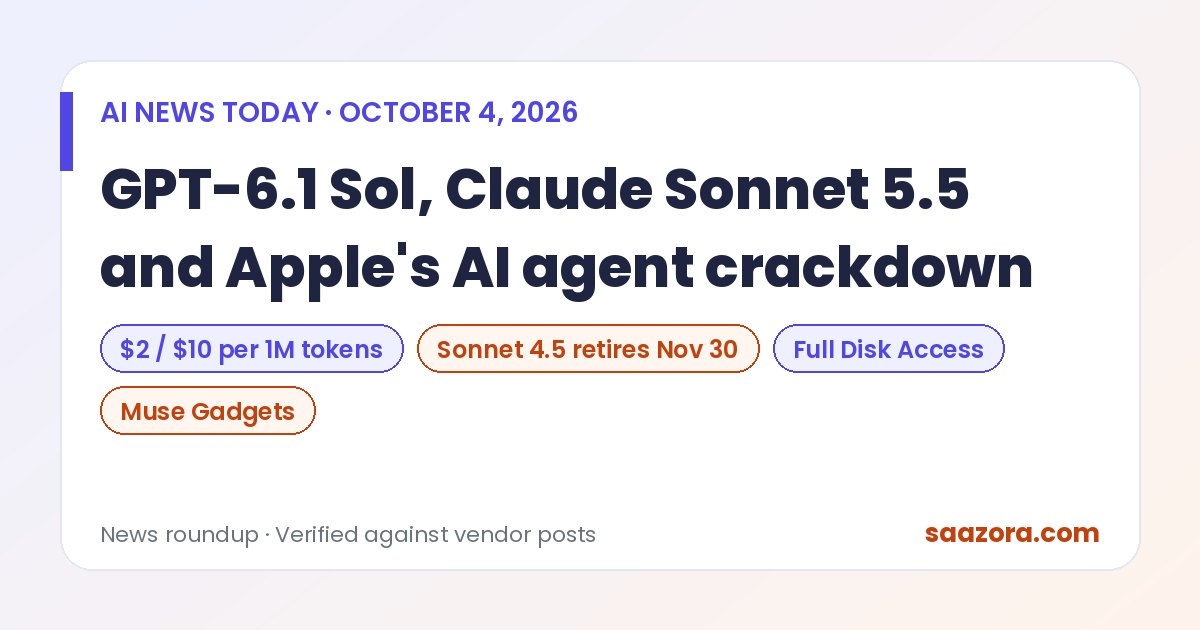
For comparison, OpenAI's GPT-6.1 Sol, launched at DevDay on September 29, also costs $2 input and $10 output per million tokens, and OpenAI says that is one-fifth of GPT-6 Astra's standard price. So at launch, Argon and Sol cost the same per token. Once Argon's intro period ends, it will cost twice as much as Sol.
Is the 1-million-token output limit a big deal?
It is the most unusual spec. Google says Argon can write up to 1 million tokens in one response, up from 64,000 on earlier Gemini models. That is roughly 750,000 English words, far more than most tasks need.
In practice, it matters for jobs that used to need many chained calls: migrating a large codebase from one language to another, producing a full set of documentation, or writing a long contract review in one pass. Google gives one internal example: converting more than 800,000 lines of C and C++ in its Fuchsia Zircon kernel to Rust.
Two cautions. First, a 1-million-token answer at the standard rate costs $20 in output alone. Second, long output is only useful if it stays accurate to the end. That brings us to the benchmarks.
How good is it? Google's numbers, and what is missing
Google reports 77.9% on DeepSWE v1.1 for real-world software engineering, 68% on CWE-bench v1 for fixing vulnerabilities (tied for first), 51.3% on AutomationBench for end-to-end business tasks (ranked first), and 91.7% on LVBench for long video understanding. It also says Argon leads the Vals Index, which weights finance, coding, legal and tax work.
What is missing is outside confirmation. As of October 2, no independent lab had reproduced the scores, according to AI Weekly's roundup, which also cites testers flagging hallucination concerns. Treat the chart as Google's claim until third-party evaluations arrive, which usually happens within days of public API access.
What to do this week
- Do not pay for "Argon access." Only Google sells it, and only to Fairwind members for now. Third-party sites claiming access are reselling something else.
- Budget at the standard price, not the intro price. If a workload only makes sense at $2/$10, it will not make sense in a few months.
- Structure prompts for caching now. Put the stable context (codebase, policy documents) first and the changing question last. That is how you capture the 95% cached-input discount on any model that offers one.
- Line up a head-to-head test. Pick 10 real tasks you run on your current model, so you can compare Argon fairly on the day you get access.
If you write code with AI every day, our look at Cursor's AI code editor covers how editors let you switch between models as new ones like Argon arrive.
Gemini 4 Argon FAQ
When will Gemini 4 Argon be available to everyone?
Google has not given a date. It says access will expand "soon," starting with paid Gemini API customers and Google AI Ultra subscribers, and then reach more developers, businesses and consumers. Right now only security teams in the Fairwind Program can use it.
How much does Gemini 4 Argon cost?
On the API, $2 per million input tokens and $10 per million output tokens during an introductory period, then $4 and $20. Cached input is 95% off. Consumer access is expected to come through Google AI Ultra, which costs $100 a month in the U.S.
Is Gemini 4 Argon free in the Gemini app?
No. Google has not announced Argon for free Gemini users or for Google AI Pro. The only consumer plan named in the rollout so far is Google AI Ultra.
Why is Google limiting access to Gemini 4 Argon?
Because of its cybersecurity abilities. Google says the model can find and patch vulnerabilities on its own, so it is giving trusted defenders first access and adding safeguards before the wider release.
Is Gemini 4 Argon better than GPT-6?
Google's published benchmarks say it leads on several tests, but independent labs had not confirmed them as of October 2, 2026. On price, Argon matches GPT-6.1 Sol at launch and costs twice as much after its introductory period.
How we researched this
We read Google's announcement and compared it with coverage from TechWire Asia and AI Weekly, plus OpenAI's DevDay recap for the price comparison. The cost table is our own calculation from Google's published per-token prices. We have not tested Argon, because it is not publicly available.
Sources (opened October 2, 2026): Google: Gemini 4 Argon (Sept 30, 2026) · TechWire Asia (Oct 1, 2026) · AI Weekly (Oct 1, 2026) · OpenAI DevDay 2026 recap (Sept 29, 2026) · Dataconomy on AI Ultra pricing (May 20, 2026)