
Last checked October 7, 2026 · News roundup
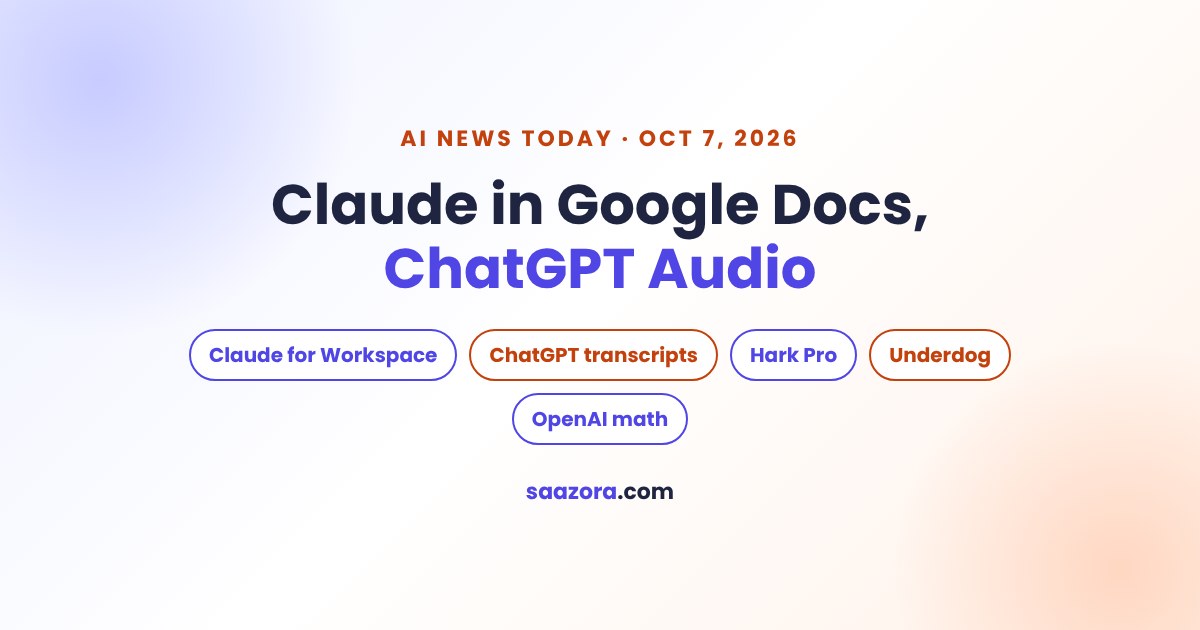
Today in brief: Claude now works inside Google Docs, Sheets and Slides through a sidebar add-on in public beta, and ChatGPT's paid plans can take audio files for transcripts and summaries. Two privacy-first personal assistants, Hark Pro and Underdog, launched on the same day, while OpenAI published new math results and Anthropic reorganized how security teams get access to Claude's cyber capabilities.
In AI news today, every item below was announced on October 5–6, 2026. Each section says what changed, who gets it, what it costs and what to do next. If you only have a minute, the figure below points you to the one story that fits your work.
Claude for Google Docs, Sheets and Slides: who can use it now
Anthropic released Claude for Google Workspace in public beta on October 6, 2026. It is a sidebar add-on from the Google Workspace Marketplace, and one install covers Docs, Sheets and Slides. Claude reads the file you have open and edits it directly, so changes show up in the file's version history.
In Docs it can fix a sentence or restyle a heading without disturbing the formatting around it. In Sheets it writes formulas, builds pivot tables and cleans data. In Slides it adds new slides that follow your existing layouts and theme. You pick between "Ask before edits," which asks you to approve each change, and "Accept all edits."
Who gets it: Claude's help center lists Pro, Max, Team and Enterprise plans. Free accounts are not included, and no separate add-on fee is listed. On Team and Enterprise, an owner must turn on connectors first, and a Google Workspace admin may need to allowlist the app.
Limits to know: a single task stops after 6 minutes, Claude only works on the open file, and Firefox isn't supported (Chrome, Edge and Safari are). Anthropic says content sent through the add-on isn't used for training and is deleted within 30 days.
Can ChatGPT transcribe audio files? Yes, on paid plans as of October 6
OpenAI's ChatGPT release notes for October 6 add audio uploads. You attach a recording, and ChatGPT can transcribe it, summarize it, answer questions about it or turn a meeting into notes or an email draft.
Who gets it: paid ChatGPT subscriptions and workspaces, including Enterprise. It is not available on the Free plan, and OpenAI says availability still varies by region, app version and model. If you're weighing a Pro subscription for heavier use, note that ChatGPT Pro usage limits change on October 30.
What files work: OpenAI's help center lists WAV, MP3, OGG, FLAC, AAC, M4A, PCM and audio-only WebM or MP4, up to 512 MB per file. Video files are rejected even if they share an extension. Very long recordings may be split into chunks, and OpenAI warns that transcripts can contain errors and that speaker labels may be unreliable.
What to do: for interviews or anything you'll quote, check the transcript against the audio before you rely on it. Free users still need a separate transcription tool.
| ChatGPT audio uploads | Google AI Edge Foresight | |
|---|---|---|
| Where audio is processed | OpenAI's servers | On your Mac, offline |
| Plan or price | Any paid ChatGPT plan; not Free | Download from Google's AI Edge site; no price listed |
| Input | Uploaded file, up to 512 MB | Live meeting audio plus your shorthand notes |
| Model | Varies by ChatGPT model | EmbeddingGemma 2 (740M parameters) |
| Caveat | Speaker labels may be unreliable | Mac only for now |
Google AI Edge Foresight for Mac: offline meeting notes from Google
Google released AI Edge Foresight, a Mac app that turns the quick bullet points you type during a meeting into complete notes, using a transcript it records and processes on the device, 9to5Google reported on October 6. It runs on EmbeddingGemma 2, a new 740-million-parameter model built on the Gemma 4 architecture and released under the Apache 2.0 license.
You can point the app at project folders, reference files, diagrams and calendar items, from local storage or Google Drive. It can also answer questions during a meeting and lets you chat with your own notes. According to 9to5Google, the model needs about 191 MB of RAM for text only and roughly 567 MB with multimodal features, which is light by AI model standards.
Cost and access: the app is a download from Google's AI Edge developer site, alongside the existing AI Edge Gallery and Eloquent apps. No price was listed. It suits people who want meeting notes without sending audio to a cloud service.
Hark Pro is out: what the privacy-focused AI assistant does and costs
Hark, the startup Brett Adcock founded less than a year ago, released Hark Pro widely on October 6, TechCrunch reported. It works like an operating system for a personal assistant: a full-screen chat surrounded by "panels," small dashboards built around your day.
With permission, Hark reads your email, calendar and files and can use your saved cards to act for you. It proposes tasks on its own, such as approving expenses, replying to email, booking flights or renewing a license at the DMV. When it browses the web, it does so in a small visible window so you can watch every step. Hark says it uses a model trained specifically for computer use and pitches itself as an assistant that won't sell ads or your data.
Price: there is a free tier and a paid subscription for heavy users; TechCrunch did not report the subscription price. Hark also promised an AI-native hardware device for 2027.
What to do: before granting card or inbox access to any agent, check which actions it can take without asking you first.
What is Underdog? A free AI assistant that runs on your own computer
Underdog, from Thiel Fellow Sigil Wen's company Conway Research, opened an invite-only beta on October 6, according to TechCrunch. Unlike Hark, Muse or Dots, it runs entirely on your device, using a 27-billion-parameter reasoning model based on Qwen3.8 27B. Wen claims it performs comparably to Claude Opus 4.6 on some benchmarks; that is his claim and hasn't been independently tested.
It works on Mac and Windows now, with Linux, iPhone and Android versions promised. Keys to the accounts you connect, such as email, are stored encrypted.
Price: free with no ads and no subscription. Underdog plans to earn a small cut of payments you make through it on Stripe's infrastructure, which TechCrunch compares to interchange fees. Backers include Andreessen Horowitz, Khosla Ventures, SV Angel and Vercel founder Guillermo Rauch.
What to do: join the waitlist if local processing matters to you, and check your computer's memory first, since local models of this size are demanding.
- Runs: cloud model trained for computer use
- Price: free tier plus paid plan (price not reported)
- Access: wide release, October 6
- Next: hardware device promised for 2027
- Runs: fully on device, 27B model
- Price: free; small cut of Stripe payments
- Access: invite-only beta, October 6
- Next: Linux, iPhone and Android versions
OpenAI's AI math results: what an internal model proved
On October 6, OpenAI published "a broad range of new mathematical results" on open problems, produced by an internal frontier model it didn't name. The release includes a GitHub repository with the results, proofs formalized in the Lean language (more are promised), 10 reasoning summaries from the model, and data on compute and the problems attempted. OpenAI says each result took on average the equivalent of about 3 hours of ChatGPT Pro thinking.
OpenAI says it followed guidance from the Institute for Advanced Study's advisory group on math and AI, set rules for how the results should be cited, and will fund workshops and conferences to study them.
Who it affects: mathematicians and researchers, mostly. No new model or plan is available to ChatGPT users, and nothing changes in price. For everyone else, the takeaway is that long-running reasoning in paid tiers is being aimed at research problems, not only coding and chat.
Anthropic's Cyber Verification Program now has three access tiers
Anthropic merged Project Glasswing and its original Cyber Verification Program on October 6 into one program with three tiers. Verified security teams get stronger cyber capabilities and fewer classifier blocks on Claude Opus 5.5, Claude Sonnet 5.5 and Claude Mythos 5.1, with access depending on the tier.
Anthropic says Glasswing partners found more than 129,000 verified vulnerabilities between April and July 2026, and that Anthropic found more than 5,500 more in open-source code. More than 33,000 of the findings were rated critical or high severity.
What to do: organizations apply through Anthropic's portal and must show proof of the required security controls. Existing members are evaluated for new models automatically, and Glasswing members move into the top tier without reapplying. There is no separate fee listed for the program.
| Tier | Who can apply | Review time |
|---|---|---|
| Defense | Company security teams, nonprofits, universities, government, hospitals and utilities, small security firms, open-source maintainers, individual researchers with a disclosure record | A few days |
| Red Team | In-house and government red teams, penetration testing firms; organizations only, authorized testing only | A few weeks |
| Specialized | A small number of verified organizations testing safety-critical systems such as power grids, telecom and banking; reviewed with the US government | Not stated |
Questions readers are asking on October 7
Is Claude for Google Docs free?
No. The Claude add-on for Google Docs, Sheets and Slides is in public beta for paid Claude plans: Pro, Max, Team and Enterprise. Anthropic hasn't listed a separate fee for the add-on itself. On Team and Enterprise, an owner has to enable connectors before members can sign in from the sidebar.
Can free ChatGPT users upload audio files?
Not yet. OpenAI's help center says audio uploads need a paid ChatGPT subscription or workspace. Supported formats include MP3, WAV, M4A, FLAC and audio-only MP4, up to 512 MB per file.
Which AI assistant keeps my data on my device?
Of the assistants launched on October 6, Underdog runs fully on your Mac or Windows PC using a local 27B model, though it's invite-only for now. Google's AI Edge Foresight also processes meeting audio on device, but it's a note-taking app for Mac rather than a general assistant.
Did OpenAI release a new model for math?
No. OpenAI shared results from an internal frontier model it didn't name, with proofs and Lean files on GitHub, but the model isn't available in ChatGPT or the API. OpenAI says each result used roughly the equivalent of 3 hours of ChatGPT Pro thinking on average.
Sources: Anthropic, Claude in Docs, Sheets and Slides (Oct 6, 2026) · Claude Help Center (checked Oct 7, 2026) · 9to5Google on Claude for Workspace (Oct 6, 2026) · ChatGPT release notes (Oct 6, 2026) · OpenAI Help Center, audio uploads (checked Oct 7, 2026) · 9to5Google on AI Edge Foresight (Oct 6, 2026) · TechCrunch on Hark Pro (Oct 6, 2026) · TechCrunch on Underdog (Oct 6, 2026) · OpenAI, AI progress in mathematics (Oct 6, 2026) · Anthropic, Cyber Verification Program (Oct 6, 2026)