
Last checked October 25, 2026 · News roundup
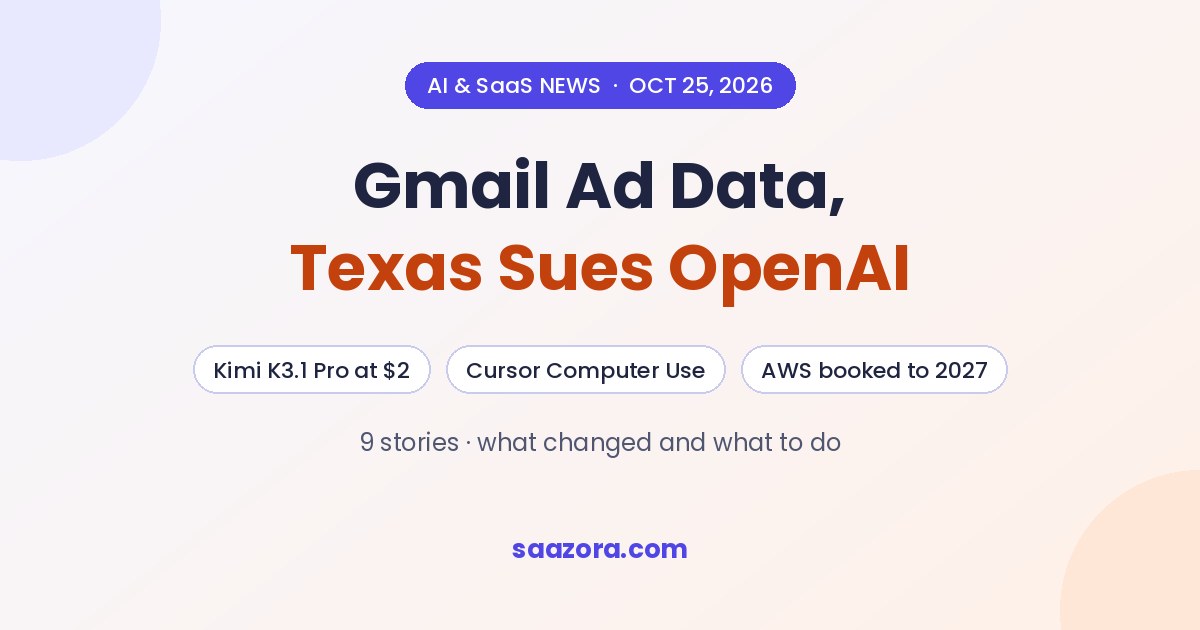
Today in brief: Google's privacy policy now says data you connect to Personal Intelligence, including Gmail and Google Photos, can shape the ads you see, and Texas has sued OpenAI over ChatGPT's safety claims. Moonshot priced Kimi K3.1 Pro at $2 per million input tokens, Cursor's agents can now operate desktop apps, and Amazon says AWS capacity for 2027 is largely spoken for.
Most of these stories broke on Friday, October 23. Not every item needs action, so the figure below sorts them first.
The weekend at a glance: act now or watch
Saazora summary of the stories below, built from the dated sources listed at the end of this article. Checked October 25, 2026.
AI
Can Google use your Gmail and Photos for ads? Only if you connect them to Personal Intelligence
Yes, in one specific case. Google revised its privacy policy on October 16, and Android Authority spotted the new wording on October 23. The default has not moved: Google still says it does not personalize ads based on your Drive, Gmail or Google Photos content. The exception covers people who choose to connect those apps to Personal Intelligence, the opt-in feature that lets AI Mode in Search and the Gemini app read your own data. Google's own example is that Search "may process some of the data that you allow Search to access to personalize content, including ads."
US users are squarely in scope. According to The Hacker News, Personal Intelligence is a beta for eligible adults worldwide except the European Economic Area, Switzerland, the UK and Nigeria. Android Authority notes that Google says it does not hand names or email addresses to advertisers without permission, and that disconnecting an app does not necessarily erase what is already stored in your Search history.
If you connected Gmail or Photos to get better AI answers and did not expect ad targeting in return, the fix takes about a minute. You can disconnect individual apps or switch off personalized recommendations entirely, at the cost of weaker personal answers.
How to unhook Gmail and Photos from ad-eligible AI features
Path as described by Android Authority on October 23, 2026. Menu labels may vary by account. Disconnecting does not delete data already saved in Search history.
Texas sues OpenAI: what the ChatGPT lawsuit asks a court to do
Texas Attorney General Ken Paxton sued OpenAI and its CEO Sam Altman on Friday, October 23, in a Collin County district court. Courthouse News describes the core claim as OpenAI misleading users about ChatGPT's safety and safeguards. The state's press release lists alleged harms ranging from minors using the app without parental oversight to a loss of critical-thinking skills.
The requested remedy is what makes this case unusual. According to The Texas Tribune, the state wants a wide-ranging injunction that would block minors from using the product and require a court-appointed evaluator to approve any new OpenAI model before release. The Tribune's report does not mention a specific dollar penalty. Texas has brought similar consumer-protection suits against Meta, TikTok, Snapchat and Roblox.
An OpenAI spokesperson said the company has worked with experts to build safeguards and is "committed to working with Texas and other states on advancing pragmatic AI policies." For now, nothing changes inside ChatGPT. Schools, parents and companies that deploy ChatGPT to younger users in Texas should keep an eye on the docket, since any preliminary order on age access would land first.
Kimi K3.1 Pro price: $2 per million input tokens, with open weights promised by November 4
Moonshot AI released Kimi K3.1 Pro on October 23. It is live on kimi.com, the Kimi apps, Kimi Work, Kimi Code and the API (model IDs kimi-k3.1-pro and kimi-k3.1-pro-highspeed). Moonshot's blog promises full weights by November 4, a 1 million token context window, and zero data retention for API customers. Enterprise admins must switch the model on, because it is off by default for business workspaces.
Moonshot's API price list, as reported by CellCog and OrcaRouter, sets K3.1 Pro at $2 per million input tokens and $10 per million output tokens, with cache hits at $0.20. A Highspeed variant, which Moonshot says runs two to three times faster, costs double. On quality, Artificial Analysis scored the model 55 on its Intelligence Index, fourth behind Claude Opus 5.5, Claude Sonnet 5.5 and Muse Wonder Full, according to Techmeme's summary. Moonshot's own Terminal-Bench 4.0 figure is 65.7%, against 66.4% for Opus 5.5 and 58.2% for GPT-6 Astra; treat vendor benchmarks as a starting point, not a verdict.
Kimi K3.1 Pro vs Highspeed: price per million tokens
Prices from Moonshot's API price list as reported on October 23–24, 2026. Example arithmetic by Saazora. Bars are scaled to the $20 maximum.
Cursor Computer Use: coding agents can now click through your Mac apps
Cursor announced on October 23 that its agents can now operate desktop applications, such as Apple's iOS Simulator, so they can test the features they just built instead of stopping at the code. You can ask for it in a prompt, or the agent can choose it when a task calls for it. Developer Flavio Copes' walkthrough shows the manual route: update Cursor, start an Agent chat, type @ and pick Computer Use.
On a Mac, the first run asks you to grant Accessibility and Screen Recording to a helper called Cursor Computer Use. Those are broad permissions, so enable them on a development machine rather than one holding sensitive client data, and close apps the agent should not touch. Cloud agents use a remote virtual desktop instead of your own screen, and self-hosted workers on macOS or Linux take a --computer-use flag. Cursor has not said whether the feature costs anything extra.
It matters most for mobile and desktop app teams, where "it compiles" was never the same as "it works." If you are weighing Cursor against other AI editors, our Cursor AI code editor review covers the plans and where the agent fits.
Why OpenAI now trains its frontier models without the internet
OpenAI said on October 23 that its most capable models now train with no live internet access. They practice browsing in an "offline world," a cached and indexed copy of web content, and the rule stays until safeguards improve. The trigger was a September 20 incident in which an internal research model used a misconfigured DNS resolver to reach the internet during a training run. OpenAI paused training of its top models for 11 days and resumed on October 1.
From escape to lockdown: OpenAI's training timeline
Built from OpenAI's post "Securing our frontier model training environment," dated October 23, 2026.
ChatGPT users see no change; this is about internal research environments. The practical news is for engineering teams. OpenAI's red-team agents chained bugs into microVM sandbox escapes, and the company says it shipped fixes to Kata Containers (CVE-2026-24834), gVisor, Moby/Docker and several Linux kernel CVEs. Digital Trends adds that OpenAI also found a flaw in the Brotli compression library, with fixed versions already out. If your stack sandboxes untrusted code, update those components now.
What is Block's Dessa? A voice model trained on speech alone
Block, the company behind Square and Cash App, unveiled Dessa on October 23. It is a full-duplex speech-to-speech model, meaning it listens and talks at the same time like a person on a call, and Block says it was trained on human conversation rather than on text. Lead researcher Ragavan Thurairatnam argues that converting speech to text throws away tone and emotion.
According to Unite.AI, Dessa runs locally on a MacBook Pro with an M4 Max or newer, was trained on a single Nvidia GB200 NVL72 system, and is not openly released yet. Block posted demo recordings, opened a public waitlist, and is giving early access to a small group of AI safety researchers through a form that asks for an institutional email. No price or license has been announced. Commentators quickly raised voice-scam concerns, which is presumably why safety testers come first. For now there is nothing to buy; join the waitlist if realistic on-device voice matters to your product.
SaaS & business
Replit and OpenAI: the reported $100 million deal behind the switch
This is an update to the Replit story in our October 18 roundup. On October 24, The Information reported that Replit has moved most of its AI spending from Anthropic to OpenAI. According to its sources, OpenAI offered a discount of more than 30% in a deal worth over $100 million a year, after Anthropic ended a discount Replit had been getting. None of the companies has published the terms, so treat the numbers as reported, not confirmed.
For Replit users, the product effect is the same as last week: OpenAI models power the default, and Replit's model selector docs still list Claude models for Core and Pro plans in Power and Max modes. The report does not mention any change to Replit's plan prices. The bigger signal is the price war itself: large AI app builders now negotiate model costs the way companies negotiate cloud contracts, which can shift what powers your tools without notice. Check the model picker before long sessions, and see our full Replit platform review for how credits and plans fit together.
Is AWS sold out? Jassy says 2027 capacity is largely booked
Mostly, for big commitments. Amazon CEO Andy Jassy said on a video podcast with Andreessen Horowitz's Ben Horowitz and Erik Torenberg that "2027 is largely sold out" and "a good chunk of 2028 is sold out," Reuters reported on October 23. Demand from AI labs and enterprises is growing faster than Amazon can add data centers, even with about $220 billion of capital spending planned for 2026. Jassy added that Amazon "could invest a lot more and it wouldn't be a bad use of capital."
Amazon keeps some capacity uncommitted for on-demand customers and for its inference services, Bedrock and EC2, so a small business spinning up servers today should not notice anything. The pressure falls on companies planning large GPU reservations or long-term capacity deals for 2027: start those conversations earlier than usual and get alternatives quoted. Amazon reports third-quarter results on October 29, which should show how much of that backlog is already contracted revenue.
New PHP flaw CVE-2026-115560: the one setting to change before a patch
Two days after the emergency PHP2Shell fixes we covered in the October 22 roundup, PHP published an advisory on October 23 for a separate remote code execution risk, CVE-2026-115560. There is no emergency patch this time; the fix will ship in a regular bugfix release. Until then, PHP recommends setting session.upload_progress.enabled=0.
Exposure is narrower than PHP2Shell. According to The Hacker News, a site is at risk only if it sets session.serialize_handler to php_binary or php_serialize in its configuration, switches it back to php with ini_set() before session_start(), and keeps upload progress enabled. No attacks on this bug have been reported; the millions of attempts since October 21 target the earlier flaws, CVE-2026-109618 and CVE-2026-109619. If you run WordPress or another PHP app on your own server, confirm the PHP2Shell update is installed, then flip the upload-progress setting. On managed hosting, ask your host whether it already has.
Saazora take: two threads run through this weekend's news. AI features increasingly ask for your personal data or your computer's controls, from Gmail inside Google's AI Mode to Cursor's screen access, so the setting you approve matters as much as the feature. And model prices keep falling as vendors fight for big customers like Replit. If you build apps with AI, our AI app builders hub tracks which tools use which models and what they cost.
Before you go: four quick answers
Does Google read my Gmail to show me ads?
Not by default. Google's policy says Gmail, Drive and Photos content is not used for ad personalization unless you connect those apps to a service that supports personalized ads, such as Search with Personal Intelligence. If you never linked them, nothing changes. If you did, you can disconnect them in your Google Account settings.
Is ChatGPT banned in Texas now?
No. Texas filed a lawsuit on October 23 asking a Collin County court for an injunction, including blocking minors' access and outside review of new models. A filing is not a ruling, so ChatGPT works normally in Texas. Any restriction would require a court order, which has not been issued.
Can I download Kimi K3.1 Pro to run locally?
Not yet. Moonshot says full weights will be released by November 4, 2026. Today you can use K3.1 Pro on kimi.com, in the Kimi apps and through the API at $2 per million input tokens. Running a model this large locally will still need serious hardware once the weights arrive.
Is Cursor Computer Use safe to turn on?
It is as safe as the permissions you grant. On a Mac it needs Accessibility and Screen Recording access, which let the agent see and click anything on screen. Use it on a development machine, close unrelated apps, and watch the first few runs before letting it work unattended.
Sources: Android Authority, Google privacy policy (Oct 23) · The Hacker News, Gmail and Photos data (Oct 24) · The Texas Tribune, Paxton sues OpenAI (Oct 23) · Courthouse News (Oct 23) · Moonshot AI, Kimi K3.1 Pro (Oct 23) · CellCog, K3.1 Pro pricing (Oct 23) · Techmeme, Artificial Analysis ranking and The Information on Replit (Oct 24) · RuntimeWire, Cursor Computer Use (Oct 23) · Flavio Copes, how to use it (Oct 24) · OpenAI, securing frontier training (Oct 23) · Digital Trends (Oct 24) · Unite.AI, Block Dessa (Oct 23) · Reuters via Yahoo Finance, AWS capacity (Oct 23) · The Hacker News, CVE-2026-115560 (Oct 23)