
Last checked October 26, 2026 · News roundup
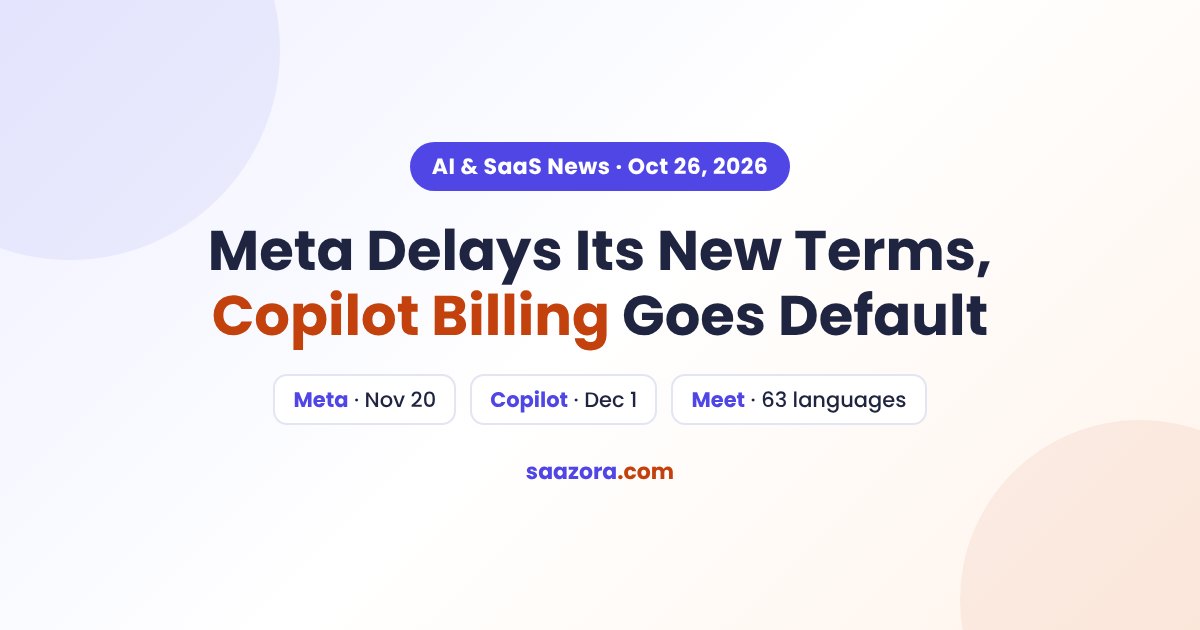
Today in brief: Meta has pushed its contested new business and ad terms back three weeks, to November 20, and Microsoft has confirmed that new Copilot Business licenses bought through partners will come with pay-per-use billing switched on from December 1. On the AI side, Anthropic handed the Agent Skills standard to the Linux Foundation, Google put Gemini Notebook inside the Gemini app and widened Meet's live translation to 63 languages, and two new readings of corporate AI returns landed with a thud.
The weekend was quiet, so most of this Monday edition picks up stories from Wednesday through Friday that we had not covered yet, plus two changes that take effect today. Several of them come with a date attached, so here they are in calendar order before the details.
Dates to put in your calendar
Built by Saazora from Google, Microsoft Partner Center, Moonshot AI and Reuters announcements, checked October 26, 2026.
Part 1 · AI
Agent Skills move to the Linux Foundation: what changes for Claude and ChatGPT users
Nothing changes in your Claude or ChatGPT account today. On October 22, Anthropic said it is donating the Agent Skills open standard, together with its name, logo, GitHub organization and the agentskills.io domain, to the Agentic AI Foundation (AAIF), the Linux Foundation group Anthropic co-founded with Block and OpenAI. The same foundation already looks after the Model Context Protocol, which Anthropic gave away earlier.
Skills are folders of instructions and scripts that an agent loads when a task needs them. Anthropic built the format while working on Claude Code, shipped it in October 2025 and published it as an open standard that December. Engineers from Anthropic, Google, OpenAI and other companies will now maintain it as individuals, with David Soria Parra and Mahesh Murag as lead maintainers. The proposed roadmap covers versioned releases, a formal proposal process and security guidance for people who write or install skills.
How far Agent Skills have spread
Figures as reported by Anthropic, October 22, 2026. Saazora has not independently counted them.
Who it affects: anyone who writes skills for one tool and wants them to work in others. With a million published skills, the security guidance is the part to watch. Until it ships, our safety checklist for third-party skills works for skills from any vendor, and our AI agents and Claude Code hub collects the rest of our agent coverage.
How to use Gemini Notebook inside the Gemini app
Since October 23 you no longer have to switch to Gemini Notebook to work with your notebooks. Google made it a Connected App in the Gemini app, so you can type @Gemini Notebook in a chat, or just ask a question that clearly refers to a notebook, and Gemini will create, edit or delete notebooks, add or remove sources, save notes, list what a notebook contains and answer questions from it.
It is available now to all Google Workspace customers, Workspace Individual subscribers and personal Google accounts, on both Rapid and Scheduled Release domains. It is on by default everywhere except the European Economic Area, where users have to switch it on under Settings > Connected Apps. Workspace admins see it only for groups where both Gemini and Gemini Notebook are enabled.
What to do: if you keep research in notebooks, try a prompt such as "list the sources in my notebook about our Q4 launch" to see whether chat is faster than the notebook view. Admins who don't want Gemini editing notebooks should check the Gemini app access settings this week, because the feature is already live.
Google Meet translation now covers 63 languages: who gets it and the time limits
Google Meet's real-time speech translation, powered by Gemini, now works across 63 languages, and one meeting can mix any of them. Before this October 22 update, a meeting was locked to one language pair. Meet now detects who is speaking which language, follows a speaker who switches mid-sentence, and translates into each listener's own preferred language. You can list languages you already understand so Meet leaves them alone.
It is off at the start of each meeting; each participant turns it on from the toolbar. Eligible plans are Business Standard and Plus, Enterprise Standard and Plus, Frontline Plus, Google AI Pro and Ultra, Google AI Pro for Education, and the AI Expanded Access and AI Ultra Access add-ons. Base Workspace and AI Pro plans get 90 minutes of translation per meeting; the Ultra tiers and Expanded Access get up to 8 hours.
Rapid Release domains got it from October 22. Scheduled Release domains, which is most companies, start on November 2 with up to 15 days before everyone sees it. It does not work in live streams, recordings, client-side encrypted meetings or dial-in calls.
Gemini 4 Argon is now the AlphaEvolve default: check your experiment bills
This one takes effect today. From October 26, new AlphaEvolve experiments in Gemini Enterprise that don't name a model run on Gemini 4 Argon instead of Gemini 3.8 Flash, and they are billed at Argon's token rates. Experiments created before today keep the model already in their configuration. To stay on the cheaper model, set gemini-3.8-flash in the models field of your generation settings.
Who it affects: research and engineering teams running AlphaEvolve jobs from templates or scripts that leave the model blank. A script that leaves the model blank will now be billed at Argon rates without anyone on the team choosing that. Our explainer on what Gemini 4 Argon costs per million tokens has the launch rates and the planned increase.
Kimi K3.1 Pro paid promotion claims: what's alleged and what isn't proven
Two days after Moonshot set Kimi K3.1 Pro's API price at $2 for each million input tokens (covered in Sunday's roundup), VentureBeat reported on October 25 that screenshots on X appear to show a creator campaign for the model. An X user posted what he said were the instructions he turned down: drafts had to be approved first, the talking points pitched Kimi as an open-source equal to Claude Opus 5.5 at a fraction of the price, and creators were told not to add a paid-partnership label.
The document has not been authenticated. It is unclear whether Moonshot, an agency or someone else wrote it, or whether anyone posted under those terms, and VentureBeat found no company response as of Sunday. The allegations also don't change the independent benchmark results.
What to do: treat glowing creator posts about any new model with care this week, and judge Kimi on your own test prompts and on third-party benchmarks. In the US, the FTC expects paid endorsements to be clearly disclosed, whoever pays for them.
Is AI paying off for companies? Apollo says no, Gartner says 13% see big value
Two readings in a week point the same way. Torsten Slok, chief economist at Apollo Global Management, wrote in a note covered by TechCrunch on October 25 that AI has delivered "zero financial payoff" to corporate America outside tech. Looking at the S&P 500 minus its seven largest tech names, he found flat profit margins and flat revenue per worker. A week earlier, on October 19, Gartner published a survey of 2,002 CIOs and tech executives, fielded May to July 2026, in which only 13% said their company had seen significant or transformational value from AI.
Gartner CIO survey: value is rare, cost pressure is not
Feel more pressure to deliver AI cost improvements: 58%
Have rules for when a pilot should not go to production: 31%
Have rules for stopping low-value AI already in production: 17%
Report significant or transformational value from AI: 13%
Have explicit plans to redesign roles for humans plus agents: 4%
Source: Gartner press release, October 19, 2026 (2,002 respondents). Chart by Saazora.
The useful part for buyers is Gartner's finding that companies with clear rules for killing weak pilots were 2.3 times more likely to be among the leaders. If you are renewing AI seats this quarter, write down the metric each tool has to move and cancel the ones that don't move it.
Part 2 · SaaS & business
Meta's new business terms delayed to November 20
This is an update to the Meta terms we followed in our October 18 roundup. On Friday, October 23, Meta told Reuters it is moving the start date of its updated Commercial Terms and Self-Serve Ad Terms from October 30 to November 20. Publishers and advertisers had complained to EU and UK competition authorities that the terms would give Meta an "unlimited right" to use their content for its AI services, which Meta denies. Meta says it needs the time to explain "what's changing and what's not."
Who it affects: any business that runs ads, a Facebook Page, an Instagram business or creator account, Business Suite catalogs or WhatsApp Business. Personal accounts aren't covered. Continued business use counts as acceptance, so there is no form to sign.
The terms still give Meta the right to crawl domains linked to your business account, and law firm Shumaker, Loop & Kendrick notes that the separate Business AI Terms make customers indemnify Meta for claims arising from its AI Business Agents. Reuters' report doesn't say whether those AI terms moved too. Use the three extra weeks to list every Meta account your agencies manage and save a dated copy of the current terms.
Microsoft 365 Copilot Business usage billing: 4,000 credits per user from December 1
Microsoft has set December 1, 2026 as the date when usage-based billing is switched on by default for new Microsoft 365 Copilot Business licenses bought through Cloud Solution Provider (CSP) partners. The date was moved from November 2 in an October 14 Partner Center update. Each user gets a default ceiling of 4,000 Copilot Credits a month, which admins can raise or lower. Existing licenses are not affected, and the rollout skips 11 countries at first, including France, Germany and India; the US is not on that list.
What the default limit could cost at most each month
Ceiling from Microsoft Partner Center (Oct 14, 2026). The $0.01 pay-as-you-go rate is Microsoft's published Copilot Credits price as cited by licensing firms LicenseQ and Quisitive; prepurchase plans cost less. You are billed only for credits actually used, on top of the per-user license.
Two more changes land first. From November 1, AI Builder capacity add-ons are no longer sold; current credits last until your term ends, then AI Builder runs on Copilot Credits. And from December 1, new Copilot and Copilot Business offers no longer require a qualifying Microsoft 365 base plan, at the same price as today's add-ons. If you buy through a partner, ask them to set your spending policy before December 1. Our October SaaS price-change tracker covers Microsoft's other CSP increases.
Is Instacart being sold? DoorDash talks, per reports
Not yet, and possibly not at all. The Information reported on Friday, October 23 that Instacart has hired an investment bank to review its options and has held acquisition talks with DoorDash. Bloomberg reported that Instacart also spoke with Uber, which reportedly walked away. Bloomberg described the talks as early and said they may not lead to a deal, and Instacart declined to comment, according to TechCrunch.
Instacart is worth more than $13 billion, according to TechCrunch, and its stock rose more than 9.2% on Friday while Uber and DoorDash shares fell. For shoppers, nothing changes: Instacart+ pricing, orders and shopper pay stay as they are unless a deal is signed and approved, and a tie-up between two of the biggest US delivery apps would likely draw antitrust scrutiny.
For retailers that sell through Instacart's storefront and ads tools, the risk is a change of owner partway through a contract. If you are negotiating a multi-year Instacart deal now, ask about change-of-control terms.
Quick answers for October 26
Do Meta's new terms start on October 30?
No. Meta told Reuters on October 23 that its updated Commercial Terms and Self-Serve Ad Terms now take effect on November 20, 2026, three weeks later than planned. Continuing to use Meta's business tools after that date counts as accepting them, so review the crawling and AI liability language with your legal or agency contact before then.
How many languages does Google Meet translation support?
Sixty-three as of October 22, 2026, and one meeting can mix any of them with automatic language detection. You need an eligible plan such as Business Standard or Google AI Pro. Base plans get 90 minutes of translation per meeting, and Scheduled Release domains start receiving it on November 2.
Will Copilot Business charge me more on December 1?
Only if you buy a new Copilot Business license through a CSP partner on or after December 1 and use credit-billed features. Those licenses come with usage billing on by default and a 4,000-credit monthly cap per user, up to about $40 at the $0.01 pay-as-you-go rate. Existing licenses are not changed.
Who controls Agent Skills now?
The Agentic AI Foundation, part of the Linux Foundation, owns the standard, its name and its domain after Anthropic's October 22 donation. Engineers from several companies, including Anthropic, Google and OpenAI, maintain it as individuals, and you can use or contribute to it without joining the foundation.
Saazora take: Three of today's stories are really about defaults: Copilot billing that switches itself on, an AlphaEvolve model that changes unless you name one, and Meta terms you accept by carrying on. Defaults are where SaaS bills creep up, so the cheapest move this week is to check each one before it is applied to you.
Sources: Anthropic, Agent Skills donation (Oct 22) · Google Workspace Updates, Gemini Notebook (Oct 23) · Google Workspace Updates, Meet translation (Oct 22) · Gemini Enterprise release notes (Oct 22) · VentureBeat, Kimi K3.1 Pro (Oct 25) · TechCrunch, Apollo note (Oct 25) · Gartner CIO survey (Oct 19) · Reuters via Investing.com, Meta terms delay (Oct 23) · Shumaker client alert (Oct 21) · Microsoft Partner Center, October 2026 announcements · LicenseQ, October 2026 licensing update · Quisitive, Copilot Credits pricing (Jun 23) · TechCrunch, Instacart talks (Oct 24). All 2026.