

Saazora may earn a commission if you sign up through some links on this page, at no extra cost to you. · Updated October 2, 2026
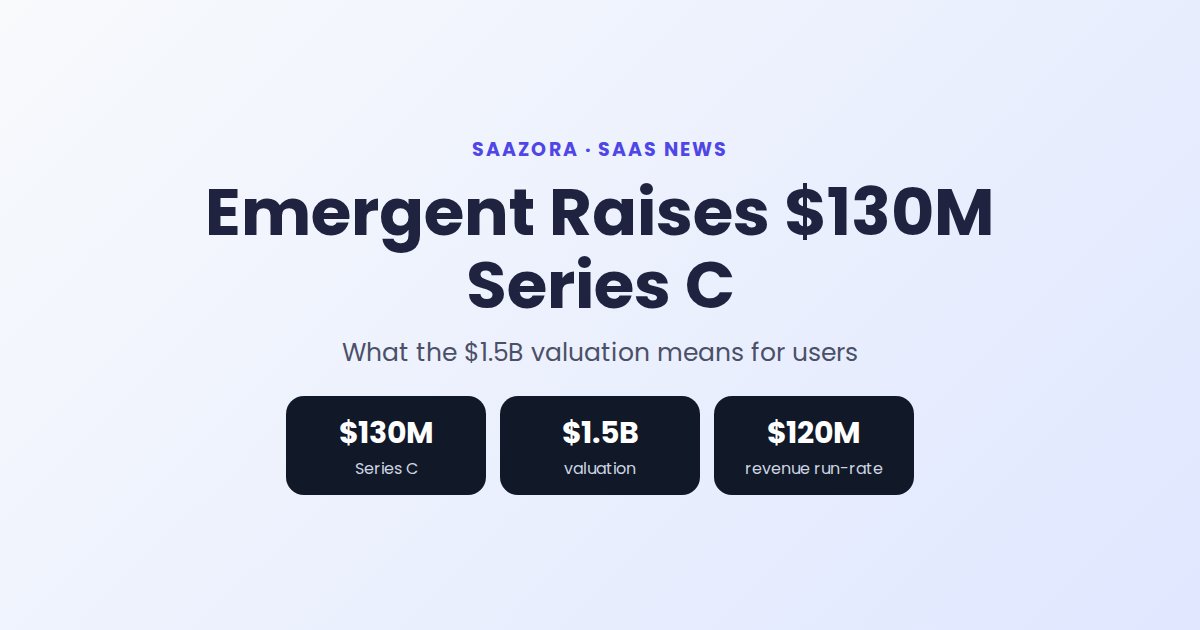
What happened: Emergent, the AI app builder that turns plain-English prompts into web and mobile apps, raised a $130 million Series C that puts its valuation at $1.5 billion, first reported on July 15, 2026. The round was led by Creaegis, with MNI Ventures–Claypond Capital and Sentinel Global co-leading, and Khosla Ventures, SoftBank Vision Fund 2, Lightspeed and Y Combinator returning. Emergent has now raised $230 million in total, about a year after launching in June 2025.
Below: the key numbers, what the company says it will do with the money, and what it means if you use or are considering Emergent.
Emergent's Series C in numbers
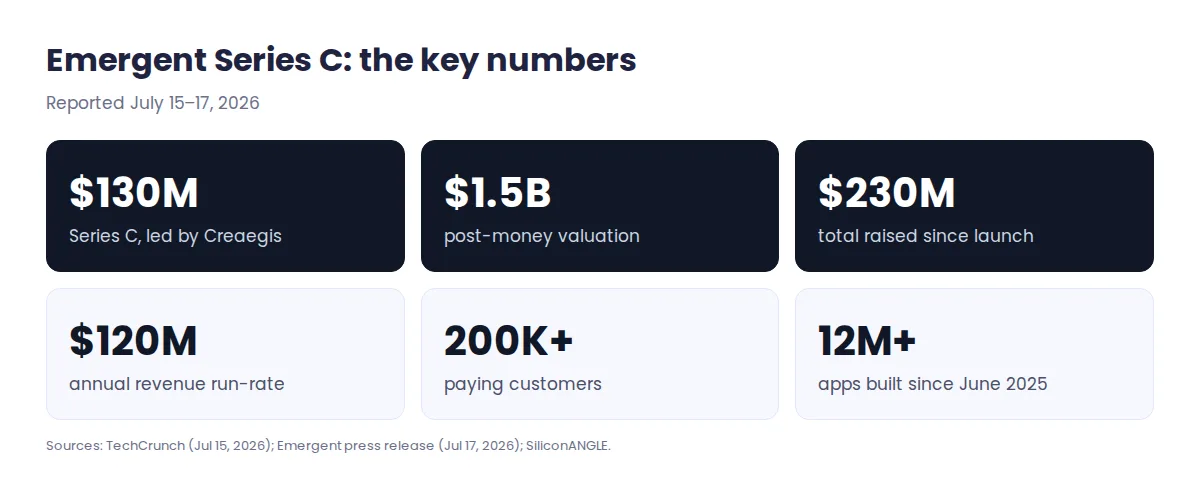
- Revenue: an annual run-rate of about $120 million, up 70% in four months, according to TechCrunch.
- Customers: more than 200,000 paying customers, with revenue split roughly one third North America, one third Europe and one third the rest of the world. India is 8 to 9%.
- Usage: more than 12 million apps built since launch, with about 70% of users having no coding background.
- Team: around 200 employees, mostly in Bengaluru, with an office in San Francisco. The company is led by co-founders Mukund Jha (CEO) and Madhav Jha (CTO).
Emergent's valuation: from about $300 million to $1.5 billion
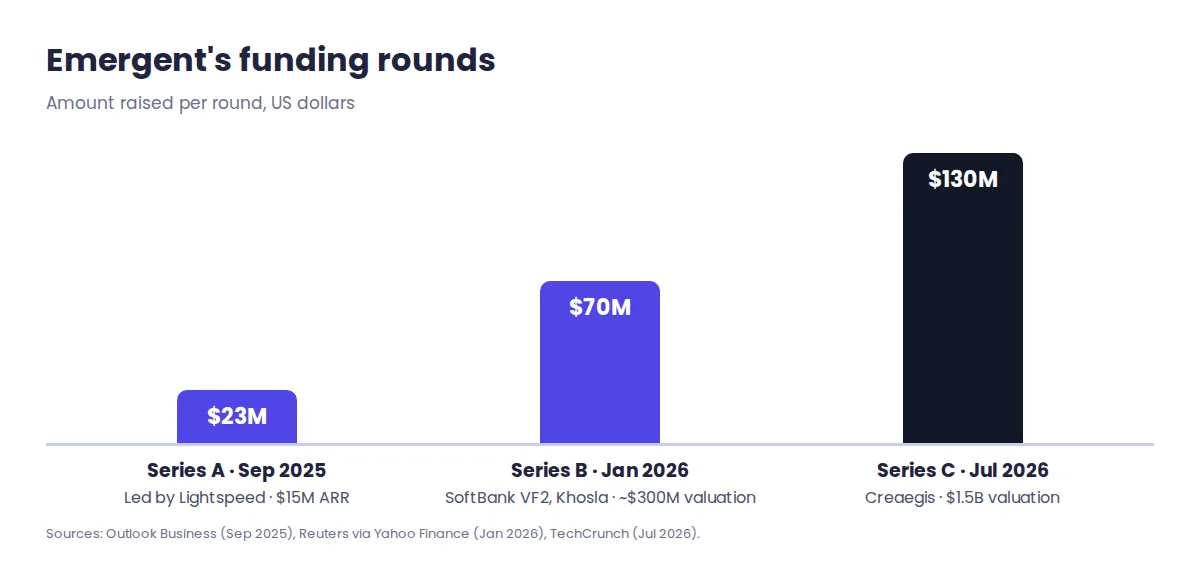
Emergent's growth has been unusually fast even by AI standards. In September 2025 it raised a $23 million Series A led by Lightspeed, reporting $15 million in annual recurring revenue within 90 days of launch. In January 2026 it raised $70 million in a Series B led by SoftBank Vision Fund 2 and Khosla Ventures, at a valuation of about $300 million, with $50 million in ARR. Six months later, the Series C put it at five times that valuation.
Where the money is going
According to TechCrunch and The Next Web, Emergent plans to spend the new funding on:
- Research and product work to raise the share of apps that are built successfully, and to improve its agent workflows.
- Support for more complex apps, including through local and open-source models.
- Go-to-market expansion, adding 30 to 40 people to its San Francisco team by the end of the year and possibly opening a European office.
The founders have been open about the weak spots. In The Next Web's coverage, Emergent acknowledged that design consistency and app success rates still need work, which matches what users report.
What it means if you use Emergent
Prices did not change with the round. As of October 2, 2026, Emergent's pricing page lists a free plan with 10 credits a month, Standard at $20 a month ($17 billed yearly) with 100 credits, and Pro at $200 a month ($167 billed yearly) with 750 credits. Business and Enterprise plans are custom. We break down what those credits buy in our Emergent pricing guide.
The main complaint is still credits. Independent reviews describe credits that run out quickly, including on fixing the AI's own mistakes, monthly credits that expire, and a large jump from the $20 to the $200 plan with no tier in between. One review puts Emergent's Trustpilot score near 2.7 out of 5. New funding aimed at higher success rates could ease that, because fewer failed builds means fewer wasted credits, but there is no promise of cheaper plans.
Our take: the round makes Emergent more likely to be around and improving in two years, which matters if you are building something you will maintain. It does not change the practical advice: start on the free plan, build something small, and watch how many credits a typical change uses before paying. Our Emergent review covers strengths and limits in detail.
How Emergent compares with other AI app builders
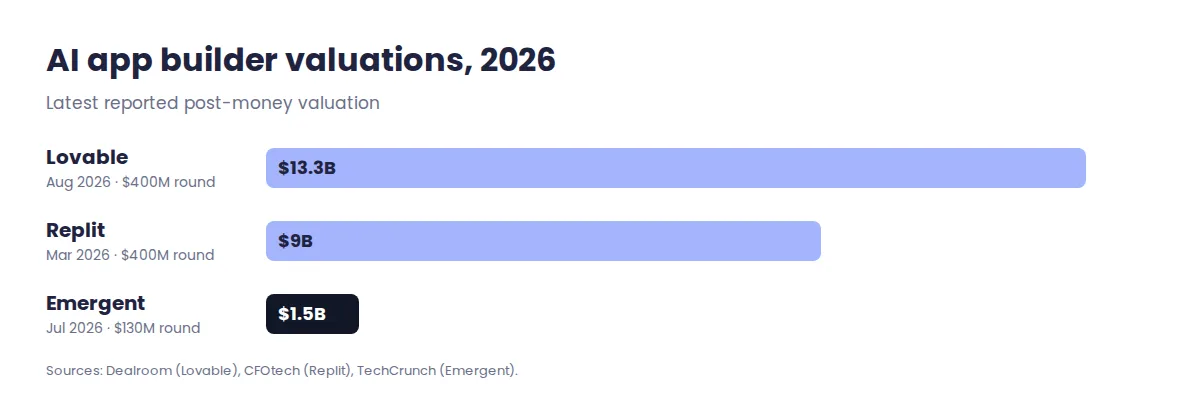
The vibe-coding market has attracted some of 2026's largest rounds. Lovable raised $400 million at a $13.3 billion valuation in August 2026, and Replit raised $400 million at $9 billion in March. Emergent is smaller, but it reached unicorn status roughly a year after launch, and its customer base is more evenly spread across regions than most of its peers. For readers choosing a tool, the funding gap matters less than fit: Emergent targets people with no coding background who want a working app, including mobile, from a prompt.
Emergent Series C: quick answers
How much did Emergent raise?
$130 million in a Series C at a $1.5 billion post-money valuation, bringing total funding to $230 million.
What is Emergent valued at?
$1.5 billion post-money after the Series C reported in July 2026, up from about $300 million at its Series B in January 2026.
Who invested in Emergent's Series C?
Creaegis led, with MNI Ventures–Claypond Capital and Sentinel Global co-leading. Khosla Ventures, SoftBank Vision Fund 2, Lightspeed and Y Combinator also took part, and Emergent's press release also names Prosus, Together Fund and Google's AI Futures Fund.
Is Emergent free to use?
Yes, there is a free plan with 10 credits a month. Paid plans start at $17 a month billed yearly. Current offers are on our Emergent deals page.
If you want to see what the funding is building on, you can try Emergent's free plan without a card. More news on AI and SaaS tools is in SaaS News.
Sources for this report
This article is based on TechCrunch's report of July 15, 2026, Emergent's press release of July 17, 2026, coverage by SiliconANGLE and The Next Web, Reuters' report on the Series B, and Emergent's pricing page as checked on October 2, 2026. Valuations for other companies are as reported at the time of their funding. See how we review software.
Research-based news report: Emergent did not pay for or review this article.