
Last checked October 4, 2026 · News roundup
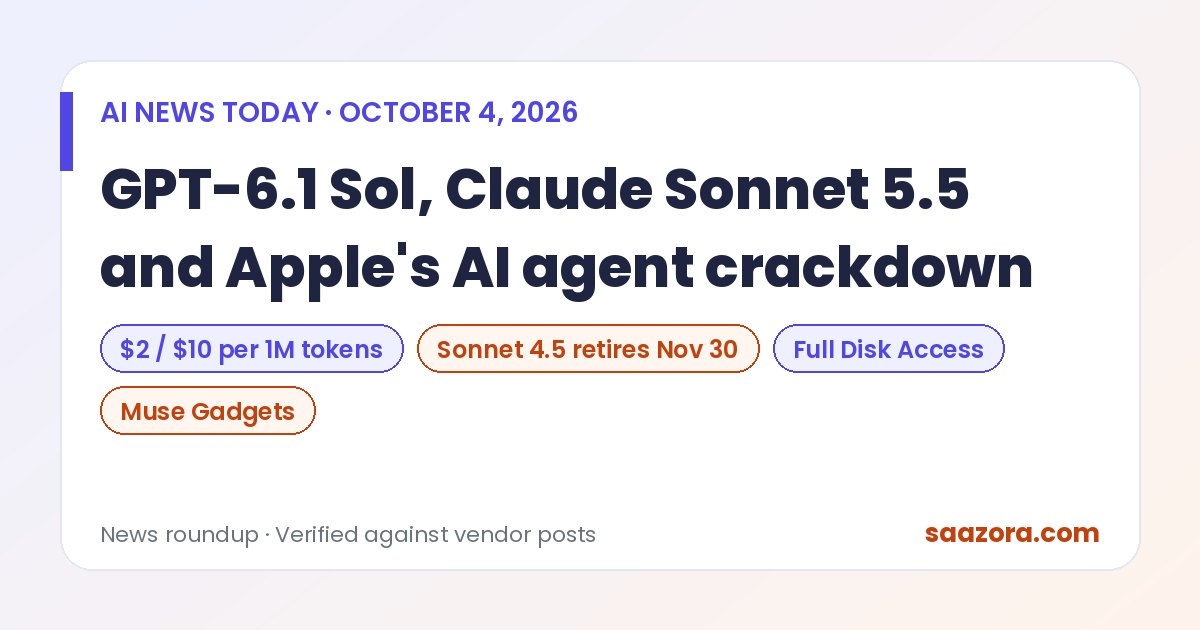
Today in brief: The AI news today is mostly about cheaper mid-tier models. OpenAI's GPT-6.1 Sol and Anthropic's Claude Sonnet 5.5 both list at $2 in and $10 out per million tokens, and Sonnet 4.5 now has a shutdown date. Apple is tightening how AI agents get full access to your Mac, Meta opened its Muse assistant to homemade hardware, and Stability AI is betting its future on music.
GPT-6.1 Sol price: what OpenAI charges and who can use it
OpenAI announced GPT-6.1 Sol at DevDay on September 29, 2026. The API price is $2 per million input tokens, $10 per million output tokens and $0.10 per million cached input tokens, according to VentureBeat's report. That is one-fifth of GPT-6 Astra's $10/$50 list price, and the cached-input rate is half what GPT-6 Sol charged. OpenAI's pitch is "near-Astra intelligence for a fifth of the price."
In ChatGPT, Sol is limited for now. It runs in ChatGPT Work and Codex for Plus, Pro, Business, Enterprise and Edu accounts, but not in the regular chat window yet. Free and Go users don't get it at launch, according to Lindy's model guide. Developers call it as gpt-6.1-sol.
The faster "Ultrafast" mode is live for GPT-6 Astra, but OpenAI says only that it is "coming soon" for Sol. VentureBeat reports Ultrafast bills at six times standard rates, and in ChatGPT it needs the new Pro 500 plan. If you are on Pro 200, the bigger change is the usage cut on October 30, which we cover in our ChatGPT Pro limits explainer.
What to do: if you pay for Astra through the API, run your evals on Sol this week. A model at a fifth of the price that comes close on your own tasks is the easiest cost cut available right now.
Google's Gemini 4 Argon has the same introductory price, but it is still limited to security teams in Google's Fairwind Program. There was no wider rollout as of October 4. Our Gemini 4 Argon access guide explains who is next in line.
Claude Sonnet 5.5 is out, and Sonnet 4.5 shuts off November 30
Anthropic released Claude Sonnet 5.5 on September 28, 2026. The price stays at Sonnet 5's level: $2 per million input tokens and $10 per million output tokens, with cache reads at $0.20 and cache writes at $2.50. Anthropic says the model runs more than 30% faster than Sonnet 5 and costs "up to 30% less per task." The saving comes from using fewer tokens per job, not from a lower rate card.
Sonnet 5.5 is available in the Claude apps, on the API as claude-sonnet-5-5, and through AWS, Google Cloud and Microsoft Azure. Anthropic says Claude Haiku 5.5 will follow "in the coming weeks."
The deadline to note is for developers still on the older model. Anthropic's deprecation page lists claude-sonnet-4-5-20250929 as deprecated on September 30 and retired on November 30, 2026. After that date, requests to it will fail.
What to do: search your code, Zapier steps and no-code tools for the Sonnet 4.5 model ID and swap it for claude-sonnet-5-5. Re-test any prompts that depend on exact output formats.
Apple tightens Full Disk Access on Mac because of AI agents
Apple said on October 2 that it will add new controls around macOS "Full Disk Access," the setting that lets an app read your files, mail, messages and browsing history. The aim is to make sure users grant it only through "very explicit user action," TechCrunch reported.
Apple's statement named the risk directly: "As AI agents become increasingly capable and autonomous, the risks associated with this level of access will grow substantially." The move follows claims that Meta's Muse agent read private messages without clear permission, and an earlier security flaw in ChatGPT's Mac app.
Apple hasn't said which macOS version brings the change or when. For now, if you run any desktop AI agent, open System Settings, go to Privacy & Security, then Full Disk Access, and switch off anything you don't actively use. Developers who ship Mac agents should expect a stricter consent flow and plan their onboarding screens around it.
Meta Muse Gadgets: build your own hardware for Muse
Meta launched Muse Gadgets on October 2, an open-source project for people who want to build their own devices around its Muse AI agent. It ships open-source firmware, a Linux SDK and starter ideas, such as a color e-ink display for Muse or an HDMI stick for your TV. It works with Raspberry Pi, ESP32 boards and other hobbyist hardware, and there is a Discord channel for help.
Meta also built its own device, the Muse Home Link, which plugs in over USB-C and connects Muse to speakers, TVs and other smart-home gear. According to TechCrunch, Meta made 5,000 units and is giving them free to Muse subscribers while supplies last, with shipping expected within weeks.
Who this affects: tinkerers and small hardware makers. The SDK is free. If you already pay for Muse and want a Home Link, request one early, since 5,000 units won't last long. Given Apple's warning above, check what access any Muse device asks for before you connect it to your home network.
Stability AI pivots to AI music with record-label backing
Stability AI, best known for the Stable Diffusion image models, is rebuilding itself around music tools. TechCrunch reported on October 2 that Napster co-founder Sean Parker is leading the new direction with CEO Prem Akkaraju.
The pivot follows a $76 million funding round in late August from Sony, Warner and Universal, which also licensed their catalogs for model training. Stability has released three audio models and music-editing software that generate full instrumentals or short segments from text. Parker says a coming feature will turn a hummed melody or a beatboxed rhythm into music.
For users, the licensed training data is the selling point: it lowers the copyright risk that has hung over AI music apps. The open question is Stable Diffusion. The report does not say what happens to the image models or their API licenses, so if your product depends on them, ask your account contact for a written roadmap before you plan next year's spend.
Anthropic puts $100 million into training Claude engineers
Anthropic launched the Claude Frontier Academy on October 2, a $100 million program to train 10,000 "Frontier Deployed Engineers" by the end of 2027. It starts with a few days of in-person onboarding, then a 12-week residency in which engineers lead real Claude projects inside their own companies. Graduates earn a Claude Resident Engineer badge and then a Claude Frontier Deployed Engineer badge.
The first cohorts come from Accenture, Bain, Capgemini, Commonwealth Bank of Australia, Deloitte, McKinsey, Morgan Stanley and Novo Nordisk. Training runs in San Francisco, New York and London, and the first graduates are expected in early 2027. Companies nominate their candidates. Anthropic doesn't ask for prior AI agent experience, but it does want people who have built with LLMs. The announcement does not state a cost to participants.
Why it matters: if you hire consultants to roll out Claude, ask whether your team includes Academy residents. The badge is designed to become a hiring signal.
Your checklist for this week
claude-sonnet-4-5-20250929 and move it to claude-sonnet-5-5 before Nov 30.FAQ: this week's AI questions
How much does GPT-6.1 Sol cost?
On the API, GPT-6.1 Sol costs $2 per million input tokens, $10 per million output tokens and $0.10 per million cached input tokens. That is one-fifth of GPT-6 Astra's list price. In ChatGPT it is included with Plus, Pro, Business, Enterprise and Edu, inside ChatGPT Work and Codex only.
When does Claude Sonnet 4.5 stop working?
Anthropic retires Claude Sonnet 4.5 (claude-sonnet-4-5-20250929) on the Claude API on November 30, 2026. Requests sent after that date will fail. Anthropic recommends switching to Claude Sonnet 5.5, which has the same $2/$10 per million token price as Sonnet 5.
Is Claude Sonnet 5.5 cheaper than Sonnet 5?
Not per token. Both list at $2 per million input tokens and $10 per million output tokens. Anthropic says Sonnet 5.5 costs up to 30% less per task because it finishes jobs with fewer tokens, and it runs more than 30% faster. Your actual saving depends on your workload.
Can free ChatGPT users try GPT-6.1 Sol?
Not at launch. GPT-6.1 Sol is available to Plus, Pro, Business, Enterprise and Edu accounts in ChatGPT Work and Codex, and it is not yet in the regular chat window. Free and Go users don't have access yet, according to launch guides. Developers can use it on the API now.
Sources: VentureBeat, GPT-6.1 Sol and Ultrafast (Sept 29, 2026) · Lindy, GPT-6.1 Sol access guide (checked Oct 4, 2026) · Anthropic, Introducing Claude Sonnet 5.5 (Sept 28, 2026) · Anthropic, Model deprecations (Sept 30, 2026) · TechCrunch, Apple Full Disk Access (Oct 2, 2026) · TechCrunch, Meta Muse Gadgets (Oct 2, 2026) · TechCrunch, Stability AI music (Oct 2, 2026) · Anthropic, Claude Frontier Academy (Oct 2, 2026)