
Last checked October 8, 2026 · News roundup
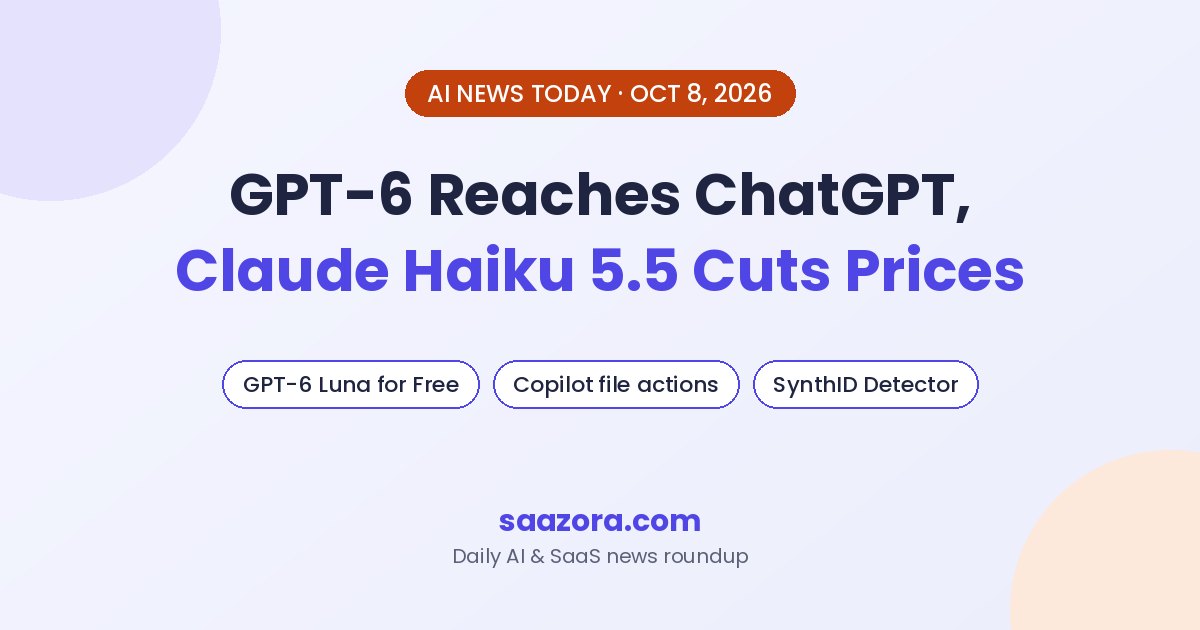
The short version: GPT-6 is now the default model in ChatGPT, and free users get their version from October 8 along with a new visual answer style called Intelligent UI. Anthropic cut small-model prices with Claude Haiku 5.5, Microsoft showed a Copilot that can act on files on your PC, and Google opened its SynthID detector to everyone.
AI news today covers seven stories from October 6–7, 2026 that change what you pay, what you can use, or what you should switch on or off. Each one lists the date, who gets it and what to do next.
Is GPT-6 free in ChatGPT? Yes, Free and Go users get GPT-6 Luna from October 8
OpenAI started rolling out GPT-6 in ChatGPT's Chat tab on October 7, 2026. Plus, Pro, Business and Enterprise subscribers get GPT-6 Sol; Free and Go users get GPT-6 Luna, with that rollout starting October 8. Enterprise access depends on workspace admin settings. OpenAI says the models behind the Work and Codex experiences are not changing in this release.
The bigger visible change is Intelligent UI. Answers can now include charts, forms, tappable buttons and small tools such as a bill splitter or savings calculator built right inside the chat. TechCrunch reports you can dial the visuals back if you prefer plain text. OpenAI also says GPT-6 Instant starts answering web-search questions 44% sooner on average than GPT-5.6 Instant.
What it costs: OpenAI did not announce any plan price change with this release, and it did not publish new usage limits. Pro subscribers should still note the separate limit change we covered in ChatGPT Pro's October 30 usage limits. What to do: if a reply turns into a widget you don't want, ask for a text-only answer or lower the visual setting in personalization.
Claude Haiku 5.5 price: $0.10 input and $0.50 output per million tokens
Anthropic released Claude Haiku 5.5 on October 7, 2026, its third model in the 5.5 generation after Opus 5.5 and Sonnet 5.5. For prompts up to 100,000 tokens it costs $0.10 per million input tokens and $0.50 per million output tokens; longer prompts cost $0.50 and $2.50. Haiku 4.5 was $1 and $5. Anthropic puts the average saving at around 75%, since the new model uses a tokenizer that produces slightly more tokens per task.
The model is aimed at high-volume work: summaries, classification, customer-support bots, browser automation and subagent jobs handed off by Opus or Sonnet. It is available now as claude-haiku-5-5 on the Claude Platform, AWS, Google Cloud and Microsoft Azure.
Two more changes came with it. Sonnet 5.5 cache reads drop from $0.20 to $0.10 per million tokens, which Anthropic says makes most agentic work about 20% cheaper. And Claude Max and Team subscribers start getting monthly API credits this week: $100 on Max 5x, $200 on Max 20x and up to $500 pooled for Team. What to do: if you run Haiku 4.5 in production, re-test your prompts on 5.5 and watch token counts, not just the per-token price.
Copilot on Windows 11 will act on your local files: what Microsoft showed
At its Windows and Surface event on October 7, 2026, Microsoft demoed what it calls Hybrid Intelligence: Copilot mixing on-device and cloud AI models to take actions with files on your PC. In the demo, Microsoft's Autopilot agent found tax documents across folders, renamed them, zipped them and drafted an email to an accountant. Microsoft says these features arrive in Copilot over the "next couple months," and Engadget reports they act on local files only with your permission.
Windows search is changing too. Starting this fall on Windows 11, the taskbar search box can run quick actions such as turning on dark mode, adjusting mic volume or sending a text.
The hardware behind the push is pricey. The Surface Laptop Ultra, built on Nvidia's new Arm-based RTX Spark chip, starts at $2,599, with preorders open now and availability on October 16. The Surface RTX Spark Dev Box starts at $5,999, and The Verge found an Asus ProArt P16 RTX Spark configuration at $6,999.99. What to do: IT admins should plan which file locations Copilot may touch before these features land.
How to check if an image is AI-generated: Google's SynthID Detector is now open to all
Google made its SynthID Detector available to everyone, globally and in English, on October 7, 2026. Upload an image, video or audio file and it checks for the invisible SynthID watermark that Google and its partners embed at creation time. Partners currently include OpenAI, NVIDIA and Kakao, and Google says Apple's models will join "soon." Google has watermarked more than 180 billion images and videos so far.
The limit is important: the tool can only confirm content that carries a SynthID watermark. A "no watermark found" result does not prove a picture is real, because images from tools outside the program will not be flagged. What to do: use it as one signal next to reverse-image search and source checking, especially for viral news photos.
Mistral Large 4 "Le Chonk": price and when the open weights arrive
Mistral opened a public API preview of Mistral Large 4, nicknamed Le Chonk, on October 6, 2026. It is a mixture-of-experts model with 1 trillion total parameters and 49 billion active, and Mistral says the open weights arrive by the end of October, with the reinforcement learning run still in progress. Preview pricing in Mistral Studio is $1.36 per million input tokens and $4.18 per million output tokens.
Mistral's own scores lean on coding and security: 82% on a reproduce-and-patch cybersecurity test and 61.7% on DeepSWE v1.1. In Mistral's human evaluation for coding it ranked second of five, behind Claude Opus 5. According to Wired, Mistral pitches the model to companies that want to own and run their model rather than rent access that could be restricted. What to do: treat preview benchmarks as provisional until the final weights and full results ship.
Google Playground lets you make a video game from a text prompt
Google Labs launched Playground on October 7, 2026, an experimental platform where you describe a game in plain English and get a playable browser game back. You can choose 2D or 3D, tweak physics and rules by chatting, then keep the game private, share a link or publish it to a community gallery with leaderboards. 9to5Google reports it runs on Gemini, Nano Banana and Lyria models.
Playground is open to US users aged 18 and older at playground.google. Free accounts can create games, and Google says creation limits are tiered by your Google AI subscription. A Unity Spark integration for more advanced 3D games is in testing. What to do: it's a quick way for teachers, parents or marketers to prototype a simple game without code.
Is Meta Muse on iPad? Yes, plus new work connectors
Meta released a dedicated Muse app for iPad on October 7, 2026, about a month after the assistant launched on iPhone and Android on September 8. Sensor Tower estimates Muse has passed 6.6 million installs, according to TechCrunch.
The iPad release adds newer "connectors" aimed at small businesses: Asana, Canva, Dropbox, Figma, QuickBooks, GitHub, Klaviyo, Zoom, Notion, Granola and Meta ad accounts. Engadget also reports a native Muse app is coming to Windows. If you're weighing whether to give Muse account access, read our earlier coverage of Muse's leaked system prompt first. What to do: connect only the services you'd trust an agent to act in, one at a time.
GPT-6, Haiku 5.5 and Copilot: quick answers
Do I have to pay to use GPT-6?
No. ChatGPT Free and Go users get GPT-6 Luna from October 8, 2026. Paid plans (Plus, Pro, Business, Enterprise) get the stronger GPT-6 Sol, which started rolling out on October 7. OpenAI did not announce plan price changes alongside the launch.
Is Claude Haiku 5.5 cheaper than GPT-6 Luna?
They match on list price. SiliconANGLE reports that Haiku 5.5's $0.10 input and $0.50 output per million tokens equal OpenAI's GPT-6 Luna API rates. Anthropic's published benchmarks place Haiku 5.5 ahead of Luna on the six tests where both have a score.
When will Copilot be able to use my files on Windows?
Microsoft says Hybrid Intelligence features arrive in Copilot over the next couple of months, with no exact date. Quick actions in Windows search arrive this fall on Windows 11. Engadget reports the file actions require your permission, so you can leave them off.
Can SynthID tell me an image is real?
No. SynthID Detector only confirms content carrying Google's watermark, made by Google or partners such as OpenAI, NVIDIA and Kakao. If it finds nothing, the image could still come from an AI tool outside that program, so check the source as well.
More daily coverage lives in our SaaS and AI news hub.
Sources: OpenAI, GPT-6 and Intelligent UI (Oct 7, 2026) · TechCrunch on Intelligent UI (Oct 7, 2026) · Anthropic, Claude Haiku 5.5 (Oct 7, 2026) · SiliconANGLE on Haiku 5.5 (Oct 7, 2026) · The Verge on Copilot and Windows (Oct 7, 2026) · Engadget, Windows and Surface event (Oct 7, 2026) · The Verge on RTX Spark laptop prices (Oct 7, 2026) · Google, SynthID Detector (Oct 7, 2026) · Mistral AI, Mistral Large 4 (Oct 6, 2026) · Wired on Le Chonk (Oct 6, 2026) · Google, Playground (Oct 7, 2026) · 9to5Google on Playground (Oct 7, 2026) · TechCrunch on Muse for iPad (Oct 7, 2026)