
Last checked November 7, 2026 · News roundup
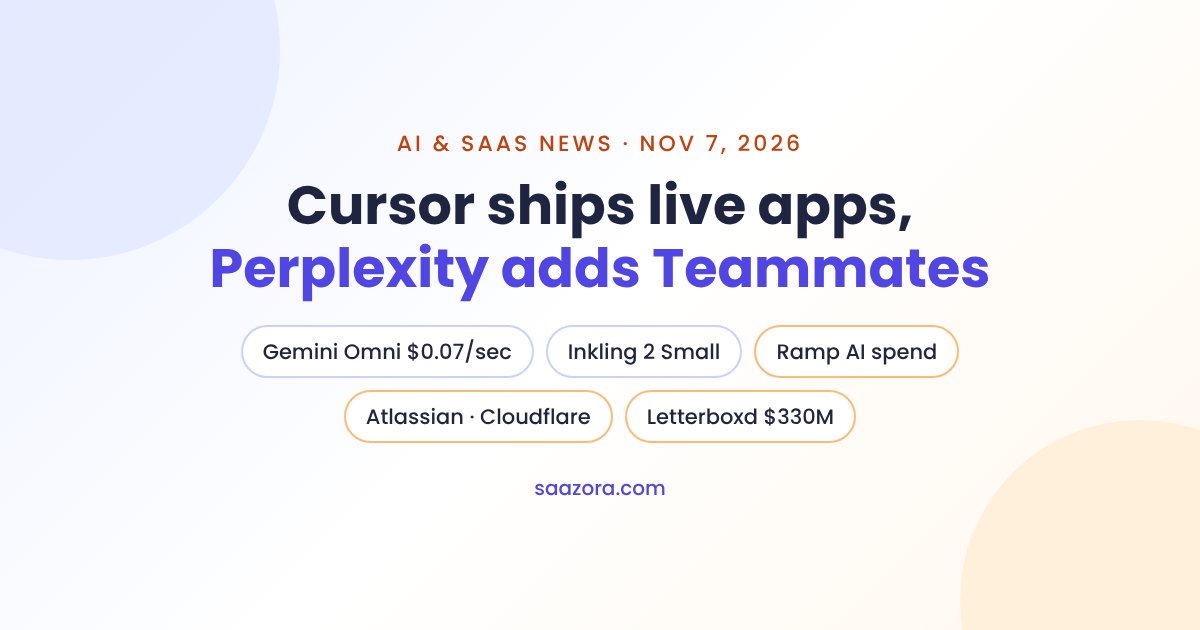
Today in brief: AI and SaaS news today is about agents that ship work, not just chat. Cursor's cloud agent can now build, host and publish a web app with a database and sign-in, Perplexity put always-on "Teammates" behind its $200 Max plan, and Google cut Gemini Omni video pricing by 30% while stretching clips to 15 seconds. On the SaaS side, Ramp data shows company AI spending going flat, Atlassian and Cloudflare reported strong quarters on the day the Nasdaq slid, and The New York Times is in exclusive talks to buy Letterboxd for $330 million.
Today's nine stories at a glance
AI · Cursor
Build Live Apps
Paid plans with cloud agents. Hosting price not published. Check secrets before you publish.
AI · Perplexity
Teammates agents
Max only, $200/month or $2,000/year. Pro users wait for the promised expansion.
AI · Google
Gemini Omni 1.2 Flash
$0.07 per second at 720p in the API; free 15-second clips in Google Vids.
AI · Thinking Machines
Inkling 2 Small
On Tinker now; Apache 2.0 weights promised after safety testing.
AI · Anthropic
Claude admin controls, Dispatch flaw
Enterprise admins get a security center; Dispatch users should audit browser extensions.
SaaS · Spending
Ramp AI spend data
Token spend grew 1.5% across August and September. Budget owners are routing to cheaper models.
SaaS · Atlassian
Q1 FY27 results
Cloud up 31%; Data Center revenue guided down about 14% next quarter.
SaaS · Cloudflare
Q3 2026 results
Revenue up 39% to $782.5M, guidance raised, workforce cut planned.
SaaS · Letterboxd
NYT buyout talks
$330M, exclusive negotiations. Nothing changes for members yet.
AI
Cursor Build Live Apps: can Cursor now deploy your web app?
Yes. In a changelog entry dated November 5, Cursor says its cloud agent can now scaffold a web app, provision a Postgres database if the app needs one, put it behind sign-in, host it and hand you a live link. You start a cloud agent, say you want to build an app, and pick a unique domain when you publish.
Apps sit behind Cursor SSO by default. You can share them with named people, groups or your whole team, and individual plans can also share publicly. Deploys come from new or existing repos on Cursor Origin or GitHub; GitLab and other git hosts are listed as "coming soon." Before anything goes live, Cursor runs deterministic and agentic checks for problems like secrets left in app files, and nothing publishes until those checks pass and you click publish. Team admins can review every app and secret and unpublish any app.
Who and what it costs: every paid plan with cloud agents turned on. Cursor's changelog gives no hosting price or resource limits, so watch your usage page in the first weeks. The feature moves Cursor into the prompt-to-app space covered in our AI app builder reviews and comparisons.
Perplexity Teammates: what the $200 Max plan now adds
Perplexity announced Teammates on November 5: always-on AI agents for work that run several assignments at once, watch for changes and keep going without a chat window open. Each Teammate builds on Perplexity Computer and can reuse the projects, skills, memory and permissions you already set up there, and you can redirect it at any point.
Access starts with Perplexity Max subscribers on the web, The Neuron reported. Max costs $200 a month or $2,000 a year, and BigGo Finance reports that Teammates connect to Slack, GitHub and Gmail, with Slack as the main place to hand out work and read updates. Perplexity says access and features will expand "over the coming weeks," but it has not given Pro or Enterprise dates. CEO Aravind Srinivas wrote on X that he expects every organization to eventually have "hundreds of teammates working for each person," according to BigGo.
Who it affects: teams comparing always-on agents from OpenAI and Anthropic now have a third option, but only at the top price tier. What to do: if you are on Pro, wait; nothing here justifies a $180 monthly jump until pricing for smaller plans is known.
Gemini Omni 1.2 Flash price: $0.07 per second, clips up to 15 seconds
Google DeepMind released Gemini Omni 1.2 Flash on November 5. The video model now generates and edits clips natively up to 15 seconds, up from 10 in Omni 1.1, and you can set length in one-second steps from 3 to 15 seconds. Google says the price is 30% lower than Omni 1.1, at $0.07 per second of 720p video. You can draft at 360p or 720p and upscale to 1080p or 4K, though Google's post does not list upscale prices.
Edits are conversational: swap a product, change weather or lighting, or switch aspect ratio with a follow-up prompt instead of regenerating. The model is generally available in the Gemini API and Google Cloud, in Flow, in Google Ads, and in Google Vids, where 15-second clips come at no extra cost with a Google account or Workspace plan. In the Gemini app it is rolling out to Google AI Ultra subscribers first. All output carries an invisible SynthID watermark.
What a 720p Gemini Omni clip costs in the API
| Clip length | Omni 1.2 Flash ($0.07/sec) | Omni 1.1 (implied $0.10/sec) |
|---|---|---|
| 3 seconds | $0.21 | $0.30 |
| 5 seconds | $0.35 | $0.50 |
| 10 seconds | $0.70 | $1.00 (old maximum) |
| 15 seconds | $1.05 | Not possible |
| 100 x 15-second ad variants | $105 | n/a |
What is Inkling 2 Small? Thinking Machines' 594-billion-parameter model
Inkling 2 Small is a mixture-of-experts model from Mira Murati's Thinking Machines Lab, released November 5. It has 594 billion total parameters with about 17 billion active per request, accepts image input through a 292-million-parameter vision encoder, and supports variable effort settings. For now it runs only through the company's Tinker platform with closed weights; Thinking Machines says full weights will follow under the Apache 2.0 license "next week," after external safety testing and red-teaming.
Independent benchmarker Artificial Analysis places it level with Gemini 3.8 Flash (high) on its index and says it would be the highest-scoring open-weights model outside China once the weights ship. Thinking Machines' own page is candid that alignment still trails closed models such as GPT-6.1 Sol. Business Insider separately reported on November 5 that the lab is closing a $5 billion round at a $40 billion pre-money valuation.
Who it affects: companies that want a strong model they can host themselves. What to do: test on Tinker now with non-sensitive data, then rerun your evaluation on the downloadable weights before you commit.
Claude security this week: new Enterprise controls, and a Dispatch flaw left open
Anthropic's release notes list new security and admin controls for Claude Enterprise on November 5: a security center, inference hooks that pass prompts and tool calls to security vendors for checks such as data loss prevention, centralized management across organizations and tighter access controls, several of them in beta. On November 6 it added project tags (beta) to track spend by cost code.
The same week, Dataconomy reported a flaw researcher Gal Weizman calls "ThisBash" in Claude Dispatch, the feature that sends tasks from a browser or phone to Claude Desktop. A malicious browser extension with access to Claude.ai could use the signed-in session to issue commands to Claude Desktop, including installing a package, and could even reach a second computer on the same account. According to the report, Anthropic validated the issue in May, closed it as a duplicate and has not patched it. Dispatch was still in limited beta for some Pro, Max and Ultra users as of October 30.
What to do: turn off Dispatch if you do not use it, remove browser extensions you do not trust, and avoid using one personal Claude account on both home and work machines. More guides on Claude Code and AI agents.
SaaS & business
Is AI spending slowing? Ramp data shows token spend going flat
Business AI spending is stalling even as usage grows, according to Ramp data reported by TechCrunch on November 6. Token spend on Ramp's card and bill-pay platform rose just 1.5% across August and September, after jumping 42% in July. It picked up again from September 23 to October 23, rising 8.9%, but Ramp economist Ara Kharazian says the headwinds remain strong.
The spread between companies is huge. The median firm spends $12 to $15 per employee per month on AI, the top 10% spend $600 to $1,000, and the top 1% sit just under $10,000. Price cuts explain part of the slowdown: OpenAI halved API prices for GPT-6 Sol and GPT-6 Luna in September, and Anthropic said in a filing that its own price cuts trimmed revenue growth by about $600 million. Mature buyers are also capping budgets and routing work to cheaper models.
The timing is awkward for Anthropic's IPO. The Wall Street Journal reported November 5 that major investors doubt a $1.5 trillion valuation after this week's tech sell-off.
Ramp: growth in business token spend
Atlassian earnings: Jira and Confluence cloud up 31%, Data Center set to shrink
Atlassian reported its first quarter of fiscal 2027 on November 5. Revenue for the quarter ended September 30 was $1.772 billion, up 24%, with cloud revenue up 31% to $1.302 billion. Subscription ARR reached $6.812 billion and remaining performance obligations rose 44%. For the December quarter, the company guides revenue to $1.825 billion to $1.835 billion, cloud growth of about 27% and a Data Center revenue decline of about 14%.
The product news was agent-heavy: an Agentic Multiplayer Protocol that gives AI agents their own identities and audit trails inside Jira and Confluence, a rebuilt MCP server with more than 220 tools that Atlassian says uses about 25% fewer tokens for the same work and already has over 2 million monthly users, and a wider OpenAI partnership. The release mentions no price changes.
Atlassian Q1 FY27 in four lines
| Line | Q1 FY27 result | Q2 FY27 guidance |
|---|---|---|
| Total revenue | $1,772M (+24%) | $1,825M to $1,835M |
| Cloud revenue | $1,302M (+31%) | About +27% |
| Data Center revenue | $391M (about +5%*) | About -14% |
| Subscription ARR | $6,812M (+23%) | Not guided |
What to do: if you still run Jira or Confluence Data Center, read that minus 14% as a signal of where Atlassian's investment is going, and put migration costs into your 2027 budget.
Cloudflare Q3 2026 earnings: revenue up 39%, job cuts planned
Cloudflare said on November 5 that third-quarter revenue rose 39% to $782.5 million, its fastest growth in nearly four years, and that it has passed $3 billion in annualized revenue. It now expects full-year 2026 revenue of $2.963 billion to $2.964 billion and fourth-quarter revenue of $845 million to $846 million. The stock jumped after hours, the Wall Street Journal reported, a rare bright spot on a day when the Nasdaq 100 fell about 6%.
The release also confirms a plan to move toward an "agentic AI-first operating model" with an estimated workforce reduction. Restructuring and related charges were $11 million in the quarter and $161.7 million so far this year.
Who it affects: sites on Cloudflare's free and paid plans see no pricing change in this release. Enterprise buyers heading into renewals should expect a vendor that is growing fast and cutting staff at the same time, so get support commitments in writing.
Is Letterboxd being sold? The New York Times is in exclusive talks
The New York Times Company has entered exclusive negotiations to buy Letterboxd, the film-logging social app, for about $330 million, the Times itself reported on November 5. The company declined to comment on its own deal. According to the report, A24 and Sony had shown interest earlier in the sale process, but A24 was priced out.
Letterboxd grew from 3 million users in January 2021 to 28 million by April 2026, and more than half are under 35, TechCrunch noted. Projected earnings this year are about $15 million. The app is free, with extra features in paid tiers.
What to do: nothing yet. No deal is signed and no plan or price change has been announced. If you want a backup of your diary and reviews, check the export option in your account settings.
Also on the radar
- Unity takeover talks: Silver Lake and Saudi Arabia's PIF have held talks to buy Unity at about $25 billion, Reuters reported November 5; Unity is working with a bank and no deal is certain.
- Google in Wyoming: Google plans to spend $17 billion on its first Wyoming data center and says it will pay for all the power it uses.
- Agility Robotics on Nasdaq: the humanoid robot maker began trading November 5 under AGLT at a pre-money equity value of about $2.5 billion, TechRepublic reported.
Saazora take: three moves for the weekend
First, if you build internal tools, try Cursor's live apps on a throwaway repo before your team does it on a real one; compare the result with dedicated builders in our best AI app builders guide. Second, if you pay for AI per seat, Ramp's numbers suggest the savings now come from routing and budgets, not from switching vendors. Third, audit browser extensions on any machine signed in to an AI assistant that can run code.
Questions readers are asking
Does Cursor charge extra to host Build Live Apps?
Cursor has not published a separate hosting price. Its November 5 changelog says the feature works on all paid plans with cloud agents enabled, and it does not list resource or database limits. Until Cursor publishes numbers, test with a small app and check your usage dashboard before inviting a whole team.
Can Perplexity Pro users get Teammates?
Not yet. Teammates launched on November 5 for Perplexity Max, which costs $200 a month or $2,000 a year. Perplexity says access will expand over the coming weeks but has not named a date for Pro or Enterprise plans, so Pro subscribers should wait for an official announcement rather than upgrade.
How much does a 15-second Gemini Omni video cost?
In the Gemini API, a 15-second 720p clip from Omni 1.2 Flash costs about $1.05 at Google's rate of $0.07 per second. Google Vids users can make 15-second clips at no extra cost with a Google account or Workspace plan, and Google AI Ultra subscribers get it in the Gemini app first.
Is the Claude Dispatch "ThisBash" flaw fixed?
According to Dataconomy's November 6 report, no. Anthropic validated the issue in May and closed it as a duplicate without a patch or CVE. The attack needs a malicious browser extension plus Dispatch turned on, so disabling Dispatch and removing untrusted extensions shuts the main path.
Sources: Cursor changelog (Nov 5) · The Neuron (Nov 6) · BigGo Finance, Perplexity Teammates (Nov 5) · Google, Gemini Omni 1.2 Flash (Nov 5) · Thinking Machines, Inkling 2 Small (Nov 5) · Artificial Analysis (Nov 5) · Business Insider (Nov 5) · Claude release notes (Nov 5–6) · Dataconomy, Dispatch flaw (Nov 6) · TechCrunch, Ramp data (Nov 6) · WSJ, Anthropic IPO (Nov 5) · Atlassian Q1 FY27 letter (Nov 5) · Cloudflare Q3 2026 release (Nov 5) · TechCrunch, Letterboxd (Nov 5) · Reuters via Central Oregon Daily, Unity (Nov 5) · Google, Wyoming (Nov 5) · TechRepublic, Agility Robotics (Nov 5)