
Prices checked on each vendor's pricing page and help docs, October 15, 2026 · Research-based guide, not hands-on testing
Saazora may earn a commission if you sign up through some links on this page, at no extra cost to you.
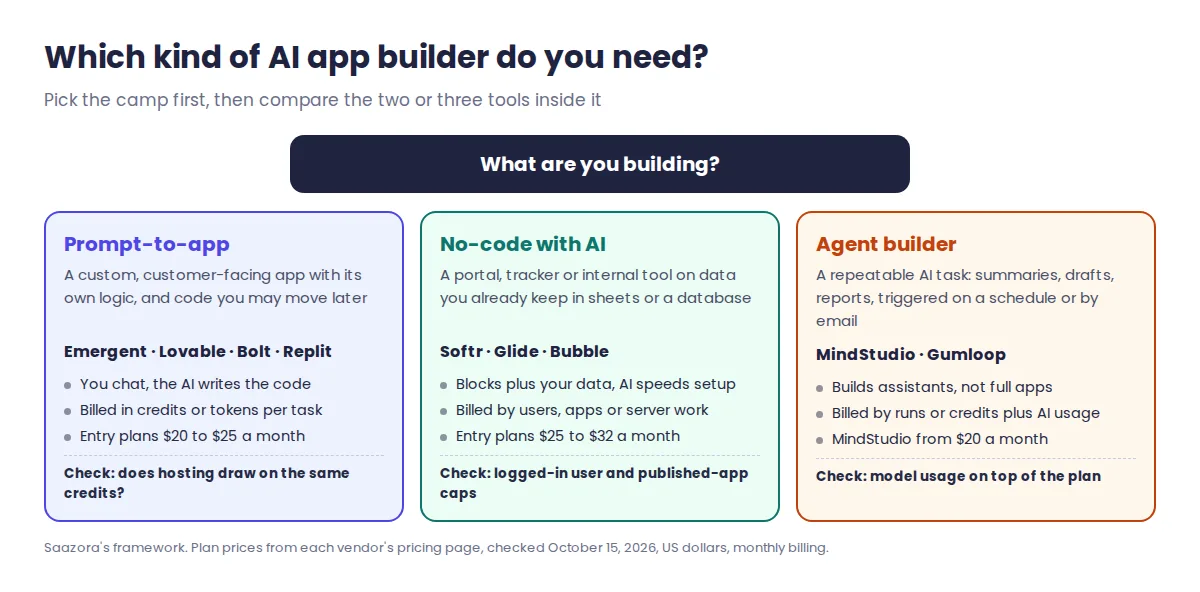
The best AI app builder for most first projects is the one whose bill matches what your app does after launch, not the one with the slickest demo. If you want a customer-facing app with its own logic and code you can take elsewhere, a prompt-to-app tool such as Emergent, Lovable, Bolt or Replit fits. If you want a portal, tracker or internal tool on top of data you already keep in a spreadsheet or database, a no-code builder such as Softr, Glide or Bubble is usually easier to hand to a non-technical team. If what you need is an AI assistant or automation rather than an app, an agent builder like MindStudio is the better match.
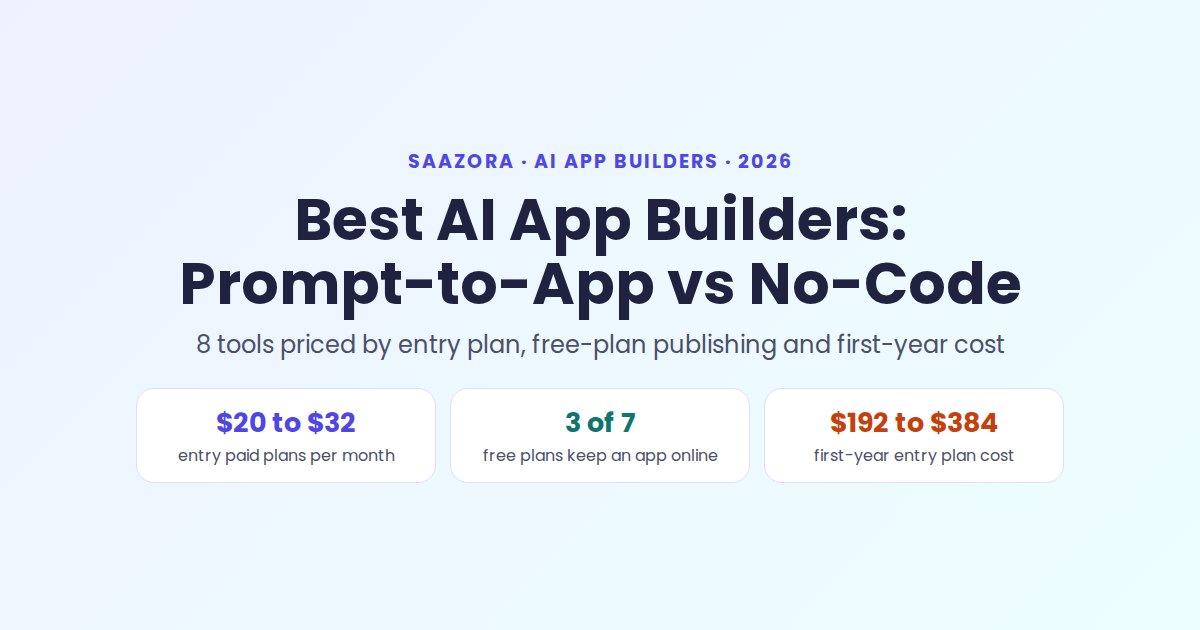
Entry paid plans for all eight tools on this list sit between $20 and $32 a month. The real differences show up elsewhere: whether the free plan can keep an app online, what a year costs on monthly versus yearly billing, and which meter (credits, hosting, users or published apps) runs out first. For guides on individual tools, start at the Saazora AI app builders hub.
Which is the best AI app builder for your project? Pick the camp first
Before comparing prices, decide which kind of tool you need. Choosing the best AI app builder starts here, because the three kinds bill in different ways and an Emergent plan and a Softr plan are not priced on the same thing.
- Prompt-to-app builders (Emergent, Lovable, Bolt, Replit) write real application code from a chat. You pay for the AI's work in credits or tokens, so complex requests cost more. They suit founders who want a custom app and will spend time steering the AI.
- No-code builders with AI (Softr, Glide, Bubble) assemble apps from blocks and your data, and use AI to speed up setup. Their limits are logged-in users, records, published apps or server work. They suit operations teams building portals and internal tools.
- Agent builders (MindStudio, and workflow tools such as Gumloop) build AI assistants and automations that run on a schedule, from an email or inside other apps. They are the right choice when the "app" is really a repeatable AI task.
Eight AI app builders side by side
Each tool's cheapest paid plan, on monthly and yearly billing, and what it includes.
| Tool | Camp | Entry paid plan, monthly | Billed yearly (per month) | What the plan includes | Best fit |
|---|---|---|---|---|---|
| Emergent | Prompt-to-app | Standard, $20 | $17 | 100 credits a month, private hosting, GitHub integration | One or two web or mobile apps built mostly by chat |
| Lovable | Prompt-to-app | Pro, $25 | $21 | 100 credits a month plus daily build credits, custom domains, unlimited users | Small teams building web apps together |
| Bolt | Prompt-to-app | Pro, $25 | Up to 28% off (price not shown to us) | From 10M tokens a month that roll over, hosting up to 1M web requests | Solo builders who iterate a lot and want hosting included |
| Replit | Prompt-to-app | Core, $20 | $18 | $20 of monthly usage credit, unlimited published apps | People who want an AI agent plus a full coding workspace |
| Softr | No-code | Basic, $25 | $19 | 5 team plus 5 client app users, 50K records, custom domain | Client portals and internal tools on existing data |
| Glide | No-code | Basic, $25 | Not offered yet | 100 credits, 2 published apps, 2 team members | Personal or team apps built from a spreadsheet |
| Bubble | No-code | Starter, $32 | $29 | 1,000 AI credits, 175K workload units, live site with custom domain | Complex visual apps that need web and native mobile |
| MindStudio | Agent builder | Individual, $20 plus AI usage | $16 (20% off) | Unlimited agents and runs; AI models billed at provider cost | AI assistants and scheduled AI tasks, not full apps |
All prices in US dollars before tax, from each vendor's pricing page, checked October 15, 2026. MindStudio's $16 is Saazora's calculation from its stated 20% yearly discount.
The no-code tools look alike at the entry level but split on the next step up: Softr Pro is $119 a month, Glide Plus $50 and Bubble Growth $134 on monthly billing.
Can the free plan keep an app online?
Every tool here has a free plan, but only some let you publish something other people can use beyond a trial, which matters if you want real users before paying.
| Tool | Free plan allowance | Can you keep a live app on it? |
|---|---|---|
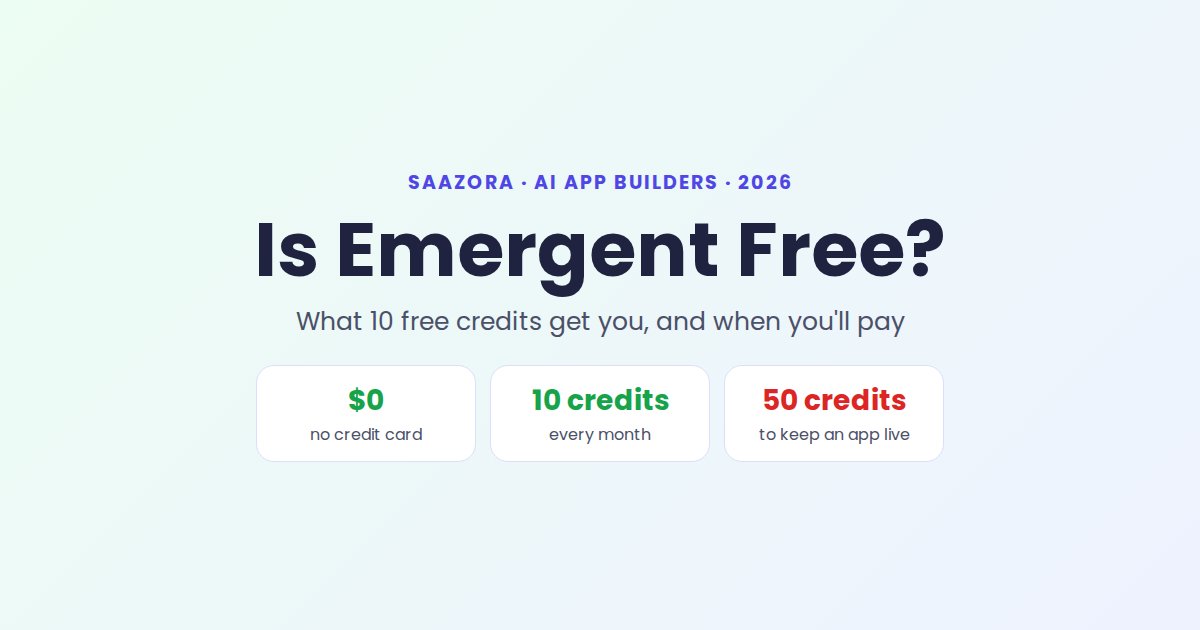
| Emergent | 10 credits a month | No. Publishing needs at least 50 credits a month, more than the free allowance |
| Lovable | 5 build credits a day (up to 30 a month) plus 20 Cloud credits a month | Yes, on up to 5 lovable.app addresses; custom domains need Pro |
| Bolt | 1M tokens a month, 300K a day | Yes, with Bolt branding and up to 333K web requests |
| Replit | Daily Agent credits up to a monthly cap, Lite build only | Temporarily: 1 published app, which goes down after 30 days |
| Softr | Unlimited apps, 5 app users, 5K records, 500 workflow actions | Yes, for up to 5 logged-in users; no custom domain |
| Glide | Limited credits, 10 projects | No. The free plan includes 0 published apps |
| Bubble | 500 AI credits, 50K workload units | No. Free covers the development version; a live website starts on Starter |
| MindStudio | 1 agent, 1,000 runs a month, plus AI usage | Not an app builder: one agent can run up to 1,000 times a month |
So of the seven app builders, three free plans (Lovable, Bolt and Softr) can keep a small app online indefinitely, Replit allows one for 30 days, and Emergent, Glide and Bubble treat the free tier as a place to build, not to launch. On those three, a free test ends at the preview stage. Our guide to what Emergent's 10 monthly credits can and cannot do covers that case in detail.
What one small live app costs in its first year
Price the plan you would need to keep one small app online for twelve months, then see what yearly billing saves.
| Tool and plan | 12 months, billed monthly | 12 months, billed yearly | Saving | Running costs to watch |
|---|---|---|---|---|
| Emergent Standard | $240 | $204 | $36 | Each live app takes 50 to 1,100 credits a month from the allowance |
| Replit Core | $240 | $216 | $24 | Hosting and Agent work share the $20 monthly credit; extra is pay as you go |
| MindStudio Individual | $240 | $192 | $48 | AI model usage on top, at provider prices |
| Lovable Pro | $300 | about $250 | about $50 | Hosting covered by the included grant for most small apps |
| Bolt Pro | $300 | not shown | up to 28% | Over 1M web requests a month needs a bigger plan |
| Softr Basic | $300 | $228 | $72 | Extra builders $5 a month each; more app users means Pro |
| Glide Basic | $300 | monthly only | none yet | Third published app means Plus at $50 a month |
| Bubble Starter | $384 | $348 | $36 | Workload overages beyond 175K units, unless you cap them |
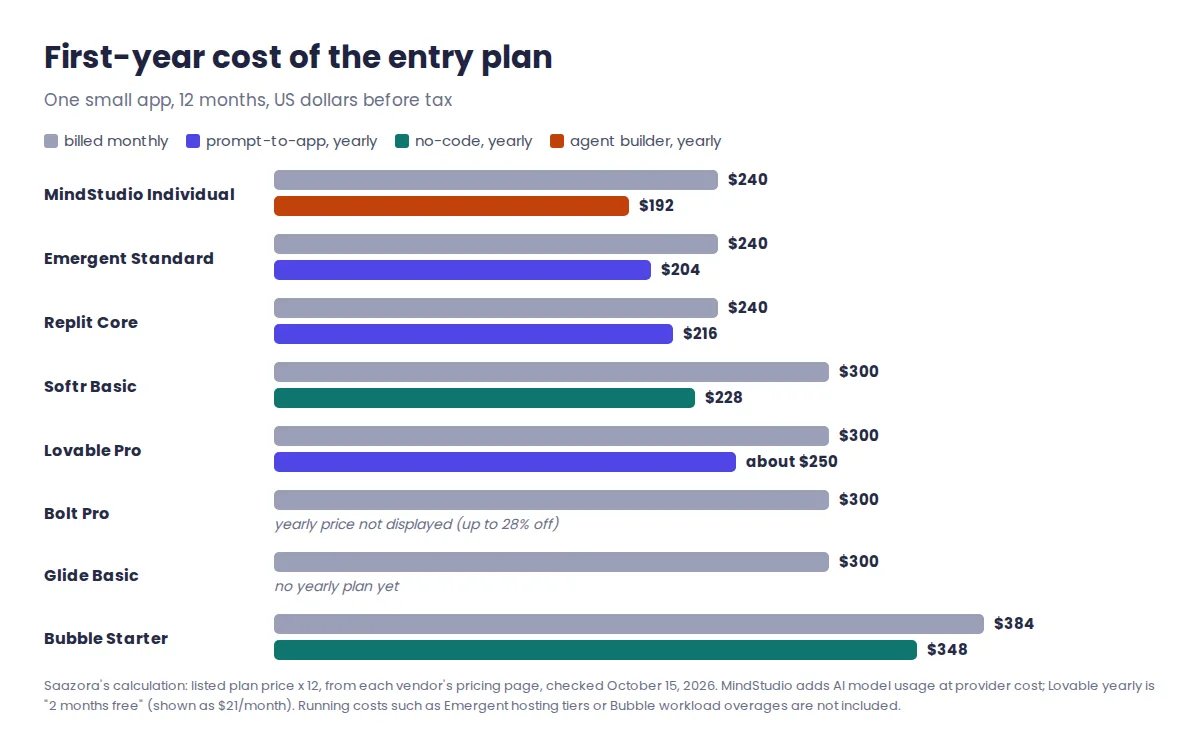
Softr has the largest yearly saving in dollars on this list ($72 on Basic), and MindStudio the largest in percentage terms (20%). Emergent and Bubble save $36 each. Lovable advertises "2 months free" on yearly billing, which is about $50 on Pro.
Check refund terms before paying for a year. Lovable's credits are not refundable; Emergent's help center describes prorated refunds on unused subscription credits after cancelling, while top-ups are final. Starting monthly is the cautious choice.
Which meter runs out first: credits, hosting, users or apps
The thing each tool counts is what pushes you onto a bigger plan.
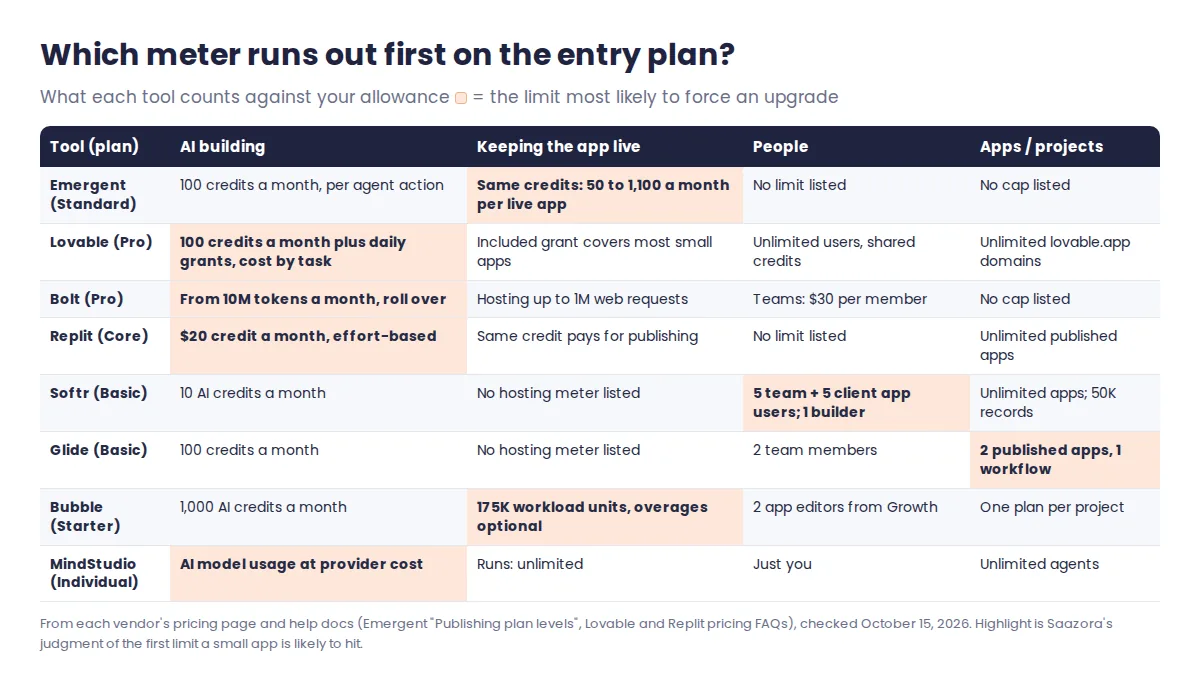
Emergent: hosting and building draw on the same credit balance. A published app runs on one of five tiers, from Starter at 50 credits a month to Elite at 1,100, and Emergent's help center warns that Starter is not suitable for production apps under meaningful load. On Standard's 100 credits, one Starter-tier app leaves 50 credits a month for building; one Launch-tier app (125 credits) already exceeds the allowance. Our breakdown of Emergent's plans, top-ups and hosting tiers works through the larger plans.
Lovable: credits are spent by task complexity. Its pricing FAQ gives examples: restyling a button costs 0.50 credits and adding sign-up and login costs 1.20. Replit works the same way ("effort-based"): the agent spends more the longer it works, and the same credits pay for publishing. Bolt counts tokens, from 10M a month on Pro, and unused tokens roll over.
Softr: most building is visual, so the limit that bites is app users: Basic allows 5 team and 5 client users, Pro 10 and 50. Our list of every cap on Softr's free tier and the signs you have outgrown it covers this in depth.
Glide limits published apps and team members (2 of each on Basic). Bubble meters workload units, its measure of server work; it emails you at 75% and 100% of the allowance, and you can switch overages off. MindStudio counts runs and passes model costs through without markup, so the bill tracks the models you choose.
Prompt-to-app builders: where each one fits
Emergent
Emergent builds web and mobile apps through a chat with AI agents, and its Standard plan adds GitHub integration so the code is not trapped in the platform. Pro ($200 a month, or $167 on yearly billing, which saves $396 a year) adds 750 credits, a 1M-token context window and custom agents. The trade-off is cost predictability: every agent action uses credits, including fixes, and a live app takes a monthly credit fee. Emergent has no public coupon code; the real savings are yearly billing and top-up credits that never expire. Read our research-based look at why Emergent's reviews are so split, or open a free Emergent account (affiliate link) and price one small feature before choosing a plan.
Lovable
Lovable does not charge per seat: every plan allows unlimited members sharing one credit balance, with per-member limits on Pro. The downside is that credits are non-refundable and monthly credits expire two months after they are issued.
Bolt
Bolt's free tier includes 1M tokens a month and website hosting. Teams costs $30 per member per month, so it gets more expensive than Lovable as a group grows.
Replit
Replit pairs its agent with a full online coding environment, which suits people who expect to edit code by hand sometimes. Pro starts at $100 a month with at least $100 in credits and up to 15 collaborators.
No-code builders and an agent option
Softr
Softr builds portals, internal tools and directories on top of its own database or sources such as Airtable, Google Sheets, Notion and HubSpot. It is one of the cheapest ways to keep a small app online for a few logged-in users, because its free plan allows that with no time limit. Basic is $19 a month on yearly billing. Its nonprofit and education discount is tracked on our page tracking Softr discounts. To try it, build a free Softr app on your own data (affiliate link).
Glide and Bubble
Glide now sells GlideOS, a new platform that builds apps from a spreadsheet, a prompt or a file, separate from Glide Classic and billed monthly only for now. Bubble is aimed at complex visual apps with their own database and workflows, and its plans cover web, iOS and Android from one backend. It is the priciest entry point here at $32 a month, and workload units take some learning before you can predict a bill.
MindStudio (for agents, not apps)
If your project is an AI assistant that summarizes documents, drafts replies or runs a daily report, MindStudio fits better than an app builder. It connects to more than 200 AI models without separate API keys and can run agents on a schedule, by email, by API or through webhooks. Our comparison of MindStudio's agent builder with Gumloop's workflow canvas helps if you are deciding between the two. You can also try MindStudio's one-agent free plan (affiliate link).
Code ownership and moving later
Lock-in is the cost nobody prices on day one:
- Lovable states that you own your code, projects and the customer data stored in it, subject to third-party rights in the underlying AI models.
- Emergent includes GitHub integration from Standard, and its help center says that after you cancel you can still export code or download assets.
- Softr can run on data you already keep elsewhere (Airtable, Google Sheets, Notion, SQL and others), so the data stays where it is if you leave.
- Glide says Classic apps keep working but there is currently no tool to migrate them to GlideOS, so moving means rebuilding. Ask any no-code vendor how you would get your app and data out before a team process depends on it.
Current offers for the tools we cover in depth are on the Emergent offers page and the MindStudio yearly discount page.
AI app builder questions, answered briefly
Which AI app builder is cheapest?
For a paid plan, Emergent Standard, Replit Core and MindStudio Individual all start at $20 a month, and MindStudio is lowest on yearly billing at $16 plus AI usage. For an app that stays online for free with a few users, Softr's free plan is the cheapest option, followed by Lovable and Bolt for public prototypes.
Are unused credits lost at the end of the month?
It depends on the tool. Emergent's monthly credits reset each cycle while top-ups never expire; Lovable's monthly credits expire after two months; Bolt's unused tokens roll over to the next month; Bubble's included AI credits refresh on the first of each month.
How we researched this list
We read the pricing pages of Emergent, Lovable, Bolt, Replit, Softr, Glide, Bubble and MindStudio on October 15, 2026, including their monthly and yearly billing views and pricing FAQs, plus Emergent's help center articles on credits, publishing tiers and refunds, and Replit's documentation for its free Starter plan. Prices are US prices before tax. Every first-year total and saving on this page is Saazora's own calculation: the listed plan price times twelve. This is a research-based guide; we did not build test apps on these platforms, so we make no claims about output quality or speed. More on our process: how Saazora reviews software.
Sources (checked October 15, 2026): pricing pages of Emergent, Lovable, Bolt, Replit, Softr, Glide, Bubble and MindStudio; Emergent help center: "How credits work", "Publishing plan levels", "Cancellation & refunds"; Replit docs: "Starter Plan".
Research-based guide, not hands-on testing: none of these vendors paid for or reviewed this article.