
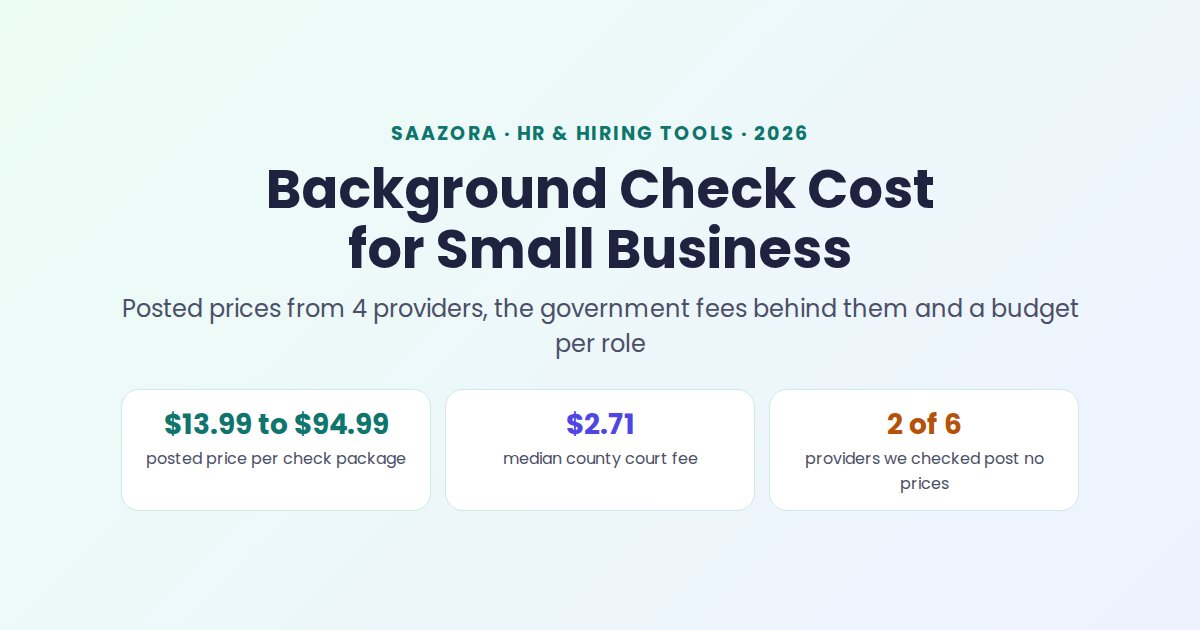
Prices checked on each provider's own website, October 17, 2026 · Research-based guide, not hands-on testing · Not legal advice
How much does a background check cost for employers? Most small businesses pay between about $14 and $95 per background check in list price, depending on which searches the job needs, and court, DMV and database fees add nothing for many local candidates but can pass $200 in rare cases. A basic database search is the cheapest line on every price list. Adding county court records, a driving record, a past-employer check or a drug test is what pushes the total up, and where the candidate has lived decides the fees.
We compared the prices that four screening companies publish on their own sites, noted the two large ones that publish none, checked government fee pages for the court and DMV charges behind those prices, and turned it into a per-role budget you can adapt. For related guides on screening and applicant software, see our HR and hiring software guides.
How much does a background check cost for employers?
The answer has three parts: the provider's price for each search, the access fee a court, DMV or database charges to release the record, and tax on those fees where it applies. Here is what each part looked like on October 17, 2026:
- Database-only criminal package (SSN trace, national criminal database, sex offender registry, watchlists): $13.99 to $29.99.
- Package with county court searches: $49.99 to $59.99.
- Package with statewide and federal searches: $94.99, the only posted price we found.
- Driving record (MVR): $9.50 to $25.99, plus the state DMV fee.
- Employment verification: from $12.50, plus database fees of up to $119.95.
- Credit report: $9.50 at the one provider that posts a price, and only where the law allows it for the job.
Two of the biggest screening companies, Sterling (now part of First Advantage) and HireRight, publish no prices at all. So any "average cost" you see online is either built from the few public price lists or from quotes that differ by contract.
Prices by check type at four providers
Each figure below comes from the provider's own pricing page, in US dollars, before passthrough fees and tax. Where a provider offers a check but shows no price, the table says so.
| Check | Checkr | GoodHire | Certn (US self-serve) | BackgroundChecks.com |
|---|---|---|---|---|
| Database criminal package | Basic, from $29.99 | Basic, from $29.99 | US Core, $13.99 (county search added where applicable for $9.99) | "Pricing starts at $29.99 per check" |
| Package with county court search | Essential, from $59.99 | Essential, from $59.99 | US Complete, $49.99 (county search over 7 years of addresses) | Offered, no price shown |
| Statewide and federal criminal | Complete, from $94.99 | Complete, from $94.99 | Not in the self-serve list | Offered, no price shown |
| Driving record (MVR) | $9.50 plus DMV fee | Not on pricing page | $25.99 plus state fee | Offered, no price shown |
| Employment verification | From $12.50 plus database fees | Not on pricing page | "Price Varies" | Offered, no price shown |
| Education verification | Offered, no list price | Not on pricing page | "Price Varies" | Offered, no price shown |
| Drug test | From $10 per test | Not on pricing page | Not listed | Offered through Quest and Labcorp sites, no price shown |
| Credit report | Not priced for employers | Not on pricing page | $9.50 | Not listed |
| Identity verification | $4.99 (included in Essential and Complete) | Included in Essential and Complete | OneID, $3.50 | Not listed |
| Reference check | Not listed | Not listed | $29.99 | Not listed |
If you pick Checkr's Essential or Complete package, the identity check runs before anything else: a government ID and a live selfie, submitted on the candidate's phone. Checkr's identity verification page says "failed or incomplete verifications prevent a background check from starting", and candidates can resubmit up to three times. Checked October 22, 2026.
Prices as of October 17, 2026, from checkr.com/pricing, goodhire.com/pricing, certn.co/us/pricing and the BackgroundChecks.com homepage. Certn's Canadian page lists different prices in Canadian dollars.
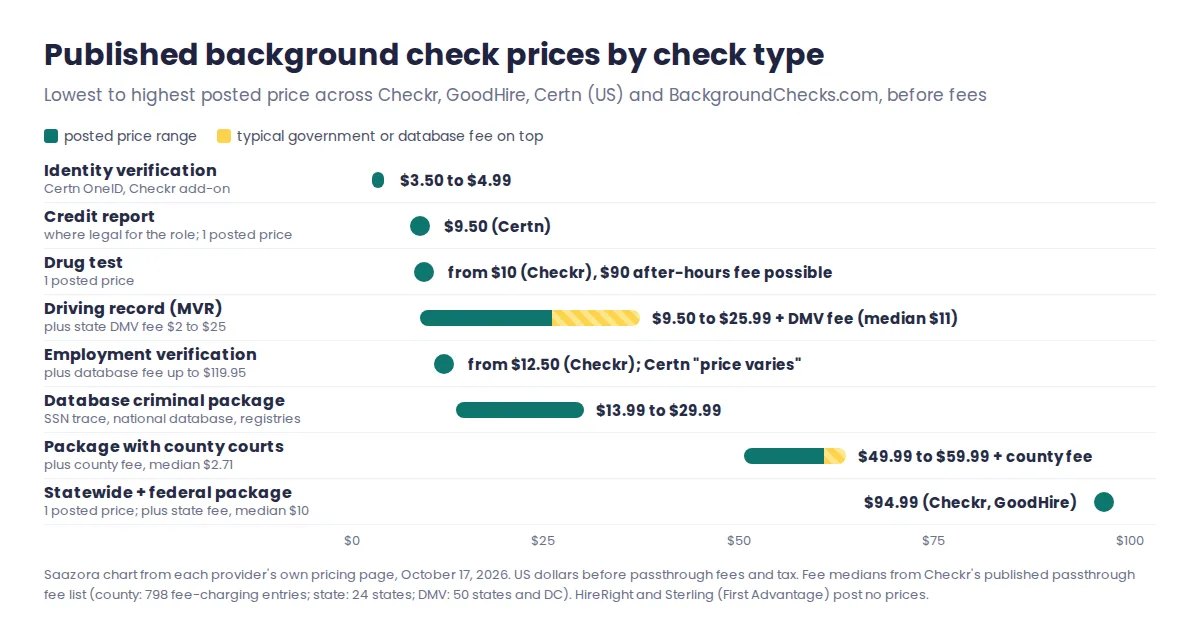
Three things stand out from the price lists:
- GoodHire's package prices match Checkr's exactly. GoodHire's company page says "Checkr Is Our Parent Company" and that Checkr acquired Inflection, GoodHire's parent, in April 2022. Comparing the two is not comparing two independent price points.
- The cheapest headline price is not always the cheapest check. Certn's $13.99 US Core rises to $23.98 once its $9.99 county search is added, which Certn says it runs automatically "where applicable".
- Package contents differ. Certn's $49.99 package searches county records across seven years of addresses, while Checkr's $59.99 Essential adds identity verification and unlimited county criminal searches. Compare the searches, not just the price.
Providers that only give quotes
Some of the largest screening firms ask you to contact sales. On October 17, 2026:
- HireRight's pricing page offers "a customized pricing quote" and no figures.
- Sterling's pricing address redirects to an older client letter about a price increase of "approximately two percent", with no price list. The site now says Sterling "is now a First Advantage company".
- GoodHire shows its three packages for buyers running fewer than 50 checks a year and offers a custom quote above that.
Quote-only pricing is not a bad sign in itself: high-volume employers often get custom packages. For a business running a handful of checks a year, though, a posted price list makes budgeting much simpler.
The government fees inside the total
Passthrough fees are what the record holder charges. Checkr's fee page says they are "standard across the industry" and that "No background check provider is exempt". To see whether a provider's list matches the official rate, we compared four fees with the government pages that set them:
| Record | Official fee (government page) | Same fee in Checkr's passthrough list |
|---|---|---|
| New York statewide criminal history search | $95.00 (NY Office of Court Administration) | $95 New York state court fee |
| Pennsylvania PATCH criminal history | $22.00 (Pennsylvania, PATCH clearance page) | $22 PATCH fee |
| California driving record | $2.00 online, $5.00 by mail (California DMV) | $2.00 California DMV fee |
| Federal court records (PACER) | $0.10 per page, capped at $3 per document; waived if you spend $30 or less in a quarter | No separate fee listed; federal search is part of the $94.99 package |
Government fee pages and Checkr's passthrough fee page, all checked October 17, 2026. Pennsylvania also adds a 2% card fee to online PATCH requests from April 22, 2026, according to the ePATCH site.
Where we could check it, the provider passed on the official fee at the official rate. The amount is set by where the records sit, not by the provider you pick, which is why every provider adds "fees may apply" to its prices.
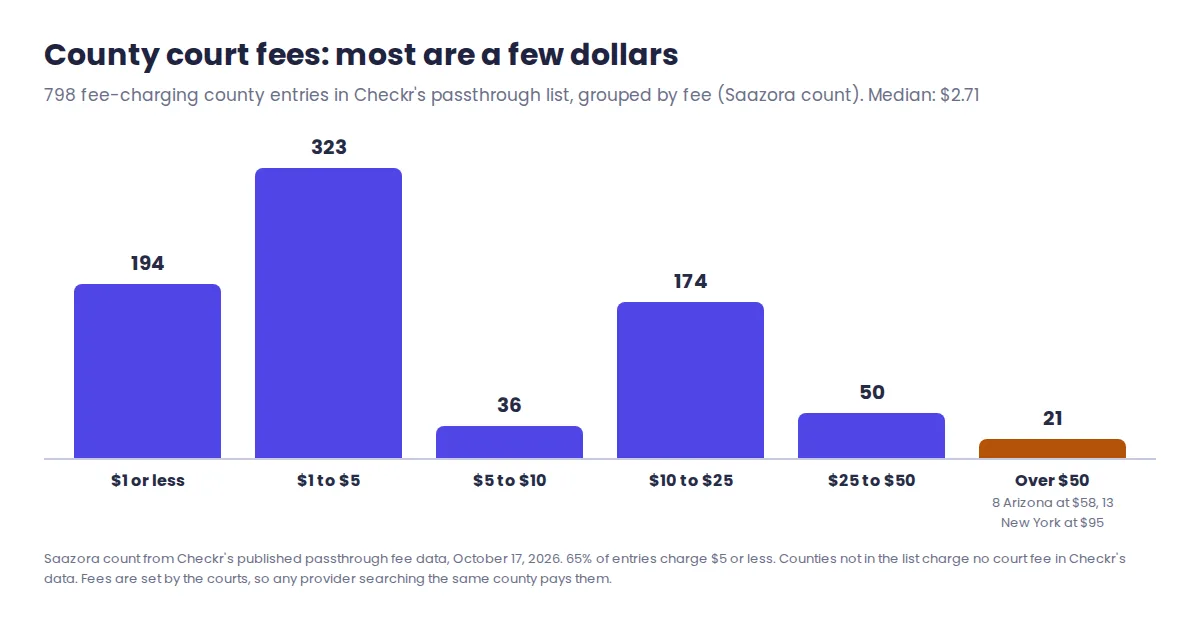
How big are county fees in practice? Checkr publishes its full fee list. A Saazora count of that list found 798 county entries that charge a fee. The median is $2.71, and 65% of them charge $5 or less. Only 21 charge $50 or more: eight Arizona counties at $58 and thirteen New York counties at $95. Among the 24 states with a statewide court fee, the median is $10; among the 50 states and DC, the median DMV fee is $11.
A screening budget by role type
The cheapest way to budget is by role, because each role needs a different set of searches. The table below is a Saazora calculation from the public prices above. "Low" uses the cheaper posted bundle and the lowest possible fee; "median fees" adds the median county, state and DMV fee where each applies; "high" uses the dearer bundle and the highest listed fees.
| Role type | Searches | Posted bundle price | Low | With median fees | High |
|---|---|---|---|---|---|
| Office, retail or hospitality | County criminal package | $49.99 (Certn) to $59.99 (Checkr) | $49.99 | $52.70 to $62.70 | $154.99 |
| Driver or delivery | County package + MVR | $69.49 (Checkr) to $75.98 (Certn) | $71.49 | $83.20 to $89.69 | $195.98 |
| Bookkeeping or cash handling | County package + past-employer check (+ credit where legal) | $72.49 (Checkr, no credit price posted) to $89.49 (Certn, incl. credit) | $72.49 | $75.20 to $92.20 | $287.44 |
| Safety-sensitive role | Statewide and federal package + drug test | $104.99 (Checkr); Certn self-serve has no statewide search | $104.99 | $117.70 | $384.99 |
Saazora calculation, October 17, 2026. Fee assumptions: county $0 to $95 (median $2.71), state $0 to $95 (median $10), DMV $2 to $25 (median $11), employment database $0 to $119.95, after-hours drug test fee $0 to $90. "High" assumes the most expensive New York records and fees together, which few candidates trigger. Verification database fees are left out of the median column. Only Checkr publishes verification database fees, so the bookkeeping "high" uses the Checkr bundle. Tax excluded.
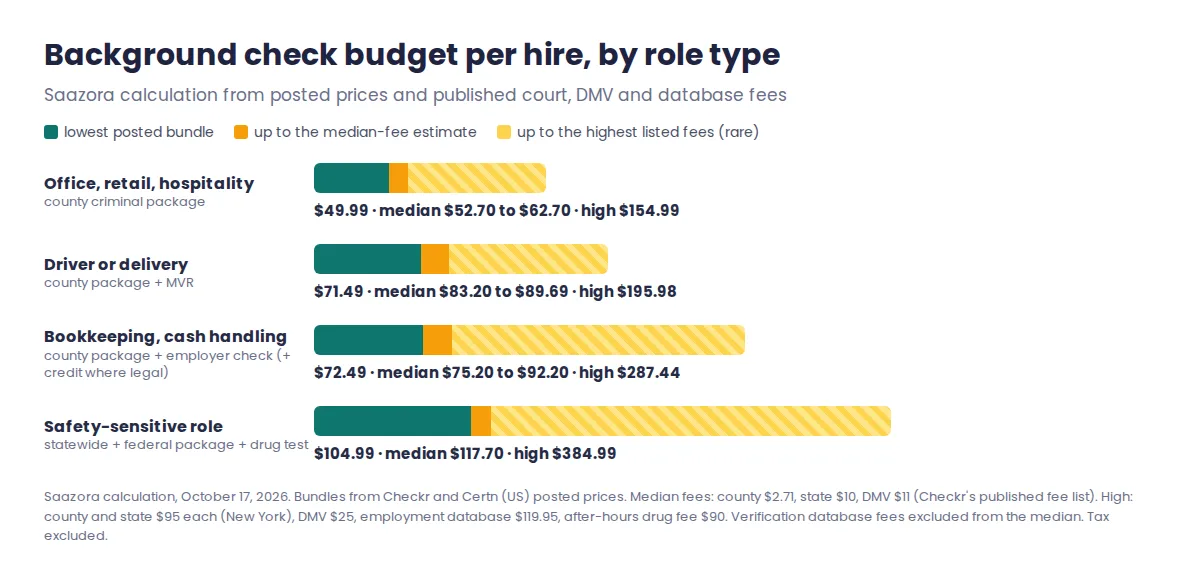
Two patterns hold across every role. First, most hires land near the median column, because most counties charge little or nothing. Second, the high end is driven by fees, not by the provider's price: a single New York candidate on a statewide package can add $190 in court fees alone. Budget at the median figure, then keep a reserve for the occasional expensive address history.
To turn this into a yearly number, multiply your planned hires in each role by the median-fee figure and add a reserve for one or two high-fee candidates. If most of your hiring is in one state, check that state's court and DMV fees first; they move the median more than anything else.
Add-ons that change the bill
- Credit reports. Certn notes that "Credit scores do not appear on reports related to employment." The EEOC and FTC guide notes that some states and municipalities regulate how background information is used in hiring, so check local rules before you order one. Only use a credit check where the job justifies it and the law allows it.
- Verifications. Past-employer checks can carry database fees of $17.95 to $119.95 per Checkr's fee page, and school records $3.95 to $50.00. Verifying only the most recent employer, as Certn's $79.99 Complete+ package does, keeps the cost predictable.
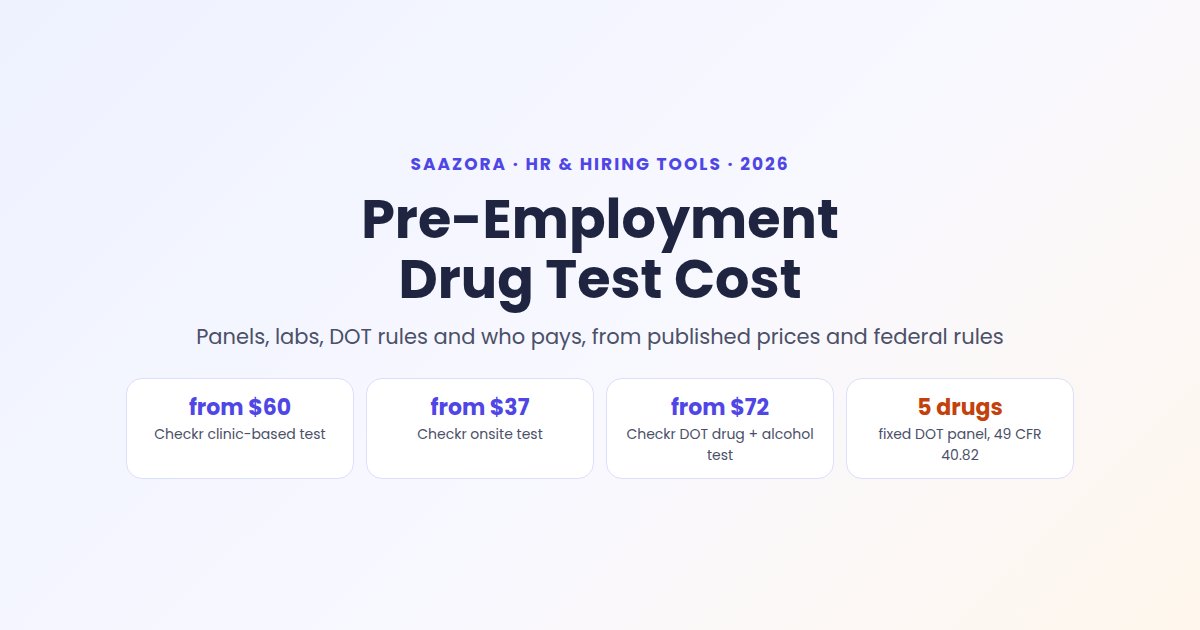
- Drug tests. The base test is cheap (from $10 at Checkr), but Checkr lists a $90 after-hours fee for tests on weekday evenings, nights or weekends, and $10 per candidate for random selection.
- State-specific databases. Some roles require a specific state search, such as Pennsylvania's PATCH check for school employees, which carries its own $22 state fee.
Your FCRA duties before and after the report
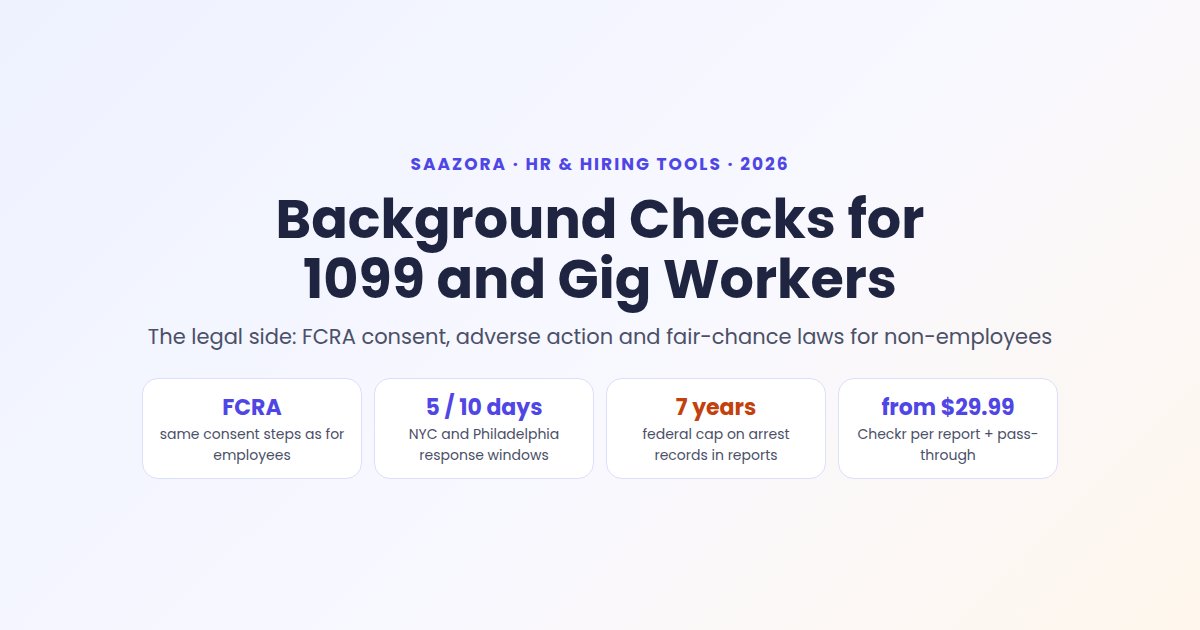
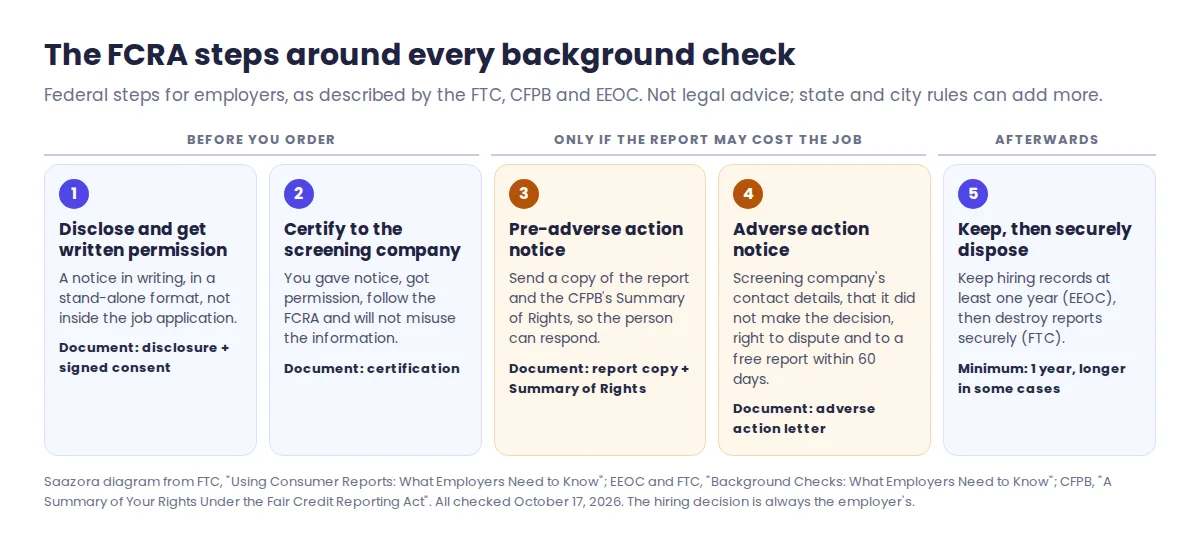
Whichever provider you use, ordering a report through a screening company brings duties under the Fair Credit Reporting Act. This is not legal advice; an employment lawyer can tell you what applies in your state and city. The federal steps, as the FTC, CFPB and EEOC describe them (pages checked October 17, 2026):
- Disclose and get written permission. The FTC says the notice "must be in writing and in a stand-alone format", not tucked inside a job application.
- Certify to the screening company that you gave notice and got permission, "complied with all of the FCRA requirements" and "will not discriminate against the applicant or employee or otherwise misuse the information".
- Before rejecting someone because of the report, send a pre-adverse action notice with a copy of the report and the CFPB's "A Summary of Your Rights Under the Fair Credit Reporting Act", so the person can respond.
- After the decision, send an adverse action notice with the screening company's name, address and phone number, a statement that the company "did not make the decision", and the person's right to dispute the report and to a free copy within 60 days.
- Keep and then destroy records properly. The EEOC says hiring records must be kept for one year (longer in some cases), and the FTC says you "must securely dispose of the report and any information you gathered from it."
The EEOC also asks employers to "Apply the same standards to everyone", which is another reason to set one search package per role in writing. Many states and cities have fair-chance or "ban the box" rules on when criminal history may be considered; check the rules where you hire.
Seven ways to spend less on screening
- Write a search list per role and stick to it. Over-ordering statewide searches or credit reports is the most common waste.
- Screen only finalists, after a conditional offer. You pay for one check instead of five, and some fair-chance rules also set when a check may be run.
- Prefer pay-as-you-go if you hire a few people a year. Checkr's small business page says "no contracts or minimums", and BackgroundChecks.com advertises "no setup fees, no contracts".
- Ask for a quote above 50 checks a year. GoodHire's page splits its pricing at that volume, and quote-based providers expect to negotiate.
- Estimate fees before you order for candidates from New York or Arizona, where county fees are highest.
- Order an MVR only for driving roles and verifications only for the employers that matter.
- Book drug tests in clinic hours to avoid after-hours surcharges.
Saazora may earn a commission if you sign up through the Checkr link below, at no extra cost to you.
If you want posted prices, no contract and a fee estimator, Checkr is one option to compare: you can open a Checkr account and price a check for one role (affiliate link). Our Checkr pricing breakdown with fee-by-fee examples goes deeper into its packages, and the current Checkr setup offer is summarised on our deals page. Certn, GoodHire and BackgroundChecks.com also post self-serve prices, so compare the searches each package includes before you pick.
Background check cost questions
Do employers or candidates pay for background checks?
In the normal hiring process the employer orders and pays for the report, and the candidate's written permission is required first. Some state or licensing checks are requested by the applicant, but for a private-sector job the cost usually sits in the employer's hiring budget.
Why do two quotes for the same check differ so much?
Because packages search different sources (database only, county courts, statewide courts), and because court and DMV fees depend on the candidate's address history. Compare the list of searches and ask whether fees are included or passed through.
Is a national criminal database search enough?
That depends on your policy and the role. Database searches are the cheapest line on every price list, which is why many employers add county court searches for roles where criminal history matters. Decide per role, in writing, and apply it to every candidate for that role.
How we researched these prices
On October 17, 2026 we saved the pricing pages of Checkr, GoodHire, Certn (US and Canada), BackgroundChecks.com, HireRight and Sterling, GoodHire's company page and Checkr's passthrough fee page and fee data. We checked court and DMV fees on the New York courts, Pennsylvania PATCH, ePATCH, California DMV and PACER sites, and read the FTC, EEOC and CFPB guidance named below. Every bundle price, median and budget figure above is Saazora's own calculation from those pages. We did not order any background checks or open provider accounts, so this is a research guide, not a test, and prices can change after the date shown. More on our method: how Saazora researches prices and products.
Sources (checked October 17, 2026): provider pricing pages listed above; NY Office of Court Administration, Criminal History Record Search; Pennsylvania, PATCH clearance page and ePATCH; California DMV, Driver's Record Request; PACER, "PACER Pricing: How fees work"; FTC, "Using Consumer Reports: What Employers Need to Know" (updated August 4, 2020); EEOC and FTC, Background Checks: What Employers Need to Know; CFPB, "A Summary of Your Rights Under the Fair Credit Reporting Act".
Research-based guide, not hands-on testing and not legal advice. No provider named here paid for or reviewed this article.