
Research guide built from public pages, not a hands-on test: Saazora did not run a background check on a contractor or gig worker for this article · Checkr prices read on checkr.com/pricing on October 23, 2026 (unchanged from a copy saved October 22) · FCRA text, FTC, CFPB, New York City and Philadelphia sources and the Uber and DoorDash screening pages checked October 23, 2026 · This is not legal advice; worker classification and fair-chance rules vary by place, so talk to an employment lawyer before you set a policy · We may earn a commission if you sign up through links on this page.
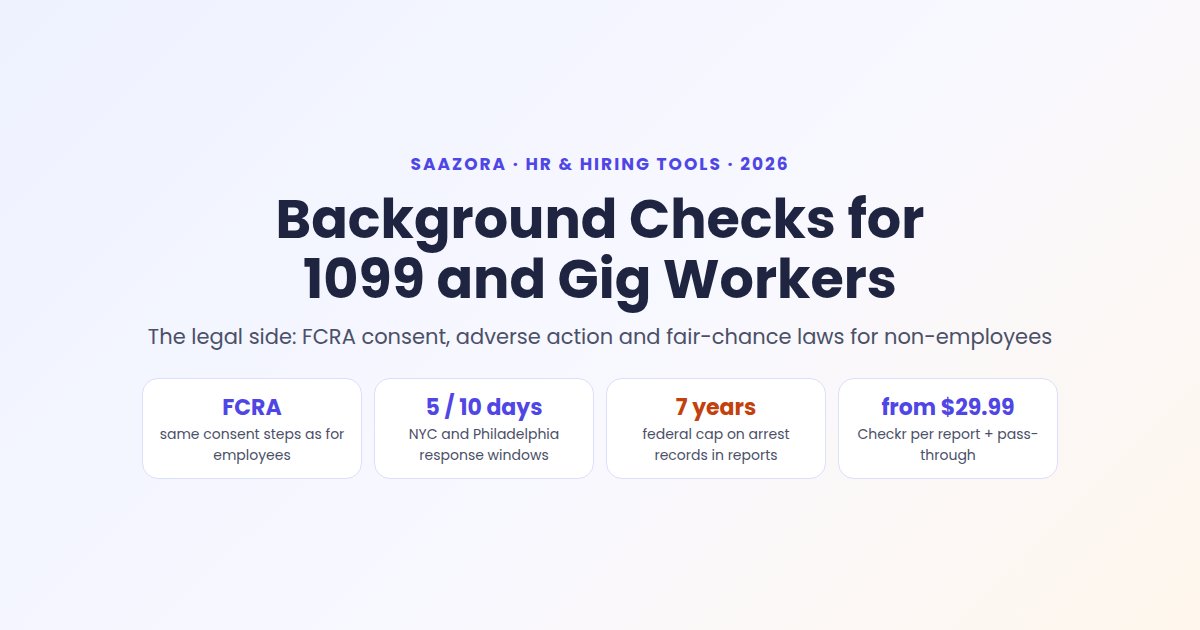
Can you run a background check for independent contractors? Yes, and the safe way to do it is the same Fair Credit Reporting Act (FCRA) process you would use for an employee: a stand-alone disclosure, the person's written authorization, a pre-adverse action notice with a copy of the report, and a final adverse action notice. The FTC's staff reads "employment purposes" broadly enough to cover people who are "not technically employees", a few courts disagree, and local fair-chance laws in places like New York City and Philadelphia name freelancers, independent contractors and gig workers outright. For an app-based marketplace, that adds two duties on top of the FCRA: wait for a conditional offer before looking at criminal history where those laws apply, and give the worker a set number of business days to answer before you deactivate them.
This guide is about the legal side of screening people who are not on your payroll: solo freelancers, 1099 contractors and workers who sign up through a delivery, rideshare or task app. It puts the rules for employees, 1099 contractors and gig workers in one table, walks through consent and adverse action when the "application" is an app sign-up, compares the two local laws that cover contractors by name, and shows how two large marketplaces describe their own screening. If you run a crew of home service techs, our companion guide on screening contractors and home service techs who enter customers' homes covers package choice and costs for that case. If you have never ordered a check at all, start with our walkthrough of ordering a first employee background check.
Background check for independent contractors: which rules apply to whom
The quickest way to see the legal picture is to line up the three kinds of worker side by side. The rows marked "yes" are written into the law or the official guidance for that group; the rows marked "best practice" are where the law is unsettled and the safe choice is to follow the employee rule anyway.
| Rule | W-2 employee or applicant | 1099 independent contractor or freelancer | Gig or on-demand worker on a platform |
|---|---|---|---|
| Report counts as "employment purposes" under FCRA §603(h) | Yes (statute says "as an employee") | FTC staff: yes, read liberally; some federal district courts: no | Same as 1099; the FTC staff examples include owner-operator truck drivers |
| Stand-alone disclosure + written authorization before the report | Yes, §604(b)(2) | Best practice; a screening company still needs a permissible purpose, and the person's written instructions are one (§604(a)(2)) | Best practice; DoorDash starts its check inside the sign-up flow |
| Pre-adverse action notice, copy of report, Summary of Rights | Yes, §604(b)(3) | Best practice (courts split) | DoorDash says it sends one, with 14 days to respond |
| Final adverse action notice | Yes, §615(a) | Best practice | DoorDash says it sends one after the 14 days |
| Arrests older than 7 years kept out of the report | Yes, §605(a), for the screening company (exception: jobs paying $75,000 a year or more) | Yes: the limit binds the screening company, whoever the report is about | Yes |
| NYC Fair Chance Act (4+ employees) | Yes | Yes: protections "apply to interns, freelancers and independent contractors" | Yes when the worker is a freelancer or contractor in the city |
| Philadelphia Fair Criminal Record Screening Standards | Yes | Yes, named in the 2021 definition of "Employee" | Yes: "transportation network company driver, rideshare driver, or other gig economy worker" |
Sources: 15 U.S.C. §§1681a(h), 1681b, 1681c (Cornell LII); FTC staff report 40 Years of Experience with the Fair Credit Reporting Act (July 2011); FTC, Using Consumer Reports: What Employers Need to Know; NYC Commission on Human Rights Fair Chance Act guidance; Philadelphia Bill No. 200479; DoorDash Dasher Background Check FAQ. Checked October 23, 2026. Not legal advice.
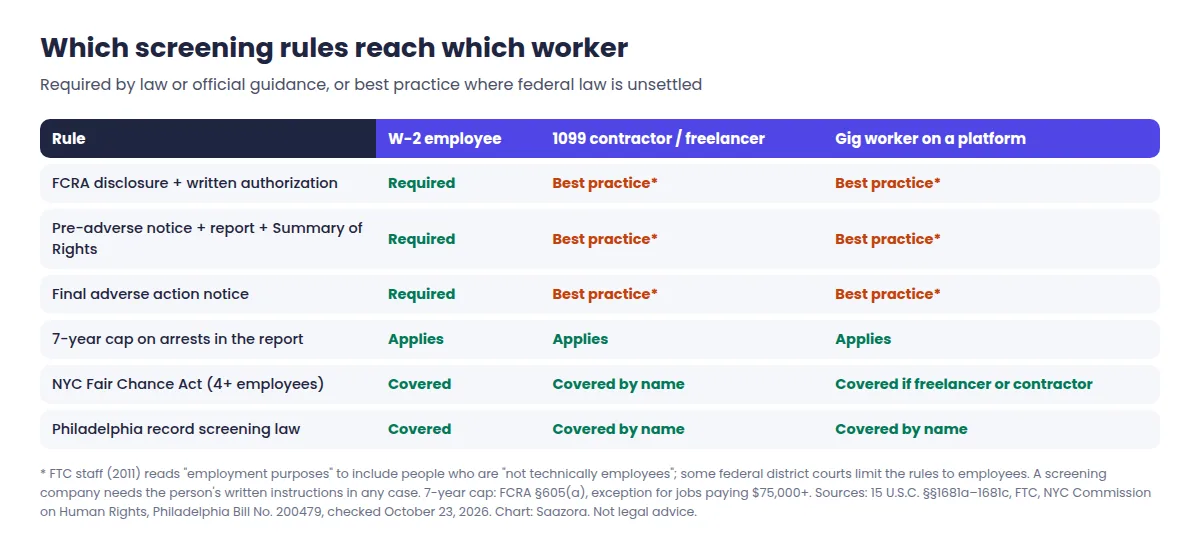
The pattern is that contractors sit in a gray zone under federal law but not under some local laws. That is why the simplest rule for a business with a mixed workforce is one process for everyone, and why platforms that operate in many cities build for the strictest local law rather than the loosest federal reading.
Why a 1099 label does not switch off the consent paperwork
The FCRA defines "employment purposes" as a report used to evaluate someone "for employment, promotion, reassignment or retention as an employee." Read word for word, that last phrase seems to leave contractors out. The FTC's staff has never read it that way. In its July 2011 staff report, in a passage on contractors, agents and volunteers, it says the term "may apply to situations where an entity uses individuals who are not technically employees to perform duties", and gives examples that look a lot like today's platform work: a trucking company checking drivers who own their own rigs, and a title insurer checking the people it "frequently enters into contracts" with.
Some federal district courts have gone the other way. In Smith v. Mutual of Omaha (S.D. Iowa, 2018), the court held that the pre-adverse action notice requirement "only applies when an applicant applies to be an employee", following earlier decisions in Ohio and Wisconsin. There is no appeals-court answer that settles it nationally. Our home-service guide traces that history in more detail; for this page, two practical points matter more:
- You need consent either way. A screening company may only furnish a report for a permissible purpose listed in §604(a) of the FCRA. If a contractor check is not "employment purposes", the obvious remaining purpose is the one in §604(a)(2): "the written instructions of the consumer to whom it relates." So a written, signed request from the worker is the floor under either reading.
- Classification is decided elsewhere. Whether a worker is really a contractor is a tax and labor question. Running the employee screening process does not turn a contractor into an employee, and skipping it does not prove the worker is a contractor.
One more data point on where federal guidance stands: the CFPB issued a circular on background dossiers and worker data in October 2024, but its own withdrawn-guidance page lists Circular 2024-06 as "withdrawn on May 12, 2025". It never mentioned contractors or gig workers anyway, so this guide relies on the statute and the FTC staff reading instead.
Disclosure and authorization when the application is an app sign-up
On a marketplace there is no paper application and often no recruiter. The worker downloads an app, enters a phone number and moves through screens. The FCRA's form rules still apply to those screens.
- Give the disclosure its own screen. The statute says the disclosure must be "clear and conspicuous", in writing, and "in a document that consists solely of the disclosure". In an app, that means a separate page that says a consumer report may be obtained, not a clause buried in the platform's terms of service or contractor agreement.
- Collect the authorization in writing. The statute lets the signed authorization sit on the same document as the disclosure. An e-signature or a checked box with a record of who agreed and when is how most sign-up flows do it; keep that record.
- Say up front if checks continue. If you plan to re-run or monitor records while the person keeps working, the FTC tells employers to "make sure you say so clearly and conspicuously" in the authorization. For a gig platform, where re-checks are part of the model, this line belongs in the very first consent.
- Check state and local rules. States can add their own notice requirements, and New York City and Philadelphia change when criminal history may be looked at (next sections). The FTC's own employer page says it is "a good idea to review applicable laws of your state".
Two things the FCRA does not ask for in this step: it does not set a minimum gap between consent and ordering the report, and it does not require that you explain which searches you will run. Fair-chance laws can require more, which is why the order of the screens matters in cities that have them.
Adverse action at platform scale: notice, wait, decide
The adverse action steps are where gig platforms are most exposed, because a single rule change can trigger thousands of decisions at once. The FCRA sequence is short. Before acting, give the person "a copy of the report" and "a description in writing" of their rights (the CFPB's Summary of Your Rights Under the FCRA). After deciding, send a final notice with the screening company's name, address and phone number, a statement that the screening company did not make the decision, and the person's right to dispute the report and to get a free copy if they ask within 60 days.
The FCRA itself sets no number of days between the two notices. Local law and platform policy fill that gap:
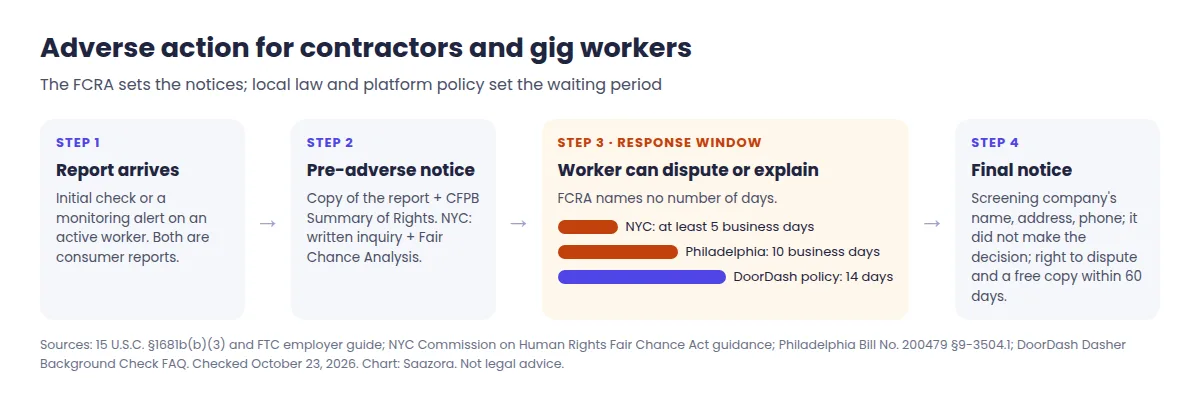
- New York City: at least five business days from receipt of the employer's written inquiry and Fair Chance Analysis.
- Philadelphia: ten business days to show the record is wrong or give an explanation.
- DoorDash (platform policy): its Dasher FAQ says that after the pre-adverse action notice is sent, a Dasher has "14 days to dispute the results", and that a post-adverse action notice and deactivation follow if nothing comes in. For an active Dasher, the account is unavailable during those 14 days.
DoorDash's FAQ also shows a split that every platform should copy: if the report is wrong, the worker disputes it with the screening company (here, through Checkr's candidate portal); if the report is right but the worker wants context considered, they write to DoorDash. Mixing up those two channels is a common reason disputes stall.
Fair-chance laws that name contractors and gig workers
Most ban-the-box and fair-chance laws were written about employees, so they may or may not reach a contractor. Two big-city laws remove the doubt by naming non-employees. We read both in their official text; other places may cover contractors too, but we only list laws we checked.
| New York City Fair Chance Act | Philadelphia Fair Criminal Record Screening Standards | |
|---|---|---|
| Who is covered | NYC Human Rights Law protections "relating to employees apply to interns, freelancers and independent contractors" | "Employee" includes anyone "permitted to work" for a private employer in the city, "including as an independent contractor, transportation network company driver, rideshare driver, or other gig economy worker" |
| Which businesses | Employers with four or more employees | Private employers, plus "any third-party person or entity that facilitates the relationship of work for pay between two other parties" |
| When criminal history may be checked | After a conditional offer | After a conditional offer |
| Look-back on convictions | Weighed case by case with the Article 23-A factors; the guidance we read names no year cutoff | Convictions older than seven years (not counting time in prison) may not be considered |
| Before a final decision | Written copy of the inquiry and the Fair Chance Analysis; at least 5 business days to respond | Written notice with the basis and a copy of the report; 10 business days to respond |
| Current workers | Since July 29, 2021 also covers current employees and pending cases | Covers applicants and employees as defined |
NYC Commission on Human Rights, Legal Enforcement Guidance on the Fair Chance Act (updated for Local Law 4 of 2021, effective July 29, 2021); Philadelphia Bill No. 200479 amending Chapter 9-3500 of The Philadelphia Code (certified copy). Read October 23, 2026. Not legal advice.
Philadelphia's definition of employer is the line platform operators should read twice. By covering any entity that "facilitates the relationship of work for pay between two other parties", it reaches marketplaces that match a customer with a worker, not only companies that hire directly. New York City's guidance adds that its rules apply to current workers and pending cases, which matters for the monitoring alerts covered next.
The federal limit in the table above works differently: it binds the screening company, not you. Under §605(a) of the FCRA, a consumer report may not include records of arrest or civil suits older than seven years (or the statute of limitations, if longer), or other adverse items that "antedate the report by more than seven years", while records of convictions have no federal time limit. The cap does not apply to a job paying $75,000 a year or more. States can go further: Uber's own FAQ notes that "some states may legally prohibit us from receiving reports about any convictions older than 7 years".
Ongoing checks on active workers: consent, alerts and deactivation
A contractor who keeps working for months is screened once at sign-up and then, on most platforms, again and again. There are two ways to do that, and both need the "throughout" language in the original consent.
- Scheduled re-runs. Order the same package again on a calendar. Checkr's pricing page describes rechecks "that can be set on a specific cadence" at "the price of the package" plus pass-through fees.
- Continuous monitoring. Checkr lists a continuous criminal search at $1.70 per individual per month to "monitor and learn about changes in workers' criminal records", and Continuous MVR at $2.50 per enrolled driver per month, with state fees and triggered reports billed on top. Our companion home-service guide works through the yearly cost of each option.
The legal point is what happens when monitoring flags something. A monitoring hit is still a consumer report. If you plan to deactivate someone because of it, the same pre-adverse notice, waiting period and final notice apply, and in New York City the Fair Chance Process now covers current workers too. DoorDash's FAQ describes exactly that flow for active Dashers. Uber's driver screening page describes the decision side: when an offense involving an active driver is identified, "our screening team reviews it" before removing the driver. The same holds for any screening provider: the FTC's final-notice wording has the business state that the company that supplied the report "did not make the decision".
How delivery and rideshare marketplaces screen, from their own pages
Checkr lists DoorDash, Instacart, Uber, Turo and Favor among its customers. Two of them publish detailed screening pages, and they make a useful reference for anyone building a contractor program. Everything below comes from the companies' own public pages; we did not test either sign-up.
| Uber (drivers and delivery people, U.S.) | DoorDash (Dashers, U.S.) | |
|---|---|---|
| Screening provider | "Third-party background check providers" accredited by the Professional Background Screening Association | "Accredited third-party background check providers, including Checkr" |
| What is checked | Identity (SSN validated with the IRS, government ID, live photo), motor vehicle record, then criminal history | Motor vehicle report if delivering by car, plus criminal history report; no MVR for bicycle delivery |
| Order of steps | MVR first; criminal check only if the MVR passes. Uber says around 70% of rejected applications fail at the MVR stage | Both run during sign-up, before access to offers |
| Look-back | Generally 7 years for most offenses; some offenses disqualify for life where law allows | Not stated on the FAQ |
| After sign-up | Driving and criminal checks re-run at least every year (annual driving re-runs do not apply in NYC), plus continuous monitoring for new charges | Reruns "under certain circumstances", plus Checkr's continuous check for new offenses |
| Adverse action | Human review before a disqualification; local fair-chance laws weighed where they apply | Pre-adverse notice with report copy, 14 days to dispute, then post-adverse notice |
Uber, Driver screening page (U.S.) and Uber Newsroom, "How We Keep Our Platform Safe" (June 27, 2026; the page notes an update to Uber's process from June 30); DoorDash Help Center, Dasher Background Check FAQ. Read October 23, 2026. Company statements, not verified by Saazora.
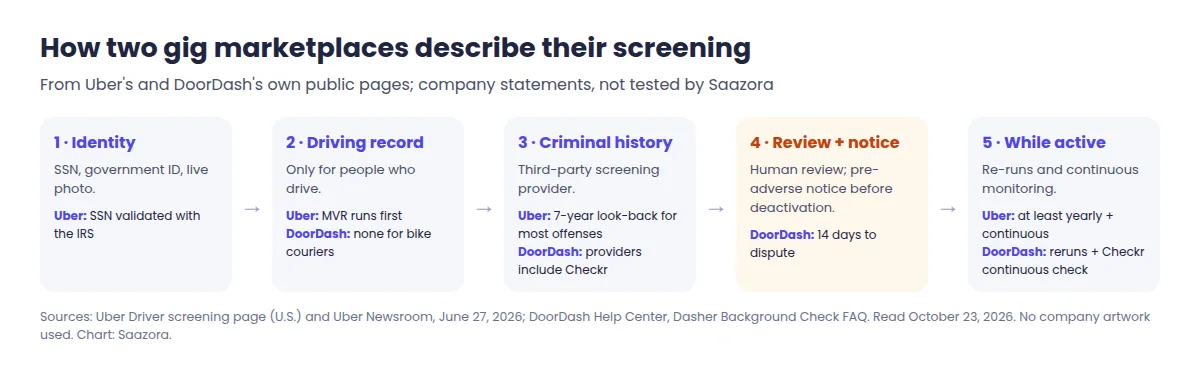
Three design choices stand out. Both companies tie the driving record to how the work is done (car versus bike), which keeps cost and data collection proportionate. Uber runs the cheap check first and only pays for the criminal search when the driving record passes. And both keep screening after sign-up, which is why any platform that re-checks needs consent that covers ongoing checks from day one.
Setting up a contractor program on Checkr: packages and a sign-up-funnel estimate
Checkr's business packages are the same whether the person is an employee or a contractor. At list price, checked October 23, 2026: Basic at $29.99 per report (SSN trace, sex offender registry, global watchlist and national criminal search), Essential at $59.99 (adds identity verification and unlimited county criminal searches) and Complete at $94.99 (adds unlimited state and federal criminal searches). A motor vehicle record is $9.50 per check. Pass-through court and DMV fees come on top at cost. Saazora's guide to every Checkr package price has the full add-on list.
For a marketplace, the order of checks matters as much as the package. Here is an illustrative funnel for 100 applicants who will drive, using Checkr list prices and Uber's MVR-first sequence. The 20% MVR failure rate is an assumption for the example, not a published figure.
| Approach | What is ordered | Arithmetic | List-price total |
|---|---|---|---|
| Everything at once | Essential + MVR for all 100 applicants | 100 × ($59.99 + $9.50) | $6,949.00 |
| MVR first | MVR for all 100; Essential only for the 80 who pass | 100 × $9.50 + 80 × $59.99 | $5,749.20 |
| Difference | $6,949.00 − $5,749.20 | $1,199.80 (about 17%) |
Checkr list prices from checkr.com/pricing, October 23, 2026, before pass-through fees. 20% MVR failure is an illustrative assumption. Totals are Saazora calculations.
Two cautions. A two-step order adds a second wait for the applicant, and in New York City and Philadelphia the criminal search must still come after the conditional offer, so the offer has to be made between the two steps. For non-drivers, skip the MVR entirely, as DoorDash does for bike couriers. For a broader look at budgets, see how much small businesses spend per background check; for driving roles, our explainer on MVR checks for drivers covers what the record shows.
If you are ready to set up the workflow, you can open a Checkr account for contractor screening (affiliate link). Checkr's pricing page describes its plans as pay-as-you-go, so you pay per report rather than a monthly fee if you only screen a few contractors a year.
A compliance checklist for screening 1099 and gig workers
Use this list to set up a background check for independent contractors and platform workers in the order the law expects: paperwork first, then the check, then any decision.
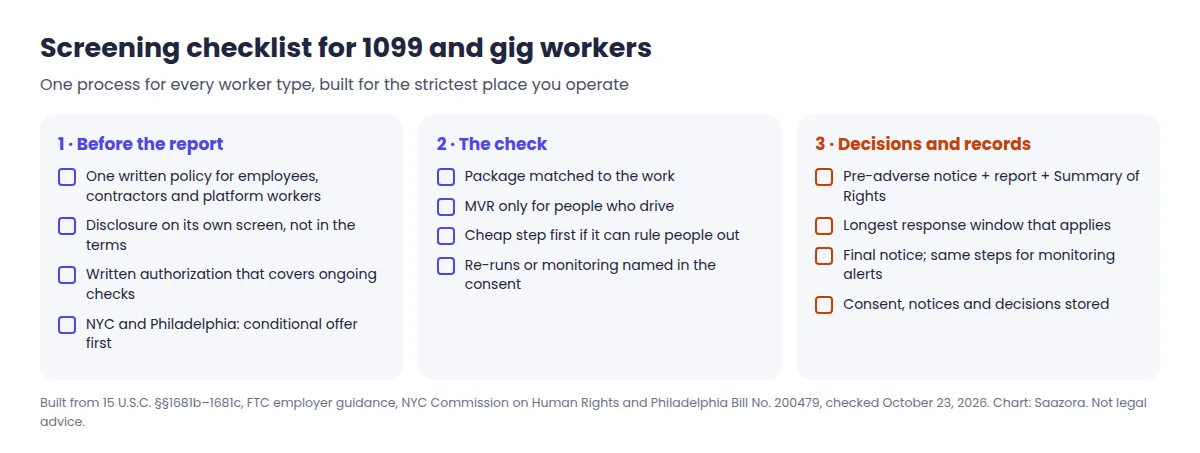
- ☐ One written screening policy that covers employees, 1099 contractors and platform workers alike, reviewed by a lawyer.
- ☐ A disclosure on its own screen or page, separate from the contractor agreement and terms of service.
- ☐ A signed or e-signed authorization that says checks may continue while the person works with you.
- ☐ In New York City and Philadelphia, a conditional offer before any criminal history search.
- ☐ A package matched to the work: MVR only for drivers, county search where records matter.
- ☐ Pre-adverse notice with the report and the CFPB Summary of Rights, then the longest response window that applies to you.
- ☐ Final adverse action notice naming the screening company and the right to dispute.
- ☐ The same notices for any monitoring alert that leads to deactivation.
- ☐ Consent records, notices and decisions stored for every worker.
Every guide in this series lives under Saazora's HR and hiring tools section, and our Checkr store page lists the current offer terms. When the policy and the screens are ready, see Checkr's business packages (affiliate link).
Questions businesses ask about screening non-employees
Is a background check for independent contractors covered by the FCRA?
The FTC's staff says it can be, because "employment purposes" is read liberally to include people who are "not technically employees", while some federal district courts have limited parts of the law to employees. Because a screening company needs the person's consent in either case, most businesses follow the full employee process for contractors.
Do gig platforms need a conditional offer before checking criminal history?
Under federal law, no. In New York City and Philadelphia, yes: both laws cover contractors or gig workers and allow a criminal history check only after a conditional offer. Other places may have similar rules, so check where your workers are.
Can I deactivate a contractor because of a continuous monitoring alert?
Only after the same steps as any adverse action: send a pre-adverse notice with the new report and the Summary of Rights, wait the response period that applies, then send the final notice. DoorDash's published policy gives active Dashers 14 days.
Can I rely on a staffing agency's or marketplace's background check instead of my own?
You can agree on that in your contract, but ask what package was run, when, and whether it covers the people who will actually do the work. In Philadelphia, a third party that "facilitates" paid work is itself covered by the law, so both sides have duties.
How this guide was researched
On October 23, 2026 we read the FCRA sections that define employment purposes, set the consent and adverse action rules and limit what a report may contain (15 U.S.C. §§1681a, 1681b and 1681c, via Cornell's Legal Information Institute); the FTC's employer guide to consumer reports and its July 2011 staff report on the FCRA; the CFPB's withdrawn-guidance list; a law-firm summary of the 2018 Smith v. Mutual of Omaha decision; the New York City Commission on Human Rights guidance on the Fair Chance Act; the certified text of Philadelphia Bill No. 200479; Uber's driver screening page and June 2026 newsroom post; DoorDash's Dasher Background Check FAQ; and checkr.com/pricing. We looked for a Los Angeles County source on contractor coverage but could not read the county's own page, so it is left out. Saazora did not order any background check for this article, and we do not rate any company's speed or accuracy.
Sources (checked October 23, 2026): Cornell LII, 15 U.S. Code §1681b, §1681a and §1681c; FTC, Using Consumer Reports: What Employers Need to Know (October 2016) and 40 Years of Experience with the Fair Credit Reporting Act (July 2011); CFPB, Withdrawn Guidance list and A Summary of Your Rights Under the FCRA; Consumer Financial Services Law Monitor, note on Smith v. Mutual of Omaha (December 2018); NYC Commission on Human Rights, Fair Chance Act guidance; City of Philadelphia, Bill No. 200479 (certified copy); Uber, Driver screening and Uber Newsroom (June 27, 2026); DoorDash, Dasher Background Check FAQ; Checkr pricing page.
Research guide, not hands-on testing and not legal advice. Checkr did not pay for or review this article.