
Research guide built from public pages, not a hands-on test: Saazora did not order or take a drug test for this article · Checkr prices read on checkr.com/pricing and its passthrough fee page on October 23, 2026 · 49 CFR Part 40 and 49 CFR §382.301 read on eCFR (Part 40 last amended June 10, 2026), the DOT Office of Drug and Alcohol Policy and Compliance (ODAPC) oral fluid lab page and Nevada's NRS 613.132 checked the same day · This is not legal advice; drug testing and marijuana rules differ by state and city, so ask an employment lawyer before you set a policy · We may earn a commission if you sign up through links on this page.
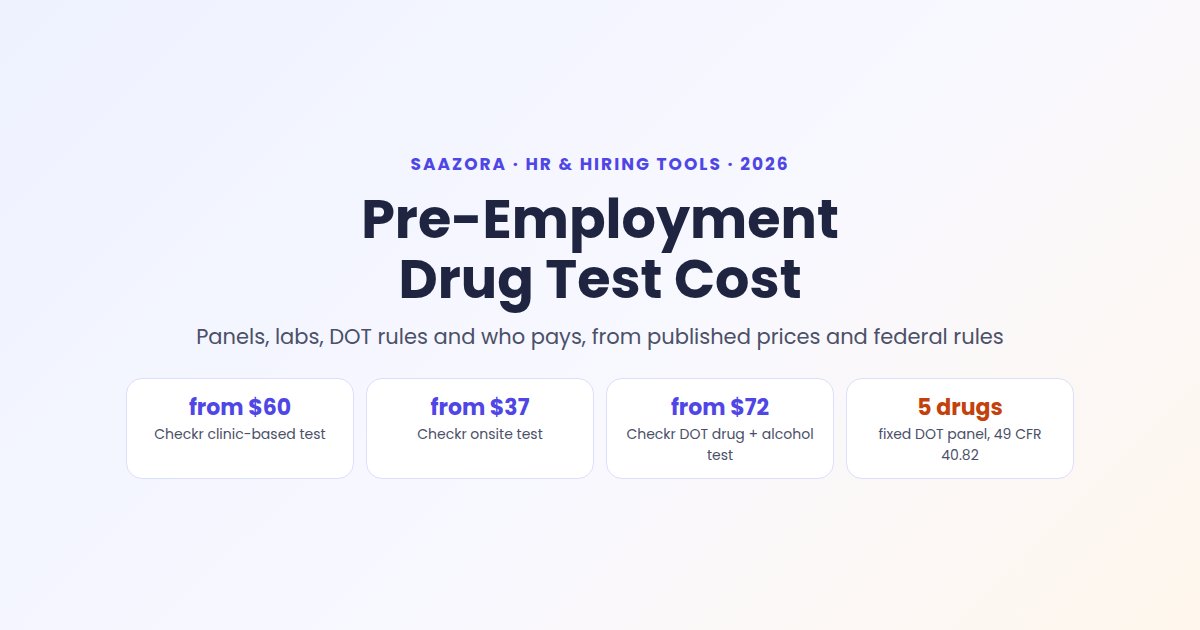
What does a pre-employment drug test cost? At Checkr, the published floor for a hiring test is $37 for an onsite test and $60 for a clinic-based test, and a DOT drug and alcohol test starts at $72 (checked October 23, 2026). The "from $10" figure on Checkr's package cards is the starting price of a random test for people already on staff, and it carries a $10 random-selection fee on top. The final price per candidate moves with three things: how many drug panels you order, the specimen (urine or hair), and where the sample is collected. The employer usually pays, and for DOT-regulated jobs the federal rules decide most of the test for you.
This guide is for small and mid-size employers adding a drug screen to their hiring process: warehouses, construction and field crews, healthcare support roles, and fleets with commercial drivers. It lays out every drug test line Checkr publishes, explains why a 5-panel and a 10-panel test are priced differently, walks through the parts of a DOT test that 49 CFR Part 40 fixes, and works through four hiring scenarios. If the drug test is one line in a larger screening budget, our breakdown of how much small businesses spend per background check puts it in context.
Pre-employment drug test cost at Checkr, line by line
Checkr is one of the few screening companies that prints drug test prices on its public pricing page. Of the two other screening companies we checked the same day, GoodHire's pricing page lists its background check packages but no drug test price, and BackgroundChecks.com's drug testing page lists its panels (5, 9 and 10 panel, with or without THC) without prices. So the table below is one vendor's list prices, not a market average, and every figure is a starting point.
| Test on Checkr's pricing page | Starting price | When employers use it | What changes the price |
|---|---|---|---|
| Onsite drug test | $37 per test | Hiring batches tested at your own site | Preset 4- to 10-panel combination |
| Clinic-based drug test | $60 per test | Individual candidates sent to a collection clinic | Panels, specimen (breath, hair or urine), clinic location; $90 at expanded-hours clinics |
| DOT drug and alcohol test | $72 per test | Safety-sensitive transportation jobs | Federal procedures; panel fixed by rule |
| DOT physical | $110 per test | Drivers who need a DOT medical exam | Exam by a licensed DOT medical provider |
| Occupational health assessment | $23 per test | Fit-for-duty checks (lift, vision, TB, physicals) | Not a drug test; priced by exam type |
| Random drug and alcohol test | $10 per test + $10 per selected person | Current employees in a random program | Panels and clinic, plus the selection fee |
Source: checkr.com/pricing (add-on list) and Checkr's passthrough fee page, checked October 23, 2026. "Starting from" prices; pass-through fees are extra.
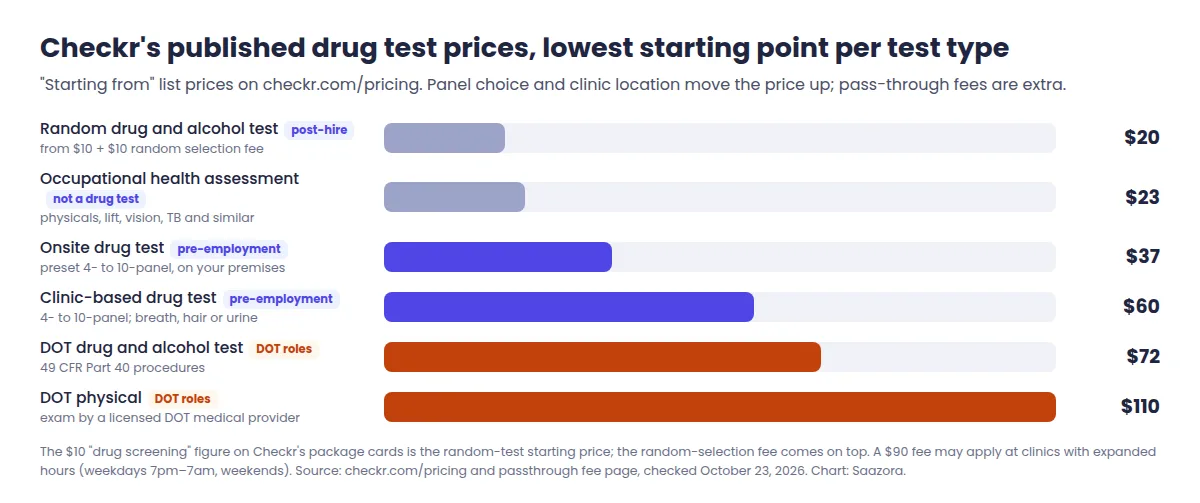
Two fees sit outside those list prices. Checkr's passthrough fee page says "A $90 after-hours fee applies when a test is administered Monday through Friday between 7pm-7am, or on Saturday or Sunday", and that the $10 random-selection fee "is only incurred for candidates chosen through random selection." The pricing page ties the expanded-hours clinics mainly to post-hire testing (random, reasonable suspicion and post-accident), so a normal daytime pre-employment visit should not trigger the $90. Our full guide to every Checkr package price covers the background check side of the same page.
Why the "$10" headline is not what a new hire costs
Every Checkr package card lists "Drug screening" as a popular add-on, and the add-on line reads "Starting from $10/test". That number is real, but it is the floor of the random test, which is the cheapest line because it is ordered for employees who are already in a testing program. A first test for a candidate is a different order: it needs a clinic visit or an onsite collector, a lab panel chosen for the job, and a result routed back into the hiring workflow. That is the $37 or $60 line.
If you budget from the headline, the gap shows up fast. For 25 hires a year, $10 a test suggests $250; the onsite floor is $925 and the clinic floor is $1,500. Budget from the line that matches how you will actually collect samples.
5-panel, 10-panel and no-THC panels: what the extra panels add
A "panel" is one drug or drug class the lab screens for. Checkr's own drug testing page describes the 5-panel test as one that "tests for the presence of amphetamines, cannabinoids (THC), cocaine, opiates, and phencyclidine (PCP)", and lists the substances larger panels add, such as barbiturates, benzodiazepines, methadone and methaqualone. Checkr's clinic and onsite tests run from 4-panel to 10-panel on urine, and its hair tests go up to 18 panels.
Checkr does not publish a separate price for each panel. Its pricing page says only that "Pricing varies by panel selection and clinic location", so the honest answer to "how much more is a 10-panel drug test" is: ask for a quote on the exact panel in your account before you write it into a policy. What you can decide without a price list is whether you need the larger panel at all:
- 4-panel (no THC). Checkr says it offers a 4-panel test "to help employers comply with local or state regulations that prohibit testing job candidates or employees for marijuana (THC)."
- 5-panel. The common baseline for non-DOT hiring, and close to the DOT panel (see the next section).
- 8- to 10-panel. Adds prescription-drug classes. That brings more results that need a Medical Review Officer to check for a valid prescription, which is where the time and follow-up go.
- Hair, up to 18 panels. A longer look-back, and a specimen DOT does not accept.
Write down one panel per job family and order the same one for every candidate in that role. That keeps the cost predictable and avoids the claim that some candidates got a stricter test than others.
DOT drug tests under 49 CFR Part 40: the panel is fixed, and so is most of the process
For jobs covered by Department of Transportation rules (commercial drivers, and safety-sensitive roles under the FAA, FRA, FTA, PHMSA and other DOT agencies), you do not pick the test. 49 CFR Part 40 sets it:
- Five drug classes, nothing else. §40.82 says labs "must test for the following five drugs or classes of drugs in a DOT drug test. You must not test 'DOT specimens' for any other drugs": marijuana metabolites, cocaine metabolites, amphetamines, opioids and PCP. A 10-panel DOT test does not exist.
- Certified labs. §40.81 allows only laboratories "certified by HHS under the National Laboratory Certification Program (NLCP)". Checkr says all of its testing runs at SAMHSA-certified labs with certified MROs.
- Separate from your own policy. §40.13 says "DOT tests must be completely separate from non-DOT tests in all respects", and DOT forms must not be used for non-DOT tests. If you also want a wider company panel, that is a second collection and a second fee.
- Only for covered employees. The same section says no one may run a DOT test "on an individual who is not a DOT-regulated employee." Office staff at a trucking company get a non-DOT test, if any.
For motor carriers, FMCSA adds the hiring rule that drives the timing: under 49 CFR §382.301, no employer may let a driver perform safety-sensitive functions "unless the employer has received a controlled substances test result from the MRO or C/TPA indicating a verified negative test result for that driver." There is a narrow exception for a driver who was in a compliant testing program in the previous 30 days and meets the other conditions in §382.301(b), with records you must obtain and keep. Part 40 also requires the previous-employer check: under §40.25 you ask DOT-regulated employers from the last two years for positive tests and refusals, and FMCSA-regulated employers do this through the Drug and Alcohol Clearinghouse. Our explainer on MVR checks for drivers covers the driving-record and Clearinghouse side.
At Checkr, the DOT pieces are separate lines: the DOT drug and alcohol test from $72, a Clearinghouse search at $20, a commercial MVR with a CDLIS search at $14.50 (plus the state DMV fee), DOT employment verification from $19.50, and a DOT physical from $110.
Hair, oral fluid and instant cups: which specimen fits which test
The specimen is where a private employer has the most freedom and a DOT employer has the least.
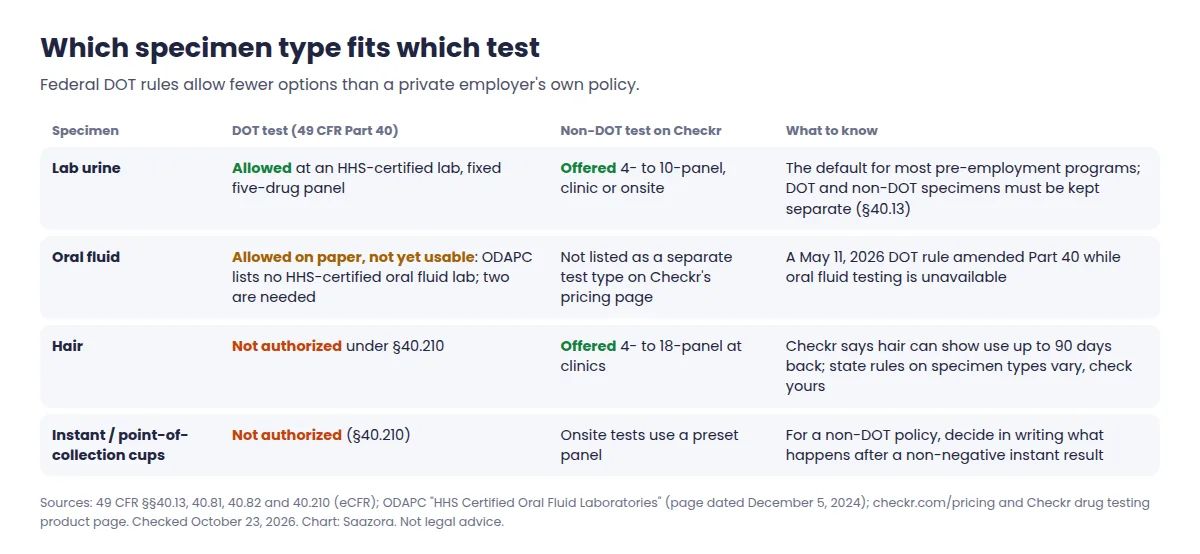
- Urine. The default. Allowed under DOT at an HHS-certified lab, and offered by Checkr from 4 to 10 panels at clinics or onsite.
- Oral fluid. Part 40 says "Both urine and oral fluid specimens are authorized", but in practice DOT employers cannot use oral fluid yet. ODAPC's lab page says "Currently there are no HHS certified oral fluid drug testing laboratories" and that "only when there are two HHS certified oral fluid laboratories may an employer begin to use oral fluid drug testing." Part 40's urine collection sections, including the direct-observation rules in §40.67, were amended again on May 11, 2026 (91 FR 25511). Plan DOT programs on urine.
- Hair. Part 40 says "hair testing, or instant tests are not authorized" for DOT. For non-DOT hiring, Checkr offers hair tests from 4 to 18 panels and says hair can show use up to 90 days back. The pricing page lists hair under the clinic-based test, so the $60 floor is the starting point, not a hair-specific price.
- Instant (point-of-collection) tests. Not authorized for DOT. For your own policy, an onsite test is the closest Checkr line ($37). Decide in writing what happens after a non-negative onsite result before the first one comes back.
Collection site, lab and MRO: what each part of the price pays for
A lab-based drug test is three services in a row, and a screening company bundles them into one per-test price. Knowing the parts helps you see which choices raise the bill.
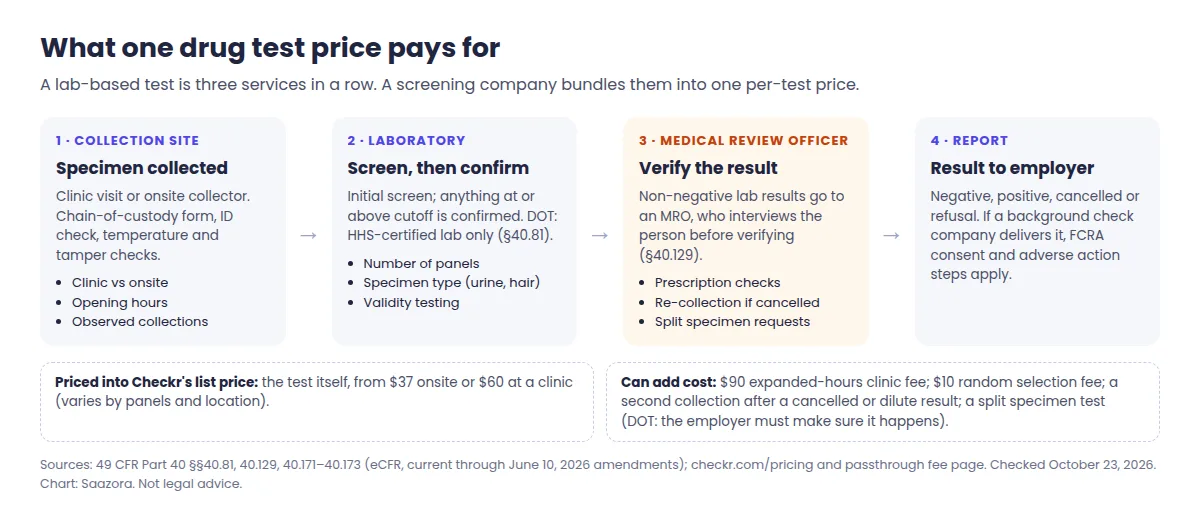
- Collection. A clinic visit or an onsite collector, a chain-of-custody form and specimen checks. Clinic versus onsite is the biggest swing in Checkr's list ($60 versus $37), and the expanded-hours clinic fee is $90.
- Laboratory. An initial screen, then a confirmation test on anything at or above the cutoff. Part 40 publishes the DOT cutoffs, for example 50 ng/mL on the initial urine screen for marijuana metabolites and 15 ng/mL on confirmation (§40.85). More panels mean more analytes and more results to confirm.
- Medical Review Officer (MRO). A physician reviews any confirmed non-negative result before it goes to the employer. Under §40.129 that includes a verification interview with "direct contact in person or by telephone between you and the employee". Legitimate prescriptions are resolved here, which is why a larger panel can mean slower results.
- Report. The result reaches you as negative, positive, cancelled or a refusal. When a background check company delivers it, Checkr notes that FCRA disclosure, written consent and adverse action steps apply, the same steps in our walkthrough of ordering a first employee background check.
Costs that arrive after the first test are easy to miss. When a DOT test comes back cancelled and a negative result is required (pre-employment is one of those cases), §40.23(g) says the employer "must direct the employee to provide another specimen immediately." Some dilute results require a second collection under direct observation (§40.67). Each of those is another test on the bill.
Who pays for a pre-employment drug test
In most hiring programs the employer pays. Checkr's own guide says "Employers typically pay for the cost of employee drug testing", and adds that under the federal Fair Labor Standards Act the time an employee spends taking a drug test "is considered hours worked". Candidates are not on payroll yet, so check with counsel how that applies to your applicants and to post-hire tests. Beyond that, the rules come from three places:
- DOT split specimens. After a verified positive, a DOT-tested employee has 72 hours to ask for the split specimen to be tested at a second lab (§40.171). §40.173 says the employer must not make that test depend on "the employee's direct payment" and must pay if the employee will not, but may seek reimbursement through written policy. In the rule's own words, Part 40 "takes no position on who ultimately pays the cost of the test".
- State law. Some states set who pays for tests or retests. Nevada's NRS 613.132 is one example verified for this guide: an employee tested within the first 30 days of employment may take an additional test "at his or her own expense, to rebut the results of the initial screening test", and the employer must consider it. Check the rules for every state you hire in.
- Your written policy. If candidates or employees will ever pay for anything (a retest, a missed appointment), it has to be in the policy they see before testing, and it still has to fit state wage and testing laws.
How long results take, and why some come back slower
Checkr's guide says results "are usually available within 2-10 business days; on average, you can expect results in three days." It lists the reasons a result takes longer: extra testing of a sample, a clinic that does not computerize records, or a test that "is not negative" and needs more information from the candidate. In other words, the slow results are mostly the non-negative ones going through MRO review. Checkr does not promise a fixed turnaround, and neither should your offer letter.
For DOT jobs, the timing rule is strict. §40.17 says an employer "must not assume that 'no news is good news'" and may not let an applicant do safety-sensitive work while a result is pending; FMCSA's §382.301 requires the verified negative first. Build the test into the start date, not the first week.
Where you place the test in the process matters too. Checkr notes that "In many states, employers cannot require candidates to take a drug test until a conditional job offer has been made." Testing after the conditional offer also means you pay only for candidates you intend to hire.
Marijuana rules: the principles to build a policy on
State and local marijuana laws change often, and this guide does not survey them. These are the principles that hold, with one state verified as an example:
- DOT jobs: marijuana stays on the panel. Marijuana metabolites are one of the five required DOT drug classes (§40.82). An MRO "must not verify a test negative" because a physician recommended a Schedule I drug under a state medical marijuana law, and must not accept hemp or other non-prescription marijuana products as an explanation (§40.151(e) and (f)). State legalization does not change a DOT test.
- Non-DOT jobs: state and local law can limit testing or the use of a THC result. Nevada is one example: NRS 613.132 makes it unlawful to "fail or refuse to hire a prospective employee because the prospective employee submitted to a screening test and the results of the screening test indicate the presence of marijuana", with exceptions that include firefighters, EMTs, driving jobs where federal or state law requires testing, and positions that "could adversely affect the safety of others". The law also does not apply where it conflicts with federal law or covers a federally funded position.
- Use a no-THC panel where needed, per location. Checkr's 4-panel test exists for places that restrict THC testing. A multi-state employer may need different panels by work location for the same job title.
This is not legal advice. Before you test for THC in a state that has legalized cannabis, have an employment lawyer check that state's statute and any city rules where you hire.
Four hiring scenarios priced at Checkr's floor
These examples use only Checkr's published starting prices. Treat them as the least you would pay before pass-through court and DMV fees, panel upgrades and clinic location, not as quotes.
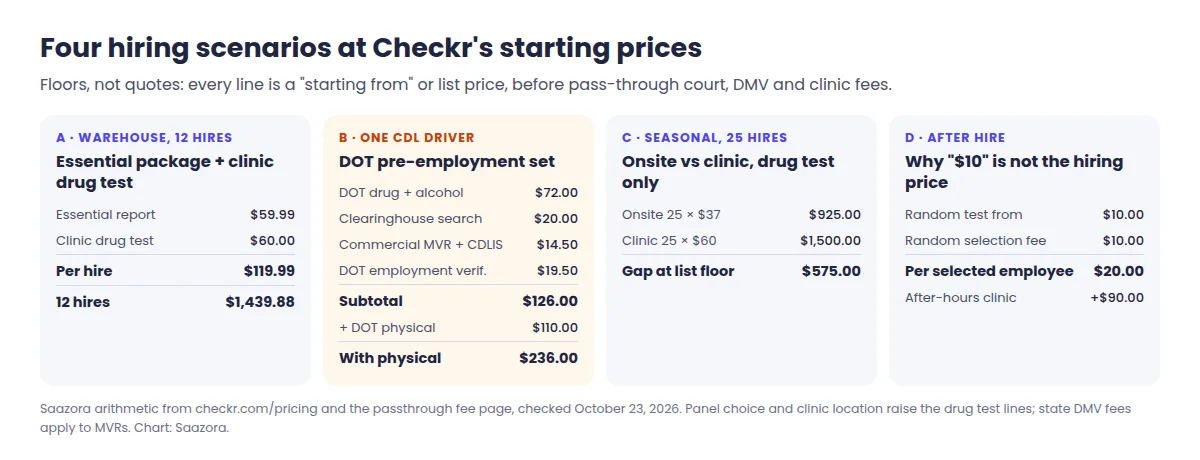
| Scenario | Lines used | Per person | Total |
|---|---|---|---|
| A. 12 warehouse hires | Essential report $59.99 + clinic drug test $60 | $119.99 | $1,439.88 |
| B. One CDL driver (DOT) | DOT drug and alcohol $72 + Clearinghouse $20 + commercial MVR $14.50 + DOT employment verification $19.50 | $126.00 | $236.00 with a $110 DOT physical |
| C. 25 seasonal hires, drug test only | Onsite $37 vs clinic $60 | $37 or $60 | $925 vs $1,500 ($575 apart) |
| D. Random test, current employee | Random test $10 + selection fee $10 | $20 | +$90 if at an expanded-hours clinic |
Source: checkr.com/pricing and passthrough fee page, checked October 23, 2026. Calculations: Saazora. State DMV fees for MVRs and court fees for criminal searches are extra.
Scenario C is the decision most small employers can actually make: if you hire in batches at one site, the onsite line saves $23 per person at list floor, as long as the preset onsite panel matches your policy. Scenario B shows that for drivers the drug test is $72 of a $126 federal pre-hire set, before the physical. If you are ready to price your own mix, open a Checkr account and see the drug test options (affiliate link); Checkr describes its pricing as pay-as-you-go, billed per order.
Before you order the first test: a short checklist
- ☐ Decide whether each role is DOT-covered. If yes, the panel, lab and specimen follow Part 40; if no, write your own panel per job family.
- ☐ Pick the collection model: onsite batches ($37 floor) or clinic visits ($60 floor), and whether candidates may need expanded-hours clinics ($90).
- ☐ Check marijuana rules in every hiring location and use a no-THC panel where required.
- ☐ Test after the conditional offer, and say in the offer that it depends on the result.
- ☐ Get written consent through the screening company's FCRA disclosure and follow adverse action steps after a verified positive.
- ☐ For drivers, order the Clearinghouse query and previous-employer checks too, and do not schedule safety-sensitive work before the verified negative.
- ☐ Put who pays for retests, split specimens and missed appointments in the written policy.
Every guide in this series sits in Saazora's HR and hiring tools section, and our Checkr store page lists the current offer terms. When your policy is written, compare Checkr's drug and background check add-ons (affiliate link).
Questions employers ask about drug test costs
How much does a pre-employment drug test cost?
At Checkr, from $37 for an onsite test and from $60 for a clinic-based test, before panel upgrades and location (checked October 23, 2026). A DOT drug and alcohol test starts at $72. Other screening companies we checked do not publish a drug test price, so get a written quote for your exact panel.
Is a 10-panel drug test more expensive than a 5-panel?
Checkr says pricing "varies by panel selection" but does not list a price per panel. More panels also mean more results for MRO review, which can slow hiring. For DOT jobs the question does not come up: the DOT test is always the five classes in §40.82.
Can an employer make the candidate pay for the drug test?
Federal DOT rules are silent on the first test but say the employer must make sure a requested split specimen test happens even if the employee will not pay. State laws vary, and Nevada, for one, puts the cost of an employee's rebuttal test on the employee. Most employers simply pay; if you plan otherwise, get legal advice first.
Can a DOT employer use a hair or saliva test to save money?
No. Part 40 does not authorize hair or instant tests, and oral fluid cannot be used until two HHS-certified oral fluid labs exist; ODAPC lists none. DOT pre-employment tests are lab urine tests today.
How this guide was researched
On October 23, 2026 we read checkr.com/pricing (package cards and the full add-on list), Checkr's passthrough fee page and its employment drug testing page; the GoodHire pricing page and the BackgroundChecks.com drug testing page, to see whether other screening companies publish drug test prices; 49 CFR Part 40 in full and 49 CFR §382.301 on eCFR (eCFR shows Part 40's latest amendment as June 10, 2026); ODAPC's page on HHS-certified oral fluid laboratories; and Nevada Revised Statutes 613.132 on the Nevada Legislature's site. We did not use market-average prices from third-party blogs. We looked for an official New York State page on cannabis testing and could not reach one, so this guide does not describe New York's rule. Saazora did not order or take a drug test for this article and does not rate any company's speed or accuracy.
Sources (checked October 23, 2026): eCFR, 49 CFR Part 40 (§§40.13, 40.17, 40.25, 40.67, 40.81, 40.82, 40.85, 40.129, 40.151, 40.171, 40.173, 40.210) and 49 CFR §382.301; DOT ODAPC, HHS Certified Oral Fluid Laboratories; Nevada Revised Statutes, Chapter 613 (NRS 613.132); Checkr pricing page, passthrough fee page and employment drug testing page; GoodHire pricing page; BackgroundChecks.com drug testing page.
Research guide, not hands-on testing and not legal advice. Checkr did not pay for or review this article.