
Last checked October 22, 2026 · Skill runs captured on October 19, 2026 in Saazora's own workspace, on real articles and store pages. Taplio details are research-based, read on Taplio's own pages on October 22, 2026.
Saazora may earn a commission if you sign up through the Taplio link on this page, at no extra cost to you. It is the only affiliate link here, and none of the skills below were supplied or paid for by a vendor.
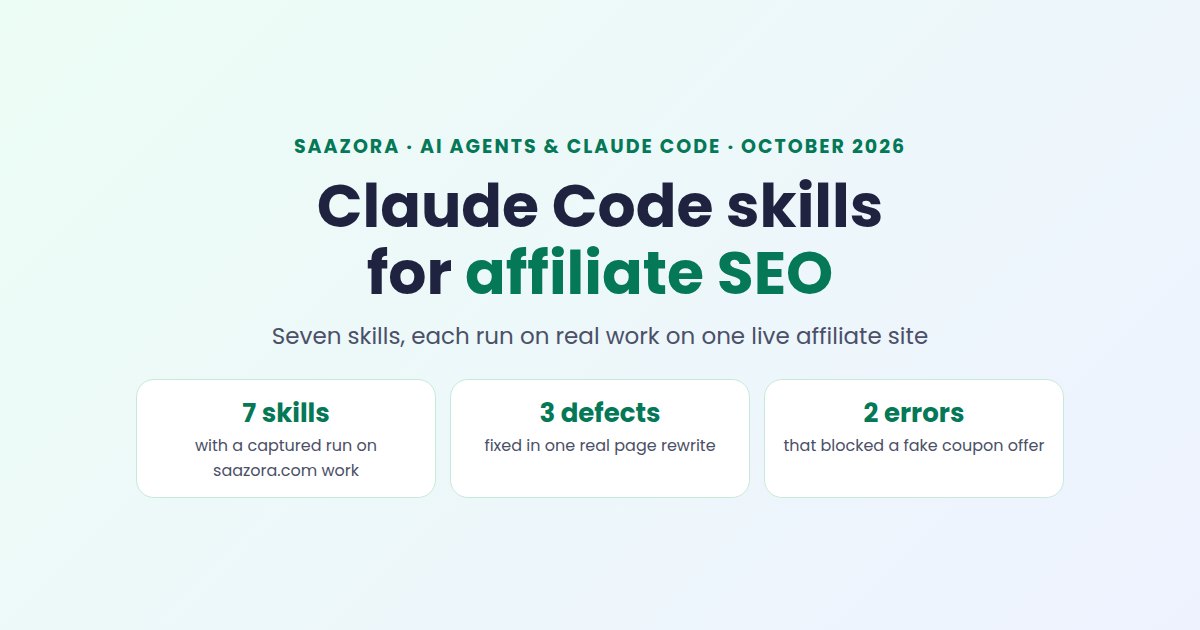
The best Claude Code skills for SEO on an affiliate site are the ones that stop a bad page from going live, not the ones that write pages faster. On Saazora, seven skills earned a permanent place in the publishing workflow, and each one has a captured run on real work: an on-page checklist that took one old review from 2 real failing checks to 0, a check script that passes or fails every draft, an effort gate that put an article on Hold, a linking skill that refused three links to pages that weren't live yet, two compliance skills that block untracked or unproven deals, and a strategy framework that turns Search Console data into a rewrite list.
This page shows what each skill did, the terminal output behind it, the one mistake none of them caught, and the order to build your own set. It is one part of Saazora's AI agents and Claude Code hub. One limit up front: these are Saazora's own SKILL.md files, written for this site. You can't install them from a registry, so each section says what the skill checks and what to put in your own version.
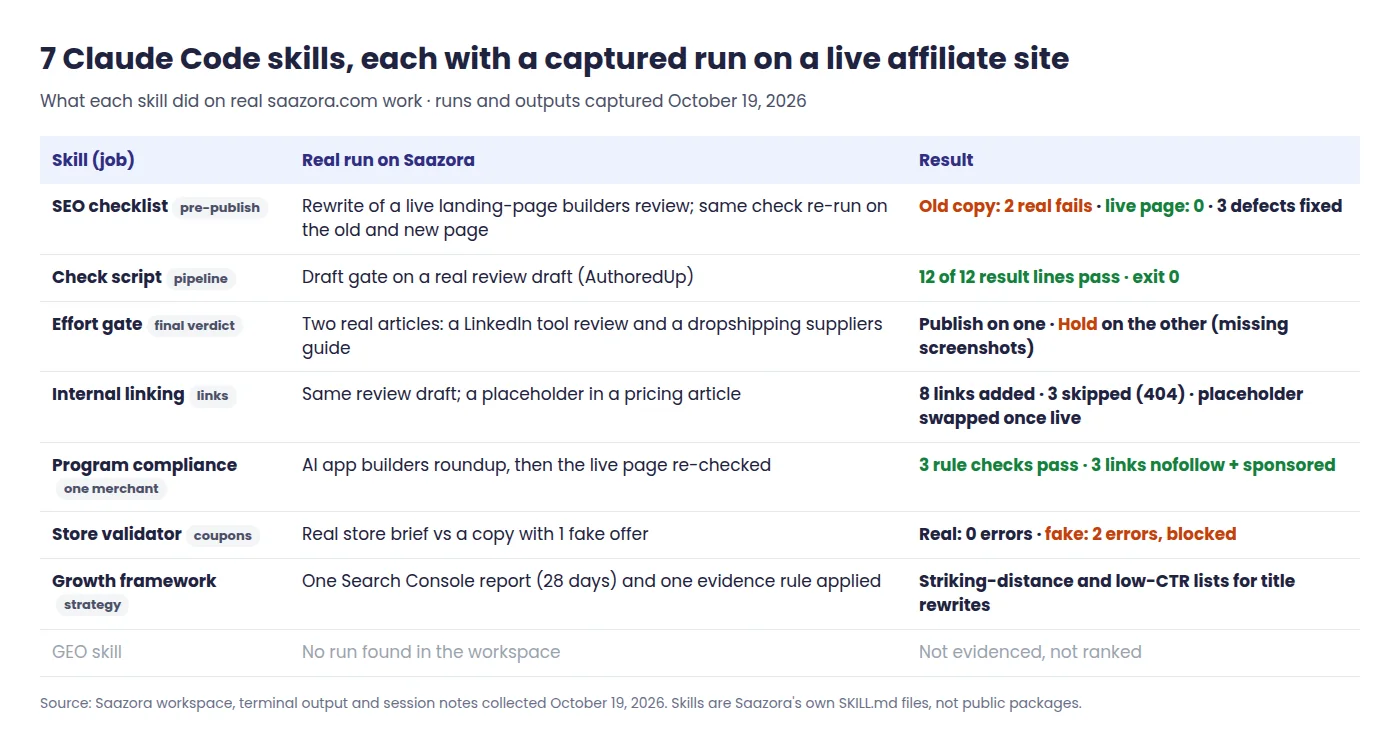
The seven skills at a glance, ranked by what they prevent
A skill is a SKILL.md file of instructions, and in the words of Claude Code's docs, "Claude uses skills when relevant". The same docs suggest making one "when you keep pasting the same instructions, checklist, or multi-step procedure into chat". That is exactly how these seven started: as rules repeated in prompts until they were written down once. The order below is by cost of the mistake each one blocks, not by size.
| # | Skill on Saazora | What it blocks | Best for | Size |
|---|---|---|---|---|
| 1 | Affiliate article SEO checklist | Duplicate text, a second H1, weak title and meta, outbound links with the wrong rel | Every article, before preview | 293 lines |
| 2 | Content pipeline roles (check script) | The model "counting" things it should measure: link status, character counts, overlap | Sites publishing more than one page a day | 52 lines + a script |
| 3 | Content effort gate | Pages that add nothing the top results don't already say | Reviews, best-of and pricing pages | 59 lines |
| 4 | Internal linking model | Links to unpublished pages, one anchor pointing to two URLs, orphan pages | Sites with hubs and tool clusters | 100 lines |
| 5 | Program compliance (one per merchant) | The wrong affiliate link, missing disclosure, banned claims | Programs with strict brand rules | 75 lines |
| 6 | Store publisher validator | Coupons with no tracking or no proof the deal exists | Coupon and deals pages | 75 lines + a script |
| 7 | Growth framework | Guessing which pages to rewrite next | Monthly planning once Search Console has data | 440 lines |
Why this order: the first four protect every page, the next two protect money and program terms on specific pages, and the last one only pays off once the site has traffic data. If you build only three, build 1, 2 and 4.
1. The SEO checklist skill: one real rewrite, and the claim it missed
The checklist is the longest working skill on the site. It sets one primary keyword per page, title and meta lengths, keyword placement, a mandatory 8-word-phrase duplicate check against every live post, the rel rules for outbound links and a guard against a second H1. Its most useful run was not on a new draft but on an old page that needed fixing.
On October 12, 2026 Saazora rewrote an older one-tool landing page review into the current comparison of landing page builders for growing businesses. The page saved before the rewrite still exists, so the same check could be run on both versions side by side on October 19.
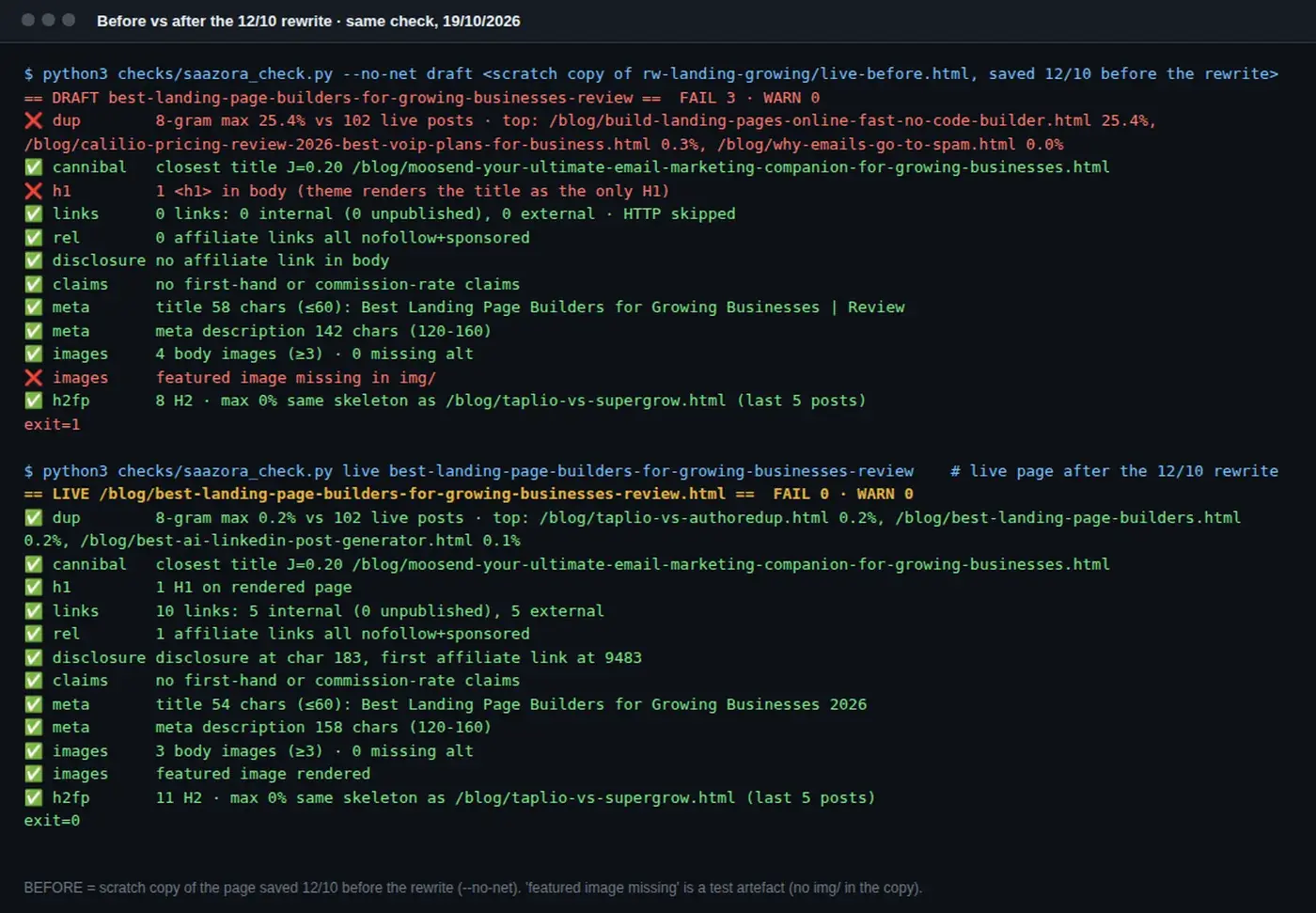
The old copy failed on two real problems: a 25.4% overlap with another Saazora post about building landing pages, and an <h1> inside the content while the theme already prints the title as the H1. The live page passes all twelve result lines. The rewrite notes list three defects fixed: the duplicate H1, three shared 8-word phrases with sibling posts (cut to zero after two price sentences were rewritten), and a testing claim.
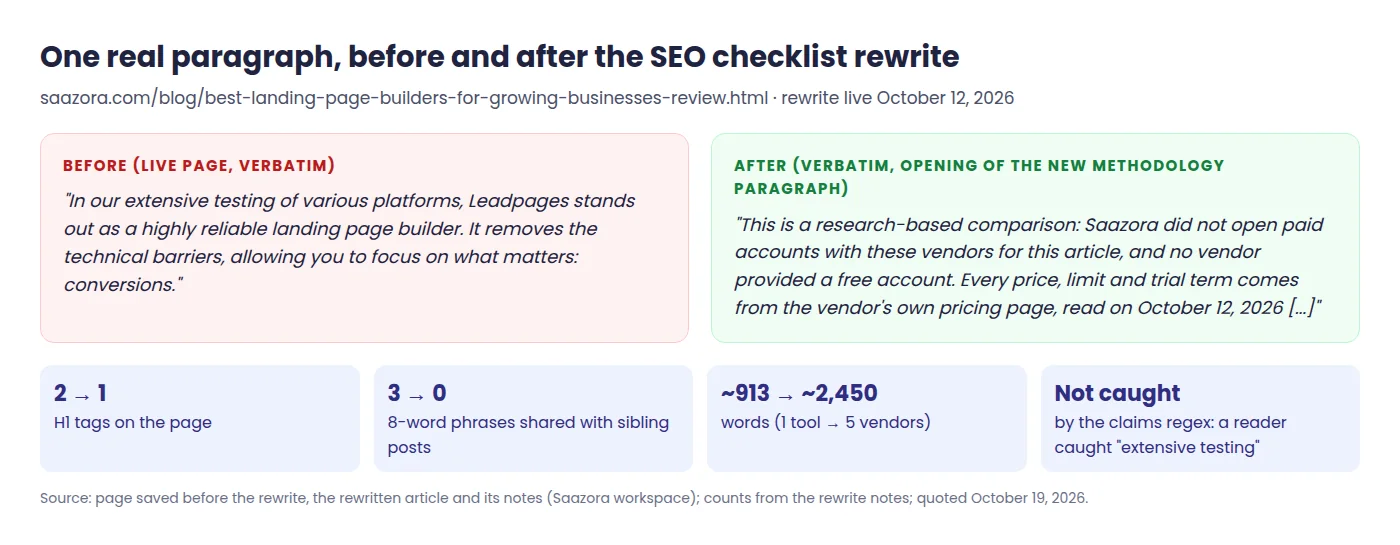
That testing claim is the honest lesson of this section. The old page opened with "In our extensive testing of various platforms", and nothing on the site supported it. The check's claims rule matches a fixed list of first-person testing phrases, and this sentence passed: an extra adjective in the middle was enough to slip between the patterns. The claim was caught because the rewrite session read the page, not because a regex flagged it. A checklist skill is a floor, not a reader. Keep a human (or a separate model pass) reading every first-hand sentence, and add each miss to the pattern list when you find one.
Put in your own version: your title and meta limits, a duplicate check against your live pages, your rule on H1s for your theme, and the exact rel value for affiliate links. Skip anything your CMS already enforces.
2. A check script as a skill: twelve lines, pass or fail
The second skill is short. It splits article work into brief, brief review, writing, independent review and gates, and its section on mechanical checks has one rule that changed the whole workflow: "Paste the script output into the review; the model interprets, it does not re-count." Saazora's saazora_check.py was built on October 17, 2026 to satisfy that section. It runs ten kinds of check and prints twelve result lines.
On October 19 it was run again on a real review draft (the AuthoredUp review, due for an 11:00 slot that day) and returned FAIL 0, WARN 0, exit 0: twelve of twelve lines green. It matched the verdict pasted in that draft's notes the day before, even though the live corpus it compares against had grown from 98 to 103 posts since then. The same day it was run in live mode on two published posts, a call tracking comparison and a roundup of AI app builders, and both passed with affiliate links tagged nofollow sponsored and the disclosure placed before the first affiliate link.
A passing run is not much proof on its own. What makes it worth having is that it fails loudly on the page in section 1, and that Saazora's walk-through of Claude Code for affiliate marketing shows it catching five seeded defects in a broken draft. Only this script part of the skill has saved output. The brief-review and independent-review roles have no saved reviewer output in the article folders, so they are described here, not counted.
Put in your own version: one rule, word for word: anything that can be counted goes to a script, and the script's output gets pasted, not paraphrased.
3. The effort gate: the skill that says Hold
Most SEO skills only add things. The effort gate is the one that says no. It runs last and returns Publish, Hold or Rework, starting with a single test: if the site name were removed, would a reader still get something they couldn't find on the pages already ranking? It then checks the evidence a page type needs. A review or best-of page needs dated screenshots from a real account, a measurement, an HTML comparison table and prices from the vendor's own page.
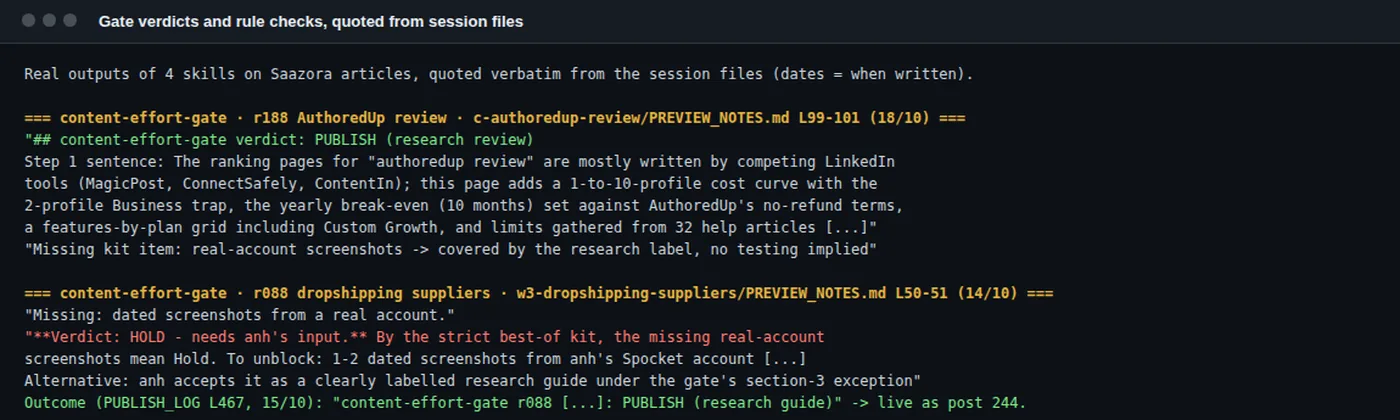
Two real verdicts show both sides. On October 18 the gate passed the AuthoredUp review as a research review, with a written reason: the ranking pages were mostly written by competing LinkedIn tools, and this page added a 1-to-10-profile cost curve, a break-even point for yearly billing and limits gathered from 32 help articles. On October 14 it put a guide to dropshipping suppliers on Hold, because a best-of page needs real-account screenshots and there were none. The owner then approved publishing it the next day as a clearly labelled research guide, which the gate allows when nothing implies testing.
That second case is the reason to have the skill. Without it, the easy fix is to soften the page until it "passes". With it, the choice is explicit: get the screenshots, or say on the page that there aren't any.
Put in your own version: the remove-the-site-name test, a short evidence list per page type, and the instruction that a Hold is skipped, never weakened to pass.
4. The internal linking skill: refusing links to pages that aren't live
Saazora's linking model is pillar hub, then a cluster per tool (review, pricing, free plan, versus, alternatives), then the store page. The skill turns that into per-page rules: one link per target, anchors that name the tool and the intent, 5 to 10 links per 2,000 words, and never a link to a page that isn't published.
On the AuthoredUp review it added 8 internal links, including the LinkedIn tools hub, and left three targets out because they returned 404 on the morning of October 18: a comparison post scheduled for later that day and two store pages that didn't exist yet. On a Spocket pricing article it did the opposite job. The draft held a marker instead of a link while the target guide was unpublished:
14/10: our <!--DS-GUIDE-LINK-->guide to dropshipping suppliers in the USA and EU<!--/DS-GUIDE-LINK--> compares
15/10: our <a href="https://saazora.com/blog/dropshipping-suppliers-usa-eu.html">guide to dropshipping suppliers in the USA and EU</a> compares
The marker became a real link the day the target went live. The skill also listed the pages that should exist but don't (a Spocket review, a free-plan page, an e-commerce hub) instead of linking to nothing. A link to an unpublished page is a 404 for the first reader and for Googlebot, and on a scheduled site it is the most common link error there is.
Put in your own version: your hub and cluster map, a "check for a 200 before linking" rule, and a placeholder format your publish step swaps for a link once the target is live.
5 and 6. Compliance skills for affiliate programs and coupon pages
Two skills exist mainly to protect commissions and program terms. They are narrow on purpose.
Program compliance. Saazora keeps one small skill per merchant with strict brand rules. The Emergent skill, for example, says: only the issued link, rel="nofollow sponsored", disclosure before the link, no invented coupon codes, no "we built" or "we tested", no commission or cookie numbers and no logos. On a roundup of AI app builders it recorded three rule checks as PASS on October 15, and the live check on October 19 confirmed three affiliate links tagged correctly, with the disclosure well before the first one.
Store publisher validator. The store skill builds coupon store pages, and its validate step refuses offers that lack proof or tracking. We tested it on October 19 with two runs: the real brief behind the live CallRail store page, then a scratch copy with one fake offer added by a short script.
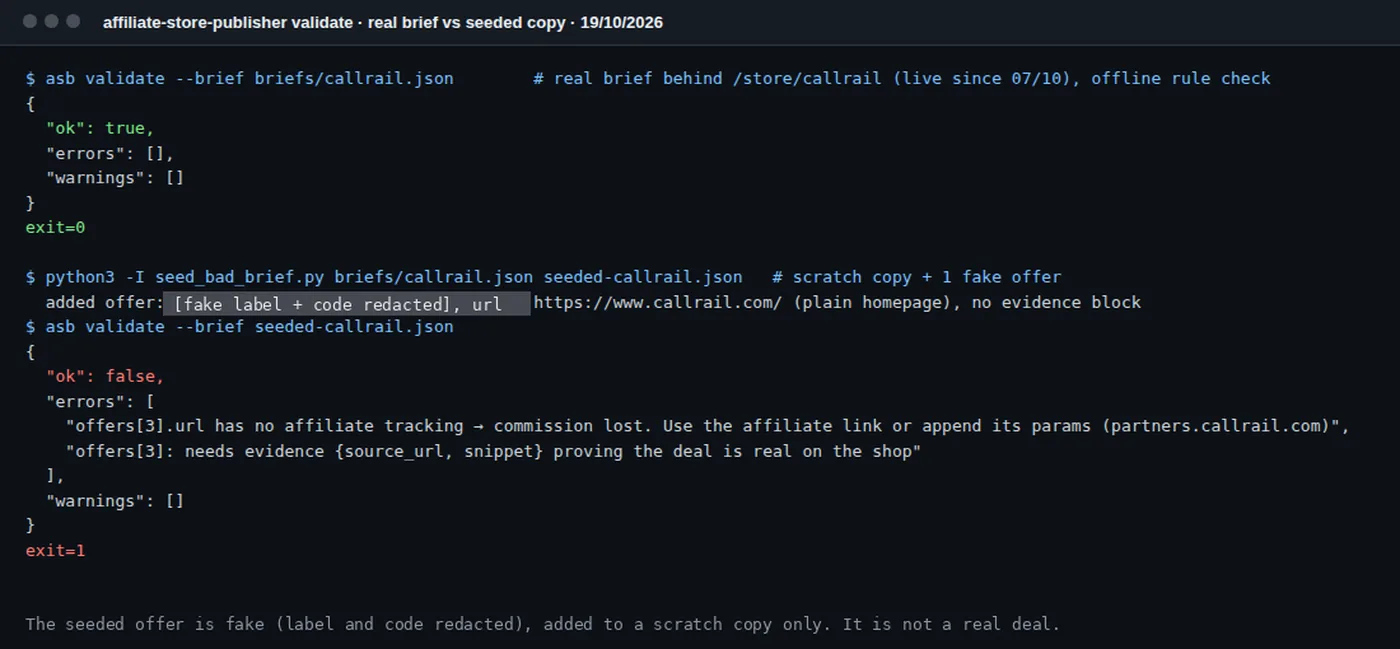
The real brief passed with 0 errors. The seeded copy failed with 2: the offer URL was a plain homepage with no affiliate tracking, so any click would earn nothing, and it had no evidence block showing the deal exists on the merchant's site. That second rule matters more than it looks. A coupon page that lists a code nobody can verify is the fastest way to lose a reader's trust, and on many programs it breaks the terms.
Put in your own version: a short file per merchant with its one correct link and its banned claims, and a validator that needs a source URL and a quoted snippet for every deal.
7. The growth framework, and the GEO skill left off this list
The largest skill on the site is a 440-line growth framework: seven decision rules plus 31 playbooks covering Search Console, content decay, comparison pages, schema and more. It would be easy to oversell. The captured evidence is narrower: one Search Console report covering 28 days to October 17, written on October 19 by its Search Radar script, listing one query in striking distance and a set of pages ranking in the top 10 with low click-through, as candidates for title and meta rewrites. Its evidence rule (R6, no review without its evidence kit) is also cited in the notes for the landing-page rewrite above. The 31 playbooks were not run for this page, and no traffic change is claimed.
Saazora also has a GEO skill for AI-search visibility (ChatGPT, Perplexity, AI Overviews). No audit, fix or citation measurement from it was found in the workspace, so it is not ranked here. It may be useful; there is simply nothing yet to show.
What none of these Claude Code skills for SEO did
A list of skills reads better than it works if the gaps are left out. These are the gaps on one live site:
- They didn't catch every false claim. The regex missed "our extensive testing". Pattern rules need a reader behind them.
- They didn't measure time saved. The publish log records when items finished, not when work started, so there is no honest minutes-per-article figure here.
- They didn't review drafts on their own. The independent-review step has no saved output, so it is not claimed.
- They didn't prove traffic gains. The Search Console report is a to-do list, not a result.
- They are not portable as-is. Each one names Saazora's hubs, merchants and thresholds. Copying the file without changing those rules would enforce someone else's site.
How to build your own set of SEO skills, in order
Claude Code's docs point out that a skill's body "loads only when it's used, so long reference material costs almost nothing until you need it". That makes it cheap to keep several narrow skills rather than one giant prompt. A sensible order for adding Claude Code skills for SEO to an affiliate site:
- Week 1, the checklist. Write down your title, meta, H1, duplicate and
relrules as one skill. Run it on three live pages and note every miss. - Week 2, the script. Move anything countable from the checklist into a script that prints pass or fail. Seed a copy of a draft with three known mistakes and confirm it catches all three.
- Week 3, linking. Map your hubs and clusters, and add the rule that blocks links to anything without a 200 response.
- Week 4, compliance. One file per affiliate program with its link and banned claims. Add a deal validator if you publish coupons.
- After that, the gate and the strategy layer. The effort gate once you publish reviews or best-of pages, and a Search Console skill once there are a few weeks of data.
If you would rather start from public SEO skill packs, they exist on GitHub and in skill registries, and they are much broader than the ones above. Saazora hasn't run them, so none is recommended here. Before installing any third-party skill, read its scripts, hooks and MCP settings first; Saazora's checklist for vetting a Claude skill before you install it covers the ten things to look for.
Coming soon: the Saazora Skill Pack. Starter templates of the SEO checklist, the script-first rule and the pre-install vetting list, stripped of Saazora's private links, keys and runner prompts. Nothing is downloadable today and nobody is collecting emails for it; a link will be added here when the pack ships.
Where Taplio fits: skills for the LinkedIn side of affiliate work
Everything above is about the page itself. Many affiliate sites also promote each article on LinkedIn (Saazora covers those tools in its hub for LinkedIn tools), and that is the one area where a vendor publishes Claude skills of its own. Taplio, a LinkedIn content and scheduling tool, lists 26 free Claude skills for LinkedIn on its site (writing, research, strategy, analytics, engagement and networking), with the source on GitHub and an install command for Claude Code: npx skills add TaplioOfficial/taplio-linkedin-claude-skills.
Read the fine print before installing. Taplio's own FAQ says the skills "run on the Taplio MCP, which needs a Taplio account", and to the question of whether they work without Taplio, it answers "No". Each skill starts by calling the Taplio MCP to load your profile, and Taplio says posts and comments are never published "without your explicit confirmation". That is a reasonable design, but it means the skills are free while the account behind them is not. Vet them like any other skill: they connect Claude to a live social account.
| Taplio plan | Monthly billing | What Taplio lists first |
|---|---|---|
| Starter | $39 a month | Scheduling, core analytics |
| Growth | $69 a month | Adds the AI post writer, faster replies and comments, team collaboration |
| Pro | $199 a month | Adds unlimited AI posts and comments, lead outreach automation |
Prices checked on Taplio's pricing page on October 22, 2026. Yearly billing is shown there as up to 25% cheaper. Every plan starts with a 7-day trial with Pro access, and Taplio lists a 30-day money-back guarantee. Research-based: Saazora has not run Taplio's Claude skills for this page.
For what the tool does beyond the skills, see Saazora's Taplio review. If LinkedIn is part of how you promote your articles, you can start a Taplio free trial (affiliate link) and try the skills during the trial week.
How these skill runs were captured
Every result described as a run on this page comes from Saazora's workspace on October 19, 2026, between about 01:50 and 02:10 UTC. The check script and the store validator were run that morning, and their terminal output was saved as text and rendered as the images above. The before-and-after paragraph is quoted word for word from the page saved before the October 12 rewrite and from the rewritten article. The effort gate, linking and compliance results are quoted from the preview notes written when those articles were prepared, with the dates shown. Nothing was published or changed on the live site to make this page, and the fake coupon used in the validator test never left a scratch folder. The Search Console figures behind the growth framework's report are not reproduced. Taplio's skills, plans and prices come from its own pages, read on October 22, 2026; Saazora has not installed them. AI tools helped draft this page, and every number was checked by hand against the saved output. No vendor reviewed or paid for it. More on how Saazora researches and tests software.
Sources (checked October 22, 2026): Claude Code docs: Extend Claude with skills. Taplio's pricing page, its "Claude skills for LinkedIn" page and its LinkedIn MCP page, read October 22, 2026.