

Last checked October 21, 2026 · Built from Saazora's own publishing workflow: real terminal output captured on October 18, 2026, the site's publish log, and Claude Code's documentation. Emergent prices checked on Emergent's pricing page on October 21, 2026.
Saazora may earn a commission if you sign up through the Emergent link on this page, at no extra cost to you. Nothing else on this page is an affiliate link, and Anthropic has no relationship with Saazora.
Claude Code for affiliate marketing is most useful for the rule-heavy work around each article, not for mass-producing the articles themselves. On an affiliate or niche site, the expensive mistakes are small and boring: a missing disclosure line, an affiliate link without rel="sponsored", a second H1, a "tested" claim nobody can back up, a link to a page that isn't live yet. Claude Code is an agent that reads your files, runs commands and follows written rules, so it is well suited to catching those mistakes every time, on every draft.
This guide shows how one working affiliate site, Saazora, uses it: the brief-to-publish pipeline, the check script that runs on every draft, what that script caught when a broken draft was fed to it on purpose, and what the publishing numbers looked like before and after. It also covers the parts automation did not fix. If you want the wider picture of the tools first, start with Saazora's AI tools hub.
What Claude Code does on an affiliate site, in plain terms
Claude Code is Anthropic's agentic coding tool. Its documentation describes it as a tool that "reads your codebase, edits files, runs commands, and integrates with your development tools", in the terminal, an IDE, a desktop app or the browser. For a niche site, "codebase" simply means the folder where your drafts, images, scripts and notes live. You don't need to be a developer to benefit, but you do need to be comfortable opening a terminal and reading what the tool proposes before you approve it.
Four of its features map almost one-to-one onto affiliate work:
| Claude Code feature | What it is | What it does for an affiliate site |
|---|---|---|
CLAUDE.md | A plain-text file of instructions Claude reads at the start of every session | Your house rules: disclosure wording, which link goes on which site, banned phrases, image sizes. You write them once instead of repeating them in every prompt. |
| Skills | Folders of instructions (and sometimes scripts) Claude loads when a task matches | Repeatable checklists: an SEO checklist, an internal-linking model, a "content effort" gate, one compliance skill per affiliate program. |
| Running commands | Claude can run scripts and read their output | Mechanical checks become a script instead of the model's opinion: duplicate text, link status, rel attributes, title length. |
Non-interactive mode (claude -p) | Runs Claude Code from a script or a schedule without a chat window | Scheduled jobs that read the content calendar, build previews and run the checks at fixed times. |
Access is not free. Claude Code's setup page says it "requires a Pro, Max, Team, Enterprise, or Console account" and that "the free claude.ai plan does not include Claude Code access". Check Anthropic's pricing page for current plan costs before you budget for it.
One caution belongs here rather than at the end. Non-interactive runs load whatever skills, hooks and MCP servers sit in the project folder, and the docs note that a -p session "shows no workspace trust dialog". If you install third-party skills to speed things up, read them first. Saazora's companion guide on how to vet a Claude skill before you install it walks through ten checks on real files.
How Claude Code for affiliate marketing works on one real site
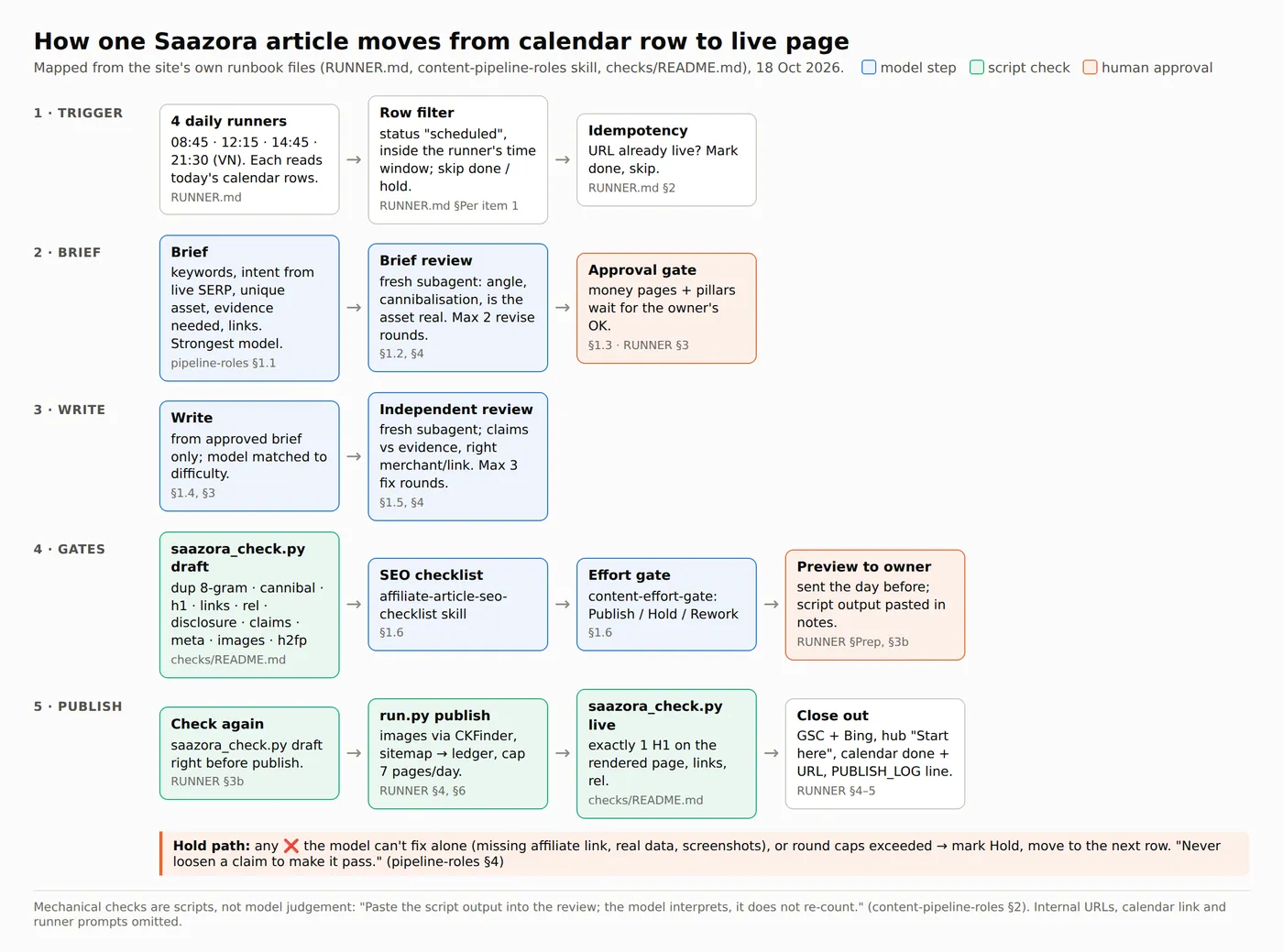
Saazora is a software review and deals site with articles, store pages, news posts and pins. Since October 11, 2026, four scheduled Claude Code runs a day read the content calendar and handle whatever is due in their time window. The map above is drawn from the site's own runbook, and it has five stages.
- Trigger. Each run reads today's calendar rows, keeps only those marked "scheduled" inside its window, and skips anything already done or on hold. If the target URL is already live, the row is marked done and skipped, so a run that fires twice can't publish twice.
- Brief. Keywords and intent from the live search results, the one asset the page will have that competitors don't, the evidence it needs, and the links it will carry. Money pages and pillar pages stop here until the site owner approves them.
- Write and review. The draft is written from the approved brief only, then reviewed against the evidence and the right merchant link, with a cap on revision rounds so a weak piece goes on hold instead of looping.
- Gates. A check script, then the SEO checklist skill, then an effort gate that returns Publish, Hold or Rework. A preview goes to the owner the day before.
- Publish and close out. The script runs again right before publishing, the publish script uploads images and posts the article (capped at 7 pages a day), the check runs a third time on the live page, and the URL goes to Search Console, Bing, the category hub, the calendar and the publish log.
The design choice that matters most is the split between judgement and counting. The site's pipeline rules put it bluntly: "Paste the script output into the review; the model interprets, it does not re-count." A language model is good at deciding whether a paragraph answers the reader's question. It is unreliable at counting characters in a meta description or remembering which of 178 URLs are live. Anything that can be counted goes to a script.
The second choice is the Hold path. When a check fails and the fix needs something only a human can supply (an affiliate link that hasn't been issued, real account screenshots, a vendor's answer), the item is marked Hold and the run moves to the next row. The rule is "Never loosen a claim to make it pass." For an affiliate site, that single rule prevents most of the compliance trouble automation can create.
The check script: a clean draft and a deliberately broken one
The mechanical gate is a single Python file, saazora_check.py, using only the standard library. It downloads the site's sitemap and live posts, caches them, and runs ten kinds of check against a draft folder, printing twelve result lines. Here is the real output on a draft that later went live as Saazora's guide to scheduling LinkedIn posts.
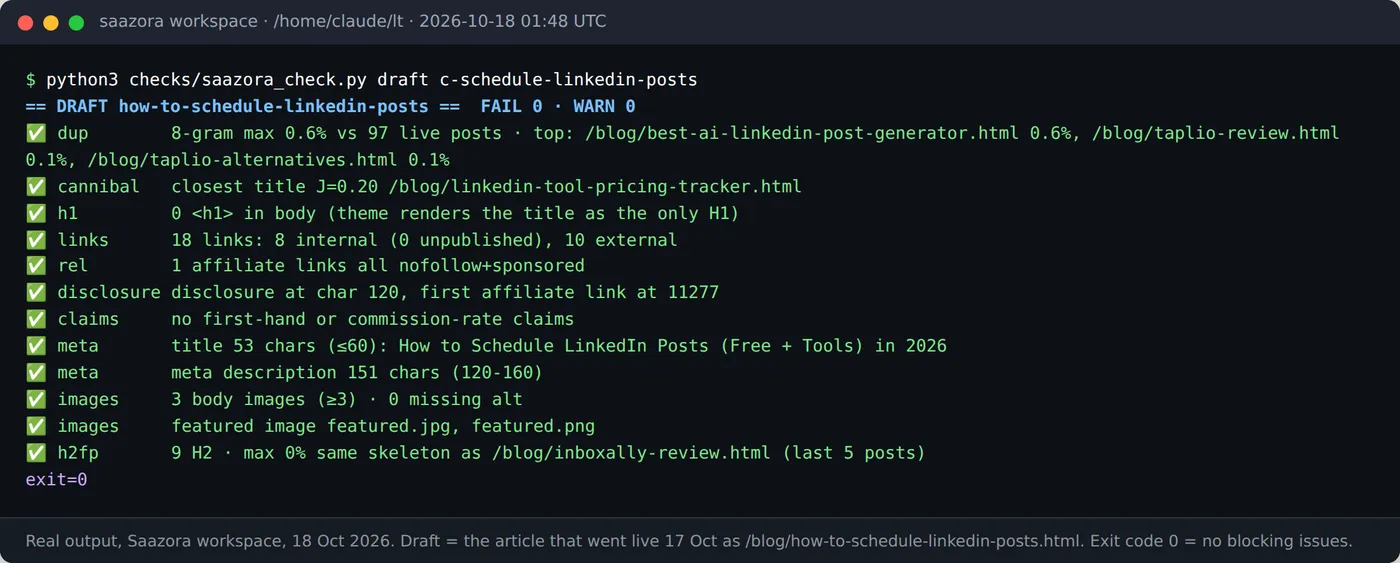
A clean run proves little on its own: a script that never fails would print the same thing. So the next step was a seeded run. We tested the gate on October 18, 2026 by copying the same draft into a scratch folder and inserting two lines that held five deliberate defects: an extra <h1>, a placeholder link, an affiliate link with no rel attribute, a fake first-hand claim and a made-up commission rate. The copy was never published.
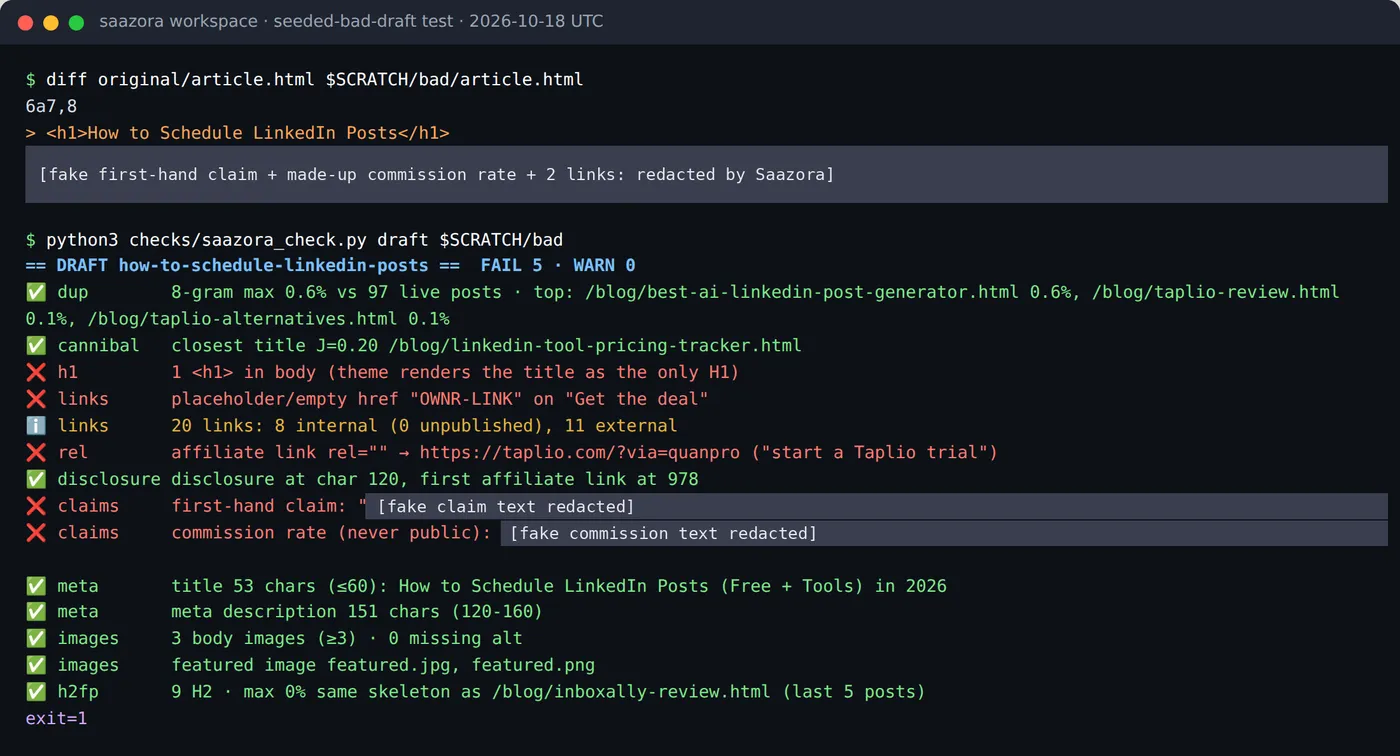
All five were caught, and each by the check you would expect. This is the part of the setup worth copying, because each check maps to a real cost on an affiliate site:
| Check | What it looks for | Why an affiliate site cares | Level |
|---|---|---|---|
| dup | 8-word phrase overlap with every live post | Near-duplicate pages compete with each other and read as mass-produced | Fail at 15%, warn at 5% |
| cannibal | Title word overlap with live titles | Two own pages chasing one query | Warn |
| h1 | Any <h1> in the draft body | The theme already prints the title as the H1; a second one is a common CMS mistake | Fail |
| links | Placeholder hrefs, internal links not in the sitemap, dead external links | "Get the deal" pointing nowhere loses the click; links to unpublished pages 404 | Fail |
| rel | nofollow and sponsored on every affiliate link | Google's link rules and most programs' terms | Fail |
| disclosure | A disclosure sentence before the first affiliate link | FTC "clear and conspicuous" placement | Fail |
| claims | First-hand wording such as "tested" or "tried", and any commission rate | Untrue first-hand claims, and program terms that keep rates private | Fail |
| meta | Title of 60 characters or fewer, description of 120 to 160 | Truncated or missing snippets | Fail |
| images | At least 3 body images, alt text, featured image, file size | Thin pages and slow pages | Fail / warn |
| h2fp | H2 outline compared with the last 5 posts | Every page on one template is a scaled-content signal | Warn at 40% |
Two details make it practical. First, the same script runs three times per article: before the preview, right before publishing, and on the live URL, because the theme and the CMS can change what you wrote. Second, the claims rule is never switched off. When a page is allowed to describe something first-hand (this one is, for the runs shown above), the page still fails the claims check, and each flagged sentence is matched by hand against a saved evidence file before publishing. That keeps "tested" tied to something a reader could, in principle, be shown.
The bar is not hard to reach. You don't need Saazora's script; you need a list of the mistakes that have cost you before, and a request to Claude Code to turn each one into a check that prints pass or fail. Start with disclosure, rel and placeholder links. Those three are the ones that cost money or trust when they slip.
Did it make publishing faster? What the publish log shows
This is where most articles on Claude Code for affiliate marketing quote a big percentage. The honest answer from one site's log is smaller and more useful.
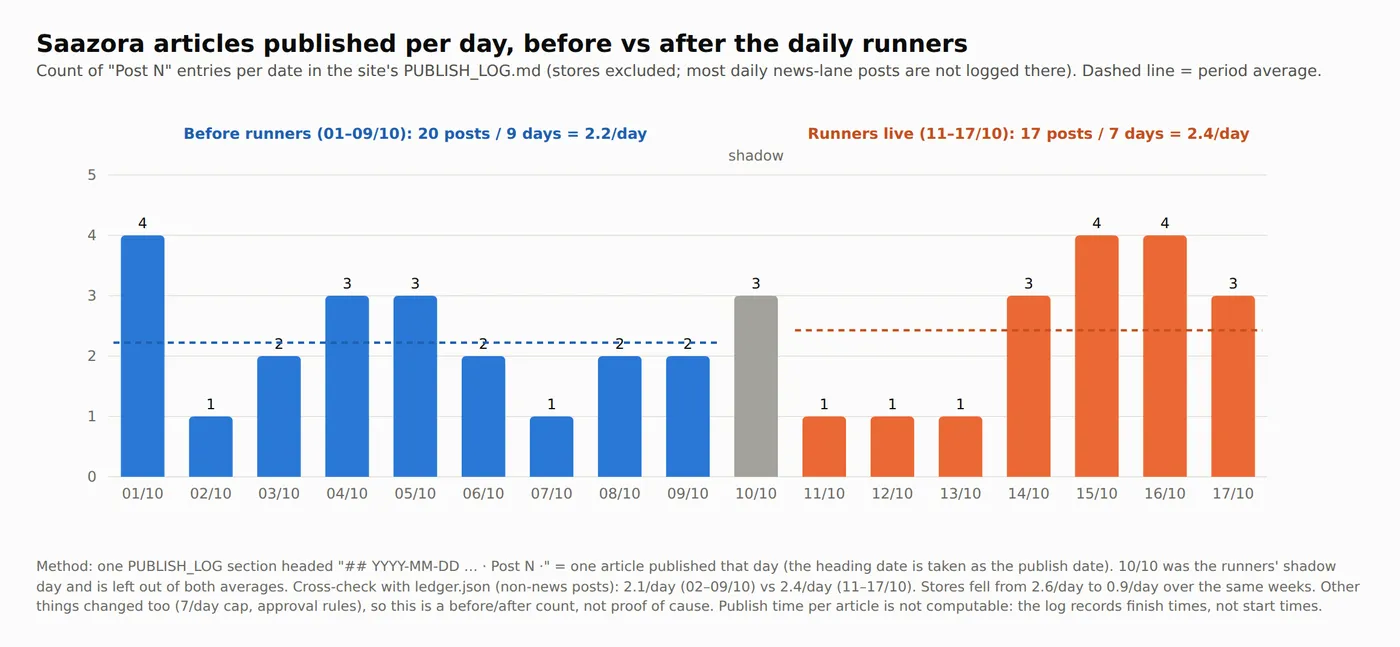
- Articles per day went from 2.2 to 2.4. The publish log shows 20 posts over 9 days before the scheduled runs (October 1 to 9) and 17 posts over 7 days after (October 11 to 17). A second count from the site's ledger gives 2.1 and 2.4 a day.
- Store pages fell from 2.6 a day to 0.9. That is not a failure of automation; store work slowed while articles moved into the new pipeline. But it shows why "output per day" alone is a poor measure.
- It is a count, not proof of cause. The 7-pages-a-day cap, the approval rules and the mix of work all changed in the same weeks.
- Time per article could not be measured. The log records when each item finished, not when work on it started, so any "minutes saved per article" figure would be invented. If you want that number for your own site, log start times from day one.
The same log also shows what scheduling did not fix. On October 15 the 09:00 article went live at 10:33. On October 16 an item due at 16:00 ran after 17:20. On October 17 a 09:00 item went live after 12:20, and two items due at 15:00 and 17:00 went out after 17:40. Pins ran 10 to 70 minutes late. Scheduled runs wait on approvals, uploads and slow pages like anyone else. Their gain is consistency (every draft gets the same ten checks, every live page gets checked again), not speed.
Six rules worth putting in your own CLAUDE.md
Most of the value above comes from rules written down once. These six are general enough for any affiliate or niche site, and each one is enforced by a line in the check script or a skill on Saazora.
- Disclosure first. "A plain disclosure sentence appears before the first affiliate link on every page." Write the exact sentence you want, so it doesn't drift.
- One link per program per channel. List the exact affiliate URL for each site and channel (website, Pinterest, LinkedIn) and forbid editing, shortening or adding tracking to it. Programs that issue per-channel links can only attribute clicks if the right one is used.
- Every affiliate link gets
rel="nofollow sponsored"and opens in a new tab, including buttons the theme generates. - No commission rates, cookie windows or payout thresholds in public content. Many programs treat them as confidential.
- "Tested" only with evidence. If nothing was run, the page says "research-based" and cites sources with dates.
- Never link to a page that isn't live. Check for a 200 response before adding an internal link, and add links from older posts to the new one on the day it goes live so it isn't an orphan.
Keep CLAUDE.md for rules that apply everywhere, and move longer procedures into skills that load only when needed. Claude Code's memory docs describe CLAUDE.md as "the place you write down what you'd otherwise re-explain", which is a good test: if you have corrected the same mistake twice, it belongs there.
A first week for an affiliate marketer
- Day 1: install Claude Code, open it in a folder that holds a copy of three published articles, and ask it to list every link and its
relattribute. Compare with what you expected. - Day 2: write a short
CLAUDE.mdwith the six rules above and your real disclosure sentence. - Day 3: ask Claude Code to write a script that checks one draft for those rules and prints pass or fail. Read the script before running it.
- Day 4: seed a copy of a draft with three mistakes and confirm the script catches all three. If it misses one, fix the script, not the draft.
- Day 5: run the script on every draft before it goes live, and keep the output with the draft.
Only after that is it worth scheduling anything. A schedule multiplies whatever the checks miss.
Coming soon: the Saazora Skill Pack. We are packaging the house-rules template, a draft-check skill and the skill-vetting checklist into a pack for Claude Code, with every private link, key and internal prompt removed. It isn't available yet and there is no sign-up form; this page will link to it once it is ready.
Don't want to install anything yourself?
Claude Code assumes you are happy in a terminal and want to own the scripts. If what you actually need is a small app for your site (a calculator, a comparison tool, a lead form) and you would rather describe it in a chat window, a browser-based AI app builder is the other route. Emergent is one of them: its site says you "chat with AI agents that design, code, and deploy your application from start to finish". It does not replace the checking workflow above, and it won't audit your articles; it covers the build-an-app side.
| Emergent plan | Monthly price | Paid yearly | Credits |
|---|---|---|---|
| Free | $0 | n/a | 10 a month |
| Standard | $20 | $17 a month | 100 a month |
| Pro | $200 | $167 a month | 750 a month |
Prices checked on Emergent's pricing page on October 21, 2026. Research-based: Saazora has not run a build on Emergent for this page.
The free plan is enough to see whether the tool understands your idea; Saazora's breakdown of what Emergent's free plan includes covers the limits, and the full Emergent review covers fit and fine print. If it suits you, you can check current Emergent plans (affiliate link). To compare it with other options, see Saazora's list of AI app builders.
How this page was put together
Everything shown as first-hand on this page comes from Saazora's own workspace. The workflow map was drawn on October 18, 2026 from the site's runbook, its content-pipeline rules and the check script's README; calendar links and runner prompts were left out. Both terminal images are real output captured on October 18, 2026: one run on a real draft, and one on a scratch copy seeded with five defects by a two-line script, kept with the diff. The seeded copy was never published, and its fake claim and fake commission text are redacted in the image. The publishing figures come from a read-only count of the site's publish log and ledger for October 1 to 17, 2026. No time-per-article figure is given because the log can't support one. Claude Code facts come from Anthropic's documentation, read on October 21, 2026, and Emergent's prices from its pricing page on the same day. No vendor reviewed or paid for this article. More on how Saazora researches software.
Sources (checked October 21, 2026): Claude Code docs: Overview, Claude Code docs: Set up, Claude Code docs: Memory and CLAUDE.md, Claude Code docs: Run Claude Code programmatically, Claude Code docs: Skills. Emergent's pricing page, checked October 21, 2026.