
Saazora may earn a commission if you sign up through some links on this page, at no extra cost to you. · Pricing checked October 2, 2026
Our pick in one line: choose MindStudio if you want to build AI agents and ship them as apps, browser extensions or APIs on a small budget, since it has a free plan and charges AI model usage at cost. Choose Gumloop if your team wants automations that run inside Slack, Teams or Gmail, with unlimited seats and admin controls, and you are comfortable with credit-based billing from $37 a month.
Both are no-code platforms for AI workflows, and both changed a lot in 2026. Gumloop dropped its free plan in July and changed its billing again in late August, so many comparisons online are already out of date. Below is how they differ today.
Two different ideas of "no-code AI"
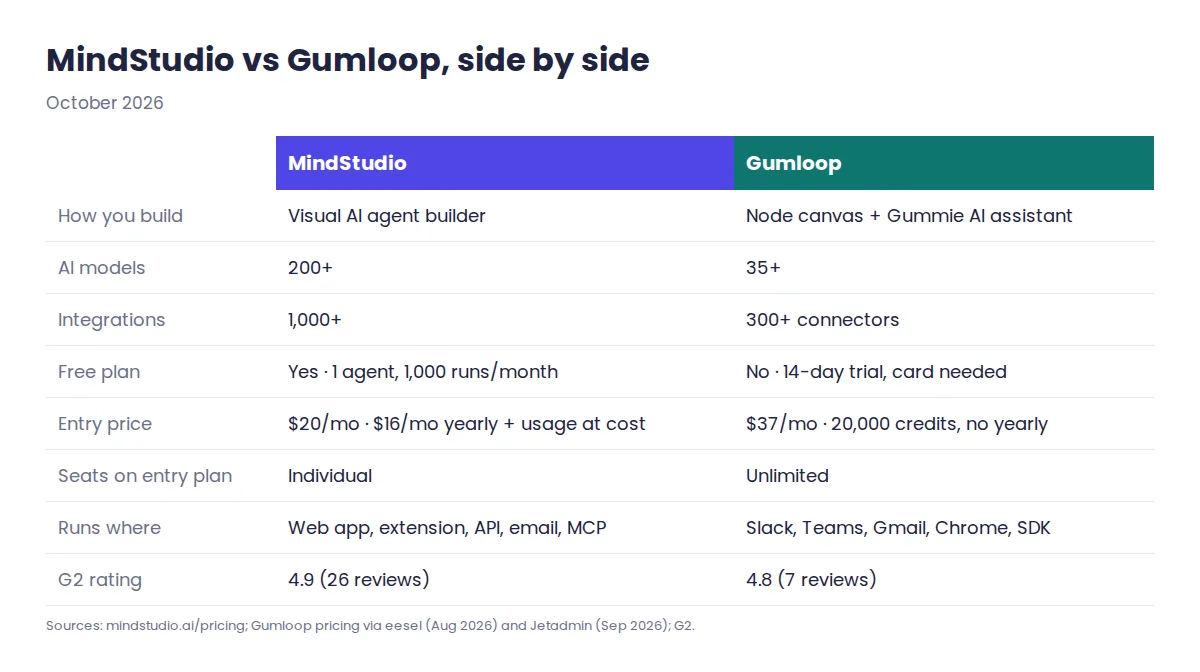
MindStudio is an agent builder. You design an AI agent in a visual editor, pick from more than 200 models, connect it to over 1,000 integrations and then deploy it the way you need: as a web app, a scheduled job, a browser extension, an email responder, a webhook or API endpoint, or an MCP server. The output feels like a small product you can hand to someone else.
Gumloop is a workflow canvas. You chain nodes on a drag-and-drop board, or ask its assistant, Gummie, to build and debug a flow from a plain-English request. It offers 300+ connectors and 35+ models, records browser workflows through a Chrome extension, and lets agents work directly in Slack, Microsoft Teams and Gmail. The output feels like automation that lives inside your team's tools.
Pricing: free plan vs credits
This is where the two differ most, and where most readers should decide.
| MindStudio | Gumloop | |
|---|---|---|
| Free plan | Yes: 1 agent, 1,000 runs a month | No; 14-day Pro trial with a card |
| Entry paid plan | Individual: $20 a month, or $16 billed yearly | Pro: $37 a month, monthly only |
| What the plan includes | Unlimited agents and runs | 20,000 credits a month, unlimited seats |
| AI model costs | Passed through at the provider's price, no markup | Paid in credits, plus an 8% orchestration fee on agent chats (16% with your own API keys) |
| Top tier | Business: custom, with SSO, self-hosting, custom domains | Enterprise: custom, with RBAC, SAML/SCIM, VPC, credit rollover |
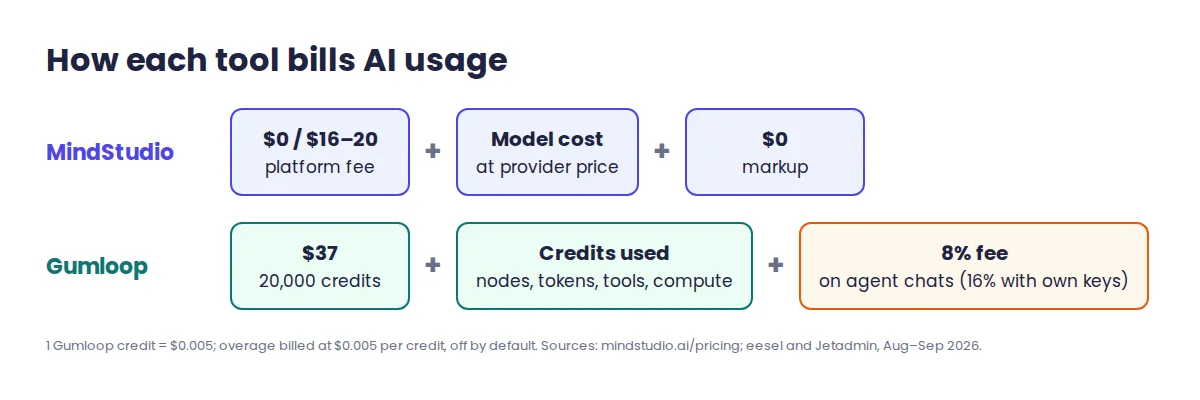
MindStudio's model is simple to predict: a flat platform fee, then each AI call costs what it would cost with your own API key. Gumloop bundles usage into credits worth half a cent each. A workflow costs one credit plus the cost of each node it runs, and agent chats add model tokens, tool calls, compute time and the 8% fee. If you run out, overage costs $0.005 per credit and must be switched on manually, with a default cap of $5,000.
For a solo builder testing ideas, MindStudio is far cheaper to start: it is free until you need more than one agent. For a team of ten that all need access, Gumloop's unlimited seats on a $37 plan can be cheaper than paying for collaborators elsewhere, as long as usage stays inside the credit allowance.
Building experience and learning curve
Reviewers say both tools are easy to start but have plenty of options to learn. MindStudio users praise the visual builder and how much time it saves non-technical staff; the most common complaints are that platform updates sometimes break agents they have built, and that complex API or MCP connections take effort. MindStudio offers 100+ templates.
Gumloop users single out fast, helpful support and describe it as simpler than n8n and more flexible than Zapier. Complaints focus on node logic having a learning curve, agents being unreliable at times, and costs rising at high volume. Gummie, the AI assistant, lowers the barrier by building a first version of a flow for you.
Deployment: where your AI ends up
- MindStudio: web app, browser extension, API or webhook, email responder, scheduled job or MCP server. Good when the agent is something other people will use, such as a client-facing tool or an internal assistant.
- Gumloop: Slack, Teams and Gmail, a Chrome extension for browser tasks, plus a command-line tool, SDK, MCP and webhooks for developers. Good when the automation should run where the team already works.
Which one should you pick?
- Pick MindStudio if you are a solo founder, consultant or small team, want a free start, want access to many models at cost, or need to ship an agent as a product. We cover it in more detail on our MindStudio deals page, including the 20% saving on yearly billing.
- Pick Gumloop if you are a team that lives in Slack, Teams or Gmail, needs governance features like spending caps and approvals, and prefers fast support over the cheapest entry price.
- Not sure? Start with MindStudio's free plan, since it costs nothing to test. Gumloop's trial requires a card, so only start it when you have a workflow ready to build.
You can build your first MindStudio agent for free and move to the Individual plan only when you need more than one agent. If you are comparing AI builders more broadly, see our guides in AI app builders.
MindStudio vs Gumloop FAQ
Does Gumloop still have a free plan?
No. Gumloop removed its permanent free plan in July 2026. New users get a 14-day trial of the Pro plan, which requires a credit card.
Is MindStudio cheaper than Gumloop?
For individuals, yes: MindStudio is free for one agent and $16 to $20 a month for unlimited agents, plus model usage at cost. Gumloop starts at $37 a month. For larger teams, Gumloop's unlimited seats can narrow the gap.
Which has more integrations?
MindStudio lists more than 1,000 integrations and 200+ AI models. Gumloop lists 300+ connectors and 35+ models, with deeper support for running inside Slack, Teams and Gmail.
Can I use my own OpenAI or Anthropic API key?
Yes, on both. MindStudio charges the same price either way. On Gumloop, your own keys make model tokens free in credits, but the orchestration fee on agent chats rises from 8% to 16%.
How we compared MindStudio and Gumloop
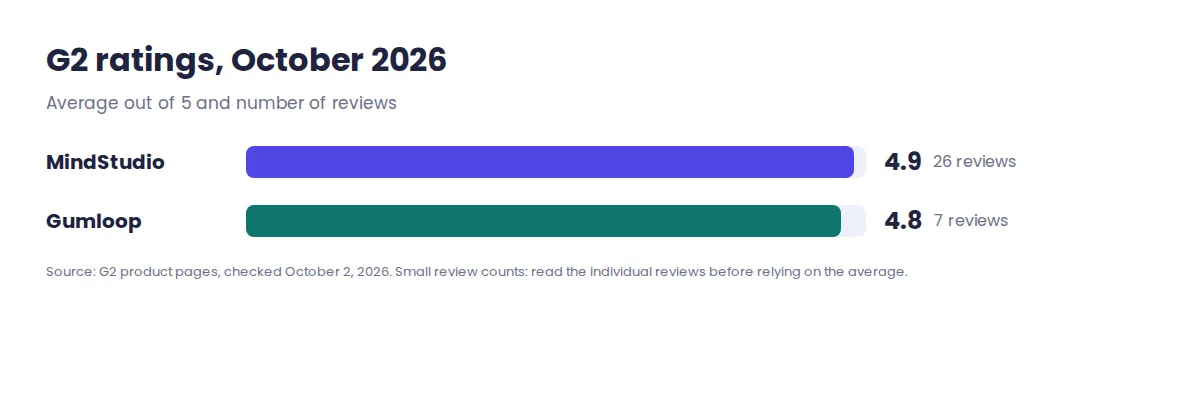
We checked MindStudio's pricing page directly on October 2, 2026. Gumloop's pricing page could not be loaded by our tools, so its prices come from two independent write-ups dated August and September 2026 that agree with each other and with a public log of Gumloop's August 26 pricing change; confirm on Gumloop's site before buying. Ratings are from G2. See how we review software.
Research-based comparison: neither MindStudio nor Gumloop paid for or reviewed this article.