
Last checked November 1, 2026 · News roundup
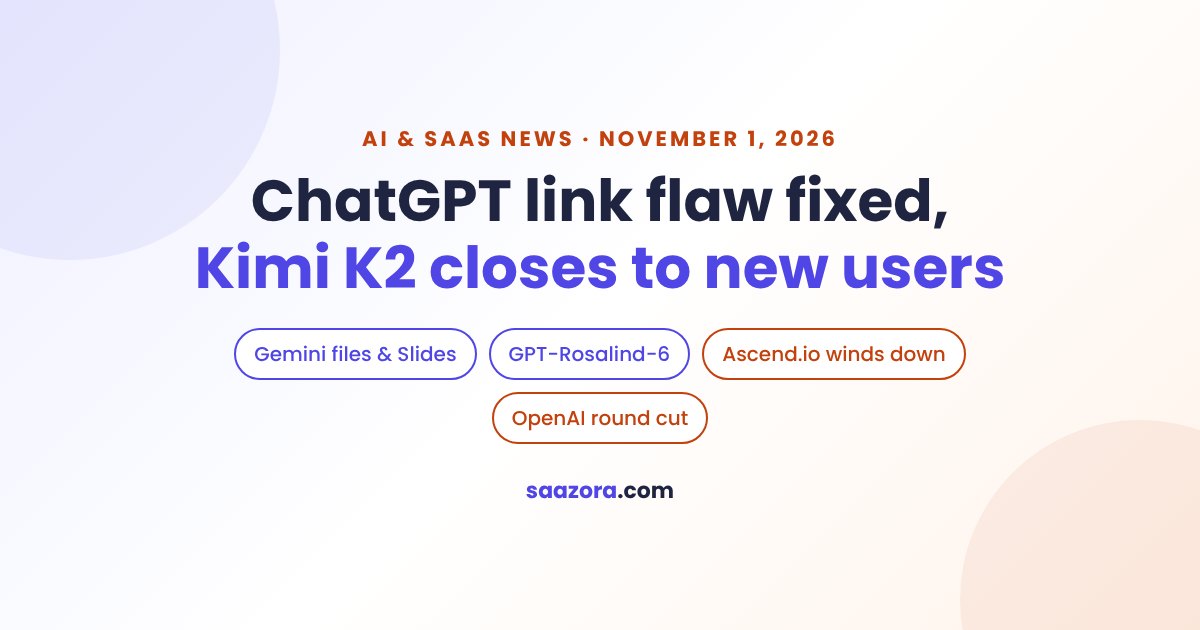
Today in brief: OpenAI fixed a ChatGPT flaw that let a booby-trapped shared link read a victim's private chats, and Gemini can now draft PDFs, Docs and slide decks right inside the chat. On the business side, the Financial Times reports OpenAI shrank its funding round to about $20 billion as AI stocks slid, Moonshot stopped taking new sign-ups for its Kimi K2 models, and data-pipeline startup Ascend.io is winding down after an Apple deal.
This weekend's stories at a glance
Part 1 · AI
Is it safe to open a shared ChatGPT link? A patched flaw could read your chats
Yes, for now. Researchers at the security firm Parameter found that a crafted ChatGPT share link could run their code inside the logged-in session of whoever opened it, The Hacker News reported on October 31. In the most reliable version, the victim opened the link and clicked Preview once; a later version triggered Preview automatically. From there the code could list recent conversations, open a private chat and send part of it to an outside server. In the researchers' words, they "could perform any action on behalf of the victim's ChatGPT account."
The cause was a chain of three design choices, not a broken sandbox. An interactive graph pulled the MathLive library into the main page, MathLive accepted messages from any sender, and those messages could carry raw HTML that created a frame treated as part of chatgpt.com. ChatGPT's script policy allowed YouTube scripts, which closed the loop.
Parameter reported the bug on October 18. OpenAI raised it to P1, its most serious tier, fixed it about eight days later and paid a $5,000 bounty. There is no sign anyone abused it outside the researchers' test. What to do: nothing, since the fix runs on OpenAI's servers. It is still a good habit to be wary of shared chats from strangers, the same way you would treat any unknown link.
Gemini can now create PDFs, Docs and slide decks in the chat, and rewrite a whole Slides deck
Google shipped two related Gemini features in the last days of October. From October 29, the Gemini app can generate, preview and edit files inside the conversation: slide decks, Google Sheets trackers, PDFs, Docs, Markdown, plain text and code. You can open a file full-screen, highlight a passage to ask about it, and save it to Drive. It is available now for all Google Workspace customers, Workspace Individual subscribers and personal Google accounts. PDF preview and editing work on web and mobile; the other formats are web only for now.
The second change lives in Google Slides. A single prompt in the Gemini side panel can now update several slides or an entire deck: refresh the styling, pull new content from a Drive file, merge slides or make formatting consistent. The edits land as normal, editable slides and can be undone. This one needs a paid tier: Business Standard and Plus, Enterprise Standard and Plus, Google AI Pro or Ultra, or the AI Pro for Education add-on. It is English-only at launch, admins get no switch to turn it off, and Google says the rollout that began October 29 may take more than 15 days to reach everyone. Higher promotional usage limits apply through at least December 1, 2026.
Who should care: anyone who builds weekly decks or reports. If you pay for Workspace, test deck-wide edits on a copy first.
What is GPT-Rosalind-6? OpenAI's biology model, for approved labs only
GPT-Rosalind-6 is a version of GPT-6 Astra, OpenAI's flagship reasoning model, tuned to refuse less often on legitimate biology and drug-discovery questions. OpenAI's deployment page, published October 30, says it uses the same weights as GPT-6 Astra and is offered only through trusted access. Scientists, research institutes, companies and government partners must apply. OpenAI reviews the intended use, security controls and governance, runs business verification for non-government applicants, and keeps a separate route for biodefense and public-health agencies. The release does not widen eligibility beyond earlier programs such as the Rosalind Academic Plan, and the page lists no price.
OpenAI rates the model High, below Critical, for biological and chemical risk, and treats it as Critical for cybersecurity because it inherits GPT-6 Astra's assessment. Approved customers must limit access to authorized users and keep qualified human review in place.
GPT-Rosalind-6 vs the previous version (OpenAI's own benchmarks)
GPT-Rosalind-6 GPT-Rosalind-5.5
MedChemBench v7
GeneBench Pro v13 (single attempt)
LifeSciBench Gold
Gemini API Computer Use is now generally available: what developers get
Google's Gemini API changelog lists Computer Use as generally available on October 30, in both the Interactions and GenerateContent APIs. The tool lets a model operate a browser, a desktop or an Android device by issuing clicks, typing, scrolling and app launches. Browser mode has the widest action set, including navigation and drag-and-drop; desktop mode controls the OS cursor and keyboard; mobile mode adds opening and listing apps.
Google's documentation is blunt about the risks. It tells developers to run agents in a sandbox such as a VM, container or limited browser profile, and to stop and ask the user whenever the model returns a require_confirmation safety decision. Prompt-injection detection exists but is opt-in and off by default, and it needs Gemini 3.5 Flash-Lite or a later model. The page warns against using the tool for sensitive data or actions whose mistakes cannot be undone. It lists no separate Computer Use fee, so budget on the underlying model's token rates.
What to do: if you prototyped on the preview, recheck your confirmation handling and turn injection detection on before you ship.
VOLTA malware uses Claude, Kimi and Gemini to rank its victims
Cisco Talos published an analysis on October 31 of VOLTA, a self-deleting Windows infostealer that hands its loot to a large language model for triage. After grabbing browser passwords, cookies, payment cards, crypto wallets, chat and gaming sessions, SSH and cloud keys, VOLTA sends a structured bundle to OpenRouter's API. The default model is Claude Opus 4.6; if it refuses, the malware falls back to Kimi K2 and then Gemini 2.5 Flash. The model returns a ranked dossier of what is worth selling, plus a profile of the person that can include home address, employer and approximate age.
Talos says VOLTA appears to be sold as a builder: each buyer plugs in their own API keys and settings, and every endpoint seen so far is third-party infrastructure. The malware still works without the AI step if no key is present.
What to do if a PC is hit: keep the volta_debug.txt log in AppData as evidence, revoke tokens and change passwords, move crypto to a wallet whose seed was created on an offline device, and prefer hardware-backed credentials. IT teams can block unexpected processes from launching Chrome in headless mode.
Part 2 · SaaS & business
Kimi K2 API closed to new sign-ups: plan the switch to K3.1 Pro
Moonshot AI's model documentation says that from October 31, 2026, newly registered users can no longer use the K2 model series. Existing customers keep access for now, but every K2 model is scheduled to retire by the end of December 2026, and Moonshot points developers to kimi-k3.1-pro with a migration guide. One oddity: the same page carries an older notice saying the K2 series was discontinued on May 25, 2026, and Moonshot does not explain the conflict.
For budgeting, our October 25 roundup reported K3.1 Pro at $2 per million input tokens and $10 per million output tokens, according to price lists relayed by CellCog and OrcaRouter, with a faster Highspeed tier at double that rate. Moonshot's model page itself does not repeat those prices.
Who it affects: teams that call K2 directly or through a router. Swap the model ID in staging now, compare output quality and token use, and avoid leaving the change to the holiday freeze.
Is Ascend.io shutting down? It is winding down as Apple hires the team
Yes. Ascend.io, which sold an "agentic data engineering" platform, now says on its homepage that it "is winding down operations as we prepare for our next great adventure." The notice gives no end date and no guidance for customers.
The context came from 9to5Mac on October 30. Apple's deal with Ascension Labs, Inc., the company behind Ascend, showed up on the European Commission's list of acquisitions that Apple must disclose under the Digital Markets Act. The terms describe a classic acquihire: Apple gets the right to offer jobs to certain employees, a non-exclusive license to Ascend's intellectual property and possibly some patents. The price was not disclosed. Ascend was founded in 2015.
What to do if you run pipelines on Ascend: export pipeline definitions, transformation code and run histories now, confirm in writing how long the platform stays up, and shortlist a replacement before your next renewal. A shutdown with no published date is the worst kind to plan around.
OpenAI funding round cut to about $20 billion as AI stocks slide
The Financial Times reported late on October 30, as relayed by CoinDesk, that OpenAI lowered its funding target from $30 billion at a $1.4 trillion valuation to about $20 billion at $1.25 trillion. OpenAI had already pushed its IPO plans to 2027. Anthropic, by contrast, plans to list in November, according to the same report, and is aiming to raise as much as $100 billion at a $1.5 trillion valuation.
The backdrop is a sharp selloff. CoinDesk puts the Nasdaq 100 down about 10% in the three weeks since its October 6 record. On Friday's close, Apple passed Nvidia as the most valuable company, at $5.03 trillion against $4.93 trillion, according to AppleInsider figures cited by FourWeekMBA; Intel fell 28.6% after its results, which the AP called its worst day since 1974.
What it means for users: nothing changes today. ChatGPT plans and API prices are untouched. The thing to watch is whether tighter money nudges AI vendors toward more usage caps and credit systems over the coming quarters.
Do companies trust AI agents? G2's 3,222 enterprise reviews say yes, with guardrails
G2 published an analysis on October 30 of 3,222 reviews of AI agents written by people at companies with more than 1,000 employees, covering January 2025 to October 23, 2026. Enterprise reviews more than doubled, from 983 in 2025 to 2,239 in 2026, and 77% of reviewers trust their agent "quite a bit" or "very much." Very few want to let go of the wheel, though.
How much autonomy enterprise users want to give AI agents
Autonomy within guardrails
Limited autonomy
Human approves each step
Total autonomy
The friction is in rollout, not output. Setup or complexity made up 25% of complaints in 2026, the average share of intended users who fully adopted their agent fell from 68% in 2024 to 55%, and praise for integrations dropped from 30% to 21% of reviews. When asked what would raise trust, 79% picked more visibility or control, such as explanations or warnings before risky actions, over better reliability. Cost comes up in about 20% of reviews for agent builders and support agents.
For buyers: during a trial, test the audit log and approval settings as hard as the answers.
Saazora take: small checks for the week ahead
Most of this weekend's news asks for small checks rather than big decisions. If you are choosing an agent platform after reading the G2 numbers, our MindStudio vs Gumloop comparison looks at exactly the controls reviewers say they want, and the AI agents and Claude Code hub gathers our guides to running agents safely. For no-code builders more broadly, see our ranked list of AI app builders.
Dates to watch
- Oct 26: OpenAI's fix for the shared-link flaw (about eight days after the October 18 report).
- Oct 29: Gemini file creation goes live; deck-wide Slides editing starts an extended rollout of 15+ days.
- Oct 30: Gemini API Computer Use reaches general availability; GPT-Rosalind-6 deployment page published.
- Oct 31: Kimi K2 models closed to newly registered users.
- November: Anthropic's planned IPO, per reports.
- Dec 1 (at least): Higher promotional limits for Gemini in Slides.
- End of December: All Kimi K2 models scheduled to retire.
Questions readers are asking this weekend
Do I need to change my ChatGPT password after the shared-link bug?
No. OpenAI fixed the problem on its servers around October 26, and researchers say there is no evidence it was used against real users. Nothing needs installing or resetting. If you reuse your ChatGPT password elsewhere, switching to a unique password and turning on two-factor sign-in is still sensible.
Is Gemini file creation free?
Creating and editing files in the Gemini app is available to personal Google accounts as well as Workspace users, so a paid plan is not required for that part. Editing an entire Google Slides deck from one prompt is different: it needs Business or Enterprise Standard or Plus, or Google AI Pro or Ultra.
Can I still sign up for Kimi K2?
No. Since October 31, 2026, new Moonshot accounts cannot use the K2 series, and existing users lose it when the models retire by the end of December. New projects should start on kimi-k3.1-pro, which Moonshot recommends as the replacement and supports with a migration guide.
Will ChatGPT get more expensive after OpenAI's smaller funding round?
Nothing announced so far suggests it. The reported change concerns how much money OpenAI raises and at what valuation, not its consumer or API pricing. Plans and rates are the same as before October 30. Watch OpenAI's pricing and release-notes pages for any change to usage limits.
Sources: The Hacker News, ChatGPT shared-link flaw (Oct 31, 2026) · Google Workspace Updates, Gemini files and Slides (Oct 29–30, 2026) · OpenAI, GPT-Rosalind-6 (Oct 30, 2026) · Gemini API changelog (Oct 30, 2026) · Gemini API Computer Use docs (checked Nov 1, 2026) · Cisco Talos, VOLTA (Oct 31, 2026) · Moonshot AI, Kimi model docs (checked Nov 1, 2026) · 9to5Mac, Apple and Ascend.io (Oct 30, 2026) · Ascend.io homepage notice (checked Nov 1, 2026) · CoinDesk, citing the FT, OpenAI funding (Oct 30, 2026) · FourWeekMBA, Apple passes Nvidia (Oct 31, 2026) · G2, AI agent adoption trends (Oct 30, 2026)