
Last checked October 29, 2026 · News roundup
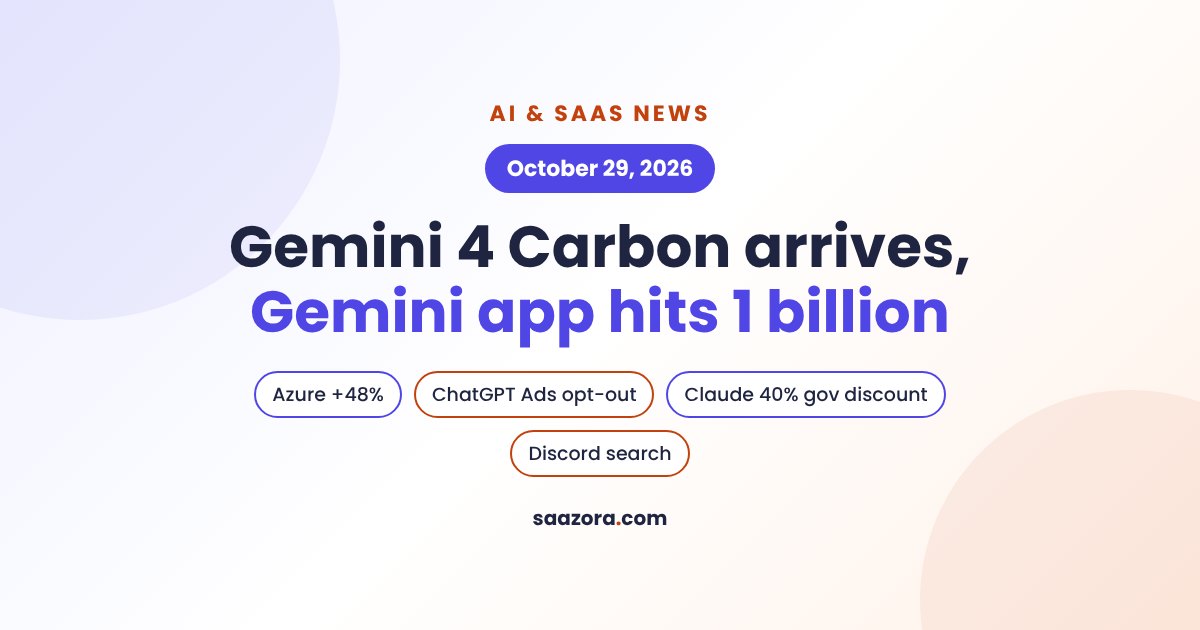
Today in brief: Google followed Gemini 4 Argon with Gemini 4 Carbon, a stronger model that only a small group of security teams can use so far, and Alphabet said the Gemini app now has one billion users. Microsoft's quarter showed Azure up 48% and Copilot daily use climbing fast. Advertisers have one day left to opt out of automatic ChatGPT ad rewrites, and Discord is about to put public server conversations on the open web.
Part 1 · AI
Gemini 4 Carbon price and access: $2 per million input tokens, invite-only for now
Google announced Gemini 4 Carbon on October 28, two weeks after Gemini 4 Argon opened broadly. The catch for most readers: you probably cannot use it yet. According to VentureBeat, Carbon is limited to selected cybersecurity defenders in Google's Fairwind Program, there is no public API, and Google only says a wider release will come "as soon as possible." Availability in Antigravity is planned after Fairwind grows, with no date.
Introductory pricing is $2 per million input tokens and $10 per million output tokens, with cached input discounted 95%. Later pricing doubles to $4 and $20. No end date has been set for Carbon's introductory period. Argon's introductory rates end November 30, and its higher pricing starts December 1.
On Artificial Analysis' Intelligence Index v5.0, Carbon scores 59, ahead of Claude Opus 5.5 at 58 and GPT-6 Astra at 57. It still trails Anthropic on the OSWorld computer-use test and OpenAI on FrontierSWE 2. Independent factual testing also showed a higher hallucination rate than Argon (11% versus 4%), even as accuracy rose. If you budget for Argon today, our Gemini 4 Argon price and access guide still applies; plan for Carbon only once Google publishes general availability.
Gemini 4 Carbon: what it costs and how far it moves past Argon
| Per 1M tokens | Introductory | Later |
|---|---|---|
| Input | $2 | $4 |
| Output | $10 | $20 |
| Example: 10M in + 1M out | $30 | $60 |
Light bar = Argon, dark bar = Carbon (Google-reported scores)
Gemini app hits 1 billion users as Google Cloud revenue doubles
Alphabet's third-quarter results, released October 28, put hard numbers on Google's AI push. CEO Sundar Pichai said the Gemini app has reached one billion users, calling it the fastest-growing product in Google's history, and that Google's own model APIs now process nearly 32 billion tokens per minute, more than four times the rate a year ago.
The money side is just as striking. Google Cloud revenue rose 103% to $30.7 billion, and its operating income climbed to $11.1 billion from $3.6 billion. Total revenue grew 25% to $127.6 billion. Capital spending jumped to $51.4 billion for the quarter, more than double last year's $24.0 billion, and diluted earnings per share fell to $2.12, partly because of an $8.7 billion loss on equity securities.
For businesses, the takeaway is supply, not price. Google is spending heavily to keep up with demand for Gemini and Cloud capacity, which is also why new models such as Carbon arrive with introductory rates that later rise. If your team signs a Google Cloud or Workspace renewal this quarter, ask in writing which AI features and token rates are locked for the full term.
Microsoft Copilot growth: daily users up about 5x as Azure grows 48%
Microsoft reported its fiscal first quarter on October 28. According to Yahoo Finance's live coverage, revenue reached $92.28 billion against $90.63 billion expected, and Azure grew 48% to $33.17 billion. Microsoft guided to 49% to 50% Azure growth next quarter.
Copilot is where most US workers feel the change. Microsoft said Copilot daily users rose nearly 50% from the previous quarter and about fivefold from a year ago, and the number of customers with more than 50,000 seats grew eightfold. It again gave no total seat count, so treat those as growth rates, not market share.
Spending keeps rising too: Microsoft expects capital spending above $50 billion in the December quarter and about $170 billion for fiscal 2027. For IT buyers, that scale matters because it underpins the usage-based Copilot billing Microsoft is rolling out. If you manage Microsoft 365 licenses, review your Copilot usage reports before year-end so you know which seats are active before any renewal conversation.
October 28 earnings: cloud growth and the AI numbers behind it
1 billion
Gemini app users (Alphabet)
~32B / min
Tokens processed by Google's model APIs
~5x
Copilot daily users vs. a year ago (Microsoft)
~$170B
Microsoft fiscal 2027 capex guidance
Nvidia Nemotron 3.5 Transcribe: a free speech-to-text model you can run yourself
Nvidia released Nemotron 3.5 Transcribe on October 28, a free, open-weight transcription model posted on Hugging Face. According to TechCrunch, the 30-billion-parameter model transcribes up to 40 languages, translates 31 languages to and from English, handles recordings up to an hour long and can tell apart up to eight speakers. Nvidia says it beats rivals on Hugging Face's Open ASR Leaderboard, though TechCrunch did not list scores.
Two limits matter before you plan around it. It works on recorded audio only, not live streams, and it needs real hardware: Nvidia says it runs on a single chip, from Jetson AGX Thor and DGX Spark up to Blackwell data center GPUs. That puts it in reach of companies that want meeting or call transcripts without sending audio to a paid API, but not of someone with a normal laptop. Nvidia also shipped version 2 of Granary, its open speech dataset, alongside the model.
Should you give an AI agent your bank password? Bank of America says no
Bank of America emailed customers a warning titled "Protecting your finances in the AI World," and a spokesperson confirmed it was real, TechCrunch reported on October 27. The message tells customers not to hand their username and password to "an AI-enabled tool or agent that offers to act on your behalf," and reminds them that "you're responsible for activity resulting from that access."
No account terms changed, and the email did not single out any assistant. The risks it describes are practical: an agent could move money without you noticing, the bank could flag the activity as fraud and lock your account, and a flaw in the assistant could leak your credentials.
What to do: keep using AI tools that read exported statements or connect through the bank's own approved data links, and never paste login credentials into a chat or browser agent. If you already did, change the password and turn on two-factor sign-in.
Part 2 · SaaS & business
ChatGPT Ads creative enhancements start October 30: how to opt out
If you run self-serve ChatGPT ad campaigns, OpenAI will switch on "creative enhancements" for new and existing campaigns starting Friday, October 30, according to an OpenAI email to advertisers first reported by Search Engine Roundtable. PPC Land noted that OpenAI's help page listed October 29, so treat today as the practical deadline.
Once it is on, OpenAI can rewrite headlines and descriptions to fit a conversation, translate ad text, resize images and even point the ad to a different page on your site. Those versions can run without you approving each one, which is a problem for regulated industries, trademark-sensitive copy and landing pages built for one offer.
To opt out, open the account settings in OpenAI Ads Manager and turn the setting off at the account level, then check individual campaigns, because campaign settings override the account default. Existing opt-outs carry over. It is still unclear whether campaigns bought through OpenAI's sales team or partners are included, so managed accounts should ask their rep.
Claude government discount: 40% off for federal, state and local agencies
Anthropic expanded its OneGov agreement with the General Services Administration on October 27. Federal agencies, plus state, local, tribal and territorial governments, can now buy Claude Enterprise, Claude for Government and the Claude API at 40% off through GSA's Multiple Award Schedule. There is no minimum spend; agencies pay for what they use.
Anthropic estimates the deal could save governments about $1 billion and says roughly 500 US government organizations already use Claude. The discount covers direct purchases now and is due to reach purchases through cloud providers "in the coming months." Claude Enterprise is still working through FedRAMP Moderate authorization, which some agencies require before deployment.
Who it affects: public-sector IT teams and the contractors who resell AI tools to them. A county or school district comparing ChatGPT, Gemini and Claude should now price Claude off the GSA schedule rather than the public list price.
Are Discord messages becoming searchable? Public servers get web pages November 16
Yes, for some servers. Discord said on October 27 that servers enrolled in Server Discovery will each get their own web page starting November 16, which may include automated summaries of active public channels, TechCrunch reported. From mid-December, selected messages from public channels may appear in search engine results.
Usernames and avatars will not be shown, and private servers, direct messages and group DMs are excluded. Server admins choose which channels take part, individual members can opt out in their settings, and teens are excluded. The feature is off by default in the EU, UK, Canada, Brazil, Australia and South Korea.
For brands and creators who run a community on Discord, this is both an SEO opening and a moderation job: review which channels are public before November 16. If you would rather keep member discussions off search engines entirely, a paid community platform is the alternative; our Circle review for courses and communities covers what that costs.
Deals and data leaks in brief: Upwind, Guidewire, Cloudflare Workers AI
- Upwind raises $400 million. The cloud and AI security company closed a Series C led by Bessemer Venture Partners at a $3.8 billion valuation, up from $1.5 billion in January, according to Decrypt (October 28).
- Guidewire buys Hyperexponential. The insurance software maker is paying $1.7 billion in cash for the UK underwriting-AI startup, with up to $400 million more tied to revenue targets; closing is expected next year. Nearly 600 insurers use Hyperexponential, per TechCrunch (October 27).
- Cloudflare Workers AI exposure. Cloudflare disclosed on October 26 that its GLM-5.3 model on Workers AI returned data from other customers' requests in 155 responses between August 27 and September 9, caused by a cache misconfiguration plus an SGLang bug. Only prompts over 681,280 tokens were affected, and both issues are fixed.
Dates to put in your calendar
Saazora take: what to do this week
Most of today's news is about access and control rather than new features you can click. Carbon and Copilot show how fast AI capacity is being sold, but the practical moves are smaller: switch off ChatGPT ad rewrites if your copy needs approval, check which Discord channels you have made public, and keep bank logins out of AI agents. If you track software costs for a team, our running list of SaaS pricing changes this month collects the plan and price moves that hit renewals.
Your questions on today's stories
Can I use Gemini 4 Carbon in the Gemini app today?
Probably not. As of October 29, Google limits Carbon to selected cybersecurity defenders in its Fairwind Program, and there is no public API. Google says a broader release will come as soon as possible. Until then, Gemini 4 Argon is the newest Gemini model most paying users and developers can actually reach.
How many people use the Gemini app?
Alphabet said on October 28, 2026 that the Gemini app has reached one billion users, which CEO Sundar Pichai called the fastest growth of any Google product. Google did not split the figure by country or by free and paid plans, so it does not tell you how many people pay for Google AI subscriptions.
Will ChatGPT change my ads without asking?
For self-serve ChatGPT campaigns, yes, unless you opt out. From October 30, OpenAI can rewrite headlines, translate text, resize images and change destination URLs without approving each version. Turn creative enhancements off in Ads Manager account settings and check each campaign, since campaign-level settings override the account default.
Is it safe to let an AI assistant log in to my bank?
Bank of America says no. Its October 2026 email tells customers not to share their username and password with AI agents and reminds them they are responsible for activity from that access. Sharing logins can trigger fraud locks or leak credentials. Use the bank's approved connections or exported statements instead.
Sources: VentureBeat, Gemini 4 Carbon (Oct 28, 2026) · 9to5Google (Oct 28, 2026) · Alphabet Q3 2026 earnings release (Oct 28, 2026) · Yahoo Finance, Microsoft earnings live (Oct 28, 2026) · TechCrunch, Nvidia transcription model (Oct 28, 2026) · TechCrunch, Bank of America (Oct 27, 2026) · Search Engine Roundtable, ChatGPT Ads (Oct 20, 2026) · PPC Land (Oct 21, 2026) · Anthropic, GSA partnership (Oct 27, 2026) · TechCrunch, Discord (Oct 27, 2026) · Decrypt, Upwind (Oct 28, 2026) · TechCrunch, Guidewire (Oct 27, 2026) · Cloudflare blog (Oct 26, 2026)