
Research guide, not hands-on testing: we did not open a Checkr account or order an MVR · Prices and fee data checked on Checkr's pages October 20, 2026 · FMCSA rules read on fmcsa.dot.gov the same day · This is not legal advice · We may earn a commission if you sign up through links on this page.
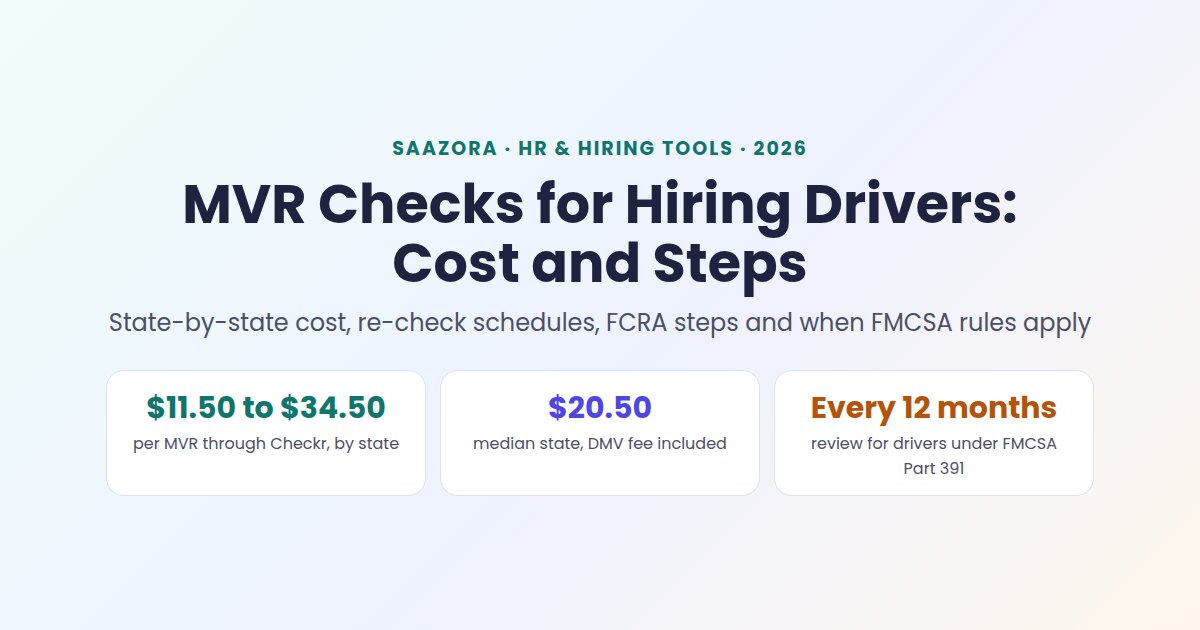
MVR check cost, in short: through Checkr, one motor vehicle record check costs $9.50 plus the fee the driver's state DMV charges for the record, which works out to $11.50 in California and $34.50 in Delaware or Oklahoma, with a median of $20.50 across the 50 states and DC. The price is the easy part. The decisions that change your yearly bill are how often you re-check drivers after hire, whether you pay for continuous monitoring, and whether your drivers fall under federal FMCSA rules that make a yearly review mandatory.
This guide is for employers hiring people who drive for work: local delivery and courier teams, app-based or rideshare-style fleets, field service crews, and motor carriers with CDL drivers. It covers what a driving record shows, the all-in cost in every state, the cost of re-checking a fleet, the FCRA consent steps, and when the Drug and Alcohol Clearinghouse comes into play. If you are screening for more than driving, start with what a full employment background check costs across providers, and find related guides on Saazora's HR and hiring tools hub.
What a driving record tells an employer, and what it leaves out
An MVR is the record a state DMV keeps for each licensed driver. Checkr describes its MVR add-on as a check to "confirm a driver's license status and class, and identify driving incidents in the US." According to Checkr's MVR page, a report can include:
- License status: valid, restricted, suspended, revoked or expired.
- License type and class: commercial, passenger, permit or ID only, which tells you what the person may legally drive.
- Accidents reported to the state, including property damage or injury.
- Traffic violations, which vary with each state's traffic laws.
- Driving-related convictions such as DUI, DWI or vehicular homicide.
Three limits are worth knowing before you write your driving standard:
- The lookback depends on the state. Checkr says most states return seven years of records, while others return anywhere from three to ten.
- Out-of-state history is not guaranteed. A DMV may copy a driver's old record when they move and get a new license, but Checkr notes "whether this occurs is at the discretion of the DMVs." A standard MVR searches the state of the current license.
- A driving record is not a criminal record. Checkr points out that in some states, driving-related felonies and misdemeanors do not show up on a criminal search, and the reverse is also true: an MVR does not replace a criminal check for roles that need one.
For commercial drivers, Checkr also sells a commercial MVR that adds medical certificate information and a search of the Commercial Driver's License Information System (CDLIS). Checkr says that "if a CDL is found in other states, an MVR check will be run in any additional state(s)," which matters for the federal rules covered further down.
MVR check cost in all 50 states and DC
Checkr's pricing page lists the MVR at $9.50 per check, with a footnote: "Standard state DMV access fees apply and vary by location, passed through at cost with no markup." Its passthrough fee page adds that "all DMVs charge fees to retrieve driving records," so there is no state where an MVR costs only $9.50. We took the DMV fee for every state from the data behind Checkr's own fee tool on October 20, 2026 (it matched our October 16 pull exactly) and added the $9.50.
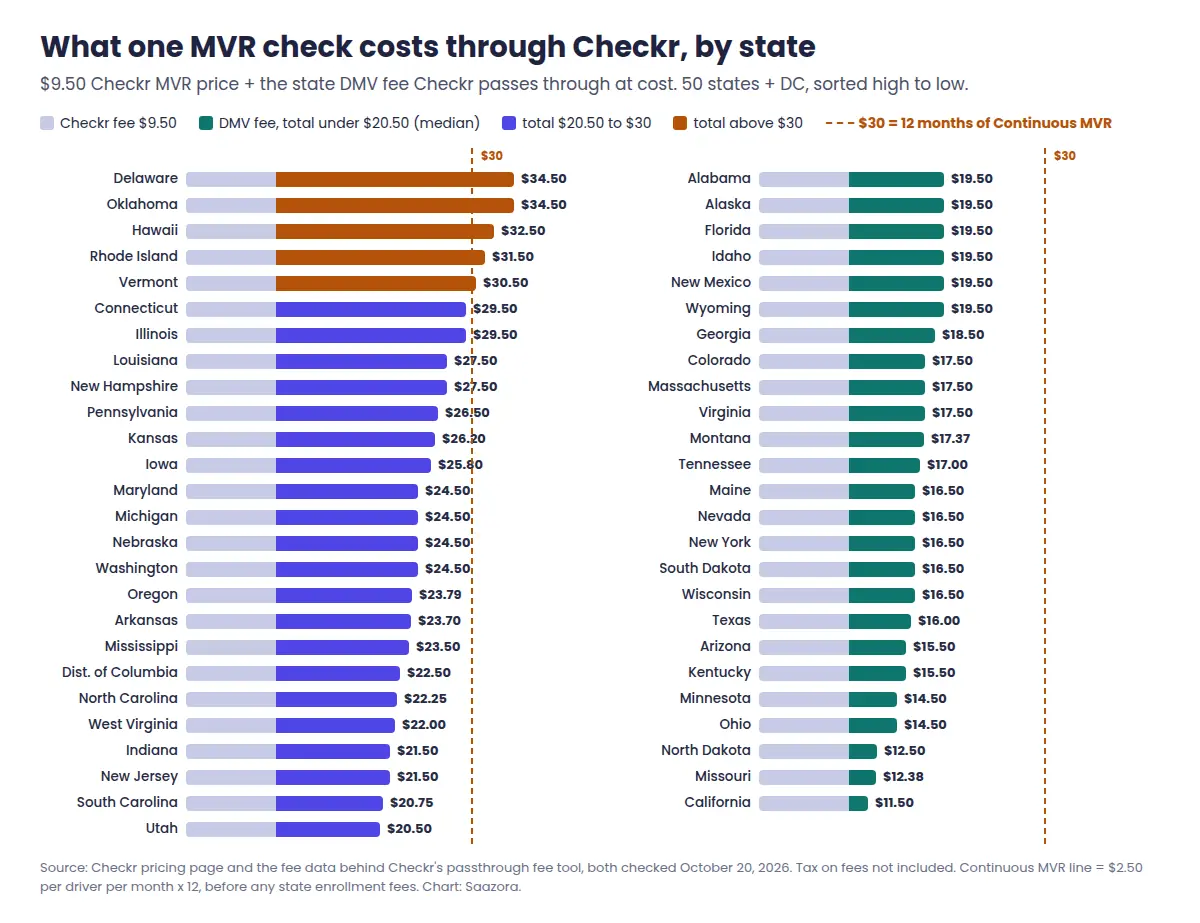
What the 51 numbers show:
- Almost half the states cost under $20. 25 of 51 come in below $20 all-in, led by California ($11.50), Missouri ($12.38) and North Dakota ($12.50).
- A dozen states cost $25 or more. Delaware and Oklahoma ($34.50), Hawaii ($32.50), Rhode Island ($31.50) and Vermont ($30.50) top the list, followed by Connecticut and Illinois ($29.50).
- The DMV fee is often the bigger part. In the median state the DMV takes $11.00 of the $20.50, more than Checkr's own fee.
- Territories differ. The same data lists Guam at $52.00 and Puerto Rico at $15.10. Tax on the fees, where it applies, is extra; Checkr says you pay "any applicable taxes or charges on these fees."
| State | DMV fee | MVR through Checkr | State | DMV fee | MVR through Checkr |
|---|---|---|---|---|---|
| Alabama | $10.00 | $19.50 | Montana | $7.87 | $17.37 |
| Alaska | $10.00 | $19.50 | Nebraska | $15.00 | $24.50 |
| Arizona | $6.00 | $15.50 | Nevada | $7.00 | $16.50 |
| Arkansas | $14.20 | $23.70 | New Hampshire | $18.00 | $27.50 |
| California | $2.00 | $11.50 | New Jersey | $12.00 | $21.50 |
| Colorado | $8.00 | $17.50 | New Mexico | $10.00 | $19.50 |
| Connecticut | $20.00 | $29.50 | New York | $7.00 | $16.50 |
| Delaware | $25.00 | $34.50 | North Carolina | $12.75 | $22.25 |
| District of Columbia | $13.00 | $22.50 | North Dakota | $3.00 | $12.50 |
| Florida | $10.00 | $19.50 | Ohio | $5.00 | $14.50 |
| Georgia | $9.00 | $18.50 | Oklahoma | $25.00 | $34.50 |
| Hawaii | $23.00 | $32.50 | Oregon | $14.29 | $23.79 |
| Idaho | $10.00 | $19.50 | Pennsylvania | $17.00 | $26.50 |
| Illinois | $20.00 | $29.50 | Rhode Island | $22.00 | $31.50 |
| Indiana | $12.00 | $21.50 | South Carolina | $11.25 | $20.75 |
| Iowa | $16.30 | $25.80 | South Dakota | $7.00 | $16.50 |
| Kansas | $16.70 | $26.20 | Tennessee | $7.50 | $17.00 |
| Kentucky | $6.00 | $15.50 | Texas | $6.50 | $16.00 |
| Louisiana | $18.00 | $27.50 | Utah | $11.00 | $20.50 |
| Maine | $7.00 | $16.50 | Vermont | $21.00 | $30.50 |
| Maryland | $15.00 | $24.50 | Virginia | $8.00 | $17.50 |
| Massachusetts | $8.00 | $17.50 | Washington | $15.00 | $24.50 |
| Michigan | $15.00 | $24.50 | West Virginia | $12.50 | $22.00 |
| Minnesota | $5.00 | $14.50 | Wisconsin | $7.00 | $16.50 |
| Mississippi | $14.00 | $23.50 | Wyoming | $10.00 | $19.50 |
| Missouri | $2.88 | $12.38 |
DMV fees from the data behind Checkr's passthrough fee tool; MVR price from Checkr's pricing page. Both checked October 20, 2026. Before tax.
If you hire drivers who also need a criminal search, the MVR sits on top of a package price. Our breakdown of how passthrough fees change Checkr's cost per hire prices packages with an MVR included. To order a single MVR for one candidate, you can open a Checkr account and add the MVR to your order (affiliate link); new accounts are approved (credentialed) before the first check runs.
Re-checking drivers after hire: yearly pulls or Continuous MVR
A pre-hire MVR is a snapshot. A license can be suspended the week after you hire someone, so many employers re-check, and for drivers under FMCSA Part 391 a yearly review is required (see the next section). There are two ways to do it through Checkr, and they price very differently.
- Annual re-pull: order a new MVR for each driver once a year at the same $9.50 plus DMV fee.
- Continuous MVR: Checkr's pricing page lists it at "$2.50 USD monthly per enrolled driver." It "monitors a driver's motor vehicle record and alerts you to new violations, license status changes, and accidents," and when a change is detected, "a full MVR report is conducted." Checkr adds two cost conditions: "Some states also charge enrollment or annual fees," and any change that triggers a new report "is billed at standard MVR rates, including applicable state fees."
Twelve months of Continuous MVR costs $30 per driver before those extras. One annual re-pull costs less than $30 in 46 of the 51 jurisdictions. Illinois is nearly a tie ($29.50), and only in Vermont, Rhode Island, Hawaii, Delaware and Oklahoma is the monitoring fee lower than a single re-pull. In other words, on fees alone continuous monitoring almost always costs more. What it buys is time: the annual pull sees a suspension up to a year late, while monitoring alerts you between pulls.
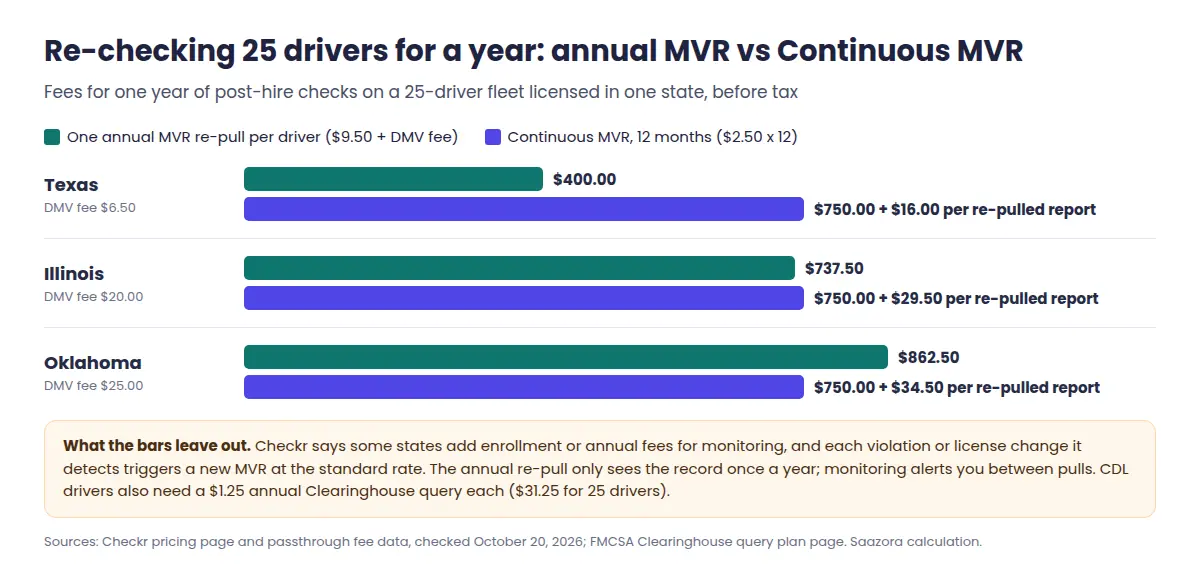
For a 25-driver fleet licensed in Texas, a yearly re-pull costs $400 against $750 for monitoring. In Illinois the gap closes to $737.50 against $750, and in Oklahoma monitoring is cheaper at $750 against $862.50, until alerts trigger new $34.50 reports. Over three years per driver (the hire MVR plus two re-pulls, or the hire MVR plus 36 months of monitoring), the totals are $34.50 against $101.50 in California, $48.00 against $106.00 in Texas and $103.50 against $124.50 in Delaware.
A practical way to choose: if your drivers carry customers, kids, cash or heavy vehicles, or your insurer asks for prompt notice of suspensions, the extra cost of monitoring is usually the point. If your drivers only run occasional errands in their own car, an annual re-pull may be enough. Either way, the consent you collected at hire must allow checks during employment, which is covered in the FCRA section below.
When federal FMCSA rules apply to your drivers
Drivers of ordinary cars and small vans usually fall outside the Federal Motor Carrier Safety Administration's driver rules, because those rules start with the vehicle. On its CMV FAQ page (last updated March 28, 2024), FMCSA defines a commercial motor vehicle as one used in interstate commerce that "has a gross vehicle weight rating (GVWR) of 10,001 pounds or more," is "designed or used to transport more than 8 passengers (including the driver) for compensation," carries more than 15 passengers without pay, or is any size vehicle carrying "hazardous materials that require federal placarding." A CDL is a further step up: FMCSA's driver page (last updated February 4, 2026) covers vehicles of 26,001 pounds or more, vehicles built for 16 or more people, and placarded hazmat, and says "Drivers are required to obtain and hold a CDL if they operate in interstate, intrastate, or foreign commerce."
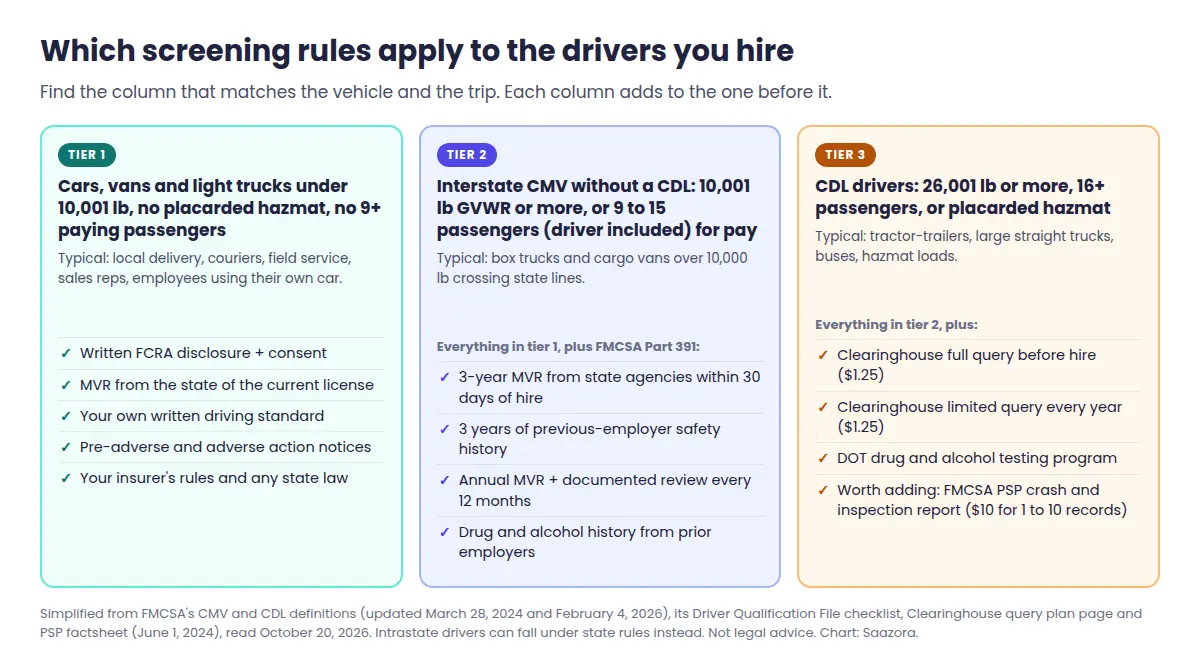
For drivers of interstate CMVs, FMCSA's Driver Qualification File checklist lists two MVR duties:
- Before or at hire: "Carriers must contact State agencies for the driver's MVR for the past three years," and the request "must be made within 30 days of hire." The same checklist requires a three-year investigation of previous employers, also "completed within 30 days of the date employment begins."
- Every year: "At least once every 12 months, the carrier must collect a current motor vehicle record (MVR)" and review it to confirm the driver still meets the safe-driving standard and is not disqualified, keeping a note of who reviewed it and when. A 2022 FMCSA rule (87 Fed. Reg. 13192, effective May 9, 2022) dropped the old annual list of violations from drivers and kept the carrier's yearly inquiry to "every State in which the driver holds or has held a CMV operator's license or permit in the past year."
You can hand the record pulls to a screening company. FMCSA guidance issued March 9, 2022 says carriers may use third-party agents for both the hiring and annual inquiries, but "the motor carrier is responsible for ensuring the information is accurate." FMCSA also said in 2015 guidance (80 Fed. Reg. 13069) that automated notification systems used to check the record at least annually can satisfy the annual review, and that a third-party system covering every state where the driver held a CMV license, with automatic updates, satisfies the inquiry part of section 391.25. Whether a particular product, Checkr's Continuous MVR included, meets that description is a question to put to the vendor and your counsel. We could not verify it.
CDL drivers: the Drug and Alcohol Clearinghouse
If the driver needs a CDL, the Clearinghouse adds two queries. FMCSA's query plan page says "All employers of CDL drivers must purchase a query plan in the Clearinghouse," and that queries are required "as part of any pre-employment driver investigation" and "at least annually for every CDL driver currently employed." The pre-employment query is a full query, which needs the driver's electronic consent inside the Clearinghouse. The annual one can be a limited query, with consent collected outside it; FMCSA says that general consent "may be effective for more than one year." Each query costs a flat $1.25, and if a limited query finds a record and you follow up with a full one, "the employer will only be charged once for both queries."
Non-CDL drivers are not queried in the Clearinghouse, but FMCSA's Clearinghouse FAQ (May 13, 2022) notes that employers of those drivers "must still comply with the driver investigation requirements of § 391.23(e), which includes drug and alcohol violation history."
Pricing a CDL hire, line by line
Here is what the federal items above cost where a price is published. Checkr's "Driver checks" package and its commercial MVR are quote-only, so the table uses the standard MVR price as a floor.
| Item | When | Where the rule or price comes from | Published cost |
|---|---|---|---|
| MVRs from the state agencies covering the past 3 years | Within 30 days of hire | FMCSA Driver Qualification File checklist | $9.50 + DMV fee per state (standard Checkr MVR); commercial MVR on quote |
| Previous employers' safety history, 3 years | Within 30 days of hire | FMCSA checklist; Checkr passthrough page | Checkr lists DOT verification source fees of $7.00 to $70.00; service price on quote |
| Clearinghouse full query | Before hire | FMCSA Clearinghouse | $1.25 |
| Drug and alcohol testing history; Part 382 testing for CDL drivers | Before hire | FMCSA checklist (49 CFR 40.25(j), 382.301); Clearinghouse FAQ; Checkr pricing | Checkr lists clinic-based drug tests from $60; no separate DOT test price is posted |
| PSP crash and inspection report | Before hire | FMCSA PSP factsheet (June 1, 2024) | $10.00 per record for 1 to 10 records |
| Annual MVR and review | Every 12 months | FMCSA checklist and 2022 rule | $9.50 + DMV fee per state, or Continuous MVR at $2.50 per month plus extras (see the caveat on automated systems above) |
| Clearinghouse limited query | Every year | FMCSA Clearinghouse | $1.25 |
For CDL drivers the MVR check cost multiplies with every state the driver has held a license in, because each state's DMV charges its own fee.
Worked example. A CDL driver hired in Texas who held a license in Oklahoma within the last three years: Texas MVR $16.00, Oklahoma MVR $34.50, Clearinghouse full query $1.25 and a PSP report $10.00 add up to $61.75 in published fees, before any drug test, the previous-employer checks and a commercial MVR quote. Once the driver has held only the Texas license for a year, the yearly MVR and Clearinghouse fees come to $16.00 plus $1.25, or $17.25 per driver.
FMCSA's PSP factsheet explains what that $10 report adds: "The PSP report is different than an MVR because it is a record of an occurrence versus a conviction record." It shows a five-year crash history and three years of roadside inspections from FMCSA's own data.
Consent first: the FCRA order for driving records
Checkr's MVR page notes that the Fair Credit Reporting Act and the Driver's Privacy Protection Act "regulate how information in motor vehicle records can be accessed and used for employment purposes." When a screening company supplies the MVR, the FCRA sets the order of steps. The FTC's guide for employers, the EEOC and FTC's joint guide, and the CFPB's required rights summary describe it as follows (all read October 20, 2026):
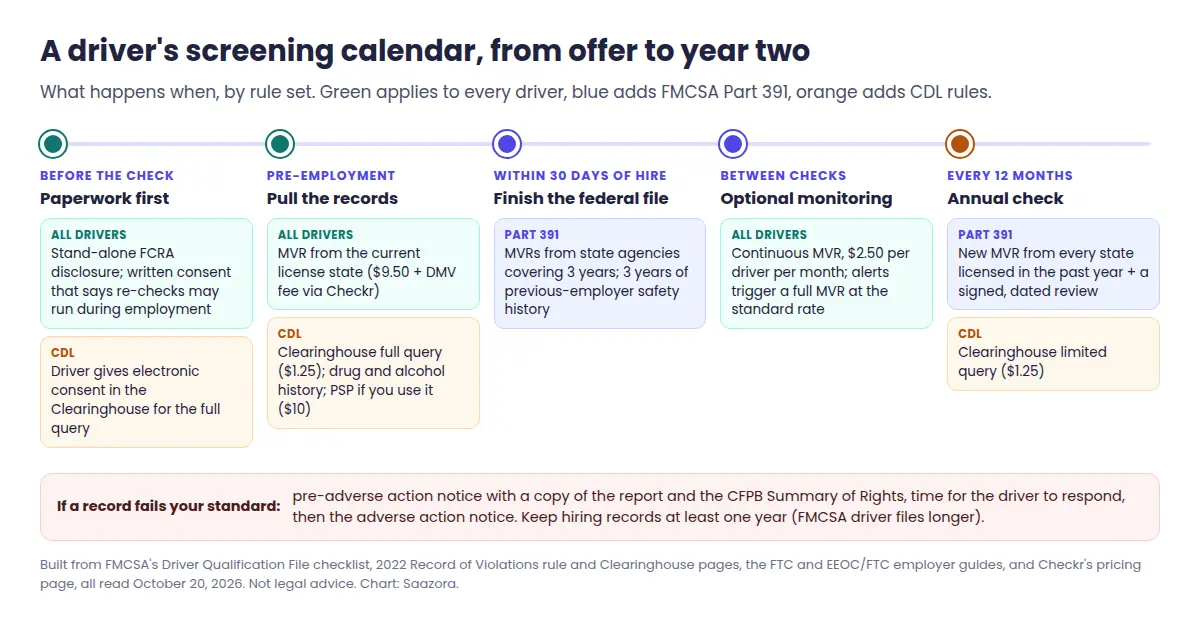
- Tell the driver in a separate document. The notice that you may use a background report "must be in writing and in a stand-alone format," not buried in the job application.
- Get written permission that covers re-checks. This step matters most for driver roles, because re-checks are routine. The EEOC guide says: "If you want the authorization to allow you to get background reports throughout the person's employment, make sure you say so clearly and conspicuously." Without that wording, annual pulls and Continuous MVR need fresh consent.
- Certify to the screening company that you gave notice, got permission and will follow the law.
- Apply your driving standard the same way to everyone. The EEOC guide asks employers to "apply the same standards to everyone," regardless of race, sex, age or other protected traits. Write down which violations, over how many years, disqualify a driver for each role.
- Before rejecting or removing a driver, send a pre-adverse action notice with a copy of the report and "A Summary of Your Rights Under the Fair Credit Reporting Act," and give the person a chance to explain or dispute an error.
- Then send the adverse action notice, which must say the screening company "did not make the decision to take the unfavorable action," and explain the right to dispute and to a free report "within 60 days."
- Keep and dispose of records properly. The EEOC guide says hiring records "must be preserved for one year," after which reports must be disposed of securely.
Checkr says its built-in workflows make it "easy to follow industry regulations and adverse action requirements," but the hiring decision, the driving standard and the review of each record stay with a person on your team. State and local rules, including fair-chance laws, can add steps. This is not legal advice; have an employment lawyer review your driving policy and consent forms, especially if you hire in several states.
Questions employers ask about driver MVRs
Can I run an MVR on a driver who already works for me?
Yes, with the right consent. Either collect new written permission or make sure the consent signed at hire says clearly that reports may be obtained throughout employment. If adverse action follows, the same pre-adverse and adverse notices apply to employees as to applicants.
How long does an MVR take through Checkr?
Checkr's own wording is that "most MVR reports are completed within a few minutes," with two conditions: some records "are not available electronically, which may cause delays," and errors such as a misspelled name or wrong license number "can also slow results." Collect the license number and state carefully.
Do these FCRA steps apply to gig or independent contractor drivers?
This guide is written for employees and job applicants. Whether and how the FCRA's employment rules apply to contractors depends on the arrangement and on state law, so ask counsel before you set up an onboarding flow for app-based drivers. Collect the driver's written consent either way.
Does an MVR show violations from every state the driver lived in?
Not reliably. A standard MVR searches the current license state, and older out-of-state history appears only if the new DMV copied it. For CDL drivers, Checkr's commercial MVR searches CDLIS and runs extra state MVRs where another CDL is found; budget for each extra state at that state's fee.
Before you commit to a provider, compare Checkr and GoodHire side by side or see how Checkr stacks up against Sterling and HireRight. Our research review of Checkr for small businesses covers the account terms, and the Checkr page with current setup terms and package prices lists what is on offer. When your consent forms and driving standard are ready, start a Checkr account for driver screening (affiliate link).
Sources and how we built the numbers
This is a research guide. On October 20, 2026 we read Checkr's pricing page, its passthrough fee page and the fee data behind its fee tool, its MVR and DOT background check pages, and FMCSA's CMV and CDL pages, Driver Qualification File checklist (revised July 2017, read alongside the 2022 Record of Violations rule), its guidance on third-party agents and automated systems, the Clearinghouse query plan and FAQ pages and the PSP factsheet. FMCSA's regulation text pages for sections 391.23 and 391.25 did not load for us, so the rules are quoted from FMCSA's own checklist, guidance and rule summary instead. All-in state costs and fleet totals are Saazora calculations ($9.50 plus each DMV fee, before tax). We did not open a Checkr account or order an MVR, and we do not rate Checkr's speed or accuracy. We also read the top-ranking pages for this topic from Checkr Trust (February 2026), Embark Safety (August 2024) and GCheck; none combined an all-in per-state cost with the re-check comparison above. More on our method: how Saazora researches and reviews software.
Sources (checked October 20, 2026): Checkr pricing page; Checkr "Passthrough access fees explained" page and fee data; Checkr MVR and DOT background check pages; FMCSA, CMV vs non-CMV FAQ (updated March 28, 2024); FMCSA, CDL drivers page (updated February 4, 2026); FMCSA Driver Qualification File Checklist (rev. July 2017); FMCSA, Record of Violations final rule, 87 Fed. Reg. 13192 (March 9, 2022); FMCSA guidance on third-party agents under §391.23 and §391.25 (March 9, 2022) and on computerized systems, 80 Fed. Reg. 13069 (March 12, 2015); FMCSA Clearinghouse query plans and Queries and Consent FAQ; FMCSA, "How much does it cost to conduct limited and full queries" (November 19, 2019); FMCSA PSP factsheet (June 1, 2024); FTC, "Using Consumer Reports: What Employers Need to Know" (updated August 4, 2020); EEOC and FTC, Background Checks: What Employers Need to Know; CFPB, A Summary of Your Rights Under the Fair Credit Reporting Act.
Research guide, not hands-on testing and not legal advice. Checkr did not pay for or review this article.