
Research guide built from public pages, not a hands-on test: Saazora did not order an employment verification for this article · Checkr prices and pass-through fees read on checkr.com/pricing and Checkr's pass-through fee overview on October 23, 2026 · The Work Number, National Student Clearinghouse, FCRA text, EEOC, New York City and California sources checked the same day · This is not legal advice; salary history and screening rules vary by state and city, so ask an employment lawyer before you set a policy · We may earn a commission if you sign up through links on this page.
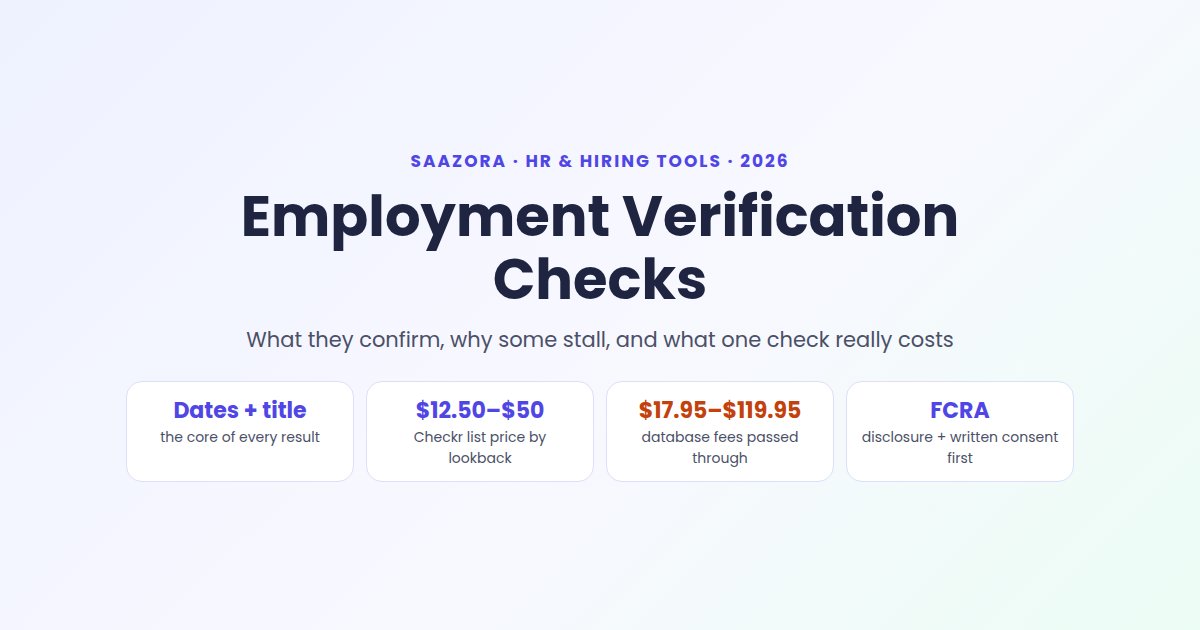
An employment verification check confirms that the jobs on a candidate's résumé are real: usually the employer's name, the start and end dates and the job title, and salary only where the law allows it. It is answered by a payroll database when the past employer contributes to one, or by a person at that employer when it does not. At Checkr's list prices on October 23, 2026, a check starts at $12.50 for the current employer and rises to $50 for a ten-year lookback, before database fees of $17.95 to $119.95 that the database owner charges. Turnaround depends on which of those two paths answers, and a check that reaches neither comes back "unable to verify", which is a gap in the record, not proof that the candidate lied.
This guide walks through what the result contains, the paths a verification can take, why some checks stall, when the Fair Credit Reporting Act (FCRA) consent steps apply, where salary questions are banned, and what one employment verification check costs once pass-through fees are added. If this is your first screening of any kind, read our step-by-step guide to running an employee background check first; this page assumes you already know you want to confirm work history.
What an employment verification check confirms, and what it leaves out
Checkr's own product page lists three items an employment verification "usually includes": "Dates of employment", "Job title or position" and "Salary (if legal in that jurisdiction)". It adds that a past employer "may also share additional information, such as what job responsibilities and roles a candidate performed", and that employers "can choose what they will and will not reveal about employees, except where laws impose restrictions." So the core of the report is short, and anything beyond dates and title depends on the former employer's own policy.
| Item | Part of an employment verification? | Where it comes from instead |
|---|---|---|
| Employer name, start and end dates | Yes, the core of the check | Payroll database or the employer's HR team |
| Job title or position | Yes | Same sources |
| Salary or pay history | Only where legal, and banned as a question in some places (see the salary section) | Payroll data; never ask where a ban applies |
| Duties and responsibilities | Sometimes, at the past employer's choice | The past employer |
| Opinions on performance or character | No, that is a reference check | References the candidate names (Checkr sells these separately, $10 per check) |
| Right to work in the US | No, that is Form I-9 | Form I-9 and, for some employers, E-Verify (Checkr lists Form I-9 at $7 per form) |
| Degrees and graduation dates | No, that is an education verification | National Student Clearinghouse or the school |
Sources: Checkr employment verification page and checkr.com/pricing, checked October 23, 2026. Prices are list prices before pass-through fees.
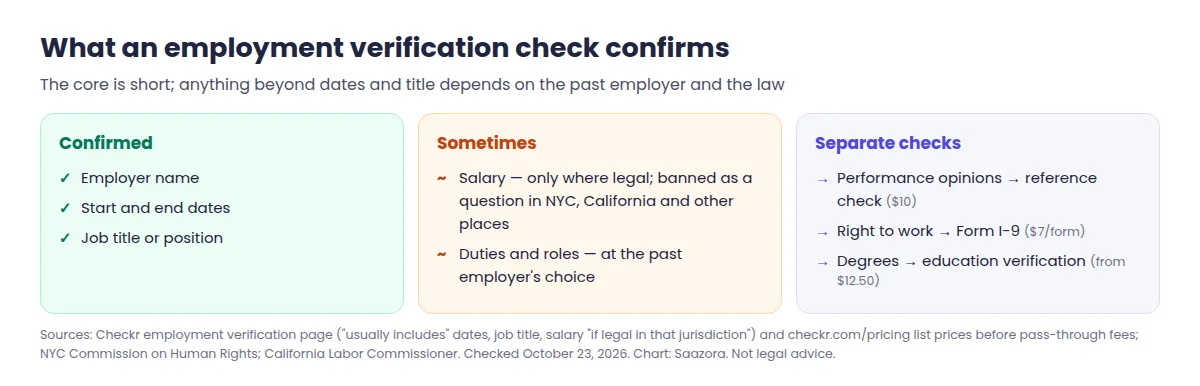
The practical point for a hiring manager is to decide before ordering what you need confirmed. If the role needs a specific license, order a license check; if it needs judgment about how someone worked, call references. A work-history check answers a narrower question: did this person hold this job, with this title, for these dates?
Database hit, payroll login or a phone call: how a past job gets confirmed
There are three ways the answer arrives, and they explain most of the differences in speed and cost you will see later.
- A payroll or employment database. The best known is Equifax's The Work Number. Equifax says "over 5 million employers contribute employment and income data, directly or through payroll providers" and that the database gives "credentialed verifiers access to more than 863 million employee records." When the past employer contributes, a lookup can return dates and title without anyone at that company being contacted. Checkr also says it runs its own "direct connections to payroll and employment databases", built in part on its acquisition of Truework.
- The candidate's own records. Checkr describes "candidate-led payroll logins" and document review: the candidate signs in to a payroll account or uploads documents such as a W-2. Checkr's page notes that a W-2 may be needed "because a previous employer is no longer in business."
- Employer outreach. If neither of the first two answers, someone contacts the past employer's HR department "by phone or email", in Checkr's words. This is the slow path, because it waits on another company's staff.
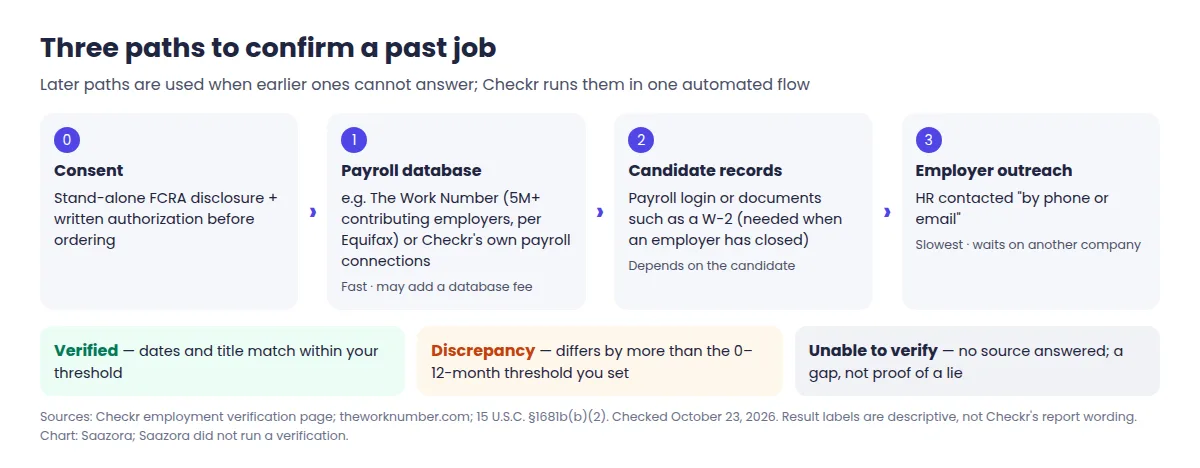
The order matters for your budget. A database answer is usually the fast one but is the path that carries a database fee; outreach adds time rather than a database charge. Checkr's package settings also let you choose a "0–12-month date matching threshold", which sets how far the dates a candidate typed can differ from the record before the result is flagged. A tight threshold catches more mismatches, including honest ones from people who rounded a start month.
Doing it yourself through The Work Number versus ordering through a screening company
You can buy verifications from The Work Number directly. Its pricing page describes a pay-per-order plan for organizations that verify "250 applicants or fewer a year", with a "typical implementation time frame" of "2-3 business days after sign-up", and says "prices start at $73.45 for some reports." Creating an account is free, but Equifax says that before you do, "you must have a valid, permissible purpose to purchase verifications", and new accounts go through a credentialing step.
| Question | Direct from The Work Number | Through a screening company such as Checkr |
|---|---|---|
| Setup | Free account, credentialing, "2-3 business days after sign-up" | Online account; Checkr describes pricing as pay-as-you-go |
| Price shown publicly | "Prices start at $73.45 for some reports"; varies by purpose and time period | From $12.50 per check, plus database fees passed through at cost |
| If the employer is not in the database | You make the calls yourself | The screening company does the outreach |
| FCRA paperwork | You still need a permissible purpose; Equifax lists FCRA-compliant delivery | Disclosure, authorization and adverse action steps (next sections) |
| Covers only database employers | Yes | No: database, candidate documents and outreach in one order |
Sources: theworknumber.com home and pricing pages; Checkr employment verification page and checkr.com/pricing. Checked October 23, 2026. The Work Number's price is its own "start at" wording; Saazora did not get a quote.
For a business that hires a handful of people a year, the direct route only answers for employers that contribute to that one database. Everything else still needs a phone call, which is the part a screening company is paid to do.
Why some employment verifications come back "unable to verify"
An "unable to verify" result means no source would confirm the job, not that the job was invented. The reasons below come from the vendors' own descriptions of where the process slows down; the "who can help" column is Saazora's reading of each case.
| Reason | What the vendor says | Who can help |
|---|---|---|
| Employer not in any database | Checkr: if the database "doesn't adequately verify employment", the employer must be contacted directly | The candidate, by giving an HR contact |
| Employer closed or was acquired | Checkr: a W-2 may be needed "because a previous employer is no longer in business" | The candidate, with W-2s or pay stubs |
| Small employer or hourly job | Checkr lists "limited coverage for hourly and small-business workers" | The candidate, with documents or a contact |
| Employer does not reply | Checkr describes "voicemail loops" and manual outreach delays | Time; a second contact route |
| Employer policy limits what it shares | Checkr: employers "can choose what they will and will not reveal" | Nobody; accept dates-only answers |
| Name changed since the job | Checkr packages search "up to 3 aliases (no additional cost)" | The candidate, by listing former names |
| Dates differ by more than the threshold | Checkr's "0–12-month date matching threshold" setting | The employer, by setting a sensible threshold |
| Job outside the US | Checkr sells international verification separately; international lookups are "more complex and time-consuming" | Plan for a longer wait |
Sources: Checkr employment verification page and Checkr's February 2026 article "The Hidden Hiring Bottleneck: Rethinking Employment Verification", checked October 23, 2026. The last column is Saazora's analysis.
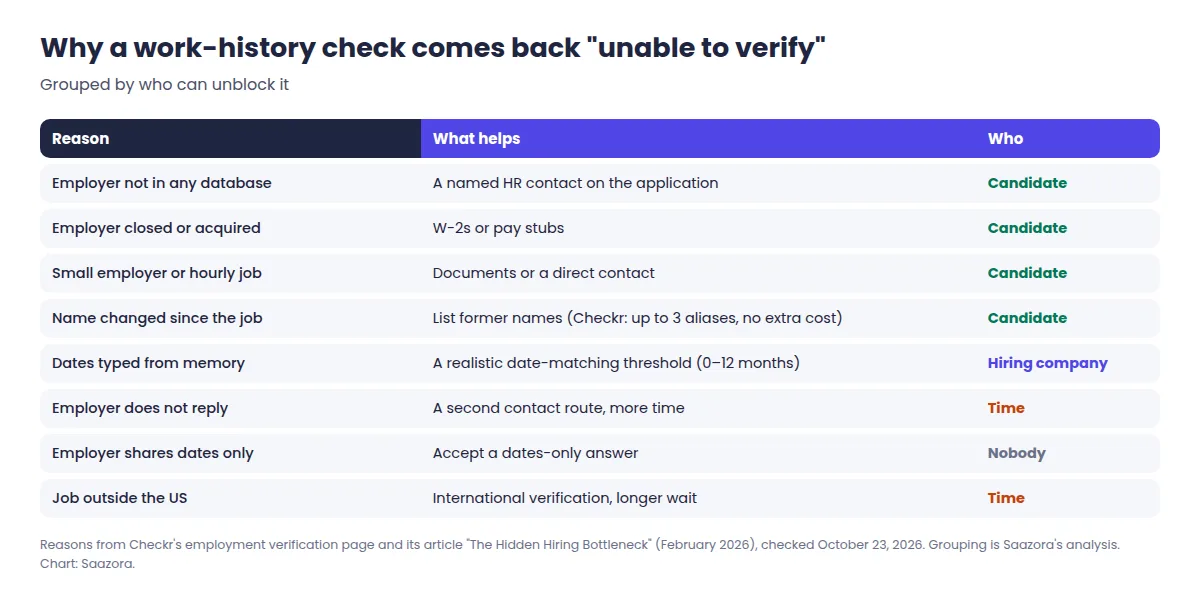
Two habits remove most of these delays. Ask candidates for each employer's legal name, location and an HR contact when they fill in the application, and tell them in advance that a W-2 or pay stub can stand in for a closed business. And treat an unverified job as a question to ask, not a reason to reject. If you do decide against a candidate because of what the report said, or did not say, the FCRA adverse action steps in the next section apply.
Consent: when the FCRA steps apply to a work-history check
The FCRA applies when a screening company prepares the report. The EEOC's joint guidance with the FTC puts it plainly: "when you run background checks through a company in the business of compiling background information, you must comply with the Fair Credit Reporting Act." That means:
- Disclosure first. Before the report is ordered, a "clear and conspicuous disclosure" in writing, "in a document that consists solely of the disclosure", that a report may be obtained for employment purposes (15 U.S.C. §1681b(b)(2)).
- Written authorization. "The consumer has authorized in writing", which the statute allows on the same document as the disclosure. The EEOC adds that if you want to run checks throughout employment, "make sure you say so clearly and conspicuously."
- Adverse action. If the verification leads you not to hire, send a pre-adverse action notice with a copy of the report and the CFPB Summary of Rights, wait, then send the final notice naming the screening company and the candidate's right to dispute (§1681b(b)(3) and §1681m).
What about calling a former employer yourself? The FCRA's definition of a consumer report leaves out a "report containing information solely as to transactions or experiences between the consumer and the person making the report" (§1681a(d)(2)(A)(i)). A past employer telling you about its own experience with the candidate generally falls in that exclusion, and the EEOC guidance attaches the extra FCRA procedures to information from "a company in the business of compiling background information." Some states add their own rules on what may be asked, so get the candidate's written consent in any case; it costs nothing and covers both routes.
Candidates have rights on the other side too. Equifax says people can see their own data on The Work Number, "see the names of any verifiers that have requested your information in the last 24 months", and "request a data freeze at any time and at no cost". If a screening company's report is wrong, the FCRA requires it to "conduct a reasonable reinvestigation" free of charge "before the end of the 30-day period" after it receives the dispute, extendable by up to 15 days when the candidate sends new information during that period (§1681i).
Salary history: where you cannot ask, even through a screening company
Salary is the one field in an employment verification that local law most often takes away. Two examples from official sources show the principle:
- New York City. The NYC Commission on Human Rights says that since October 31, 2017 "it became illegal for public and private employers of any size in New York City to ask about an applicant's salary history during the hiring process, including in advertisements for positions, on applications, or in interviews."
- California. The Labor Commissioner's Equal Pay Act FAQ says an employer "cannot, orally or in writing, personally or through an agent, seek salary history information, including compensation and benefits, about an applicant" (Labor Code §432.3(b)), and generally cannot rely on it to decide an offer. A candidate may still volunteer it "without prompting".
The words "through an agent" are the reason this matters for an employment verification check: a screening company ordering pay data for you is acting for you. Checkr's own page says salary history bans apply "at the state or local level and vary by jurisdiction", some only to government employers, and that its workflow is built to help with "state and local restrictions on asking for salary history." The safe default is to leave salary out of the package for every hire unless your lawyer confirms it is allowed where the candidate applies. Other states and cities have their own versions; check each place you hire in.
Education verification, briefly
Degree checks run on a similar two-path model. Checkr's fee overview says the National Student Clearinghouse "holds most education records", and its education page says "when the information requested is already in the system, education verifications typically take only a few minutes." When it is not, "the Clearinghouse will contact a participating school directly", and "the volume of pending requests and how promptly the school replies to requests will impact the turnaround time." The Clearinghouse itself describes verifying "high school diplomas and postsecondary enrollment and degrees" online. A GPA is "generally not included"; ask for a transcript if the role needs one.
On price, Checkr lists education verification at $12.50 for one degree, $18.75 for up to two and $25 for up to three, "not consumption based", with school-set pass-through fees of $3.95 to $50.00.
Cost per employment verification check: Checkr's lookback tiers plus pass-through fees
Checkr prices employment verification by how far back you look. Its pricing page, read on October 23, 2026, lists: "current employer ($12.50), last 3 years ($15), 5 years ($25), 7 years ($35), and 10 years ($50)." Its product page adds that "lookback period and number of employers verified impact pricing." On top of that come pass-through fees, which Checkr says are charged by others and "passed through at cost, with no markup":
- Third-party database fees: "range from $17.95-$119.95", depending on which database holds the record.
- Checkr's direct-match database: "$58, a one-time fee no matter how many times we use it", which "won't be combined with applicable third-party database fees." If that database is not used, "fee stacking can apply" across several past employers.
Here is what one check can cost at each tier under four fee cases. The fee cases are bounds taken from Checkr's published ranges, not a prediction for any candidate.
| Lookback (Checkr list price) | No database fee | + lowest third-party fee ($17.95) | + direct match ($58) | + highest third-party fee ($119.95) |
|---|---|---|---|---|
| Current employer ($12.50) | $12.50 | $30.45 | $70.50 | $132.45 |
| Last 3 years ($15) | $15.00 | $32.95 | $73.00 | $134.95 |
| 5 years ($25) | $25.00 | $42.95 | $83.00 | $144.95 |
| 7 years ($35) | $35.00 | $52.95 | $93.00 | $154.95 |
| 10 years ($50) | $50.00 | $67.95 | $108.00 | $169.95 |
Checkr list prices and fee ranges from checkr.com/pricing and Checkr's pass-through fee overview, October 23, 2026. Totals are Saazora arithmetic for one check; they leave out taxes and any per-employer pricing Checkr may apply. Stacked third-party fees across several employers can exceed the last column.
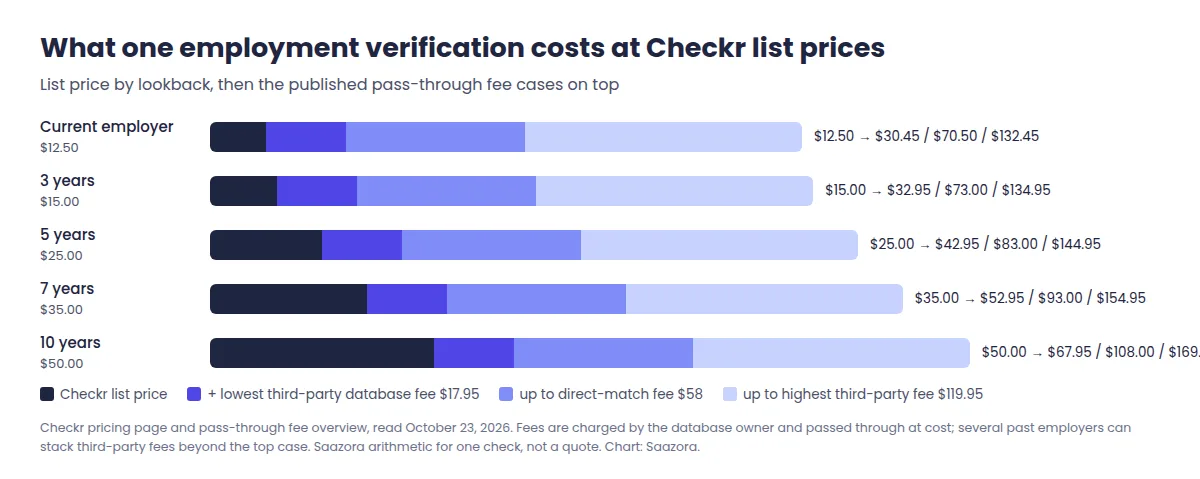
Three things stand out. First, the fee often costs more than the check: on a current-employer check, even the lowest database fee more than doubles the price. Second, the direct-match fee is capped at $58 per candidate, so for someone with several past employers it can come out cheaper than paying a third-party fee for each one. Third, the lookback is the lever you control. For an entry-level role, Checkr's own guidance suggests you "might check a candidate's employment going back three years", and seven years or more for a senior job.
A worked budget: ten hires a year at a seven-year lookback is 10 × $35 = $350 at list price. If every check hit the highest single database fee, the fees would add 10 × $119.95 = $1,199.50; if none did, they add nothing. Most budgets will land in between, which is why it helps to set aside a per-hire allowance for fees rather than plan on the list price alone. Checkr's product page speaks of "lowering passthrough fees" through its payroll connections, but its fee overview still lists the ranges above, so budget for them. Driving roles regulated by the Department of Transportation use a separate DOT employment verification, listed from $19.50 for the current employer to $57 for ten years, with DOT source fees of $7.00 to $70.00.
Employment verification is an add-on to Checkr's background check packages (Basic $29.99, Essential $59.99, Complete $94.99 per report) or can be ordered "as a standalone screening". Our breakdown of every Checkr package and add-on price covers the rest of the list, and what a full background check costs a small business per hire puts the verification inside a whole screening budget. When you are ready to add it to a package, you can set up employment verification on Checkr (affiliate link); Checkr describes its business pricing as pay-as-you-go, charged per report.
Turnaround, in the vendors' own words
No vendor promises a fixed time, and each phrases it with a condition:
- Checkr, employment: "Most verifications complete in under 3 days", through "payroll integrations, AI-powered document review, and employer outreach". Lower on the same page: "The majority of our employment verifications are completed within minutes." Both are Checkr's statements about its own volume, not a guarantee for one candidate.
- Checkr, doing it yourself: contacting each past employer "could take weeks" for an HR team.
- Checkr, education: "a few minutes" when the record is already in the Clearinghouse; longer when the school has to reply.
- The Work Number: "Verifications returned instantly" once your account is set up, for employers in its database.
The pattern is the same as the cost pattern: a database answer is fast, a human answer waits on someone else's inbox. Checkr says its AI tools flag "errors or inflated job titles" and that "human review ensures oversight"; the hiring decision stays with you. Our guide to how long each part of a background check takes covers the full timeline.
Employment verification questions from hiring managers
Is an employment verification check part of a standard background check?
Not by default. Checkr's Basic, Essential and Complete packages are built around criminal and identity searches; employment verification is an add-on or a standalone order. Checkr's page notes that "unless laws require specific types of checks based on job title or industry, employers are generally free to determine" what to include.
How far back does an employment verification go?
As far as you pay for. Checkr's settings run from the current employer to a ten-year lookback, and its product page describes a "1–10 year lookback window" with 1 to unlimited employers.
Can a past employer refuse to confirm a job?
It can limit what it shares; many confirm only dates and title. If it will not respond at all, a W-2 or pay stub from the candidate is the usual substitute.
Should I reject a candidate whose job comes back unverified?
Not on that alone. Ask for documents first. If the report still leads you to say no, follow the pre-adverse and adverse action steps, because the decision was based on a consumer report.
How this guide was researched
On October 23, 2026 we read Checkr's employment verification and education verification pages, its pricing page, its pass-through fee overview and its February 2026 article on employment verification; The Work Number's home, pricing and employee pages from Equifax; the National Student Clearinghouse business verifications page; 15 U.S.C. §§1681a, 1681b and 1681i via Cornell's Legal Information Institute; the EEOC's "Background Checks: What Employers Need to Know"; the NYC Commission on Human Rights salary history page; and the California Labor Commissioner's Equal Pay Act FAQ. Checkr's help-center article on employment verification would not load for us, so nothing from it is used. Saazora did not order any verification, and we do not rate any company's speed or accuracy. Every price is a published list price with the date it was read.
All of Saazora's screening guides live in our HR and hiring tools section, and the Checkr store page lists current offer terms. To compare packages before ordering, see Checkr's business pricing (affiliate link).
Sources (checked October 23, 2026): Checkr, Employment verification; Checkr, Education verification; Checkr, Passthrough fees overview; Checkr, The Hidden Hiring Bottleneck (February 2026); The Work Number, Pricing and home page; The Work Number for Employees; National Student Clearinghouse, Business Verifications; Cornell LII, 15 U.S. Code §1681b, §1681a and §1681i; EEOC and FTC, Background Checks: What Employers Need to Know; NYC Commission on Human Rights, Salary History; California Labor Commissioner, Equal Pay Act FAQ.
Research guide, not hands-on testing and not legal advice. Checkr did not pay for or review this article.