
Research guide built from public pages, not hands-on testing: Saazora did not order a background check for a restaurant or hotel worker for this article · Checkr prices read on checkr.com/pricing on October 26, 2026 (unchanged from a copy saved October 22) · BLS turnover data, Checkr's turnaround guide and the New York City, California and Philadelphia fair-chance sources checked October 26, 2026 · This is not legal advice; screening and fair-chance rules vary by state and city, so have an employment lawyer review your policy · We may earn a commission if you sign up through links on this page.
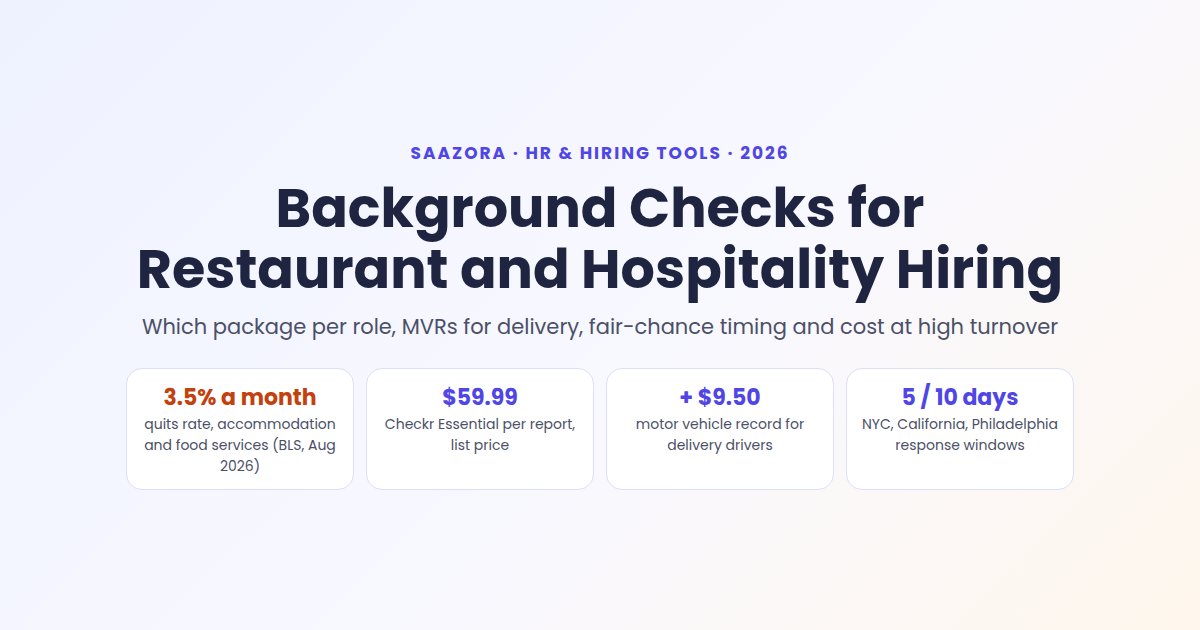
A restaurant background check does not need to be the most expensive package. For most front-of-house and kitchen roles (servers, bartenders, hosts, line cooks, dishwashers), a criminal search package with a county court search covers what a restaurant usually needs to see. Add a motor vehicle record only for people who drive for you, and save the deepest search for managers and staff who handle cash, keys or guest rooms. What makes hospitality different is volume: the U.S. Bureau of Labor Statistics put the monthly quits rate in accommodation and food services at 3.5% in August 2026, the highest of any private industry, so a restaurant screens the same position again and again. That turns small per-report differences, the order of checks and fair-chance timing into real money and real legal risk.
This guide is for owners, general managers and HR leads at restaurants, delivery-heavy kitchens, hotels and resorts. It maps each common role to a package, shows when the driving record belongs in the order, explains how to get people onto the schedule quickly without skipping a legal step, compares three fair-chance laws that hit hospitality hiring hard, and prices a year of screening for a 40-person restaurant at three turnover rates. If you have never ordered a check before, read the eight-step process for an employee background check first; this page assumes the basic consent paperwork and builds on it for high-volume hiring.
Restaurant background check by role: what to run for each job
Checkr's three business packages are the same for every industry. At list price on October 26, 2026: Basic at $29.99 per report (SSN trace, sex offender registry, global watchlist search and national criminal search), Essential at $59.99 (adds identity verification and unlimited county criminal searches) and Complete at $94.99 (adds unlimited state criminal searches and a federal criminal search). A motor vehicle record (MVR) is $9.50 per check, and court and DMV access fees are passed through at cost on top of every order.
The table below is Saazora's suggested starting point for common hospitality roles. It is a planning aid, not a rule: your own policy, your insurer and any state or local law for a specific job come first.
| Role | What the job touches | Starting package | Add-ons worth considering | List price before pass-through fees |
|---|---|---|---|---|
| Dishwasher, prep cook, line cook | Kitchen only, no cash, no guest contact alone | Basic or Essential | None in most cases | $29.99 or $59.99 |
| Server, host, barista, bartender | Guests, card payments, cash drawer at some venues | Essential | None in most cases | $59.99 |
| Delivery driver in a personal or company car | Public roads, customer doors, your insurance policy | Essential | MVR ($9.50); Continuous MVR ($2.50 per driver per month) | $69.49 + monitoring |
| Housekeeper, room attendant, maintenance, bell staff | Keys and access to guest rooms | Essential | Continuous criminal search ($1.70 per person per month) if your policy re-checks staff | $59.99 + optional monitoring |
| Night auditor, cashier lead, bar manager | Cash counts, deposits, voids and comps | Complete | Employment verification (from $12.50) | $94.99 + $12.50 |
| General manager, kitchen manager, hotel department head | Hiring, vendor payments, keys to the whole site | Complete | Employment verification (from $12.50); education verification (from $12.50) if the job requires a degree | $107.49 and up |
Package contents and prices from checkr.com/pricing, checked October 26, 2026. Role mapping is Saazora's suggestion, not a Checkr recommendation. Pass-through court and DMV fees are extra. Not legal advice.
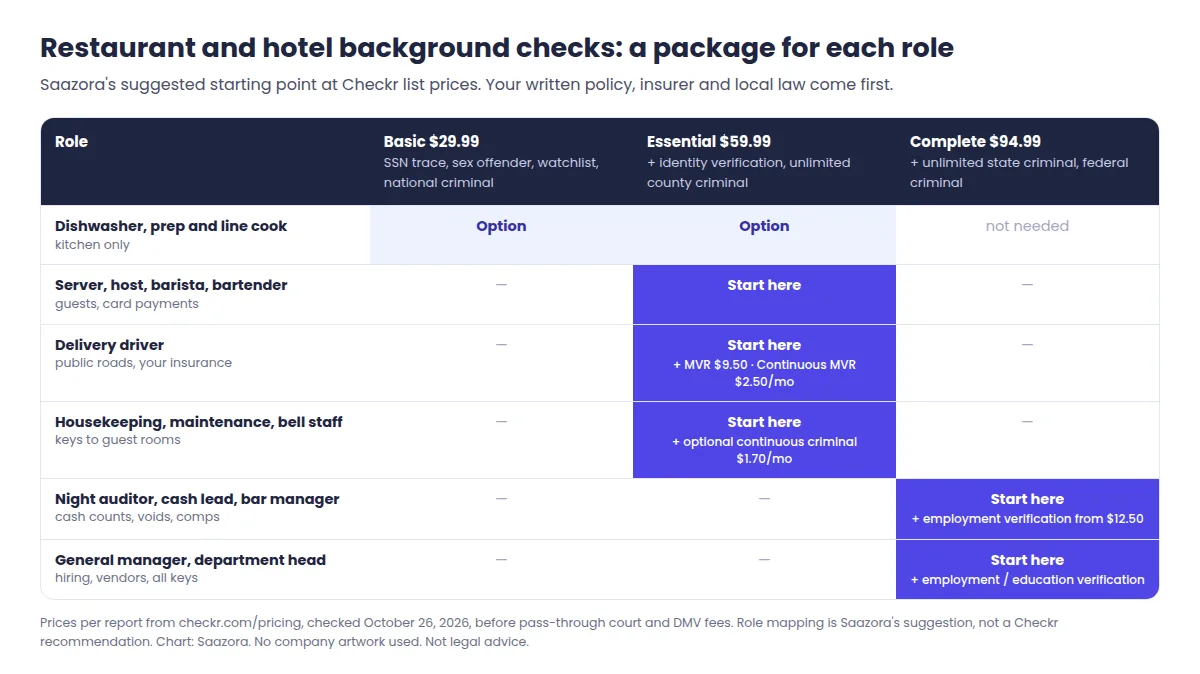
Two patterns are worth noticing. First, the jump from Basic to Essential is mostly about the county court search: a national criminal database search is a fast first pass, while the county search goes to the courts where a person has lived, and identity verification comes included. Second, the roles that justify Complete in hospitality are defined by money and access, not seniority. A night auditor who closes out the day's cash can carry more risk than a sous chef, so tie the package to the job duties you write down and apply it the same way to every candidate for that role. For prices at other providers and a budget by role type, see our price comparison of background check providers for small businesses.
One check that is not a background check at all: the federal Form I-9 for employment eligibility. Every new hire needs it regardless of package. Checkr lists I-9 verifications at $7 per form, so a multi-location group can keep both in one workflow, but the I-9 has its own rules and is not covered by the FCRA steps in this guide.
Why turnover changes the math on screening
The BLS Job Openings and Labor Turnover Survey measures quits as a share of employment each month. In its October 13, 2026 summary, BLS reported that "the quits rate was 2.1 percent in private industry as a whole" in August 2026, with accommodation and food services at the top of the range at 3.5 percent. The total nonfarm rate was 1.9 percent.
Turn that into a staffing plan and the scale becomes clear. If 3.5% of a workforce quits every month and the rate holds for a year, that is about 42 quits for every 100 jobs. This is Saazora's own arithmetic, it assumes the August rate stays flat, and it counts only people who leave on their own, not dismissals, seasonal layoffs or candidates who accept an offer and never show up. Real replacement hiring can be higher.
Three consequences follow for a hospitality screening program:
- Per-report price differences add up. The $30 gap between Basic and Essential is trivial for one hire and noticeable across dozens of replacements a year, which is why the package choice per role matters more here than in a low-turnover office.
- Checks on people who never start are a real cost. A report you ordered is billed whether or not the candidate shows up for orientation. Ordering only after a conditional offer, which several fair-chance laws require anyway, keeps that waste down.
- Paperwork has to be repeatable. With frequent hiring, a manager on a Friday night is often the person sending the consent form. A standard disclosure, a standard authorization and a standard adverse action script per location reduce the chance that one rushed hire breaks the process.
Delivery drivers: when the driving record belongs in the order
Delivery is where restaurant screening most often goes beyond a criminal search. If someone drives a personal or company car on your behalf, an MVR shows license status, violations and accidents from the state's motor vehicle records. Checkr lists the MVR at $9.50 per check plus any state fee, and Continuous MVR at $2.50 per enrolled driver per month, which "monitors a driver's motor vehicle record and alerts you to new violations, license status changes, and accidents". Any change that triggers a new report is billed at the standard MVR rate.
Three practical points for restaurant delivery:
- Tie the MVR to how the job is done. Order it for car and scooter delivery where a license is required; skip it for walking or bike couriers and in-house staff who never drive for work.
- Ask your insurer first. Commercial auto and hired and non-owned auto policies can set their own standards for who may drive for the business. The MVR is how you show you checked, so build the package around those standards.
- Decide between yearly pulls and monitoring. One extra MVR per driver per year costs $9.50 plus the state fee; Continuous MVR costs $30 per driver per year before state enrollment fees. Our MVR guide with state-by-state fees works through that choice and what a driving record does and does not show, so this page does not repeat it.
Checkr lists restaurant and delivery brands such as McDonald's, Subway, Steak N Shake, Domino's and DoorDash among its customers. If you use third-party delivery apps instead of your own drivers, those couriers are screened by the platform under its own policy, not by you.
Getting new hires on the schedule fast without skipping a step
Speed is the most common reason restaurants cut corners on screening: a cook quits on Tuesday and the replacement needs to be on the line by the weekend. The legal order of steps does not change, but you can make each one faster.
On turnaround, the only figures used here are Checkr's own, with its conditions. Its June 22, 2026 guide says pre-employment checks "may take anywhere from minutes to several business days, depending on the comprehensiveness of the search, the types of screenings performed, the ease of communication with candidates, and whether an employer uses a background check company". It gives typical ranges by check type and says that "89% of criminal checks at Checkr are completed within one hour", while noting that turnaround times vary by screening type.
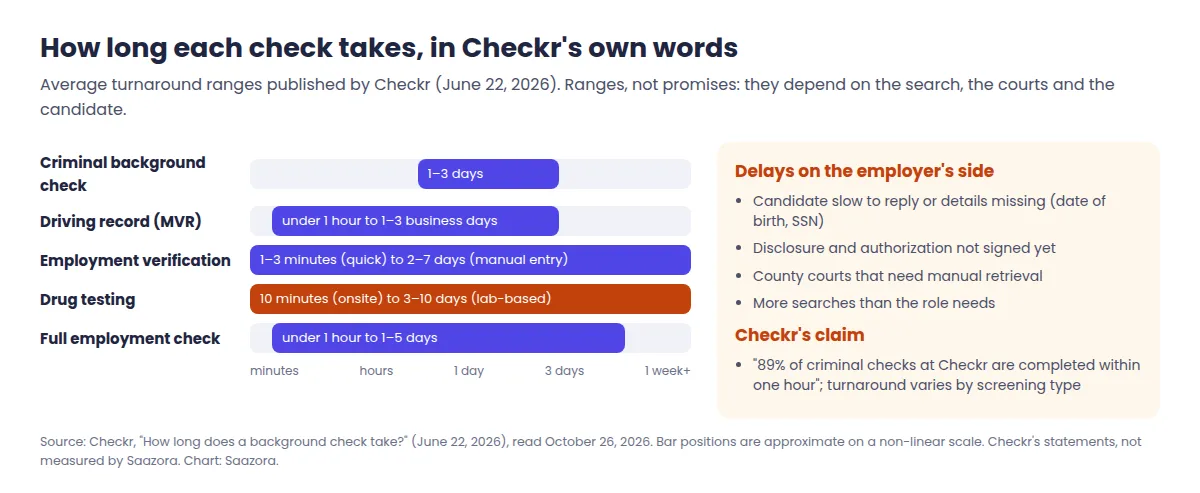
The same guide names the delays that sit on the employer's side, and they are the ones a busy restaurant can fix:
- Collect complete details once. Checkr notes that slow candidate responses and missing details such as a date of birth or Social Security number delay the check. Send the candidate invitation from the platform the moment the conditional offer is made, not at the end of the shift.
- Get the disclosure and authorization signed on the spot. The FCRA consent comes before the order. The FTC says the notice "must be in writing and in a stand-alone format", so keep it as its own screen or page, separate from the application and the handbook.
- Order only what the role needs. Database searches can return in minutes; county searches take longer when a court requires manual retrieval. A dishwasher does not need the state and federal searches that come with Complete.
- Decide in writing whether anyone may start before the report is back. Some operators let a new hire work while a check is pending. If you do, put it in your policy and treat the hire as conditional. California's Civil Rights Department states that its Fair Chance Act covers "people who start work before their employer runs a background check", so starting early does not take someone outside the law.
If a report does show something you might act on, the pre-adverse notice, waiting period and final notice still apply. The eight-step walkthrough linked above covers those notices in full; the next section covers the extra waiting periods three hospitality-heavy places add.
Fair-chance rules in New York City, California and Philadelphia
Many states and cities limit when and how employers may look at criminal history. The principle in most of them is the same: judge the candidate on qualifications first, make a conditional offer, then look at criminal history, and give the person a chance to respond before withdrawing the offer. The details differ, and three places with big restaurant and hotel workforces show how much. We read each law's official source; other states and cities have their own rules, so check where your locations are.
| New York City Fair Chance Act | California Fair Chance Act | Philadelphia Fair Criminal Record Screening Standards | |
|---|---|---|---|
| Which employers | Four or more employees | Public employers and private employers with five or more employees, including temporary employment agencies | Private employers in the city, plus third parties that facilitate work for pay between two other parties |
| Hospitality-relevant coverage | For temporary help firms, the conditional offer is the offer to place someone in the labor pool | Covers job applicants and "people who start work before their employer runs a background check" | "Employment" includes "temporary or seasonal work, contracted work, contingent work" |
| When criminal history may be checked | After a conditional offer | After a conditional offer | After a conditional offer |
| What may not be considered | Assessed case by case with the Fair Chance Analysis | Arrests without conviction (limited exceptions), sealed or dismissed records, and conviction history more than seven years old | Convictions older than seven years, not counting time in prison |
| Before a final decision | Written copy of the inquiry and Fair Chance Analysis; at least 5 business days to respond | Written notice with the convictions and report; at least 5 business days, at least 10 days if the person challenges the report's accuracy | Written notice with the basis and a copy of the report; 10 business days to respond |
NYC Commission on Human Rights, Legal Enforcement Guidance on the Fair Chance Act (reflecting Local Law 4 of 2021, effective July 29, 2021); California Civil Rights Department, Fair Chance Act page and Criminal History and Employment Fact Sheet (June 2025), Gov. Code §12952; Philadelphia Bill No. 200479 (certified copy). Read October 26, 2026. Not legal advice.
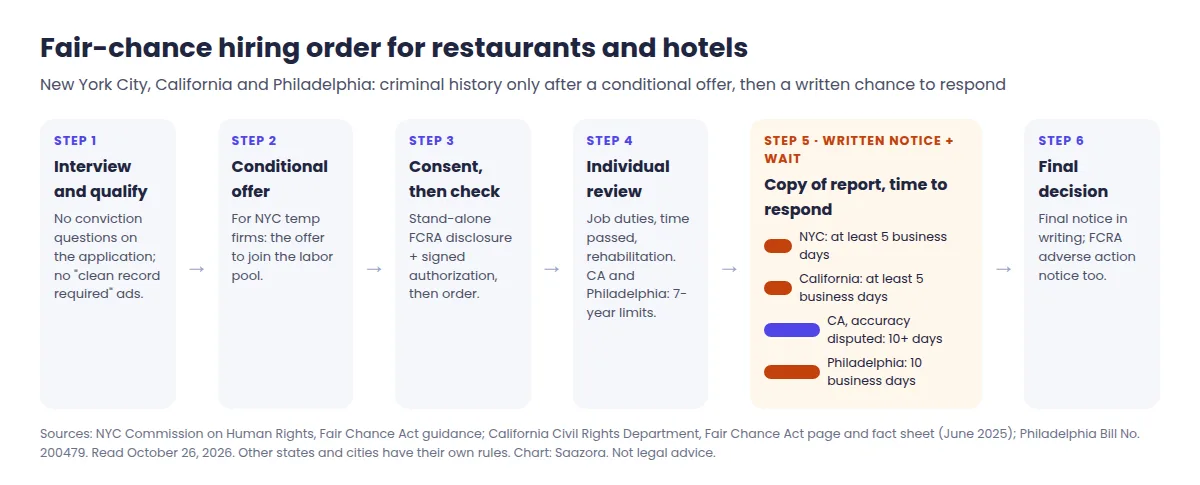
For a restaurant group, the operational lessons are specific. Job ads that say "clean record required" are a problem under these laws; California's fact sheet names "Must Have Clean Record" as an example of a statement to avoid. Seasonal and temporary hiring for summer patios, holiday banquets or resort seasons is still covered in Philadelphia. And the waiting period is real time: in New York City the guidance says that during the response period an employer may not permanently place another person in the role, so plan cover shifts rather than filling the spot the same day.
If your locations span several states, the simplest approach is to build the hiring flow around the strictest rule you are subject to and apply it everywhere, then have a lawyer confirm the exceptions. Federal law adds its own layer: the FCRA's pre-adverse and adverse action notices apply on top of these local steps.
What a year of screening costs a 40-person restaurant
To make the turnover point concrete, here is an illustrative budget for a restaurant with 40 hourly staff: 34 in the kitchen and front of house screened with Essential, and 6 delivery drivers screened with Essential plus an MVR and enrolled in Continuous MVR. The annual hiring counts apply each turnover rate to each group and round to whole hires. The 42% row is the BLS August 2026 quits rate held for twelve months; the 75% and 100% rows are assumptions for comparison, not published figures.
| Annual turnover (replacement hires) | Staff hires × Essential $59.99 | Driver hires × ($59.99 + $9.50 MVR) | Continuous MVR, 6 drivers × $2.50 × 12 | Year total | Per position per year |
|---|---|---|---|---|---|
| 42% (BLS quits rate × 12) | 14 × $59.99 = $839.86 | 3 × $69.49 = $208.47 | $180.00 | $1,228.33 | $30.71 |
| 75% (assumption) | 26 × $59.99 = $1,559.74 | 5 × $69.49 = $347.45 | $180.00 | $2,087.19 | $52.18 |
| 100% (assumption) | 34 × $59.99 = $2,039.66 | 6 × $69.49 = $416.94 | $180.00 | $2,636.60 | $65.92 |
Checkr list prices from checkr.com/pricing, October 26, 2026, before pass-through court and DMV fees and state MVR enrollment fees. Turnover rates of 75% and 100% are illustrative assumptions. All totals are Saazora calculations.
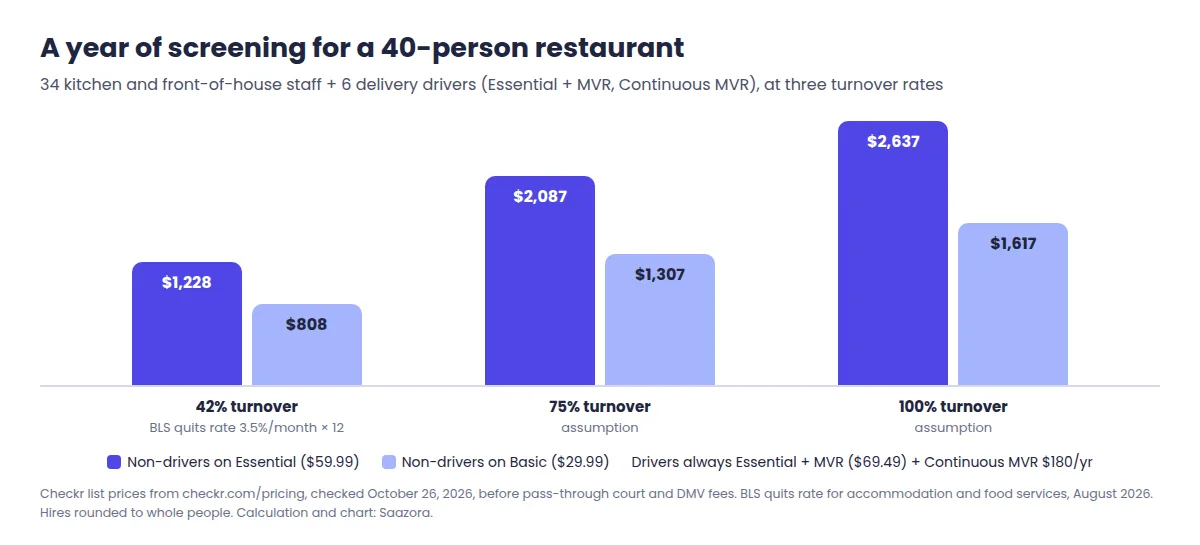
What the numbers say:
- Turnover moves the budget more than the package does. Going from 42% to 100% turnover more than doubles the bill, from about $1,228 to about $2,637 a year.
- Basic instead of Essential for the 34 non-drivers saves $30 a hire. At 42% turnover that brings the year to $808.33; at 100% it brings it to $1,616.60. The trade-off is losing the county court search and the included identity verification, so decide by role, not only by price.
- Drivers cost more to keep than to hire. Continuous MVR for six drivers ($180 a year) is close to the cost of screening three new drivers. If your drivers turn over quickly, a single MVR at hire plus a yearly pull may be enough; if they stay for years, monitoring catches changes between pulls.
- Pass-through fees vary by location. County court fees and state DMV fees are billed at cost and are not in the table. Our breakdown of Checkr package prices and pass-through fees shows how much they can add per order.
Checkr describes its pricing as "simple, pay-as-you-go", priced per report, so a single-location restaurant pays for the reports it orders rather than a plan sized for a large chain. If you want to set up role-based packages for your locations, you can create a Checkr account for restaurant hiring (affiliate link).
Hotels, resorts and casinos: guest-room access, cash and licensed roles
Hotels add a risk that most restaurants do not have: staff who carry keys to rooms where guests sleep and leave belongings. That is why housekeeping, maintenance, engineering and bell staff sit on Essential in the role table rather than Basic, and why some hotels re-check staff with room access while they are employed. If you plan to re-check or monitor people after hire, say so clearly in the original authorization, as the FTC advises, and treat any new finding as a new report with the same notices before acting on it.
A few points specific to larger properties:
- Night audit and front-office cash. Roles that close out the day's revenue, handle refunds or post comps are where the state and federal searches in Complete, plus an employment verification, are easiest to justify.
- Seasonal surges. A resort that hires a summer or ski-season wave needs the same consent and fair-chance steps for every seasonal worker. In Philadelphia, seasonal work is named in the law.
- Licensed gaming jobs. Casino operators such as Harrah's work under state gaming regulators, which can set their own licensing and screening requirements for gaming staff. Check with your regulator before building packages for those roles; this guide does not cover gaming licenses.
- Brand standards. Franchised and managed hotels may have screening standards in their brand agreements. Checkr lists Kimpton among its customers; ask your brand or management company what it requires before you write your own policy.
A hiring-week checklist for restaurants and hotels
Use this list to set up a restaurant background check program, or a hotel one, that holds up under constant hiring.
- ☐ One written screening policy per role (kitchen, front of house, delivery, housekeeping, cash-handling, management), reviewed by a lawyer.
- ☐ Job ads without "no felons" or "clean record" language.
- ☐ Conditional offer first where fair-chance laws apply, then the consent and the check.
- ☐ A stand-alone disclosure and a signed authorization, sent from the platform at the moment of the offer.
- ☐ MVR only for people who drive for work; a decision on yearly pulls or Continuous MVR.
- ☐ A written rule on whether a new hire may work while the report is pending.
- ☐ Pre-adverse notice with the report, the longest local response window that applies, then the final notice.
- ☐ Cover shifts planned for the waiting period instead of filling the role immediately.
- ☐ Form I-9 completed for every new hire, separately from the background check.
- ☐ Consent records, notices and decisions stored for each hire at each location.
All the guides in this series are collected in the HR and hiring tools hub, and our Checkr offers page keeps the current sign-up terms in one place. When your role policy is ready, compare Checkr's packages for hospitality roles (affiliate link).
Questions restaurant and hotel owners ask about screening
Do restaurants have to run background checks on employees?
For most restaurant jobs it is the employer's policy choice: the FCRA governs how you run a check, not whether you must. Some roles can carry their own requirements, such as drivers under your insurance policy or licensed gaming jobs at a casino. If you do run a restaurant background check, the FCRA consent and notice steps apply, and state or city fair-chance laws may control when you can look at criminal history.
Which package should I use for servers and bartenders?
Saazora's suggested starting point is a package that includes a county criminal search, such as Checkr's Essential at $59.99 (list price, October 26, 2026). Basic at $29.99 relies on the national database search without the county court search. Decide per role and apply the same choice to every candidate for that role.
Can a new cook start working before the background check comes back?
That is a policy choice for the employer; write it down and treat the hire as conditional. In California, the Civil Rights Department says the Fair Chance Act covers people who start work before their employer runs a background check, so the same assessment and notice steps apply if the report later leads you to let them go.
Do I need an MVR for delivery drivers who use their own car?
If they drive for your business, an MVR is the record that shows license status and violations, and your insurer may expect it. Checkr lists it at $9.50 per check plus state fees. Couriers who walk or ride a bike usually do not need one.
How this guide was researched
On October 26, 2026 we read checkr.com/pricing (identical to a copy saved October 22), Checkr's June 22, 2026 guide to background check turnaround times, the BLS Economics Daily summary of August 2026 quits rates by industry, the New York City Commission on Human Rights guidance on the Fair Chance Act, the California Civil Rights Department's Fair Chance Act page and its June 2025 fact sheet, and the certified text of Philadelphia Bill No. 200479. FCRA consent steps follow the FTC's employer guide, read October 23, 2026. Checkr's customer names come from Checkr's published customer list. The role-to-package map and the cost table are Saazora's own analysis; Saazora did not order any background check for this article and does not rate any company's speed or accuracy. We did not research state alcohol-server permits, food-handler cards or gaming licenses, and we covered only the state-level law in California, not city ordinances there.
Sources (checked October 26, 2026): BLS, Quits rate 3.5 percent in accommodation and food services, August 2026 (October 13, 2026); Checkr, How long does a background check take? (June 22, 2026) and pricing page; NYC Commission on Human Rights, Fair Chance Act guidance; California Civil Rights Department, Fair Chance Act and Criminal History and Employment Fact Sheet (June 2025); City of Philadelphia, Bill No. 200479 (certified copy); FTC, Using Consumer Reports: What Employers Need to Know.
Research guide, not hands-on testing and not legal advice. Checkr did not pay for or review this article.