
Last checked October 13, 2026 · Research-based guide, not legal advice
Saazora may earn a commission if you sign up through some links on this page, at no extra cost to you.
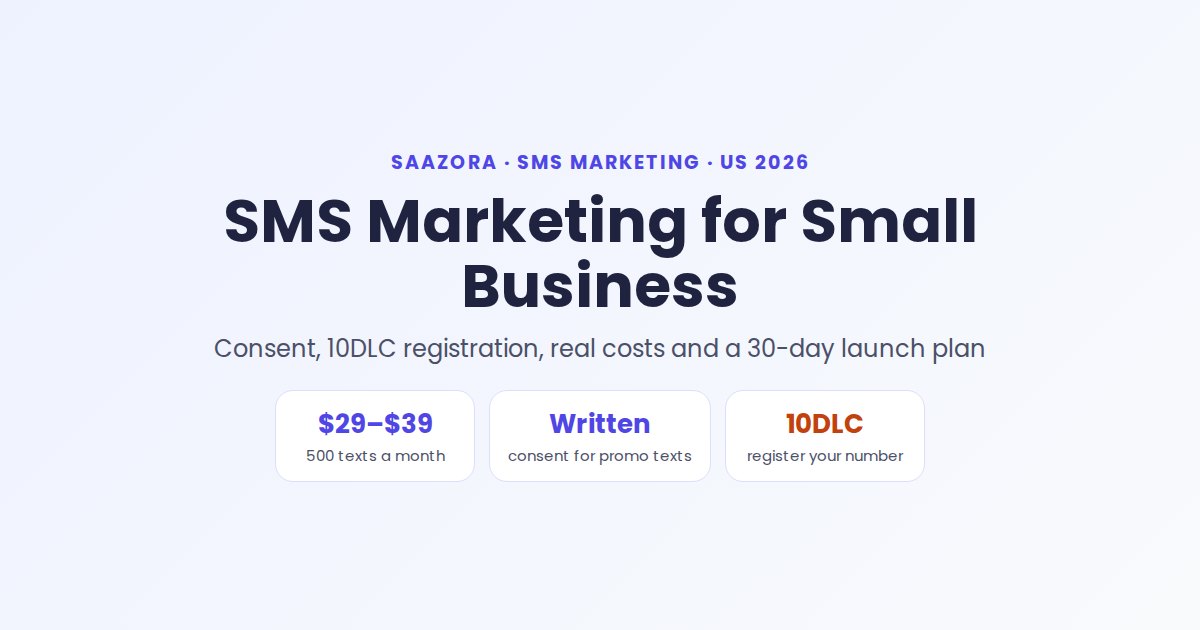
SMS marketing for small business comes down to four jobs: get written permission to text people, register the number you send from, pick a texting platform, and send a small number of useful messages. In the US, an entry plan for about 500 texts a month costs roughly $29 to $39 on the popular platforms, and carriers expect every business number to be registered before it sends marketing traffic.
This guide walks through those steps in the order you will actually do them, with the rules from the FCC and the wireless industry, real fees checked on vendor pages on October 13, 2026, and copy-ready opt-in wording. If you still need a business line to text from, start with our guide on how to get a virtual US phone number.
Is SMS marketing a good fit for your business?
Texting works best when a message is short, timely and something the customer asked for. That is the core test for SMS marketing for small business: would your customer be glad this landed on their phone? The carriers' trade group, CTIA, sorts business texts into three kinds, and each one carries a different consent expectation:
| Message type | Small business example | Consent CTIA expects |
|---|---|---|
| Conversational | A customer texts "Are you open Sunday?" and you reply | None beyond the customer starting the chat |
| Informational | Appointment reminders, order or pickup alerts | Agreement to receive texts for that purpose |
| Promotional | "20% off this weekend", new menu, flash sale | Express written consent for marketing |
Most owners start with promotional texts and add reminders later. That order is fine, but it means the strictest consent rules apply from day one. A salon, a restaurant, a gym or a local retailer with repeat customers usually gets the most out of it. A business that sells once every few years (roofing, say) is better off using texts for quotes and appointment updates than for a weekly promo list.
What US rules apply before you send the first text?
Three sets of rules overlap: federal law (the Telephone Consumer Protection Act, enforced by the FCC), carrier rules published by CTIA, and the 10DLC registration system the carriers run. You do not need a lawyer to start, but you do need to get these basics right.
1. Written consent for marketing texts
The FCC's TCPA rules (47 CFR 64.1200) require prior express written consent for autodialed or prerecorded marketing calls to cell phones. The rule defines that consent as a signed written agreement (electronic signatures valid under federal or state law count) with a clear and conspicuous disclosure, and it says the customer cannot be required to agree as a condition of buying anything. CTIA's Messaging Principles say the same thing in carrier terms: get express written consent before sending marketing messages. SimpleTexting's own compliance guide tells customers to collect it before any promotional text.
2. Easy opt-out, honored fast
Under the current FCC rule, a customer can revoke consent "in any reasonable manner", and replying stop, quit, end, revoke, opt out, cancel or unsubscribe always counts. You must honor it within a reasonable time, no later than 10 business days, and you may send one confirmation text without marketing content. In September 2026 the FCC voted to revise parts of the revocation rules (including letting senders name standard reply keywords as the opt-out method), and it is asking whether to shorten the 10-day window. Treat STOP as instant and you will be safe under either version.
3. Sending hours and honest disclosures
The TCPA bars telephone solicitations before 8 a.m. or after 9 p.m. in the recipient's local time. CTIA also expects your opt-in to name the program, say how often you text, explain fees ("Msg & data rates may apply"), and show HELP and STOP instructions. Never text a bought or shared list; CTIA says opt-in lists that were rented, sold or shared should not be used.
4. Register your number (10DLC)
If you text from an ordinary 10-digit local number, carriers require you to register your brand and use case with The Campaign Registry. That is "10DLC" registration. Your texting platform files it for you, and the fees are covered in the next section.
This is a plain-English summary for planning, not legal advice. Some states have their own telemarketing laws that also cover texts, so check yours.
Local number, toll-free or short code: which should you text from?
Your sending number decides your setup fees, how quickly you can start and how many texts carriers let through. Using SimpleTexting's published fees as the example:
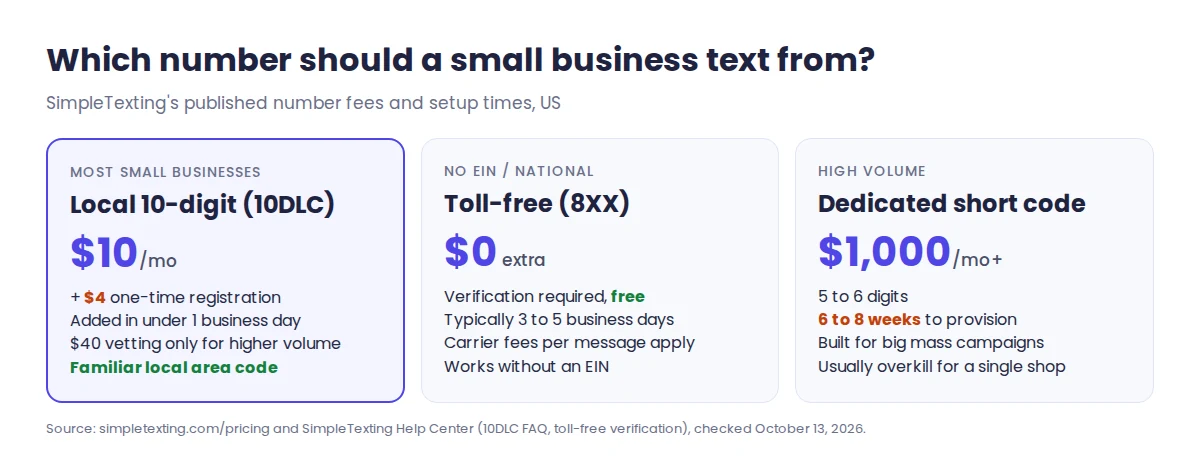
| Number type | Monthly fee (SimpleTexting) | Setup | Best for |
|---|---|---|---|
| Local 10-digit (10DLC) | $10, plus $4 one-time registration | Usually within a business day; $40 vetting if you need higher throughput | Most local businesses; customers recognize the area code |
| Toll-free (8XX) | No extra fee | Free verification, typically 3 to 5 business days | Businesses without an EIN, or national brands |
| Dedicated short code | From $1,000 | 6 to 8 weeks to provision | High-volume retail and big campaigns |
For most small businesses a local number is the right call. SimpleTexting notes that 10DLC registration needs an EIN; if you do not have one, a verified toll-free number is the workaround. Other platforms price numbers differently: Textedly includes one toll-free and one 10DLC number and pays the registration for your first 10DLC number, while EZ Texting includes carrier registration in its plans.
How much does SMS marketing for small business cost each month?
Plan prices look alike at the low end, but the fees around them do not. Here is what about 500 texts a month costs on monthly billing with a local number, from each vendor's pricing page on October 13, 2026:
| Platform | 500-text plan | Number and carrier costs | Starting monthly total | Trial or free option |
|---|---|---|---|---|
| SimpleTexting | $29 | $10/mo local number, $4 one-time, carrier fees passed through | $39 | 14-day trial, no card |
| EZ Texting (Launch) | $25 | $5/mo Telecom Fee on Launch; registration and 10DLC carrier fees included | $30 | 14-day trial |
| Textedly (Basic) | $29 | First 10DLC registration paid by Textedly; fees apply to extra numbers | $29 | Free account with 50 texts |
| SlickText | $29 | Carrier fees passed through at cost | $29 + carrier fees | Free start, no card |
| Twilio (build it yourself) | $4.15 in usage ($0.0083 per text) | $1.15/mo number, carrier fees, 10DLC: $4.50 brand + $15 vetting, then $2 to $10/mo | About $9 to $18, plus software and developer time | Free to start |
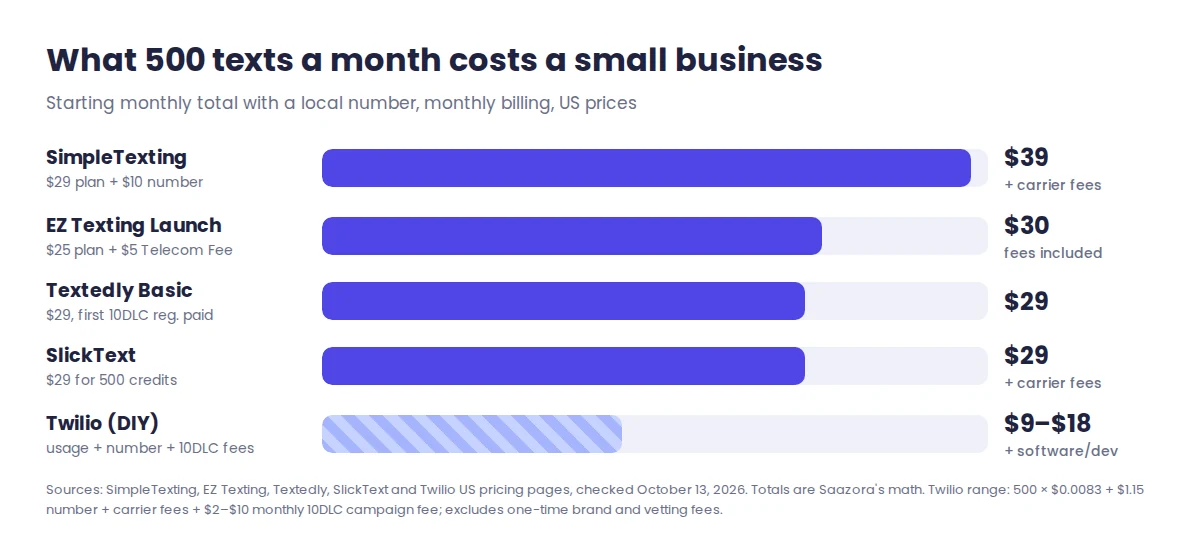
Yearly billing lowers most of these: SimpleTexting takes 20% off its credit price ($33.20 a month with the number), EZ Texting's Launch drops to $20 a month, Textedly keeps the price but adds 20% more texts, and SlickText gives two months free. Twilio is the cheapest per message, but it is a developer platform: you or a contractor build the opt-in, the sending tool and the unsubscribe handling yourself.
Carrier surcharges are small but real. At the per-message rates SimpleTexting publishes for local numbers (a third to under half a cent per text on the three big networks), a list that gets 2,000 texts a month adds roughly $7 to $9 on any platform that passes those fees through.
How many texts will you actually need?
Platforms sell credits, not contacts, so the math is subscribers × messages per month. A plain text up to 160 characters uses 1 credit. On SimpleTexting a picture message (MMS) uses 3, and a longer 306-character message uses 2.
- Coffee shop, 400 subscribers, one offer a week: 400 × 4 = 1,600 credits a month.
- Same shop, but one of the four sends has a photo: 1,200 + (400 × 3) = 2,400 credits, enough to push you up a tier.
- Clinic sending reminders only: 300 appointments × 2 reminders = 600 credits, plus free replies on most platforms.
Pick the plan that covers a normal month, not your busiest one. Extra texts are billed per credit, and some platforms roll unused credits forward (SimpleTexting does on monthly plans; SlickText lists rollover on every plan).
A 30-day plan to launch your first SMS campaign
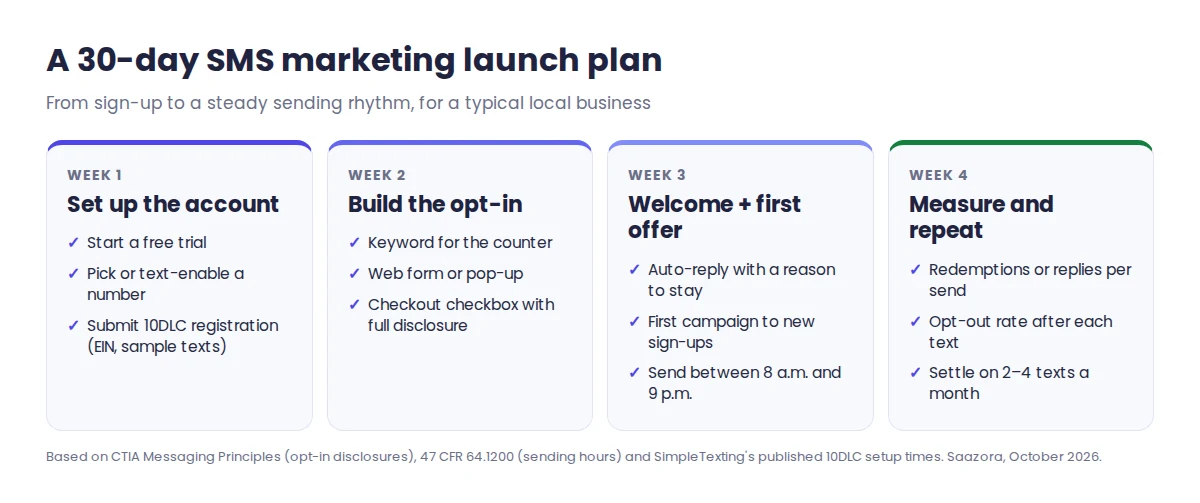
- Week 1, set up the account. Start a free trial, choose a local number (or text-enable your existing business line) and submit the 10DLC registration with your legal business name, EIN and a sample of the messages you plan to send. Registration details must match your website, or approval stalls.
- Week 2, build the opt-in. Create a short keyword ("Text SUNDAY to …"), a web form or pop-up, and a checkbox at checkout. Put the full disclosure next to each one (sample below). If you need a simple page for the form, our roundup of the best landing page builders covers cheap options.
- Week 3, send the welcome and one offer. Set an auto-reply that confirms the sign-up and delivers a reason to stay (a discount code works). Send your first campaign to the people who joined, during business hours.
- Week 4, measure and set a rhythm. Track redemptions or replies per send and the opt-out rate. Two to four texts a month is a sensible starting cadence; raise it only if opt-outs stay low.
Copy-ready opt-in wording and first messages
These samples follow the CTIA disclosure list. Swap in your own name, frequency and offer.
Web form or checkout checkbox:
☐ Yes, text me offers and updates from Maple Street Bakery at the number above. Up to 4 msgs/month. Consent is not a condition of purchase. Msg & data rates may apply. Reply HELP for help, STOP to cancel. See our Terms and Privacy Policy.
Keyword sign-up on a counter card or poster:
Text BREAD to (555) 010-0199 for a free cookie and up to 4 offers a month from Maple Street Bakery. Msg & data rates may apply. Reply STOP to cancel.
Welcome auto-reply:
Maple Street Bakery: You're in! Show this text for a free cookie today. Up to 4 msgs/mo. Reply HELP for help, STOP to opt out.
First offer (under 160 characters):
Maple Street: Fresh sourdough is back. 15% off any loaf Sat–Sun with code SOUR15. Reply STOP to opt out.
Start every message with your business name so people know who is texting, and keep the opt-out line in promotional texts even when your platform already sent a compliance message.
Where should your SMS list live?
Your texting platform will store contacts, but customers also exist in your point-of-sale, booking or CRM system. Keep the consent record (date, source and the wording they agreed to) wherever the master customer list lives, and sync opt-outs both ways so someone who texts STOP is not re-added from an import. If you do not have a customer database yet, our list of the best free CRM tools for small business is a good place to start; SimpleTexting includes Mailchimp and Zapier integrations on every plan, and EZ Texting and Textedly also list integrations.
Is SimpleTexting a good first platform?
For a first SMS program, SimpleTexting is an easy recommendation to test: every plan includes unlimited contacts, unlimited keywords, three users, opt-in forms and live support seven days a week, and it sends a free standalone compliance text the first time it messages a new contact. The trade-off is that the $10 local number fee and carrier fees sit on top of the plan price, which makes it a few dollars dearer than Textedly or EZ Texting at 500 texts. Our SimpleTexting review covers every tier, the fees and the refund conditions in detail.
You can try SimpleTexting free for 14 days (affiliate link) with no card and send test texts to your own phone before choosing a plan. Current deals, including the yearly discount, are on our SimpleTexting deals page.
SMS marketing for small business: quick answers
How much does SMS marketing cost for a small business?
About $29 to $39 a month for 500 texts on the main SMS platforms with monthly billing, as of October 2026. SimpleTexting is $29 plus a $10 local number fee, EZ Texting's Launch plan is $25 plus a $5 Telecom Fee, and Textedly and SlickText start at $29. Carrier surcharges of a fraction of a cent per text may be added.
Do I need permission to text my customers?
Yes for marketing. FCC rules require prior express written consent for automated marketing texts to cell phones, and carriers expect it for all promotional messages. Having a customer's number from a purchase is not the same as consent to receive promotions.
What is 10DLC registration and do I need it?
10DLC is the carriers' registration system for business texts sent from standard 10-digit local numbers. If you text from a local number, you must register your business and use case through your provider. On SimpleTexting it costs $4 once, plus a $10 monthly carrier fee for the number.
Can I use my current business phone number for texting?
Usually, yes. SimpleTexting, for example, can text-enable an existing landline or local number; it often takes about a day, or 3 to 5 business days if the number is moving from another texting provider.
How often should a small business send marketing texts?
Start with two to four a month and state that frequency in your opt-in. Watch the opt-out rate after each send; if it climbs, send less or make the offers more specific.
How we researched this guide
On October 13, 2026 we read the US pricing pages of SimpleTexting, EZ Texting, Textedly, SlickText and Twilio, SimpleTexting's help articles on 10DLC fees, carrier fees, toll-free verification and its compliance message, Twilio's A2P 10DLC fee page, the current text of 47 CFR 64.1200 on eCFR, the FCC's September 2026 fact sheet on revocation rules and CTIA's Messaging Principles and Best Practices. Monthly totals and credit examples are our own math from those listed prices. We did not run campaigns on these platforms for this guide. More tools for growing a customer list are in Sales Prospecting & CRM, and our research and review process explains how we check prices.
Sources (checked October 13, 2026): SimpleTexting pricing page and help center (10DLC FAQ, Carrier Fees for Local Numbers, Toll-free Verification, Free Compliance Message, How to Get a Local Number); EZ Texting, Textedly and SlickText pricing pages; Twilio US SMS pricing and A2P 10DLC fees; eCFR 47 CFR 64.1200 (up to date as of October 8, 2026); Federal Register, "Strengthening the Ability of Consumers To Stop Robocalls" (March 5, 2024); FCC Fact Sheet, September 9, 2026; CTIA Messaging Principles and Best Practices (May 2023).
Research-based guide: no vendor paid for or reviewed this article.