
Research guide built from public pages, not a hands-on test: Saazora did not open a Checkr Tenant account or screen a real applicant · Prices read on checkr.com/pricing and Checkr Tenant's FAQ on October 22, 2026 · FCRA duties from FTC and CFPB pages, Fair Housing Act points from HUD pages, fee limits from California, New York and Washington government pages, all checked the same day · This is not legal advice; for your own rental, ask a landlord-tenant attorney · We may earn a commission if you sign up through links on this page.
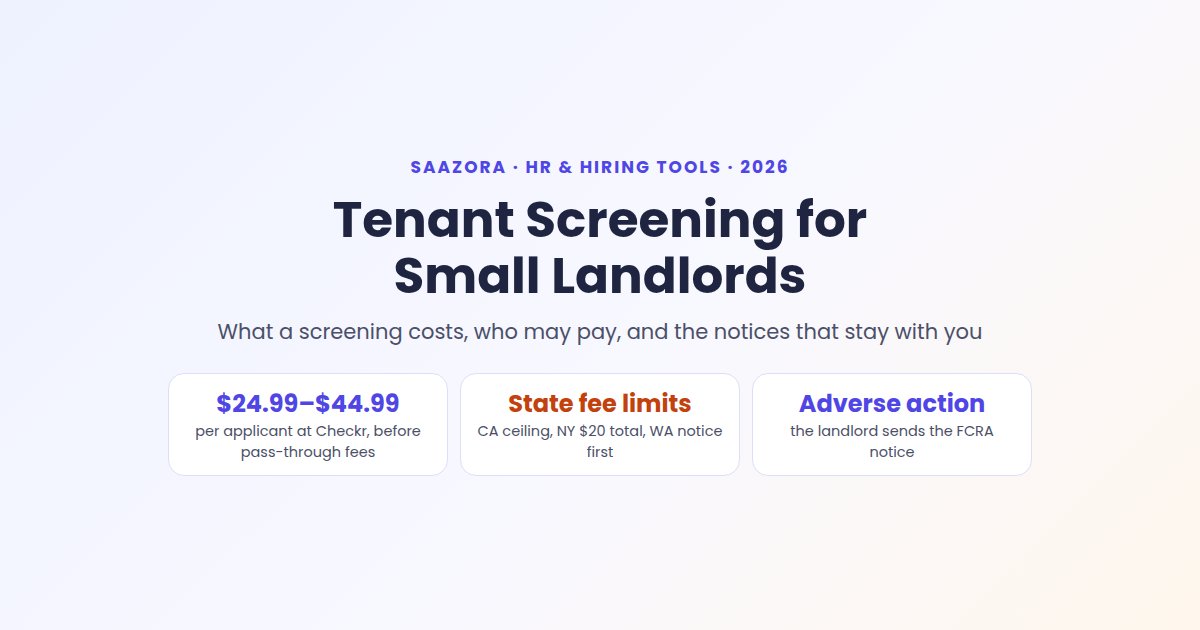
At Checkr's posted prices, tenant screening costs a small landlord $24.99, $34.99 or $44.99 per applicant, depending on whether you want criminal history only, criminal plus credit and eviction history, or all of that plus income, employment and asset checks. Court and database pass-through fees come on top. You can pay at checkout or let the applicant pay, but state fee limits decide how much of the cost you may pass on, and if you turn someone down because of the report, the federal adverse action notice is your job, not the screening company's.
That is the short version. The rest of this guide prices three realistic screenings for a one- to ten-unit owner, sets the fee rules of three states side by side, walks through the Fair Credit Reporting Act (FCRA) duties that apply to landlords, and explains what changed at HUD in September 2025 on criminal records. If you hire staff as well as rent units, the costs and rules there are different; what employer background checks cost by provider covers that side, and the rest of our screening guides sit under Saazora's HR and hiring tools guides.
Tenant screening cost per applicant at Checkr's posted prices
Checkr sells tenant screening as a separate product, Checkr Tenant, with three self-serve packages on its pricing page. Each one is billed per report, with no subscription:
| Package | Price per report* | What the report includes | Who Checkr pitches it to |
|---|---|---|---|
| Starter | $24.99 | Criminal history | "Essential checks for landlords just getting started" |
| Essential | $34.99 | Criminal history, full eviction history, credit score, credit report | "The full picture on every tenant: financials, rental history, and background in one report" |
| Complete | $44.99 | Everything in Essential plus employment verification, income information, assets and bank report | "Make informed decisions with income, employment, and asset verifications" |
| Business/Partner | Quote (demo) | Everything in Essential and Complete, API and agent access, dedicated support | Property managers, partners and startups |
*Each package on checkr.com/pricing carries the note "Pricing does not include pass-through fees." Checkr's general footnote says standard third-party court and database access fees "may apply, passed through at cost with no markup." Checked October 22, 2026.
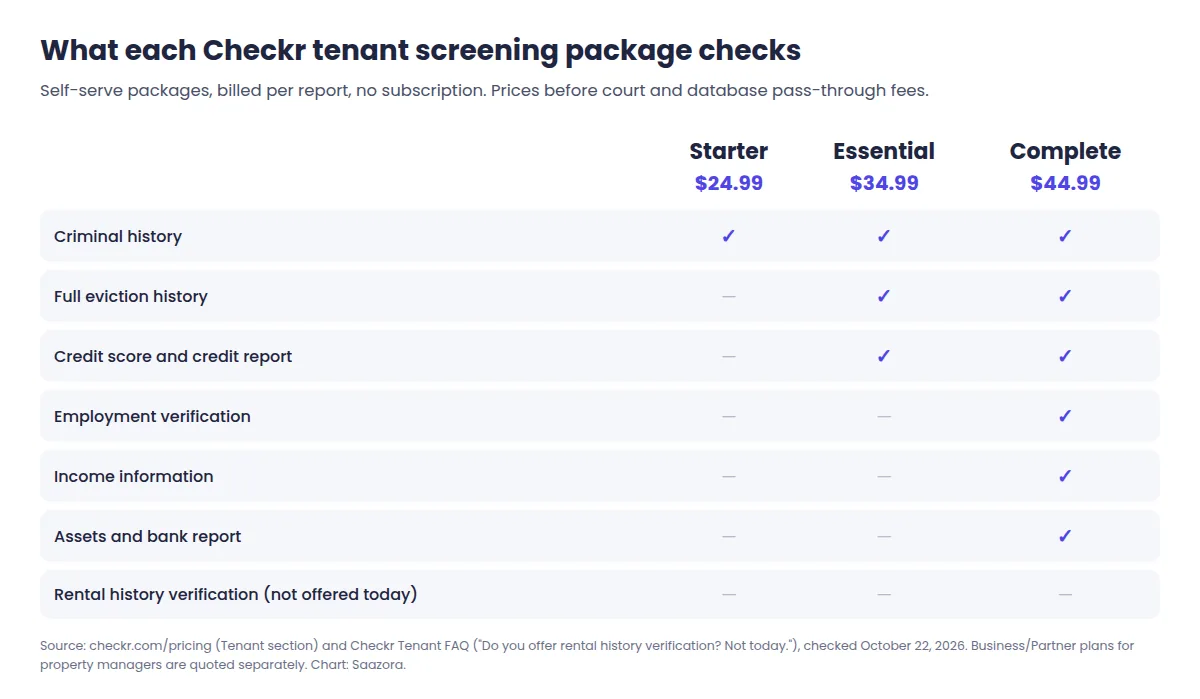
A few details from Checkr Tenant's own FAQ change what you actually get for the money:
- Eviction history starts at Essential. Starter is criminal history only. Checkr also says it does not offer rental history verification "today", so calls to a previous landlord stay with you.
- You do not need the applicant's Social Security number to order. Applicants who have one type it in themselves; those who do not can still finish every check, according to the FAQ.
- Your own identity is checked first. Criminal, sex offender registry and watchlist searches run right away, but credit, eviction, income and identity checks wait until you, the landlord, pass a photo ID and selfie check.
- Refunds are narrow. If no results have come back 14 days after the order, a cancel button gives a full refund. Once any result has come back, Checkr says no refund is granted, including when you disagree with the results.
The employee packages on the same page start higher, at $29.99 for Basic, and are built around hiring searches rather than credit and eviction history; Checkr's full price list for employer packages breaks those down. For a rental, the tenant tiers are the cheaper and better-fitting choice.
Three screenings priced out: one unit, one shortlist, one staged order
The per-report price only matters once you multiply it by how many people you screen for one vacancy. Here are three common patterns for a small landlord, at Checkr's posted prices and before pass-through fees and tax:
| Example | What you order | Arithmetic | Total |
|---|---|---|---|
| 1. Single unit, one strong applicant | Starter for one person | 1 × $24.99 | $24.99 |
| 2. One vacancy, three applicants compared on equal terms | Essential for all three | 3 × $34.99 | $104.97 |
| 3. Staged order: criminal check for three, full file for the finalist | Starter for three, then Complete for one | 3 × $24.99 + $44.99 | $119.96 |
| For comparison: Complete for all three | Complete for all three | 3 × $44.99 | $134.97 |
Prices from checkr.com/pricing, checked October 22, 2026. Totals are Saazora calculations; pass-through court and database fees and any sales tax are extra and vary by location.
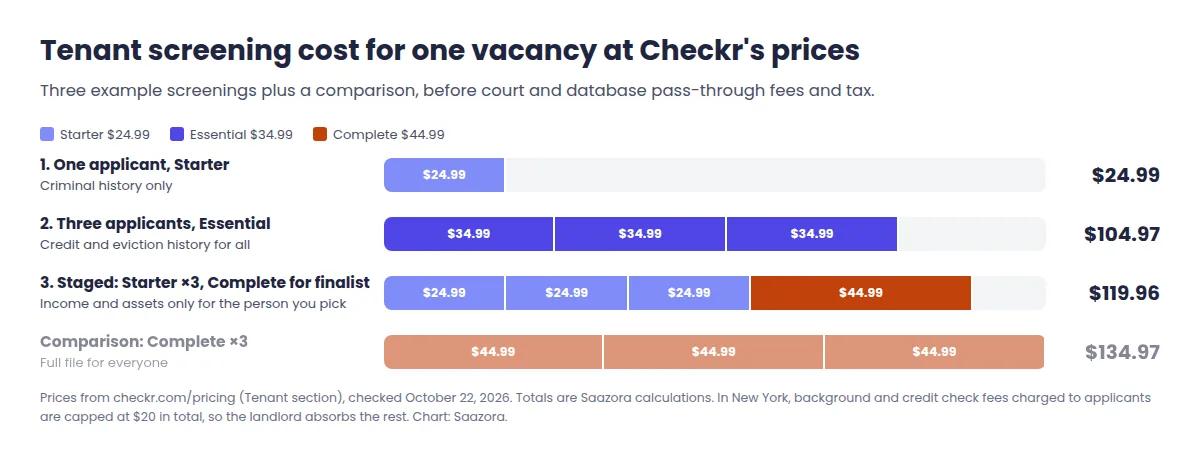
What the numbers say:
- Example 2 is the plain default. Three people, the same report, about $35 each. It gives you credit and eviction history for everyone, so every applicant is judged on the same file.
- The staged order saves $15.01 against Complete for everyone, but costs $14.99 more than Essential for everyone. It only pays off when you actually need income and asset verification for the person you choose. It also means the finalist's criminal search runs twice, and it splits your decision into two rounds, so write down in advance what moves someone to round two.
- Uneven screening is the real risk, not the price. If you give one applicant the full file and another the cheap one, you have applied different standards. Pick the package by property, not by applicant, and the cost question becomes easy.
Who pays: landlord checkout, Applicant pays, and the state fee limits
Checkr Tenant offers two ways to pay. You can pay by card or Apple Pay when you place the order, or choose "Applicant pays" at checkout, in which case the applicant is asked to pay as the first step of their screening. Checkr also gives every property a shareable application link, and screenings started from that link are always paid by the applicant.
Whether you may pass the cost on, and how much, is a state and sometimes city question. States differ: some cap the fee, some tie it to actual cost, some require notices first. Three examples, each read on an official state page:
| California | New York | Washington | |
|---|---|---|---|
| Limit on the fee | Actual out-of-pocket costs plus reasonable time, with a CPI-adjusted ceiling; the state's 2026 tenant guide says it "could not exceed $62.02" as of December 2023 | "Landlords can't collect application fees and can't charge more than a total of $20 for background or credit check fees" | Only "costs incurred in obtaining a tenant screening report"; a landlord's own screening may not exceed "the customary costs charged by a screening service in the general area" |
| Before you charge | Give the screening process in writing with the application; no fee if you know there is no vacancy soon | Give the applicant a copy of the check and a receipt or invoice from the company that ran it | Written notice (or posting) of what you will check, what can lead to denial, the reporting agency's name and address, and whether you accept a reusable screening report |
| After | Itemized receipt; refund if the applicant is not selected or not considered (2025 rules); copy of the credit report within seven days | Without the copy and invoice, the Attorney General's 2019 guide says landlords "can't charge you for it" | Written adverse action notice stating the reasons, in the statute's format |
| Source | California Department of Real Estate, California Tenants guide, 2026 edition (Civ. Code § 1950.6) | New York State Assembly tenants' rights guide (updated March 2026); NY Attorney General tenant guides | RCW 59.18.257, Washington State Legislature |
Summaries only, read October 22, 2026. California's ceiling moves with the Consumer Price Index each year, so confirm the current figure before you set a fee. Cities such as Berkeley, Portland and Seattle add rules of their own, and other states have their own limits. Not legal advice.
Put that next to Checkr's prices and two practical points fall out. In California, an applicant-paid Essential report at $34.99 sits well under the ceiling the state guide quotes, provided you also follow the receipt and refund rules. In New York, the $20 total is below every Checkr Tenant package, so if you screen with any of them you are absorbing at least $4.99 per applicant on Starter and $14.99 on Essential. Whether an applicant paying Checkr directly through "Applicant pays" fits under New York's cap is a question for a New York attorney before you switch it on; we did not find an official answer.
The FCRA side: why you may pull a report, and the consent Checkr collects
A tenant screening report is a consumer report under the FCRA. The FTC's guide for landlords says so directly: "Tenant background check reports are consumer reports." Three duties follow from that before you ever see a result.
- Permissible purpose. "Landlords may get consumer reports on applicants and tenants who apply to rent housing or renew a lease," the FTC writes. Screening someone who has not applied, a neighbor, or a guest is not that.
- Certification. You certify to the screening company that you will use the report only for housing purposes.
- Permission. For landlords, the FTC frames written permission as evidence rather than a separate legal step: "You may also get written permission from applicants or tenants to show that you have a permissible purpose." This is a real difference from employment screening, where the FCRA requires a stand-alone disclosure and written authorization; the employer version of these FCRA steps walks through that process.
In practice you get consent anyway. Checkr Tenant's FAQ says the applicant receives a secure link, then they "review the disclosures, give consent, confirm their details, and verify their identity." Keep that consent record with the application. The applicant can also stop a screening they did not ask for: there is an "I don't recognize this property" button in the invite, which cancels it and refunds you automatically.
When a report changes your answer, the adverse action notice is on you
Checkr Tenant's FAQ answers the question bluntly. Asked whether it sends adverse action notices, it says: "Not today. If you deny an applicant based on information in their report, you're responsible for sending the adverse action notice required by the Fair Credit Reporting Act (FCRA)." It also covers more than outright denials.
The FTC says an adverse action is "any action by a landlord that is unfavorable to the interests of a rental applicant or tenant." Its examples include:
- denying the application;
- requiring a co-signer on the lease;
- requiring a deposit, or a larger deposit, that another applicant would not have to pay;
- charging a higher rent than for another applicant.
The notice must give the name, address and phone number of the screening company; a statement that the company "did not make the decision to take the unfavorable action" and "can't give specific reasons for it"; the applicant's right to dispute the accuracy or completeness of the information; and the right to a free report from the company "if the person asks for it within 60 days." The FTC adds that the notice "is required even if information in the consumer report wasn't the primary reason for the decision." If you used a credit score, you must also give the score itself, a description of it and the key factors that hurt it.
The notice may be given "in writing, electronically, or orally," but the FTC calls written notices "the best practice," and the CFPB's page for renters lists the same contents from the applicant's side. A short email with these items, saved with the file, is the simplest proof. In Washington, the state goes further: the landlord's written notice must state the reasons and follow the format printed in RCW 59.18.257, with boxes for rejection, an increased deposit, a qualified guarantor, last month's rent or higher rent, and for whether the reason was a consumer report, rental history, a criminal record, a civil record or employment verification.
Last, disposal. The FTC says "you must securely dispose of the report and any information you gathered from it", for example by shredding paper copies. Checkr keeps reports in its Screening Hub, so the copy to watch is the PDF you download.
If you want those reports in one dashboard and are ready to place a first order, you can start a tenant screening account with Checkr (affiliate link); choose tenant screening when the signup asks what the account is for. Just plan the adverse action letter yourself.
Criminal records and the Fair Housing Act after HUD's 2025 memos
The federal floor has not moved: HUD's fair housing page says the Fair Housing Act prohibits discrimination in the sale or rental of housing "because of race, color, national origin, religion, sex, familial status, and disability." What changed in September 2025 is HUD's own guidance on how criminal-record screening is judged under that Act.
- A memo from HUD's General Counsel lists the April 4, 2016 "OGC Guidance Application of Fair Housing Act Standards to Use of Criminal Records" among documents that "no longer express the official legal opinion and/or official policies and procedures of the Office of General Counsel."
- A September 16, 2025 memo from HUD's Office of Fair Housing and Equal Opportunity orders the same 2016 guidance removed from its guidance repository, says investigations built on "screening for felony convictions" "will no longer be prioritized," and tells staff to prioritize "cases involving facially discriminatory conduct."
- HUD's April 29, 2024 tenant screening guidance now sits on HUD's archive site rather than its current pages.
For a small landlord, that does not mean anything goes. Treating applicants differently because of a protected trait is still what the Act forbids, and an uneven criminal-record rule is one of the easiest ways to do that: accepting one applicant with a ten-year-old conviction and rejecting another with a similar record. State and city laws can also limit what criminal history a landlord may consider, and they did not change with HUD's memos. The safe pattern is the same one that keeps costs predictable: one written rule per property, applied to every applicant, checked against local law before you use it.
Checkr's role here is narrow. The report shows records; the decision about whether a record matters for your rental is yours, made by a person against your written criteria.
From listing to decision: a screening timeline for one vacancy
Here is the order of work for one unit, with the legal step and the cost at each point.
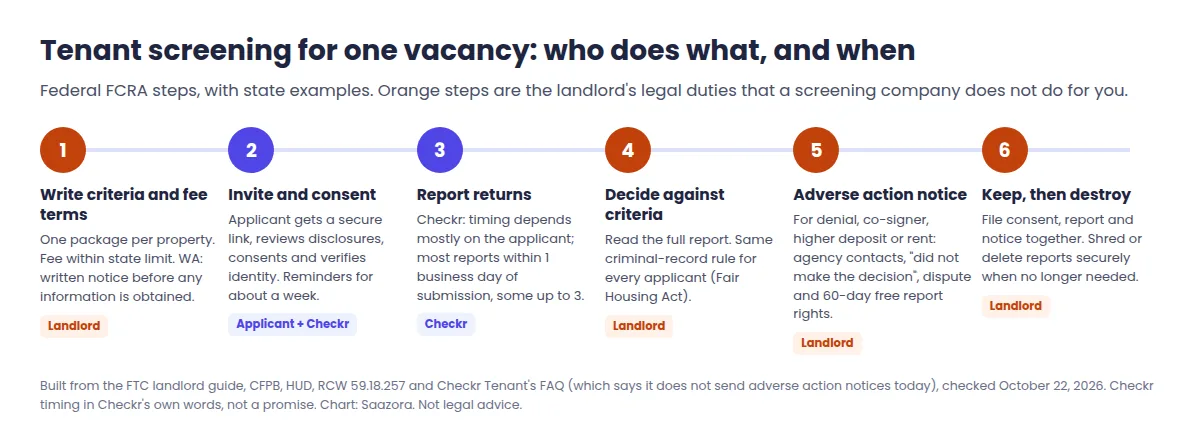
- Before you list: write the screening criteria (credit, eviction, criminal, income), pick one package for the property, and set the fee within your state's limit. In Washington, the criteria notice must reach the applicant before you obtain any information.
- Application: send each applicant the Checkr invite or share the property link. The applicant consents and verifies identity. Checkr says that if they do not finish right away it sends reminders "for about a week."
- Report: Checkr's FAQ says timing "depends mostly on your applicant," that "most reports are ready within 1 business day" after they submit, and that "some checks can take up to 3 business days." Results can appear piece by piece; Checkr itself advises waiting for the full report before deciding.
- Decision: compare the report with your written criteria. Approve, or decide on denial or conditions.
- Adverse action notice: if the report played any part in a denial or harsher terms, send the notice described above, by email or letter, and keep a copy.
- Records: keep the application, consent, report and notice together; destroy the report securely when you no longer need it.
Our research-based review of Checkr looks at the company's public terms and pricing, if you want more on the vendor before you order.
Landlord screening checklist to keep with each application
Print it, or copy it into the folder for each unit. Every line is something you can show later if a decision is questioned.
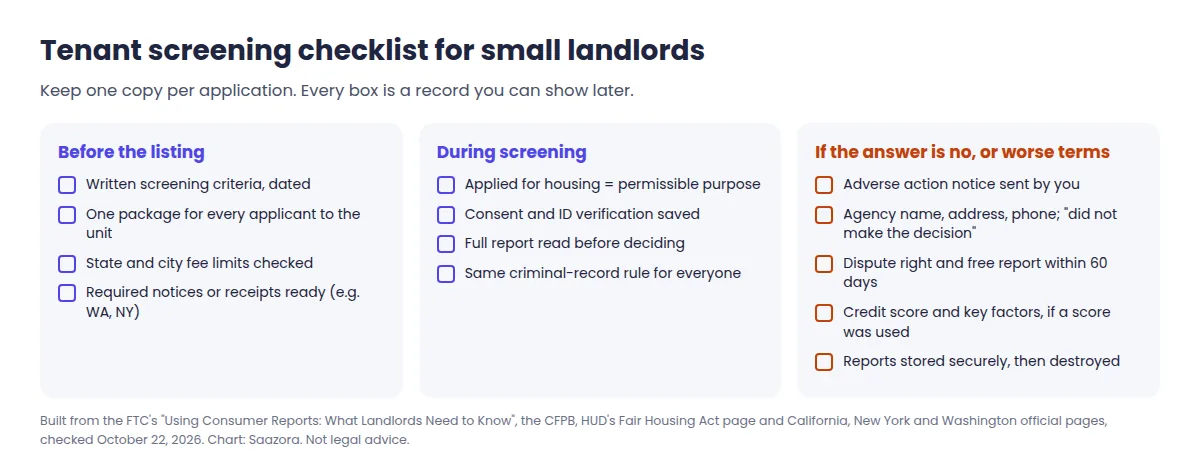
- ☐ Written screening criteria for the property, dated before the listing went up.
- ☐ One package chosen for every applicant to this unit (Starter, Essential or Complete).
- ☐ State and city fee rules checked; receipts or notices ready where required.
- ☐ Applicant's consent and identity verification saved with the application.
- ☐ Full report read before deciding, against the written criteria, by you or a named person.
- ☐ Same criminal-record rule applied to every applicant; local limits on criminal history checked.
- ☐ If denied or offered worse terms: adverse action notice sent with the company's contact details, the "did not make the decision" statement, the dispute right and the 60-day free report right.
- ☐ If a credit score was used: score, its description and key factors included.
- ☐ Downloaded PDFs stored securely; destroy date set.
Saazora keeps current Checkr setup terms on our store page, and when the checklist is ready you can order a Checkr Tenant report for your next applicant (affiliate link).
Questions small landlords ask about tenant screening
How much does tenant screening cost per applicant?
At Checkr, $24.99 for criminal history only, $34.99 with credit and eviction history, and $44.99 with income, employment and asset checks added, each before pass-through court and database fees (checked October 22, 2026). For one vacancy with three applicants on the middle package, budget about $105 plus fees.
Can I make the applicant pay for the screening?
Checkr lets you choose "Applicant pays" at checkout, and property links are always applicant-paid. Whether that is allowed, and up to what amount, depends on your state and city: New York caps background and credit check fees at $20 in total, California ties the fee to actual cost under a CPI-adjusted ceiling, and Washington requires a written notice before any charge.
Do I have to send a notice if I reject someone because of their report?
Yes. Under the FCRA, a denial, a required co-signer, a higher deposit or higher rent based even partly on the report needs an adverse action notice from you. Checkr Tenant says it does not send these notices for you today.
Can I still screen for criminal records after HUD's 2025 changes?
Criminal history checks remain available and the Fair Housing Act still forbids treating applicants differently because of race, color, national origin, religion, sex, familial status or disability. HUD withdrew its 2016 criminal-records guidance in September 2025, but state and local rules may still limit what you can consider. Use one written rule for every applicant and ask a local attorney before you rely on it.
How this guide was researched
On October 22, 2026 we read Checkr's pricing page (Tenant section, compared against a copy saved earlier the same day with no changes), Checkr Tenant's FAQ and its fee-limits resource page; the FTC's "Using Consumer Reports: What Landlords Need to Know" (updated July 2023); the CFPB's page on rental applications denied because of a screening report (last reviewed May 28, 2024); HUD's fair housing rights page, its Office of General Counsel memo and its September 16, 2025 FHEO enforcement memo; the California Department of Real Estate's 2026 tenant guide; the New York State Assembly and Attorney General tenant guides; and RCW 59.18.257. We also read the top-ranking cost guide for this keyword; it gives averages and fee caps but not the HUD change or who sends the adverse action notice. We did not open a Checkr Tenant account or screen anyone, and we do not rate any company's speed or accuracy.
Sources (checked October 22, 2026): Checkr pricing page and Checkr Tenant FAQ; FTC, Using Consumer Reports: What Landlords Need to Know; CFPB, What should I do if my rental application is denied because of a tenant screening report?; HUD, Fair Housing: Rights and Obligations; HUD OGC, Fair Housing Guidance Memoranda and Documents; HUD FHEO, Fair Housing Act Enforcement and Prioritization of Resources (September 16, 2025); California DRE, California Tenants (2026 edition); New York State Assembly tenants' rights guide (March 2026) NY Attorney General, Residential Tenants' Rights Guide and "Changes in New York State Rent Law" (2019); Washington State Legislature, RCW 59.18.257.
Research guide, not hands-on testing and not legal advice. Checkr did not pay for or review this article.