
Research guide built from public pages, not a hands-on test: Saazora did not order a personal check, create a Checkr Profile or request an FBI or state record for this article · Checkr prices read on checkr.com/pricing and Checkr Personal pages on October 23, 2026 · FBI, state, DMV, FTC, CFPB and Federal Register pages checked October 22–23, 2026 · This is not legal advice; if a record affects a job, license or lease, talk to a lawyer or legal aid office · We may earn a commission if you sign up through links on this page.
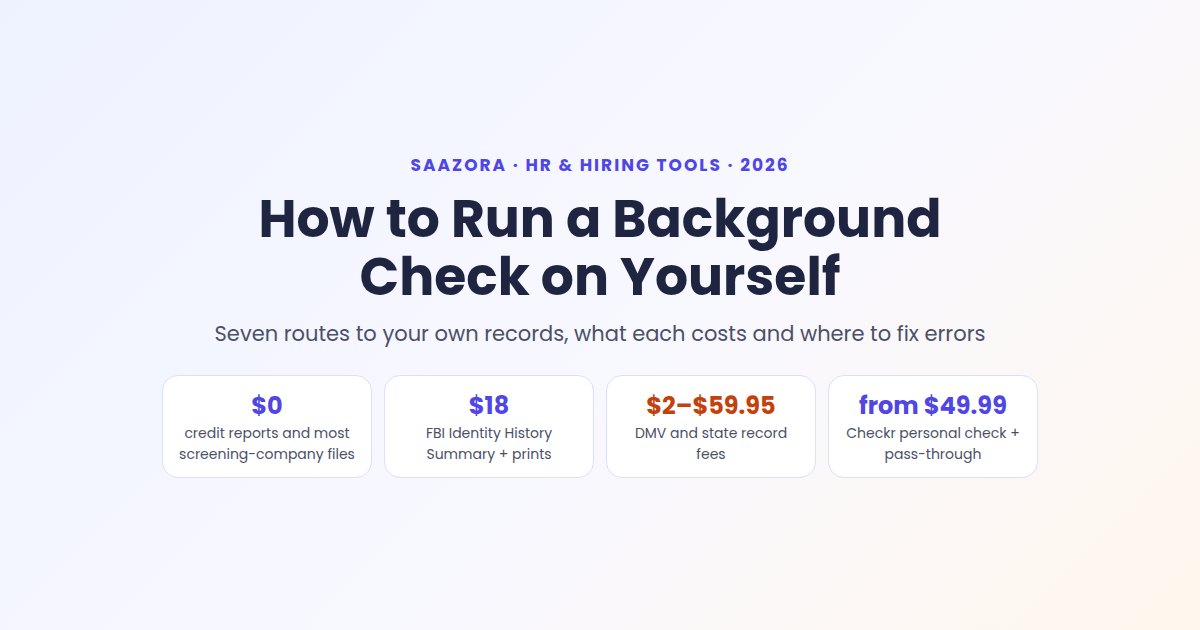
How to run a background check on yourself, in short: start with the free records the law already gives you: your credit reports from the three bureaus every week at AnnualCreditReport.com, and a copy of your file from any background check company that has screened you. Then add the paid records that match where you are applying: your driving record from your state DMV (California charges $2 online), your FBI Identity History Summary ($18 plus fingerprinting), your state criminal record (California $25, for example), or a commercial personal check such as Checkr's, which starts at $49.99 before pass-through fees and shows the kind of court-record report many employers order.
No single one of these is "your background". An FBI summary is built from fingerprints sent in by police agencies; a Checkr report is built from court and database searches; a credit report shows debts, not crimes. This guide sets the seven routes side by side with their cost, explains which one answers which question, prices a full do-it-yourself set in three states against one personal check, and shows where each kind of error gets fixed. If you are the one hiring, the employer's step-by-step FCRA process is a different job with different rules, and every Saazora screening guide sits under our HR and hiring tools hub.
One rule before anything else: knowing how to run a background check on yourself is about your own records only. The FBI, California and Checkr all build their self-request routes around your own identity, consent or fingerprints. Looking up another person is a different legal question and outside this guide.
How to run a background check on yourself: seven routes, priced
These are the official and commercial routes an individual can use for their own records, with the price each source posted when we checked.
| Route | Cost (checked Oct 22–23, 2026) | What it shows | How you ask |
|---|---|---|---|
| Credit reports (Equifax, Experian, TransUnion) | Free, weekly | Accounts, payment history, collections, inquiries; no criminal records | AnnualCreditReport.com or 1-877-322-8228 |
| Your file at a background check company that screened you | Often free; otherwise at most $16.00 in 2026 | Whatever that company reported about you, e.g. to a past employer | The company's consumer or candidate portal |
| State DMV driving record | California $2 online ($5 by mail); Texas $4–$20 by record type | License status and class, violations, crashes, suspensions | Your state DMV website |
| FBI Identity History Summary | $18 plus fingerprinting ("additional fees may apply") | Arrests and dispositions tied to fingerprints sent to the FBI | Online at edo.cjis.gov, then fingerprints at a participating post office or by mailed card |
| State criminal record review | California $25 plus Live Scan fee; New York $59.95 fingerprint fee; Texas $15 plus $10 fingerprinting, or $1 name search | That state's criminal history repository | State justice or public safety department |
| Checkr Profile | Free | Identity verification, sex offender registry check, national criminal search, shown as badges you can share | Checkr Personal sign-up |
| Checkr personal check | From $49.99 plus pass-through fees | SSN trace, sex offender registry, global watchlist, national, county, federal and state criminal searches | Checkr Personal, "Check yourself" |
Sources: FTC Free Credit Reports (June 2026); CFPB List of Consumer Reporting Companies (2025) and Federal Register 2025-22772; California DMV; Texas DPS; FBI Identity History Summary FAQ; California DOJ, New York DCJS and Texas DPS record-review pages; checkr.com/pricing and Checkr Personal. Fingerprinting and court access fees vary by site and are not included.
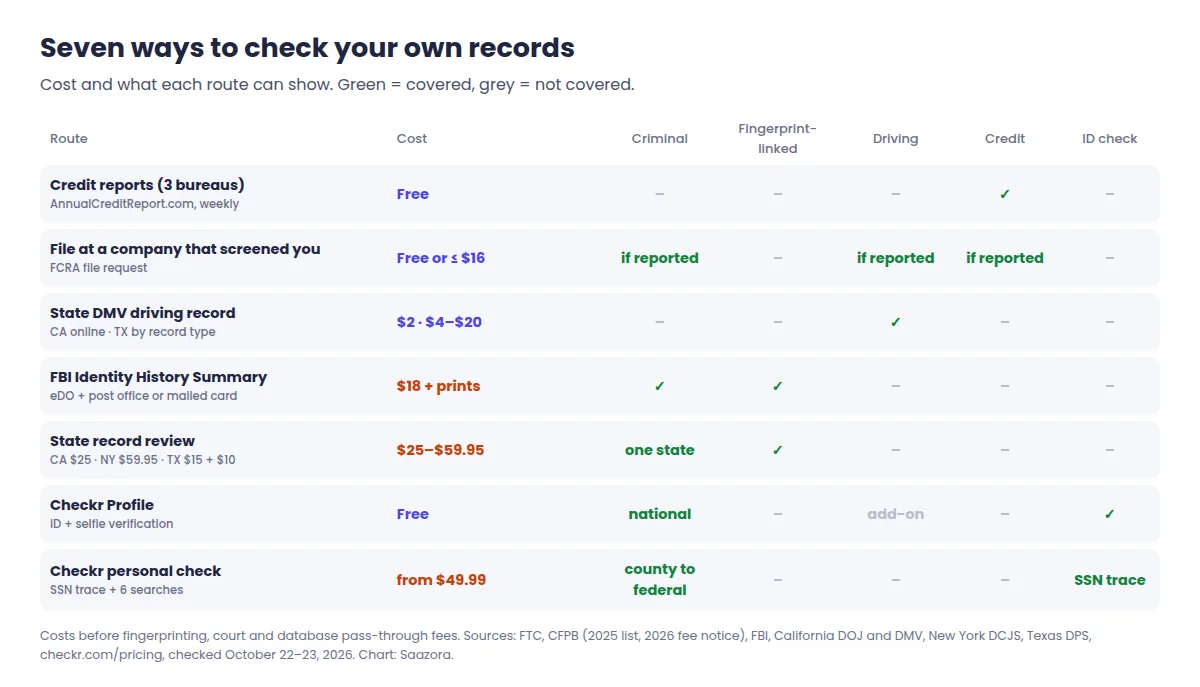
Two things stand out in that table. First, the two free routes are the ones people skip, and they are the ones a lender, landlord or past employer has actually used. Second, the criminal-record routes split into two families: fingerprint-based government records (FBI and state) and name-and-SSN-based commercial searches (Checkr and other screening companies). They draw on different sources, so a clean result in one does not promise a clean result in the other.
Which check answers your question: job, license, rental or loan
The right route depends on who is about to look at you. Match the check to the decision, not to the price.
- A private-sector job offer. Most employers buy a consumer report from a screening company. A personal check from a company of that type, like Checkr's, is the closest preview. If you have been screened before, also ask that company for your existing file.
- A professional license, a government job, or work with children or vulnerable adults. These often run on fingerprints sent to the state and the FBI. Your FBI Identity History Summary and your state record review are the matching preview.
- A driving job. Your state DMV record is the source an employer's motor vehicle report draws on. Our guide to how employers pull driving records for drivers shows what they look for; pulling your own copy first costs a few dollars.
- A rental application or a loan. Credit reports come first. The CFPB notes that a credit report is a common part of tenant screening, so check all three bureaus before you apply.
The CFPB puts the timing simply in its 2025 list of consumer reporting companies: "If you are applying for a job, home rental, or insurance policy, also fact-check your background screening reports to ensure there are no errors." It also warns that "many employment screening companies won't have information on you unless you authorized an employer or other end-user to obtain a report", which is why the file request only works for companies that have screened you before.
The FBI Identity History Summary: $18 and a set of fingerprints
The FBI calls it an Identity History Summary; most people call it a rap sheet. The FBI's eDO site describes it as "listing certain information taken from fingerprint submissions kept by the FBI and related to arrests and, in some instances, federal employment, naturalization, or military service." For an arrest, it lists the agency that sent the prints, the arrest date, the charge and "the disposition of the arrest, if known".
That last phrase matters. If a court dismissed a case but nobody reported the outcome to the FBI, your summary can show the arrest with no ending. Finding that gap before an employer or licensing board does is the main reason to order one.
How to request it, per the FBI's pages checked October 22–23, 2026:
- Start the request online at the FBI's eDO site (edo.cjis.gov) and pay the $18 fee. The FBI accepts credit cards, money orders and certified checks.
- Give fingerprints. Either submit them electronically at a participating U.S. Post Office, or mail a completed fingerprint card. The FBI's FAQ says only that "additional fees may apply" for fingerprinting, so ask the post office or your local police department for their price.
- Wait for results. eDO says that with electronic fingerprints at a participating post office, "your results will be available within 48 hours" after the FBI receives them; if you mail a card, processing is "currently 10 days from the date we receive your fingerprint card", plus mail time.
- Mail option in full: FBI form 1-783 (revised March 19, 2025) says to mail the signed form, the fingerprint card and $18 to FBI CJIS Division – Summary Request, 1000 Custer Hollow Road, Clarksburg, West Virginia 26306.
If you plan to hand the summary to someone else, the FBI's FAQ says "a release must be submitted with the request when the information will be provided to another party." For a purely personal review, you keep it.
Your state's criminal record: California, New York and Texas compared
The FBI only holds what agencies send it. Your state's own repository can hold more, or different, detail, and each state runs its own request process. Three examples, each read on the state's official page:
| California DOJ | New York DCJS | Texas DPS | |
|---|---|---|---|
| Fee | $25 DOJ processing fee, plus the Live Scan site's rolling fee | $59.95 fingerprinting fee (paid to the state's fingerprint vendor) | $15 fingerprint-based check plus $10 fingerprinting; or online name search at $1 per credit plus card fees |
| How | Live Scan form BCIA 8016RR marked "Record Review"; out-of-state applicants mail FD-258 cards with form BCIA 8705 | Fingerprint appointment through IdentoGO, using DCJS's personal record review code | Fingerprints through the state's contracted FAST service, or the public Conviction Name Search |
| Fee help | Fee waiver available | Fee waiver packet with proof of need | Not covered on the pages we read |
| Results | A Record Review response; a challenge form comes with it if a record exists | By U.S. mail within seven to 10 business days of receiving prints | About 10 business days for fingerprint requests |
| Fixing errors | Form BCIA 8706, "Claim of Alleged Inaccuracy or Incompleteness", with proof | Challenge form included with the response | Get a certified court copy of the missing disposition and send it to the DPS error resolution unit |
California DOJ "Criminal Records – Request Your Own" and Texas DPS name search page read October 22–23, 2026; New York DCJS record review page (undated) and Texas DPS Crime Records FAQ (dated September 29, 2020) read via fetch on October 23, 2026. Fees change; confirm on the state page before you book.
California states the self-only rule most plainly: individuals "have the right to request a copy of their own criminal history record from the Department to review for accuracy and completeness. Requests from third parties are not authorized and will not be processed." It also says records requested for personal review cannot be used for visa or immigration purposes.
Texas shows the trade-off between cheap and certain. Its name search costs $1 a credit plus card fees, but DPS itself warns that "searches based on names, date of birth and other alphanumeric identifiers are not always accurate" and that "the only way to positively link someone to a criminal record is through fingerprint identification." A name search can miss your record or return someone else's, so treat it as a quick look, not a final answer.
Driving record and credit reports: the cheap or free half of the picture
Driving record. Order it from the DMV in the state that issued your license. California's DMV lets you print your own record through a MyDMV account for $2.00 online, against $5.00 by mail. Texas sells six record types: a $4 status record, a $6 three-year history, a $7 list of all crashes and violations (sold only to the record holder), certified versions at $10, and a $20 certified abstract of the complete record. Type 3 lists every crash and violation, ticketed or not; only the $20 Type AR, DPS says, "contains all information in a driver record", including suspensions.
Credit reports. The FTC's June 2026 page says you can check your report from each of the three nationwide bureaus once a week for free, and that "only one website — AnnualCreditReport.com — is authorized" for the free reports. You can also call 1-877-322-8228. The FTC warns that "other sites pretend to be associated with AnnualCreditReport.com", so type the address yourself. Checking your own reports there does not affect your credit scores, the site says.
A credit report is not a criminal check, but it is part of many background checks for rentals and for finance roles, and it is the fastest place to spot identity theft: accounts, names or addresses that are not yours.
Your file at a background check company, and the $16 cap on what it may charge
This is the route almost nobody uses. Under the Fair Credit Reporting Act (FCRA), any consumer reporting company must show you what it holds on you if you ask. The CFPB's 2025 list puts it this way: "all consumer reporting companies are required to provide you a copy of the information in your report if you request it and many do so for free." The largest nationwide companies must do it free at least once every twelve months.
When it is not free, there is a ceiling. The CFPB's annual adjustment, published in the Federal Register on December 15, 2025, says: "The maximum allowable charge will be $16.00 for 2026." And it is always free in specific cases, including after an adverse action: if an employer turns you down because of a report, the FTC says you have "the right to get an additional free report from the background reporting company" if you ask "within 60 days of the employer's decision."
Checkr is on the CFPB's list under employment screening. Its 2025 entry says Checkr "will provide a free report if you request it and if previously requested from Checkr by one of its clients", and points to Checkr's candidate portal, phone 844-824-3257, and a mailing address marked "Attn: Privacy Questions" in San Francisco. In plain terms: if an employer has ever run a Checkr check on you, you can ask Checkr for that file at no cost, separate from buying a new personal check.
The same logic applies to every screening company that has checked you. If you do not know which one an employer used, the CFPB suggests asking for the company's name when you give your authorization; the adverse action letter must name it too.
Checkr's personal check and free Checkr Profile: what $49.99 adds
Checkr sells two things to individuals, and only one of them costs money.
Checkr Profile (free). On checkr.com/pricing, Profiles are listed as "Free", with identity verification, a sex offender registry check and a national criminal search included. Checkr Personal's FAQ says you verify "with a government ID and a selfie" and that one verification adds a safety check (national criminal and sex-offender screen), a photo matched to your ID, adult confirmation and a verified email to a profile you can share by link. Work history, degree, driving record and license verifications, and continuous monitoring, are listed as add-ons. The Profile is useful for proving who you are to clients on a marketplace; it is not a full county-level criminal check.
Personal check (from $49.99). Checkr's pricing page lists "Personal checks starting from $49.99" with an SSN trace, sex offender registry check, global watchlist search and national, county, federal and state criminal searches, and the note "Pricing does not include pass-through fees". Those fees are court and database charges that Checkr says it passes through at cost with no markup. Checkr's self-check page says it is "the same screening platform employers use, run for you", and gives timing in its own words: "Most results take 3-5 business days, with email updates along the way."
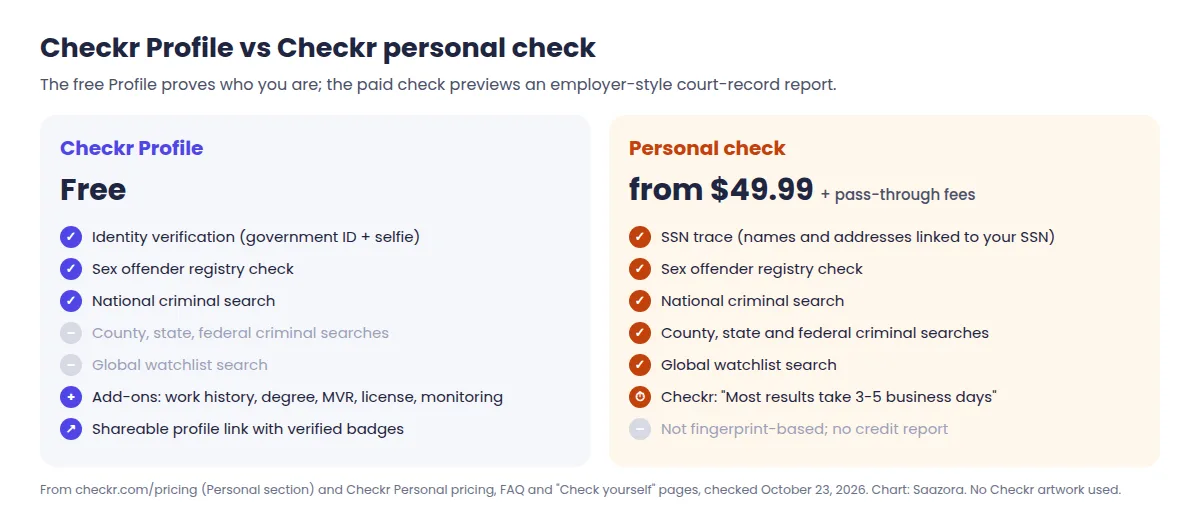
What it does not do, by design: it does not show what every employer will see. Another employer may use a different screening company, a different package, a longer or shorter lookback, or add credit, drug or employment checks. Checkr says results "depend on the searches being run, the lookback period, and any applicable federal, state, or local laws." Read it as a preview of a typical court-record report, not a guarantee. Saazora's independent Checkr review based on public terms covers the company in more depth.
If a commercial preview fits your situation, you can start a personal check on yourself with Checkr (affiliate link); on the sign-up page, pick "For personal use" and then "Myself".
What a do-it-yourself set costs next to one personal check
Here is the arithmetic for someone who wants the full government set (FBI, state record, driving record and credit) in three states, against a single Checkr personal check. Fingerprinting at the post office or a Live Scan site is extra in every state and not included, because the FBI and California do not post one price.
| Set | Items | Arithmetic | Posted total |
|---|---|---|---|
| California resident | FBI summary + CA DOJ record review + CA DMV online record + 3 credit reports | $18 + $25 + $2 + $0 | $45.00 + two fingerprinting fees |
| Texas resident | FBI summary + Texas fingerprint check (incl. $10 FAST fingerprinting) + Type 3 driving record + 3 credit reports | $18 + $15 + $10 + $7 + $0 | $50.00 + FBI fingerprinting fee |
| New York resident | FBI summary + NY DCJS record review + 3 credit reports | $18 + $59.95 + $0 | $77.95 + FBI fingerprinting fee + NY DMV record fee |
| Checkr personal check | One report: SSN trace, registry, watchlist, national, county, federal, state criminal | from $49.99 | from $49.99 + pass-through fees |
Prices from the FBI, California DOJ and DMV, Texas DPS, New York DCJS, AnnualCreditReport.com and checkr.com/pricing, checked October 22–23, 2026. Totals are Saazora calculations. New York DMV abstract fee not verified for this guide.
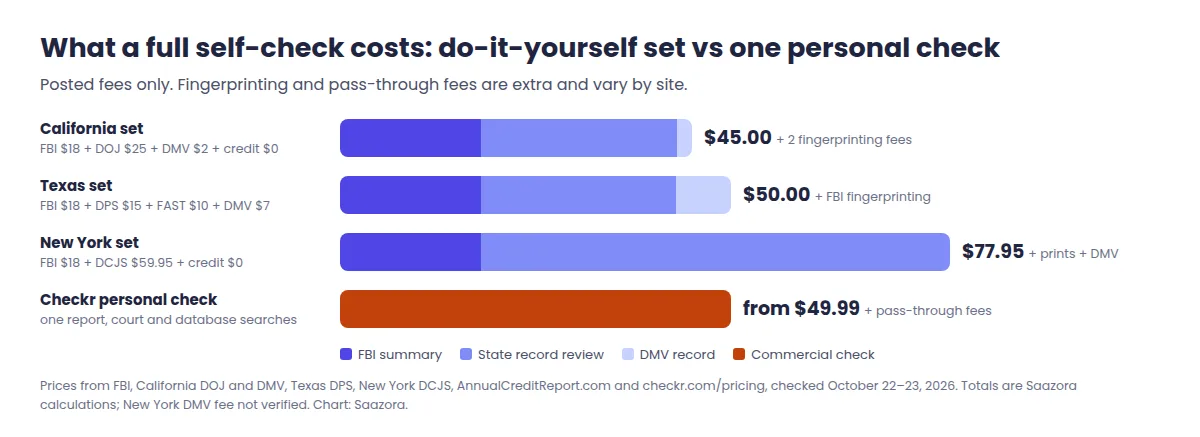
What the numbers say:
- The prices are close; the coverage is not. The government set gives you fingerprint-linked records from the FBI and one state, plus driving and credit. The personal check gives you court searches across several levels in one report, with no fingerprints and no credit or driving record. They answer different questions, which is why the table in the second section matters more than this one.
- Moved states? The do-it-yourself route covers only the state you request from. If you have lived in three states, you would repeat the state step three times, each with its own fee and form. A commercial check that searches by address history avoids that, at the price of not being fingerprint-based.
- Start free either way. Credit reports and any existing screening-company file cost nothing and take minutes. Do those first, then decide whether you need the paid steps at all.
For context on the employer side of these prices, see what a small business pays per background check, and Saazora's breakdown of every Checkr package price lists the employer and tenant tiers next to the personal one.
Found a mistake? Where each kind of error gets fixed
The fix depends on who owns the record. Disputing with the wrong office wastes weeks.
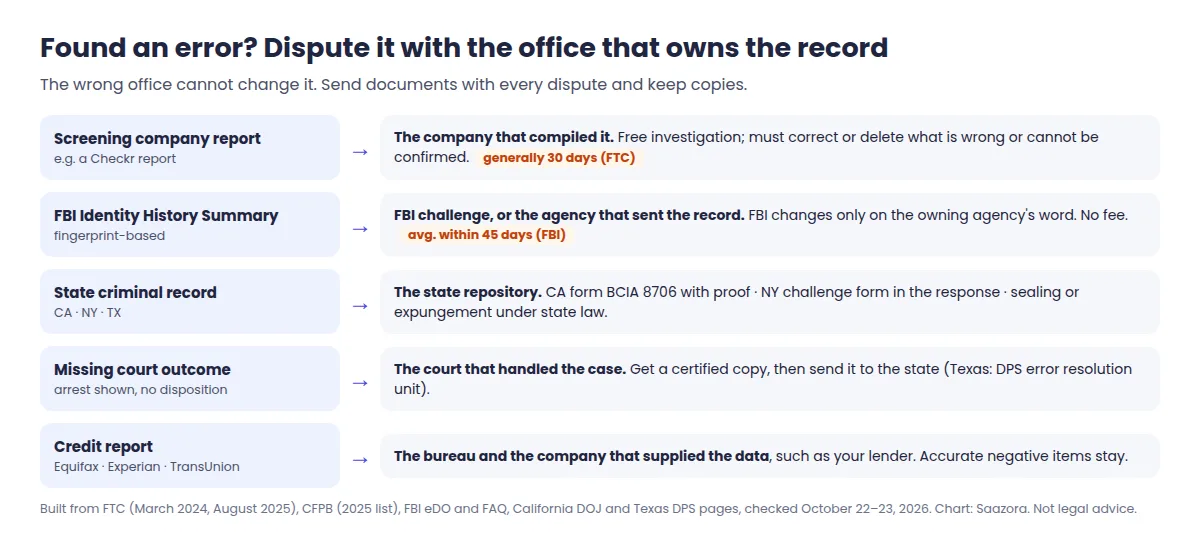
- A screening company's report (including Checkr's). The FTC says to "submit a dispute directly to the company that put together your report" and to include copies of supporting documents. "Generally, the background check company must investigate your dispute — and tell you the results — within 30 days," with 45 days in some cases. If the information is wrong or cannot be confirmed, the company "must delete or correct the information." The CFPB adds that the investigation is free of charge.
- Your FBI summary. The FBI says it cannot change a record unless the agency that owns it tells it to. You can challenge through the FBI using the FBI number from your summary or your state ID number; the FBI says "there are no fees for challenging your Identity History Summary" and the average response is "within 45 days". Sealing or expunging a state arrest goes to that state, not the FBI.
- Your state record. California uses form BCIA 8706 with proof; New York includes a challenge form with its response. In Texas, a missing court outcome is fixed by getting a certified copy from the court and sending it to DPS.
- Credit reports. Dispute with the bureau that shows the error and, per the CFPB, with the company that supplied it, such as your lender.
Accurate negative records are a different matter. The CFPB is direct: if the information "is current and accurate, even if negative, you do not have the right to have it removed." For an old conviction, the route is record sealing or expungement under your state's law, which is where a lawyer or legal aid clinic earns its fee.
Self-check checklist before your next application
This is how to run a background check on yourself in order. Work through it top to bottom: the free steps come first, and every paid step is tied to a decision you are about to face.
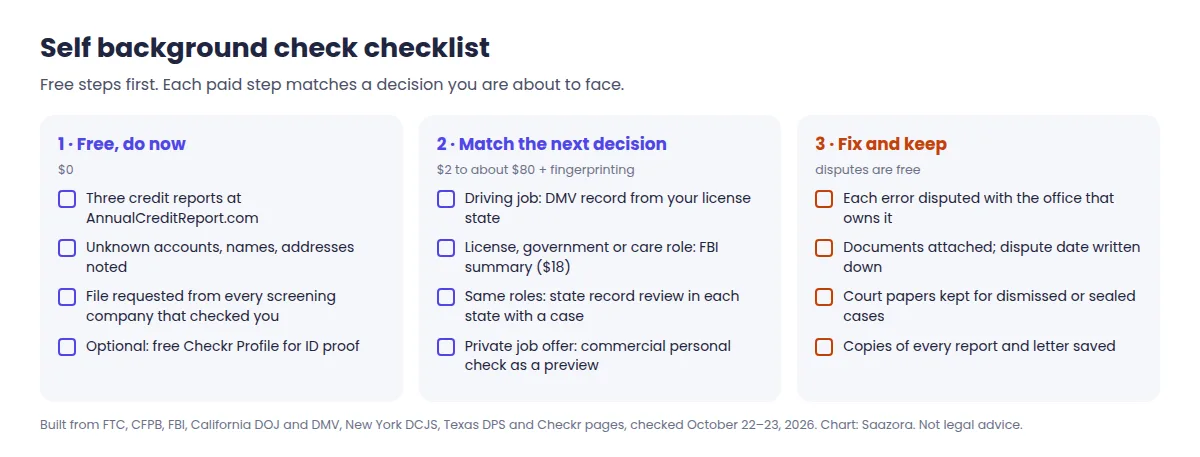
- ☐ Three credit reports pulled at AnnualCreditReport.com; unknown accounts and addresses noted.
- ☐ Each screening company that has checked you (old offer letters, adverse action letters) asked for your file.
- ☐ Driving record ordered from your license state, if the job involves driving.
- ☐ FBI Identity History Summary requested, if a license, government job or care role will fingerprint you.
- ☐ State record review requested from each state where you had an arrest or case.
- ☐ For a private job offer, a commercial personal check considered as a preview.
- ☐ Every error disputed with the office that owns it, with documents, and the date written down.
- ☐ Copies of every report and letter saved, plus court papers for any dismissed or sealed case.
Saazora's Checkr store page with current terms lists how the company bills, and when the free steps are done you can order your own Checkr personal check (affiliate link) if you still want the employer-style preview.
Questions about checking your own background
Can I run a background check on myself for free?
Partly. Your credit reports are free every week at AnnualCreditReport.com, a Checkr Profile is free, and a screening company that has already reported on you must give you your file, often free and in 2026 never for more than $16. A criminal record check from the FBI ($18) or your state, and a full commercial check, cost money.
Does checking my own background hurt my credit score?
No. AnnualCreditReport.com says checking your reports there will not affect your scores, and the CFPB says requesting copies of your own consumer reports does not hurt your credit scores.
Will my FBI summary show the same thing as an employer's background check?
Not necessarily. The FBI summary lists arrests and outcomes reported with fingerprints. Most private employers buy a report from a screening company that searches court records by name, Social Security number and address history. One can show a record the other misses.
How long does a self background check take?
It depends on the route. The FBI says electronic fingerprints at a participating post office give results within 48 hours of receipt; New York mails results within seven to 10 business days; Checkr says most personal check results take 3–5 business days. Credit reports and DMV records are usually available online right away.
How this guide was researched
On October 22 and 23, 2026 we read checkr.com/pricing (identical to a copy saved on October 22), Checkr's personal background checks page and the Checkr Personal home, pricing and "Check yourself" pages; the FBI's Identity History Summary FAQ, its eDO site and form 1-783; California DOJ's record review page and the California DMV driver record page; New York DCJS's personal record review page; Texas DPS's Crime Records FAQ, name search page and driver record page; the FTC's pages on free credit reports, employer background checks and disputing background check errors; the CFPB's 2025 List of Consumer Reporting Companies; and the Federal Register notice setting the 2026 file disclosure fee. We also read the top-ranking pages for this search, including Checkr's own guide. Saazora did not order any of these records or checks, and we do not rate any company's speed or accuracy.
Sources (checked October 22–23, 2026): Checkr pricing page and Checkr Personal pages; FBI, Identity History Summary Checks FAQ and form 1-783; FBI CJIS, Electronic Departmental Order (eDO); California DOJ, Criminal Records – Request Your Own; California DMV, Driver's Record Request; New York DCJS, Personal Criminal History Record Review; Texas DPS, Crime Records Services FAQ, Criminal History Name Search and How to Order a Driver Record; AnnualCreditReport.com; FTC, Free Credit Reports (June 2026), Employer Background Checks and Your Rights (August 2025), Disputing Errors on Your Tenant Background Check Report (March 2024); CFPB, List of Consumer Reporting Companies (2025); Federal Register, Fair Credit Reporting Act Disclosures (December 15, 2025).
Research guide, not hands-on testing and not legal advice. Checkr did not pay for or review this article.