
Research guide built from public pages, not hands-on testing: Saazora did not screen any volunteer for this article · Checkr prices read on checkr.com/pricing on October 30, 2026 · FTC and CFPB guidance, the FCRA text, 34 U.S.C. 40102 and 45 CFR 98.43 read October 30, 2026 · This is not legal advice; state laws on volunteers, youth programs and fingerprinting vary, so have a lawyer review your screening policy · We may earn a commission if you sign up through links on this page.
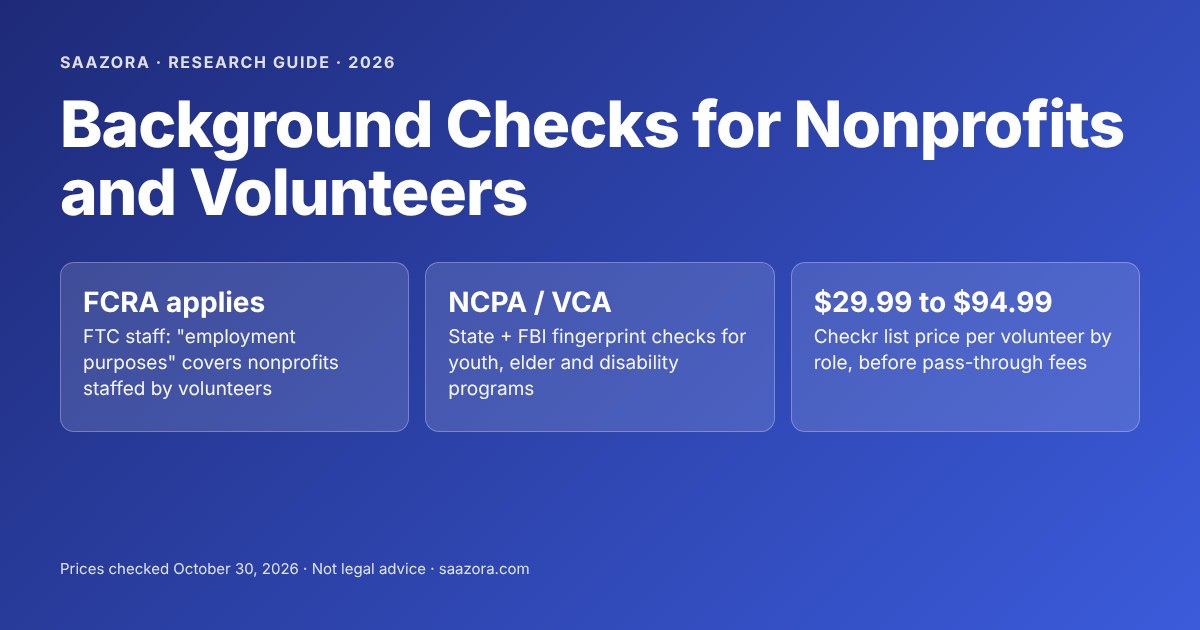
Background checks for nonprofits follow most of the same federal rules as background checks for paid staff. If you buy a volunteer background check from a screening company, the FTC's staff has long read the Fair Credit Reporting Act's "employment purposes" to include "a nonprofit organization staffed in whole or in part by volunteers", so you still need a stand-alone disclosure, written authorization and the two-step adverse action process. Youth-serving groups have a second route: under the National Child Protection Act, as amended by the Volunteers for Children Act, a qualified organization can ask for a state and FBI fingerprint check on volunteers through a state program, at a fee the statute says must not discourage volunteers. At Checkr list prices on October 30, 2026, a name-based volunteer check runs from $29.99 for an adult-only role to $94.99 for someone with one-to-one access to children, before court fees.
This guide is for executive directors, volunteer coordinators and board members at charities, youth sports leagues, mentoring programs, faith groups, food banks and camps. It answers whether the FCRA covers volunteers and what that means for your forms, compares the three ways to screen a volunteer (searching public sites yourself, using a screening company, or a state fingerprint check), explains the National Child Protection Act and the Volunteers for Children Act from the statute itself, covers the extra federal rule for child care settings, and prices a check for each common volunteer role and a full season for a youth league. If you have never ordered a check before, read our walkthrough of the FCRA steps for an employee background check first; almost every step there carries over to volunteers, and this page focuses on what is different.
Does the FCRA cover volunteers who are not paid?
The statute's own wording is about employees. Section 603(h) of the Fair Credit Reporting Act defines "employment purposes" as "a report used for the purpose of evaluating a consumer for employment, promotion, reassignment or retention as an employee" (FCRA text as posted by the FTC, revised March 2026). A volunteer is not an employee, so on a literal reading you might expect the law to stop there.
The FTC's staff has not read it that way. In 40 Years of Experience with the Fair Credit Reporting Act (July 2011), the staff commentary on section 603(h) has an item titled "Independent Contractors, Agents, and Volunteers". It says the term "may apply to situations where an entity uses individuals who are not technically employees to perform duties", and lists, among its examples, "a nonprofit organization staffed in whole or in part by volunteers." That is a staff report summarizing earlier interpretations, not a regulation or a court ruling, but it is the clearest official text on the point we found.
In practice, the safe course for a nonprofit that buys a report from a screening company is to treat every volunteer as an applicant under the FCRA:
- Disclosure. Section 604(b)(2)(A) requires a clear and conspicuous written disclosure "in a document that consists solely of the disclosure". The FTC's employer guide puts it as "in writing and in a stand-alone format". Do not bury it inside the volunteer application, a liability waiver or a code of conduct.
- Authorization. The volunteer must have "authorized in writing". The FTC guide says permission can be included in the same document as the notice.
- Pre-adverse action. Before you turn someone away "based in whole or in part on the report", you give them a copy of the report and a written description of their rights (section 604(b)(3)(A)); the FTC names that document "A Summary of Your Rights Under the Fair Credit Reporting Act".
- Adverse action notice. After the decision, the notice includes "the name, address, and phone number of the consumer reporting company that supplied the report", a statement that the company did not make the decision, and the person's dispute rights. The CFPB's consumer page on employment screening says the same from the volunteer's side: if an organization plans to take adverse action, it "must give you a copy of the report it received."
- Disposal. The FTC guide adds that "you must securely dispose of the report and any information you gathered from it." For a volunteer program with paper files in a church office or a coach's car, that line deserves its own policy.
Two details of the FCRA read differently when nobody is paid. First, a screening company's report generally may not include "records of arrest that from date of entry, antedate the report by more than seven years" (section 605(a)(2)); convictions are not limited the same way, because the general seven-year limit applies to items "other than records of convictions of crimes" (605(a)(5)). Second, those time limits do not apply to "the employment of any individual at an annual salary which equals, or which may reasonably be expected to equal $75,000" or more (605(b)(3)). An unpaid volunteer cannot reach that threshold, so in our reading the exception is not available for volunteer screening; old arrest records that did not lead to a conviction should not appear in a volunteer's consumer report. Ask your screening company how it applies that rule to volunteer orders.
What the FCRA does not tell you is whether you must screen at all. Neither the FTC's employer guides nor the statute requires a nonprofit to run checks; they govern how you do it once you choose to use a consumer reporting company. Requirements to screen come from elsewhere: state laws, funding rules such as the child care rule covered below, insurers and national governing bodies. The FTC also recommends reviewing "the laws of your state and municipality regarding background reports or information", since "some states and municipalities regulate the use of that information for employment purposes." Whether a state fair-chance law reaches volunteers is a state-by-state question this guide does not answer.
Three ways to screen a volunteer, compared
Nonprofits usually pick from three routes, and they are not interchangeable. They search different records, come with different legal paperwork and give you different outputs: a list of search results, a full report, or a yes-or-no fitness determination.
| Search public sites yourself | Screening company (for example Checkr) | State fingerprint check under the NCPA/VCA | |
|---|---|---|---|
| What is searched | Whatever you search: commonly the DOJ's National Sex Offender Public Website (NSOPW) and online court indexes | Name and date-of-birth based database, county, state and federal court searches, depending on the package | State criminal history and FBI records, matched by fingerprints |
| What you get back | Search results you interpret yourself | A consumer report with the records found | A determination of whether the person has been convicted of, or is under pending indictment for, a crime bearing on fitness; the statute does not say the record itself goes to you |
| Legal frame | No consumer reporting company is involved; registry sites have their own conditions of use | FCRA disclosure, authorization and adverse action steps | 34 U.S.C. 40102: fingerprints, a signed statement, the person's right to a copy and to challenge |
| Cost | The NSOPW About page lists no search fee; staff time | $29.99 to $94.99 per report at Checkr list prices, plus pass-through fees | Set by the state; the statute caps it at actual cost |
| Speed | Minutes | See our guide to background check turnaround times | The state agency "shall make reasonable efforts to respond to the inquiry within 15 business days" |
| Fits best | A quick registry screen of one-day event helpers | Ongoing programs that want the full record and online consent | Youth, elder and disability programs that want fingerprint-matched FBI data |
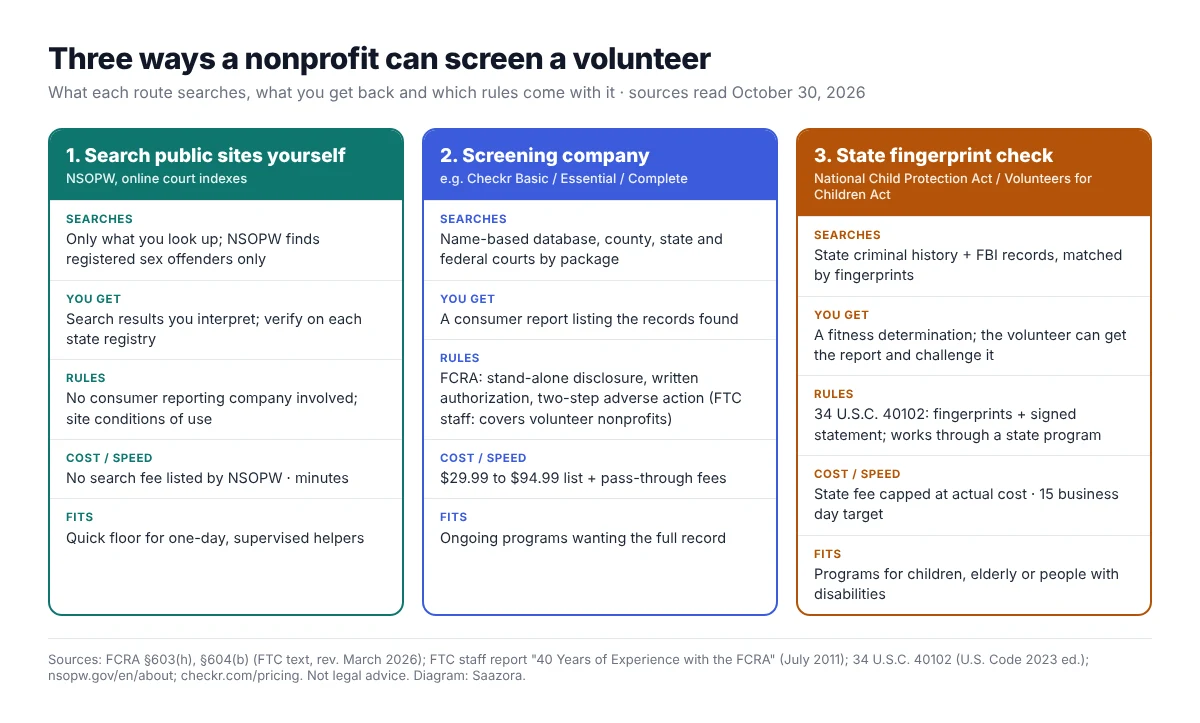
A note on searching public sites yourself. NSOPW describes itself as "a partnership between the U.S. Department of Justice and state, territorial and tribal governments" and "the only U.S. government website that links public state, territorial and tribal sex offender registries". It also warns that "Search results should be verified by visiting the individual jurisdiction's" own registry, and that search options "are limited to what each individual jurisdiction may provide." A registry search is useful, but it only finds people who are on a sex offender registry. It says nothing about other convictions, so it is a floor, not a full volunteer background check. Checkr's Basic package also lists a "Sex offender registry" search alongside its "National criminal search", which means a paid report already covers that floor.
The National Child Protection Act and the Volunteers for Children Act, from the statute
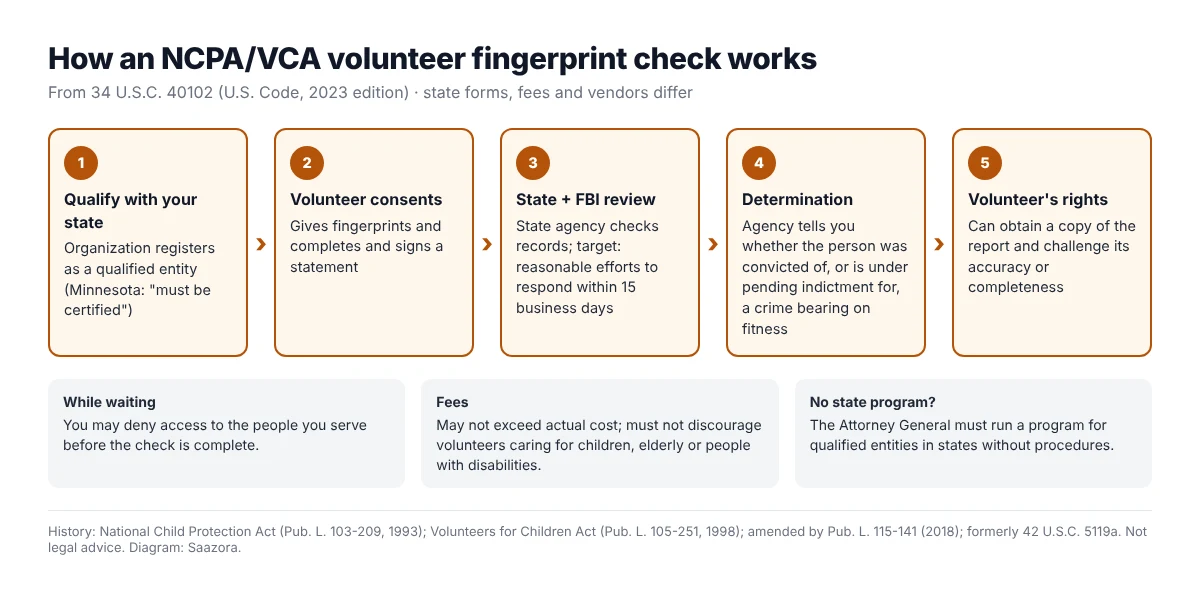
The law most nonprofits hear about is now codified at 34 U.S.C. 40102. According to the U.S. Code's own notes, it began as the National Child Protection Act ("Pub. L. 103–209, §3, Dec. 20, 1993"), was expanded by "the Volunteers for Children Act (sections 221 and 222 of Public Law 105–251)" in October 1998, and was amended again by Pub. L. 115–141 on March 23, 2018. It "was formerly classified to section 5119a of Title 42", which is why older guides cite 42 U.S.C. 5119a. Here is what the current text (2023 edition of the Code, published by GPO) actually does:
- It works through states. A state may set up procedures "(established by State statute or regulation)" for qualified entities to request checks on "covered individuals" (the 2018 amendment replaced the older word "provider"). For qualified entities "located in States that do not have in effect procedures described in paragraph (1)", the statute says "The Attorney General shall establish a program" for "national criminal history background checks on, and criminal history reviews of, covered individuals."
- It requires fingerprints and a signed statement. The volunteer first provides "a set of fingerprints and completes and signs a statement".
- You get a determination, not a rap sheet. The state agency must "make a determination whether the covered individual has been convicted of, or is under pending indictment for, a crime" bearing on fitness and "convey that determination to the qualified entity." The volunteer, not the organization, is the one "entitled to obtain a copy of any background check report", and can ask "to challenge the accuracy or completeness of the information".
- It has a timing target. The agency "shall make reasonable efforts to respond to the inquiry within 15 business days."
- You can keep people out while you wait. The volunteer must be told that "prior to the completion of the background check the qualified entity may choose to deny the covered individual access" to the people it serves.
- Fees are capped, and volunteers are named. Fees "may not exceed the actual cost of the background check conducted with fingerprints", and the fee system must ensure fees "do not discourage volunteers from participating in programs to care for children", the elderly or individuals with disabilities.
- It does not force you to screen. "A qualified entity shall not be liable in an action for damages solely for failure to conduct" a check under the section. That is about this federal statute only; your state, insurer or funder can still require one.
What it looks like on the ground depends on your state. Minnesota's Bureau of Criminal Apprehension, as one example, says the NCPA/VCA and state law "allow for a qualified entity to request state and federal background checks on covered Individuals." Its steps start with "The qualified entity must be certified", then a submission with "The completed, signed consent form", fee payment and "A good quality set of fingerprints on an FBI applicant fingerprint card", with NCPA/VCA written in the "Reason Fingerprinted" block. Other states use different forms, fees and fingerprint vendors, so start with your state's criminal history repository.
Youth-serving organizations: where the bar goes up
Programs that serve children are where volunteer screening matters most and where outside rules most often apply. Three points from federal sources stand out.
Child care funded through CCDF has its own federal check list, and it is not limited to paid staff. Under 45 CFR 98.43, states must have rules to "require and conduct background checks" for "child care staff members (including prospective child care staff members)" of licensed, regulated or registered providers and providers paid through the Child Care and Development Fund. The definition covers someone "employed by a child care provider for compensation", but also anyone "Whose activities involve the care or supervision of children for a child care provider" or who has "unsupervised access to children who are cared for or supervised by a child care provider". A volunteer in a covered child care setting can fall within it. The required components are "A Federal Bureau of Investigation fingerprint check using Next Generation Identification", "A search of the National Crime Information Center's National Sex Offender Registry", and searches of the state criminal, sex offender and "State-based child abuse and neglect registry and database" in "each State where such staff member resided during the preceding five years". Checks repeat "Not less than once during each 5-year period", and until all parts are done, the person "must be supervised at all times by an individual who received a qualifying result". A name-based commercial report on its own does not meet that list, because the rule names an FBI fingerprint check and state child abuse registries; your state's child care agency runs that process.
Outside child care, the fingerprint route is optional but available. For a mentoring program, youth sports league or camp, 34 U.S.C. 40102 gives you a way to get fingerprint-matched FBI data you cannot buy from a commercial screening company. The trade-off is that you get a fitness determination, not the details, and the turnaround depends on your state.
Screening is one layer of a youth-protection policy, not the policy. A clean check only means no disqualifying record was found. Consider pairing checks with supervision rules, such as two adults present and no one-to-one contact out of view, plus training and a reporting process. Those rules are policy choices for your board and insurer, not something this research confirmed as a federal requirement, but they cover the risk a check cannot see: people with no record at all.
Background checks for nonprofits: cost per volunteer role
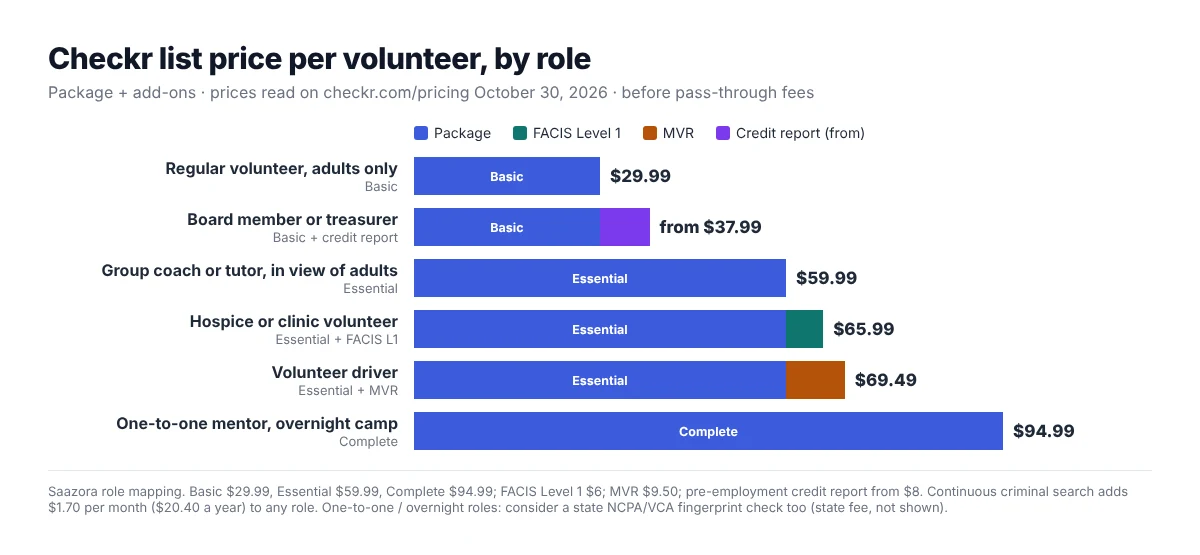
The table below maps common volunteer roles to Checkr packages and add-ons at list price. The mapping is Saazora's suggestion, built from what each package searches; your insurer, funder or state may require more. Checkr's pricing page did not mention nonprofit or volume pricing when we read it, so ask sales if you screen in volume.
| Volunteer role | Suggested order | Why | Checkr list price |
|---|---|---|---|
| One-day event helper, adults only, supervised (5K, food drive) | None, or a registry search yourself; Basic if your policy screens everyone | Short, supervised contact with adults | $0 to $29.99 |
| Regular volunteer serving adults (food bank, front desk, adult literacy) | Basic | SSN trace, sex offender registry, global watchlist and national criminal search | $29.99 |
| Board member or volunteer treasurer | Basic + pre-employment credit report | Access to accounts and donor funds; check state limits on credit checks first | From $37.99 |
| Group coach or tutor working in view of other adults | Essential | Adds identity verification and unlimited county criminal searches | $59.99 |
| Hospice, hospital or clinic volunteer | Essential + FACIS Level 1 | Healthcare sanctions search alongside the criminal search | $65.99 |
| Volunteer driver (meal delivery, rides to appointments, team travel) | Essential + motor vehicle record | The driving record is a separate search; DMV fees vary by state | $69.49 |
| One-to-one mentor, overnight camp counselor, trip chaperone | Complete (consider an NCPA/VCA fingerprint check as well) | Adds unlimited state and federal criminal searches; "Federal records are not found in county and state searches" | $94.99 + state fingerprint fee |
| Any of the above, monitored between checks | Add continuous criminal search | Ongoing alerts instead of waiting for the next re-screen | +$1.70 per month ($20.40 a year) |
All prices are Checkr list prices read on checkr.com/pricing on October 30, 2026: Basic "$29.99 / report", Essential "$59.99 / report", Complete "$94.99 / report", motor vehicle record "$9.50/check", FACIS "Level 1 ($6) and Level 3 ($15.50)", pre-employment credit report "Starting from $8/check" and continuous criminal search "$1.70/individual per month". They exclude pass-through fees: Checkr's footnote says "Standard third-party court and database access fees may apply, passed through at cost with no markup", and DMV fees "vary by location". County court fees can add noticeably to an Essential or Complete order; our breakdown of Checkr's per-report prices and pass-through fees shows how. For drivers, our MVR guide for driver roles covers what a driving record shows and the state fees behind it. For hospice and clinic volunteers, our guide to background checks for healthcare staff explains the OIG exclusion rules, which name volunteers, and how often to re-run the sanctions search.
Budgeting a season: a 120-coach youth league
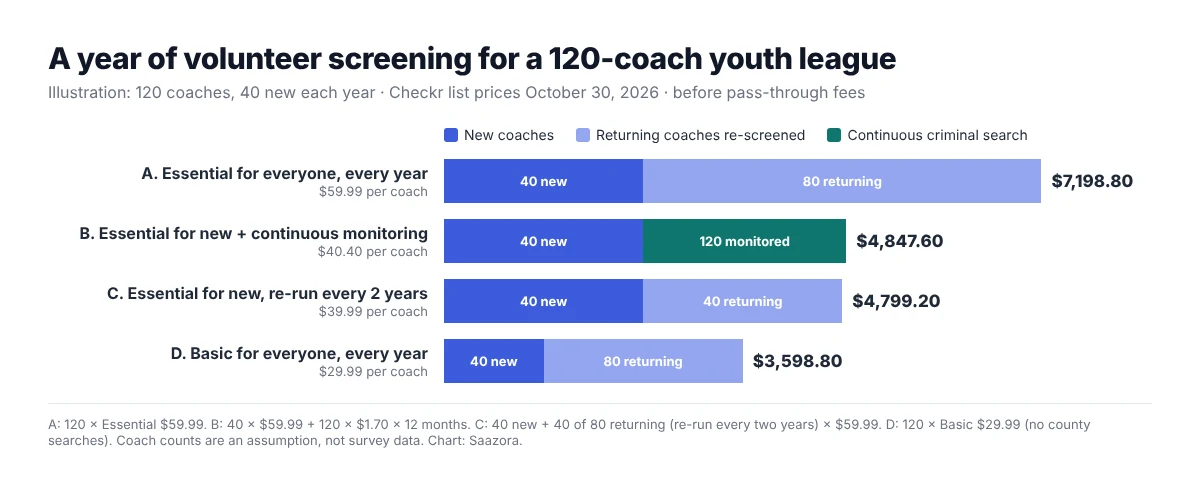
Per-report prices are easy to compare. The bigger budget decision is how often you re-screen returning volunteers. Take an illustrative youth sports league with 120 volunteer coaches, of whom 40 are new each year (an assumption, not survey data), screening everyone on Checkr Essential at $59.99. Four policies give four very different bills:
| Policy | Math | Yearly cost | Per coach |
|---|---|---|---|
| A. Re-run Essential on every coach every year | 120 × $59.99 | $7,198.80 | $59.99 |
| B. Essential for new coaches, continuous criminal search on all 120 | 40 × $59.99 + 120 × $1.70 × 12 | $4,847.60 | $40.40 |
| C. Essential for new coaches, returning coaches re-run every two years | 40 × $59.99 + 40 × $59.99 | $4,799.20 | $39.99 |
| D. Basic for every coach every year | 120 × $29.99 | $3,598.80 | $29.99 |
Policy D is the cheapest but drops the county court searches that Essential includes, which is a real trade-off for people coaching children. Policies B and C cost about the same; the difference is coverage between checks. Under C, a returning coach could pick up a conviction and keep coaching for up to two years before the next check; under B, the monitoring is ongoing. Before choosing B, ask Checkr and your lawyer what authorization language ongoing monitoring needs, since your original consent form may only cover a one-time report. Court pass-through fees come on top of every line except continuous monitoring, and they hit A hardest because it orders the most county searches.
Who pays is a policy question too. Some organizations ask volunteers to cover their own check. For fingerprint checks under 34 U.S.C. 40102 the statute itself says fees should not discourage volunteers, which is a useful principle for commercial checks as well: a $60 charge to coach a children's team is a real barrier. If budget is the issue, the cheapest change is usually policy C or a sponsor, not a cheaper package. If you also screen paid staff, our comparison of background check prices across providers helps you see whether one account can cover both. When your role list is ready, you can set up a Checkr account for volunteer screening (affiliate link).
Edge cases volunteer coordinators run into
- Teen volunteers. Some programs use 16- and 17-year-old helpers. Whether a minor can sign an FCRA authorization on their own, and whether a screening company will process the order, are questions for counsel and for the vendor; this guide did not find official text on either. A common approach is to keep minor volunteers supervised and outside the screened roles.
- A volunteer who becomes paid staff. The volunteer report was ordered for a volunteer role. When the person is hired, treat it as a new decision with a new disclosure and authorization, and re-run the package the paid role calls for.
- Volunteers screened by someone else. A school district, hospital or church denomination may already screen the same person. Accepting their result is a policy decision. Their report was ordered for their own purpose, so ask counsel before any report is shared between organizations, and ask whether they will confirm clearance in writing instead.
- People who moved recently. The child care rule asks for registries in each state the person lived in during the "preceding five years". A county search based on current address alone can miss that history, which is one reason Complete adds unlimited state searches.
- Turning a volunteer away. The FCRA adverse action steps apply even though no job is at stake. Send the pre-adverse action notice with the report and the summary of rights, give the person time to respond, then send the final notice. The FTC's employer guide does not set a waiting period in days; agree one with counsel.
- Applying the same standard to everyone. The FTC's background check guide says "Apply the same standards to everyone" and "make sure that you’re treating everyone equally". Write down which records disqualify a volunteer from which role before you see any report.
A volunteer screening policy in eight lines
- List every volunteer role and mark which ones involve minors, vulnerable adults, money, driving or overnight stays.
- Check whether a state law, funder (such as CCDF child care), insurer or governing body requires a specific check for any role.
- Assign a package per role from the table above, and decide where an NCPA/VCA fingerprint check is worth the wait.
- Use a stand-alone FCRA disclosure and a written authorization, separate from the volunteer application and waiver.
- Write the disqualifying records per role before ordering, and apply them the same way to everyone.
- Keep unscreened volunteers away from unsupervised contact until results are in.
- Follow the pre-adverse and final adverse action steps for anyone you turn away, and store and dispose of reports securely.
- Pick a re-screening policy (yearly, every two years or continuous monitoring) and budget for it.
For other screening guides and tools, see Saazora's HR and hiring tools hub, and our Checkr offers page keeps current sign-up terms in one place. Once your disclosure form and role list are written, you can compare Checkr packages for your volunteer roles (affiliate link).
Questions nonprofits ask about volunteer background checks
Do nonprofits have to run background checks on volunteers?
Not under the FCRA, which governs how checks are run, not whether they are required. Federal law does require checks in some settings, such as child care providers covered by 45 CFR 98.43, and the National Child Protection Act explicitly says an organization is not liable for damages "solely for failure to conduct" a check under that section. Requirements usually come from state law, funders, insurers or a national governing body, so check those for each role.
Do volunteers have to sign an FCRA consent form?
If you order the report from a screening company, plan on it. The FTC staff's 2011 report reads "employment purposes" to include "a nonprofit organization staffed in whole or in part by volunteers", so use the same stand-alone disclosure and written authorization you would use for an employee.
How much does a volunteer background check cost?
At Checkr list prices on October 30, 2026, $29.99 for Basic, $59.99 for Essential and $94.99 for Complete, plus court and database pass-through fees. A state fingerprint check under the NCPA/VCA costs whatever your state charges, which the statute caps at actual cost.
Is a fingerprint check better than a name-based check?
They answer different questions. A fingerprint check matches records to the person's prints and reaches FBI data, but under the NCPA/VCA you get a fitness determination rather than the record. A name-based report from a screening company shows the records found in the courts and databases it searched. Depending on the role, you can use one or both.
Can a volunteer start before the check comes back?
The NCPA/VCA lets an organization deny access "prior to the completion of the background check", and the federal child care rule requires a pending staff member to be "supervised at all times". Outside those rules it is your policy call, but keeping unscreened volunteers supervised and away from one-to-one contact is the cautious default.
How this guide was researched
On October 30, 2026 we read checkr.com/pricing (prices also confirmed in a browser the same day), the FCRA text as posted by the FTC (revised March 2026), the FTC staff report 40 Years of Experience with the Fair Credit Reporting Act (July 2011), the FTC's two employer guides, the CFPB's consumer page on employment background checks (last reviewed December 31, 2024), 34 U.S.C. 40102 in the 2023 edition of the U.S. Code on GovInfo, 45 CFR 98.43 on eCFR (not the official legal edition), the NSOPW About page and the Minnesota Bureau of Criminal Apprehension's NCPA/VCA page. Long PDFs and statutes were read through a text-extraction tool that returns short verbatim excerpts, so quotes on this page are short. The role-to-package map and the league budget are Saazora's own analysis using list prices; the coach counts are assumptions. Saazora did not order any background check for this article and does not rate any company's accuracy or speed. We did not research individual state volunteer-screening laws, state fingerprint fees or fair-chance laws as applied to volunteers.
Sources (checked October 30, 2026): Checkr pricing; FTC, Fair Credit Reporting Act, 15 U.S.C. § 1681 (revised March 2026); FTC, 40 Years of Experience with the Fair Credit Reporting Act (July 2011); FTC, Using Consumer Reports: What Employers Need to Know; FTC, Background Checks: What Employers Need to Know; CFPB, what employers see in credit and background checks; 34 U.S.C. 40102, Background checks (U.S. Code, 2023 edition, GovInfo); 45 CFR 98.43, Criminal background checks (eCFR); NSOPW, About; Minnesota BCA, NCPA/VCA background checks.
Research guide, not hands-on testing and not legal advice. Checkr did not pay for or review this article.