
Research guide from public pages, not a hands-on test: Saazora ran no background check for this article · New York statutes read on nysenate.gov, plus New York City Commission on Human Rights, NYS Department of Labor, Governor's office and NY Courts pages, October 30, 2026 · Checkr prices read October 30 and rechecked November 1, 2026 · Not legal advice; talk to a New York employment lawyer before you change a hiring policy · We may earn a commission if you sign up through links on this page.
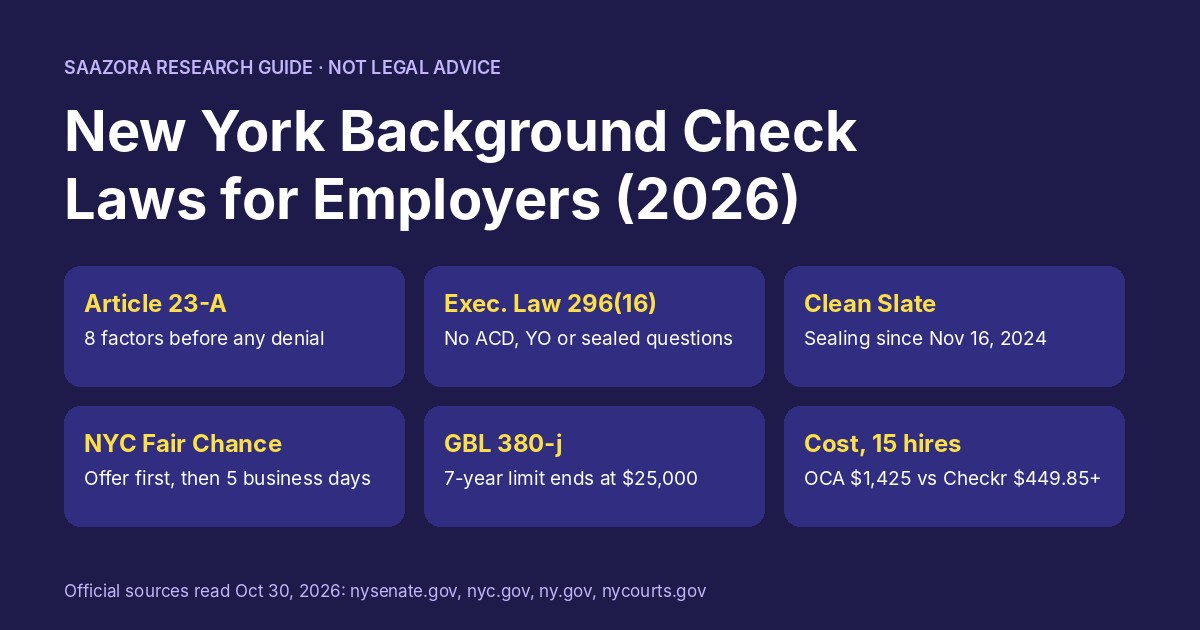
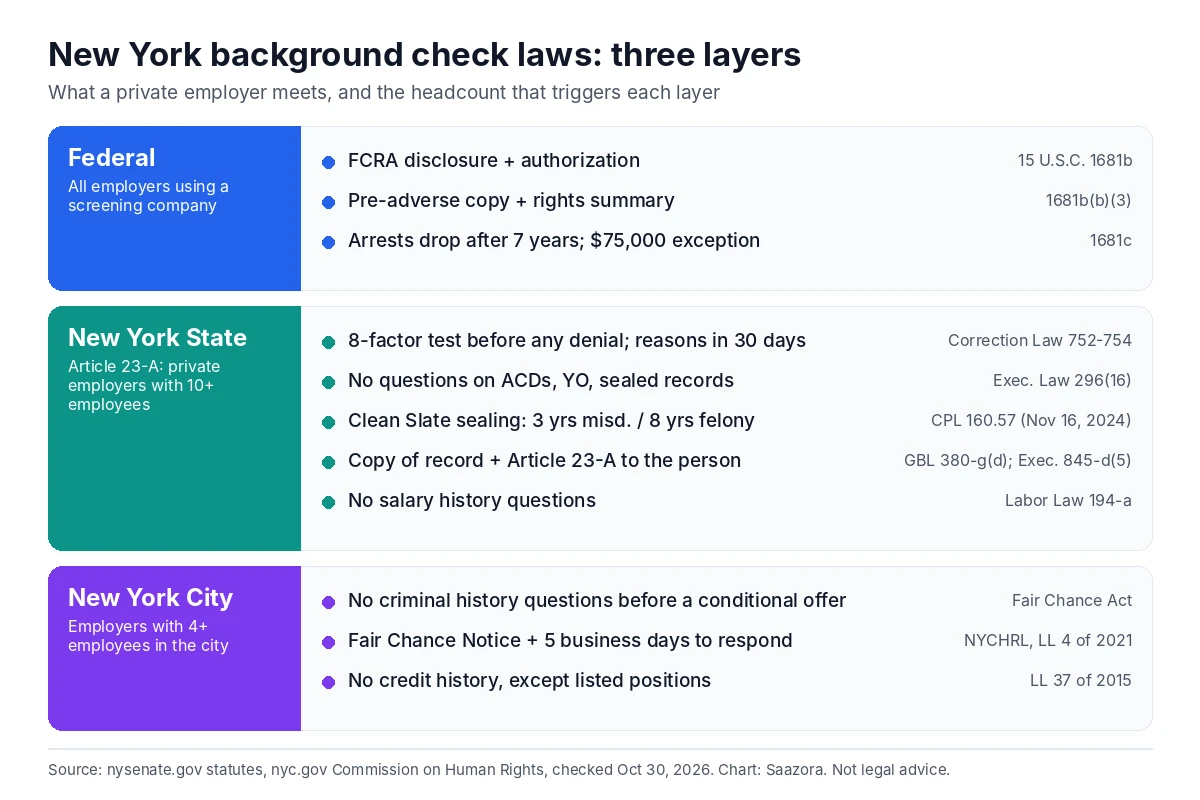
New York background check laws give applicants more protection than federal law in four places. Correction Law Article 23-A bars an employer with ten or more employees from turning someone down over a conviction unless the offense has a "direct relationship" to the job or hiring would create an "unreasonable risk", and it lists eight factors that must be weighed first. Executive Law §296(16) stops employers from asking about arrests that ended in the person's favor, youthful offender adjudications and sealed convictions. The Clean Slate Act, in force since November 16, 2024, seals many misdemeanors three years and felonies eight years after sentence or release. In New York City, the Fair Chance Act moves every criminal history question to after a conditional offer, for employers with four or more employees.
This guide covers private employers hiring in New York State, with a separate layer for New York City. It quotes each rule from the official text, runs six sample records through the state and city rules, puts a dated clock on the city's Fair Chance process, and prices a New York check two ways: the court system's own statewide search and Checkr's packages. If this is your first screening program, read our walkthrough of the federal FCRA steps for an employee background check first; this page explains what New York adds on top, as our California background check laws guide does for that state.
New York background check laws: three layers and two headcounts
A New York employer deals with federal law, state law and, inside the five boroughs, city law. The two numbers that decide who is covered are ten and four. Correction Law §750 defines a "private employer" as one "which employs ten or more persons", and New York City's guidance says "Employers must have four or more employees in New York City to be covered by the NYCHRL." A business with six employees in Brooklyn is outside Article 23-A's definition but inside the city's Fair Chance Act, which itself makes the Article 23-A factors part of the city process.
| Rule | Citation | What it does for a hire | Who it reaches |
|---|---|---|---|
| Fair chance test for convictions | Correction Law Art. 23-A, §§750, 752–754 | No denial over a conviction unless a direct relationship or unreasonable risk exists, after weighing eight factors; written reasons on request within 30 days | Private employers with 10+ employees |
| Article 23-A made enforceable, plus a negligent-hiring presumption | Executive Law §296(15) | Violating Article 23-A is an unlawful discriminatory practice; a good-faith Article 23-A review gives a rebuttable presumption in negligent hiring suits | Same employers |
| Questions you may not ask | Executive Law §296(16) | No inquiry about non-pending arrests that ended in the person's favor, youthful offender adjudications or sealed convictions | Employers and other covered entities, unless a statute requires or permits the question |
| Automatic sealing | Clean Slate Act: Criminal Procedure Law §160.57; Executive Law §845-d(5) | Eligible misdemeanors sealed after 3 years, felonies after 8; entities receiving criminal history must give the person a copy and Article 23-A | Everyone reading New York records, with exceptions for fingerprint-check employers |
| New York FCRA | General Business Law Art. 25, §§380-b, 380-c, 380-g, 380-j | Written notice before a report; Article 23-A copy with any report that contains a conviction; no reports of arrests without a conviction unless pending | Employers using a screening company, and the screening company |
| Fair Chance Act | NYC Human Rights Law, as amended by Local Law 4 of 2021 | No criminal history question until after a conditional offer; written analysis, Fair Chance Notice and at least five business days to respond | Employers with 4+ employees in New York City |
| Credit and salary history | NYC Local Law 37 of 2015; Labor Law §194-a | No credit history in most NYC hiring decisions; no salary history questions statewide | NYC: 4+ employees; state: New York employers |
Built from nysenate.gov statute pages (Correction Law ch. 43, Executive Law, General Business Law, Criminal Procedure Law, Labor Law) and New York City Commission on Human Rights publications, read October 30, 2026. A condensed view; each rule has exceptions this table leaves out. Not legal advice.
Article 23-A: the eight-factor test behind every conviction-based "no"
The current text of Article 23-A on the Senate site carries a 2014 revision date. Its core is one sentence in §752: no application for employment "shall be denied" because of a previous conviction, with two exceptions. The first is when "there is a direct relationship between one or more of the previous criminal offenses" "and the specific license or employment sought or held by the individual". The second is when hiring "would involve" "an unreasonable risk to property or to the safety or welfare of specific individuals or the general public."
You do not get to call either exception from instinct. Section 753 says the employer "shall consider the following factors", and lists eight:
- The state's public policy "to encourage the licensure and employment of persons" previously convicted.
- The specific duties and responsibilities of the job.
- How the offense bears on the person's fitness or ability to perform those duties.
- "The time which has elapsed since the occurrence of the criminal offense or offenses."
- The person's age at the time of the offense.
- How serious the offense was.
- "Any information produced by the person, or produced on his behalf, in regard to his rehabilitation and good conduct."
- The employer's legitimate interest in protecting property and the safety and welfare of specific people or the public.
Subdivision 2 adds a ninth input. A certificate of relief from disabilities or a certificate of good conduct "shall create a presumption of rehabilitation in regard to the offense or offenses specified therein." If an applicant hands you one, your written analysis has to deal with it.
Section 754 then gives the applicant a paper trail: on request, "a public agency or private employer shall provide" "within thirty days of a request" "a written statement setting forth the reasons for such denial." In practice that means writing your reasons down at the time, factor by factor, because you may have to send them a month later.
Why the analysis also protects you. Executive Law §296(15) makes a denial "in violation of the provisions of article twenty-three-A of the correction law" an unlawful discriminatory practice. The same subdivision creates a "rebuttable presumption in favor of excluding from evidence" the prior conviction in a negligent hiring, retention or supervision case, if the employer weighed the Article 23-A factors and made a reasonable, good-faith decision to hire. The documentation that defends a rejection is the same documentation that defends a hire. Subdivision 15 also bars employers from requiring a person to hand over a copy of their own criminal history record "that he or she obtained pursuant to the rules and regulations of the division of criminal justice services."
Questions a New York employer may not ask at all: Executive Law §296(16)
Article 23-A is about convictions. Section 296(16) is about everything that did not end in an open conviction. Unless a statute specifically requires or permits it, a covered employer may not "make any inquiry about, whether in any form of application or otherwise", or act adversely on, several kinds of records:
- An arrest or accusation that is not pending and ended in the person's favor, including a case "adjourned in contemplation of dismissal" (an ACD) once it is dismissed.
- "a youthful offender adjudication, as defined in subdivision one of section 720.35" of the Criminal Procedure Law.
- "a conviction which is sealed pursuant to section 160.57 of the criminal procedure law", the Clean Slate section, and "a conviction which is sealed pursuant to section 160.59 or 160.58 of the criminal procedure law".
The applicant's side of this is unusually direct. A person asked for that information "may respond as if the arrest, criminal accusation, or disposition of such arrest or criminal accusation did not occur". So if your application asks "Have you ever been arrested?", a truthful applicant with an ACD can answer "no", and you cannot treat that as a lie. Ask only about convictions and pending cases, if you are allowed to ask at all, and say on the form that sealed records, youthful offender adjudications and dismissed cases need not be disclosed. The subdivision does not apply to firearms licensing or to police and peace officer applications, with some limits.
Screening companies face the matching rule. General Business Law §380-j(a) says no consumer reporting agency "shall report or maintain in the file on a consumer, information:" "relative to an arrest or a criminal charge unless there has been a criminal conviction for such offense" "or unless such charges are still pending." Federal law only drops arrests after seven years; New York drops a non-conviction arrest at once.
The Clean Slate Act: what sealing since November 16, 2024 changes for employers
Governor Hochul signed the Clean Slate Act (S.7551A/A.1029C) on November 16, 2023, and the Governor's release says it "takes effect one year from today", which puts the start date at November 16, 2024. The sealing rules sit in Criminal Procedure Law §160.57. In outline:
- Misdemeanors become eligible when "at least three years have passed from the defendant's release from incarceration or the imposition of sentence." The NY Courts FAQ puts it as "three years after sentencing or three years after release from incarceration, whichever is later".
- Felonies become eligible when "at least eight years have passed from the date the defendant was last released from incarceration." The courts' version: "eight years after sentencing or eight years after release from incarceration, whichever is later".
- Exclusions. Sex offenses are out: the conviction must not be "for an offense defined as a sex offense or sexually violent offense." So are Class A felonies "other than class A felony offenses defined in article two hundred twenty of the penal law", which is the drug article. The Governor's summary lists "sex offenses, murder" among records that will not be sealed.
- Clean status required. The person must not have "a subsequent criminal charge pending in this state" and must not be "currently under the supervision of any probation or parole department."
For most private employers, a sealed conviction simply disappears. The NY Courts statewide search says "Sealed records are not disclosed," and §296(16) bars asking about one. The exception is for employers that must run fingerprint checks: §160.57 keeps access for entities "required by a local law," or by state or federal law "to request and receive a fingerprint-based check of criminal history information." The Governor's release names "Employers permitted by law to perform fingerprint-based criminal history checks" and "the hiring of teachers at public and private schools". If your jobs fall under a fingerprinting law, your counsel should confirm which sealed records you may still see and use.
The copy rule the Act added. Executive Law §845-d is titled "Criminal record searches: reports for civil purposes", and its revision date of November 22, 2024 matches the Clean Slate start. Subdivision 5 says: "Except as otherwise required by law, every entity that receives criminal history information for civil purposes" "shall provide or ensure the provision of a copy of such criminal history information" "to every individual for whom such information is received", with notice of the "right to seek correction of any incorrect information" and "with a copy of article twenty-three-A of the correction law". Employment screening is not a criminal justice use, and the law-firm summaries we read treat this as a duty to send the copy whether or not you plan to reject the person. The section sits in the article on the state Division of Criminal Justice Services, so ask counsel how it applies to a report bought from a private screening company. The safe practice costs little: send every candidate a copy of any criminal history you receive, with Article 23-A.
Six sample New York records, and what an employer may see or use
Six made-up records, checked against a report run on November 16, 2026, two years after the Clean Slate start. "Eligible" means the record meets §160.57's tests on paper. We did not confirm on an official page how far the courts have got in sealing older records, so an eligible record may still show up on some searches. If it does, it is still a record the law means to seal: ask counsel before you use it.
| # | Record (illustrative) | Clean Slate status on Nov 16, 2026 | New York State rules | New York City, extra |
|---|---|---|---|---|
| 1 | Misdemeanor petit larceny, conditional discharge (no jail) June 2022, no later charges | Eligible since June 2025 (three years from sentence) | Once sealed: may not be asked about or used (§296(16)); not in the OCA statewide search | Same, plus no questions before the offer |
| 2 | Class D felony, released from prison March 2016, parole ended 2019 | Eligible since March 2024 (eight years from release) | Same as #1 once sealed. If a fingerprint-check law covers the job, sealed access may remain | Same |
| 3 | Felony, released January 2021, parole ended 2023 | Not eligible until January 2029 | A conviction: reportable, but an Article 23-A analysis is required before any denial | Only after a conditional offer; Fair Chance Notice and five business days |
| 4 | Arrest 2024, ACD, case dismissed 2025 | Not a conviction; nothing to seal under §160.57 | May not be asked about; a screening company may not report it (§380-j(a)) | Same: never considered |
| 5 | Pending misdemeanor charge, filed August 2026 | Not sealed; a pending charge also blocks sealing of this person's older convictions | Pending charges are reportable and §296(16) protects only non-pending matters; use care | After the offer only, judged under the city's Fair Chance factors for pending cases |
| 6 | Youthful offender adjudication, 2020 | Not a conviction | May not be asked about (§296(16)); the applicant may answer as if it did not occur | Never considered |
Illustrative records, not real cases. Applies CPL §160.57, Executive Law §296(15)–(16), GBL §380-j and NYC Commission on Human Rights guidance as read October 30, 2026. Real eligibility turns on details this table leaves out, such as the exact offense class and every later charge. Not legal advice.
Rows 1 and 2 are the big change since 2024: an eight-year-old felony used to be an ordinary Article 23-A question, and for most private employers it is now a record you should not have. Row 5 is the reverse: one new charge keeps old records unsealed.
General Business Law Article 25: New York's own FCRA, and a $25,000 salary line
When you buy a report from a screening company, New York's consumer reporting statute adds paperwork to the federal FCRA. Three sections reach employers directly:
- Advance notice, §380-b(b). The applicant must be "first informed in writing or in the same manner in which the application is made that" "(i) a consumer report may be requested in connection with such application". The federal FCRA also needs a stand-alone disclosure and written authorization, so most employers cover both with one New York-specific form.
- Investigative reports, §380-c. For reports built from interviews, such as reference checks run by the screening company, the employer must have "first provided the consumer with notice of the procurement or preparation". "The notice required by this section shall be in writing if a written application is made by the consumer", and for employment the employer "shall in such notice also provide the subject of such report with a copy of article twenty-three-A".
- Article 23-A with every conviction report, §380-g(d). "When a consumer reporting agency provides a consumer report that contains criminal conviction information," the employer "requesting such report shall provide the subject of such report" "a printed or electronic copy of article twenty-three-A of the correction law". This duty applies when the report arrives, before you decide anything.
Then comes a number many multistate employers miss. Section 380-j(f) sets seven-year limits on old adverse items, including conviction records that, "from date of disposition, release, or parole, antedate the report by more than seven years". That looks stricter than federal law, which does not time-limit convictions at all. But §380-j(f)(2) lifts the limits for "employment of any individual at an annual salary which equals" "or which may reasonably be expected to equal twenty-five thousand dollars, or more." The federal exception starts at $75,000.
Run the arithmetic against New York's own minimum wage. The Department of Labor lists "$17.00 per hour" for "New York City, Long Island, and Westchester County" and "$16.00 per hour" for the "rest of New York State". At $16.00, a 40-hour, 52-week job pays $33,280, already above the line. The line is crossed at about 30 hours a week upstate and about 28.3 hours a week downstate. In practice, New York's seven-year limit on convictions only protects part-time and seasonal hires. For everyone else, the filters that matter are Clean Slate sealing and Article 23-A.
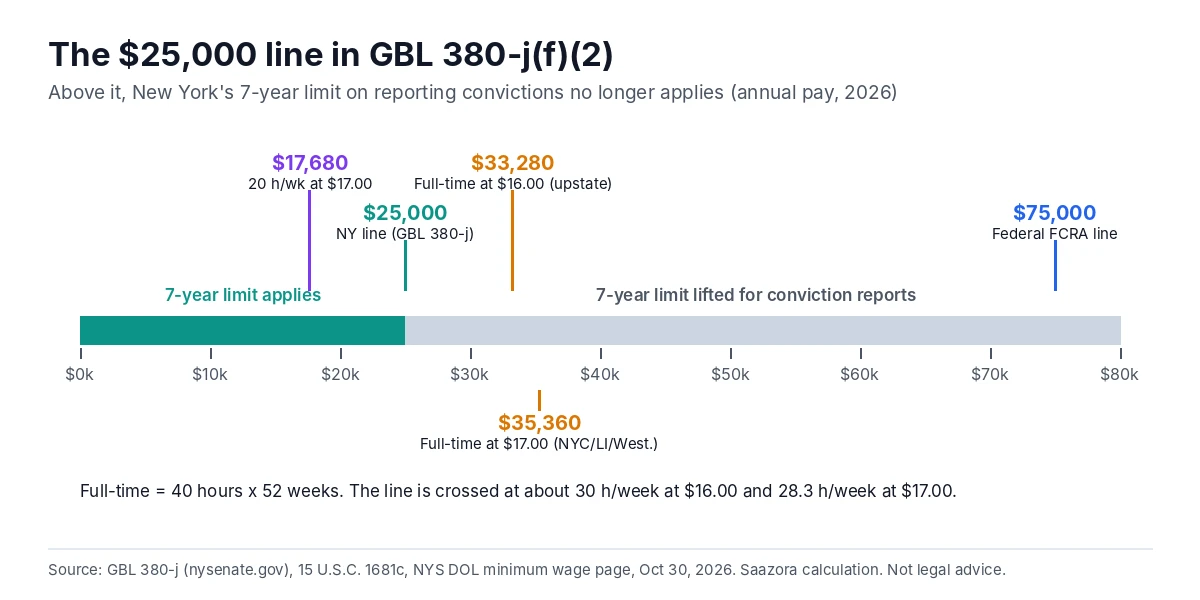
One practical consequence: when you order a report for a part-time role under the line, tell the screening company the expected annual pay. A 20-hour job at $17.00 an hour works out to $17,680 a year, and for that role a conviction more than seven years past disposition, release or parole should not be on the report. For more on what each search tends to return and why county checks add days, see our timing guide to each part of a background check.
New York City's Fair Chance Act, step by step with dates
Inside the five boroughs, the timing of every criminal history question changes. The Commission's fact sheet tells employers to "Instruct your human resources and hiring staff to not ask applicants any questions about criminal records." The criminal check comes only "after you've vetted an applicant on all non-criminal information", which the Commission's legal guidance calls "Receiving the information in two stages." Since Local Law 4 of 2021, "which is effective July 29, 2021," the protections also cover pending cases and current employees: "Employers are not permitted to automatically discipline or terminate an employee."
Two scope points small businesses often miss. The guidance says the protections "apply to interns, freelancers and independent contractors", so a 1099 courier is covered (our guide to screening 1099 and gig workers covers the federal side). And some records are never in play: the guidance treats "Cases that resolved in a conviction for a violation," youthful offender cases and "Convictions that have been sealed" as non-convictions, along with "Instances when the police decided not to charge a person following their arrest."
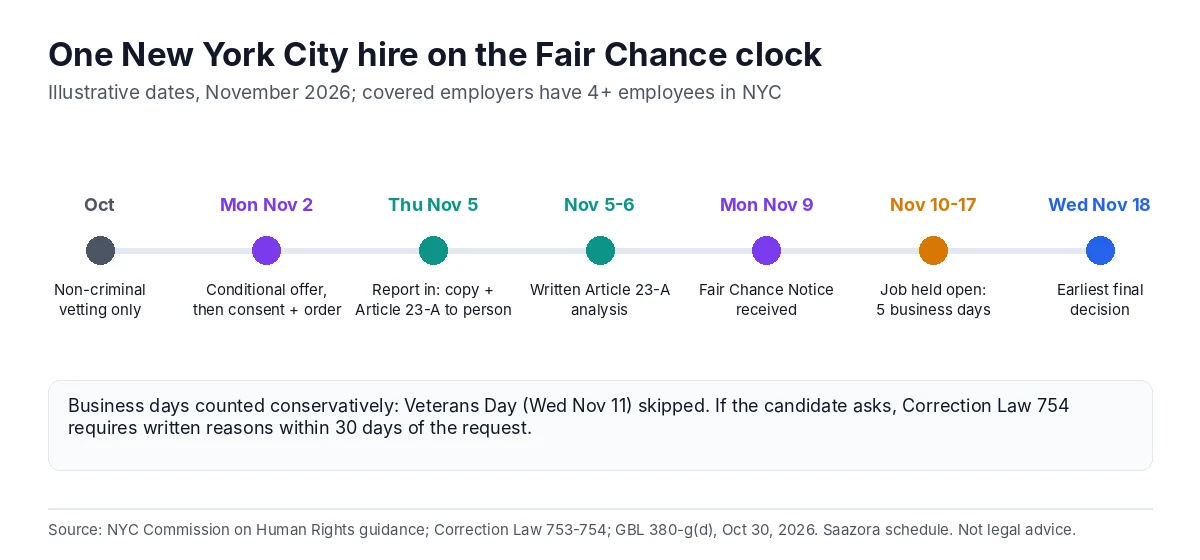
Here is one hire on a calendar, with the steps the Commission lists:
| Date (2026) | Step | Source of the rule |
|---|---|---|
| October | Job post, interviews, reference and employment checks (non-criminal information only). No criminal history questions, on forms or aloud | NYC Fair Chance Act |
| Mon Nov 2 | Conditional offer in writing. Then the New York notice that a consumer report may be requested and the FCRA disclosure and authorization for the criminal search, and only then the order | NYC Fair Chance Act; GBL §380-b(b); 15 U.S.C. §1681b |
| Thu Nov 5 | Report arrives with a 2021 felony conviction. Send the candidate a copy of the criminal history and Article 23-A | GBL §380-g(d); Executive Law §845-d(5) |
| Nov 5–6 | Written analysis under the Article 23-A factors (and the city's Fair Chance factors for any pending case) | Correction Law §753; NYC Fair Chance Act |
| Mon Nov 9 | Candidate receives the Fair Chance Notice, the analysis and a copy of the report, with the FCRA summary of rights | NYC Fair Chance Act; 15 U.S.C. §1681b(b)(3) |
| Tue Nov 10 – Tue Nov 17 | Job held open for at least five business days (counting conservatively, we skip Veterans Day, Wed Nov 11) | NYC Fair Chance Act |
| Wed Nov 18 | Earliest final decision; if adverse, send the final notice | NYC Fair Chance Act; FCRA |
| Within 30 days of a request | Written statement of reasons, if the candidate asks | Correction Law §754 |
Illustrative schedule. The Commission's wording is "at least five business days, from when an applicant receives this information"; whether a public holiday counts as a business day is a question for counsel, so the table uses the later date. Not legal advice.
The Commission's model "Fair Chance Act Notice" has blanks for the Article 23-A factors and the reasons, and a response period "(must be at least five business days)", so it doubles as your Article 23-A record. The guidance lists exemptions, among them "Actions Taken Pursuant to Federal, State, or Local Law Requiring Criminal Background Checks," and "Police and peace officers are exempt from the NYCHRL's employment protections". It also says "Employers in the financial services industry are exempt from the Fair Chance Process". Check any exemption against the full guidance before you rely on it.
Credit reports and salary history: two checks New York mostly takes away
Credit in New York City. The Stop Credit Discrimination in Employment Act (Local Law No. 37 of 2015) covers the same four-employee employers. The Commission's FAQ says "Employers cannot inquire about payment history or credit worthiness, credit standing, or credit capacity," and gives examples of such information: "credit card debt, child support, student loans". The rules define consumer credit history as "an individual's credit worthiness, credit standing, credit capacity, or payment history," whether from a credit report, a score or questions to the applicant. The exemptions in the Commission's rules are narrow:
- Credit checks "required by state or federal law or regulations or by a self-regulatory organization"
- "Police officers or peace officers"
- "Positions requiring bonding under city, state, or federal law or regulation"
- "Positions requiring security clearance under federal or state law"
- "Non-clerical positions having regular access to trade secrets"
- Positions with "signatory authority over third-party funds or third-party assets that are valued at $10,000 or more"
- "Positions with regular duties that allow the employee to modify digital security systems"
For a NYC office manager who pays vendors under $10,000 at a time, a credit check is probably off the table. For a controller who signs larger wires, it may be allowed, and the file should say which exemption you relied on.
Salary history, statewide. The Department of Labor says the law "took effect on January 6, 2020" and that "New York employers cannot ask job applicants to provide their wage or salary history as a condition of employment." "The law also prevents businesses from seeking similar information from other sources." Labor Law §194-a also bars employers from relying on salary history, with two openings. An applicant may disclose "voluntarily, and without prompting", and "An employer may confirm wage or salary history only if at the time an offer of employment with compensation is made" and the other conditions of subdivision 3 are met; read that subsection before you rely on it. If you order employment verification, make sure the vendor's form does not ask former employers for pay. Our explainer on what an employment verification check returns shows where salary data usually appears.
Pricing a New York check: the courts' $95 search vs Checkr
New York's court system sells its own statewide search. The Criminal History Record Search (CHRS) of the Office of Court Administration is offered "for a fee of $95.00." It covers "criminal cases originating from County/Supreme, City, Town and Village courts of all 62 counties," and reports "open/pending and convictions." "Sealed records are not disclosed." Requests go by mail or through the online Direct Access program; "There is no In-Person Service at 25 Beaver Street."
Checkr's pricing page, read October 30, 2026, lists three packages and add-ons, with this footnote: "Standard third-party court and database access fees may apply, passed through at cost with no markup."
| Checkr item | List price | New York note |
|---|---|---|
| Basic | $29.99 / report | SSN trace, sex offender registry, global watchlist and national criminal search; "Our most affordable option with limited criminal search" |
| Essential | $59.99 / report | Adds identity verification and unlimited county criminal search |
| Complete | $94.99 / report | Adds unlimited state criminal search and federal criminal search |
| State criminal search | Starting from $10 / check | A state-level search added to Basic or Essential |
| County criminal search | $25 / check | One named county |
| MVR | $9.50 / check | For driving roles; New York's $7.00 DMV fee passes through |
| Employment verification | Starting from $12.50 / check | Keep pay questions off the form (Labor Law §194-a) |
Checkr list prices from checkr.com/pricing, October 30, 2026, before pass-through fees. Enterprise pricing is by quote.
New York pass-through fees. Checkr's passthrough fees page, read November 1, 2026, lists a New York state court fee of $95.00, the same as the OCA search fee, and a $7.00 state DMV fee. It also lists county court fees for 29 New York counties, from $5.00 to $95.00; 13 are at $95.00, including all five New York City counties, Nassau and Erie. These fees are added at cost to the list prices above.
The arithmetic for 15 New York hires, before any pass-through fees:
| Option | Arithmetic | Total for 15 hires | What you get |
|---|---|---|---|
| OCA statewide CHRS, do it yourself | 15 × $95.00 | $1,425.00 | New York court cases from all 62 counties, open and convictions, sealed records excluded; no other states, no identity check |
| Checkr Basic | 15 × $29.99 | $449.85 | National database search, SSN trace, registries |
| Checkr Basic + state criminal search | 15 × ($29.99 + $10.00) | from $599.85 | Adds a state-level search; the add-on is "starting from" $10 |
| Checkr Essential | 15 × $59.99 | $899.85 | Adds county searches where the person lived, plus identity verification |
| Checkr Complete | 15 × $94.99 | $1,424.85 | Adds state and federal searches |
Saazora arithmetic from the NY Courts CHRS page and Checkr list prices, both read October 30, 2026. Pass-through fees (above) are extra on every Checkr row.
Before fees, the OCA search costs about as much per person as Checkr Complete. With one $95.00 state court fee per report, Basic plus a state search becomes from $134.99 and Complete $189.99 (from $2,024.85 and $2,849.85 for 15 hires), and each search in a $95.00 county adds the same again. For New York courts alone, OCA is cheaper; Checkr adds national, county and federal layers. Check where candidates lived before choosing between Basic plus a state search and Essential. Our guide to Checkr's packages and passthrough fees explains the tiers, and our cost-per-hire comparison for small businesses sets Checkr against other vendors.
If Essential fits your New York roles, you can set up a Checkr account for New York hiring (affiliate link). Billing is per report, so a business that hires a handful of people a year pays only for what it orders. Whichever vendor you use, the Article 23-A analysis, the Fair Chance Notice and the copies above are still your job.
All our hiring guides are in Saazora's HR and hiring tools section, and the Checkr store page lists current offer terms. When your forms are ready, compare Checkr's business packages (affiliate link).
How we researched this New York guide
On October 30, 2026 we read the following on nysenate.gov with a page-reading tool that returns short verbatim excerpts, noting each revision date: Correction Law §§750 and 752-754; Executive Law §§296 and 845-d; Criminal Procedure Law §160.57; General Business Law §§380-b, 380-c, 380-g and 380-j; and Labor Law §194-a. Longer quotations are joined from consecutive excerpts. We also read the Governor's November 16, 2023 Clean Slate release, the NY Courts Clean Slate FAQ and CHRS page, the NYS Department of Labor's salary history and minimum wage pages, the New York City Commission on Human Rights' Fair Chance and credit history publications (fact sheet, 2021 flyer, legal guidance dated January 3, 2022, notice form, FAQ and final rules) and the federal FCRA on Cornell LII. On November 1, 2026 we rechecked Checkr's prices, read its New York passthrough fees, and confirmed the CHRS fee and the Executive Law §296 (revised June 5, 2026) and GBL §380-j (revised June 19, 2026) text quoted here.
Sources (checked October 30, 2026): NYS Senate, Correction Law §750, §752, §753 and §754; Executive Law §296 and §845-d; Criminal Procedure Law §160.57; General Business Law §380-b, §380-c, §380-g and §380-j; Labor Law §194-a; Governor of New York, Clean Slate Act signing release, November 16, 2023; NY Courts, How much time must pass before convictions are sealed? and Criminal History Record Search; NYS Department of Labor, Salary History and Minimum Wage; NYC Commission on Human Rights, Fair Chance Act: Fact Sheet for Employers, Fair Chance Act information for employers (2021), Fair Chance Act legal guidance, Fair Chance Act Notice form, Credit History FAQ and Final Rules Implementing the Stop Credit Discrimination in Employment Act; Cornell LII, 15 U.S. Code §1681b and §1681c; Checkr, pricing page and passthrough fees page.
Research guide, not hands-on testing and not legal advice. Checkr did not pay for or review this article.