
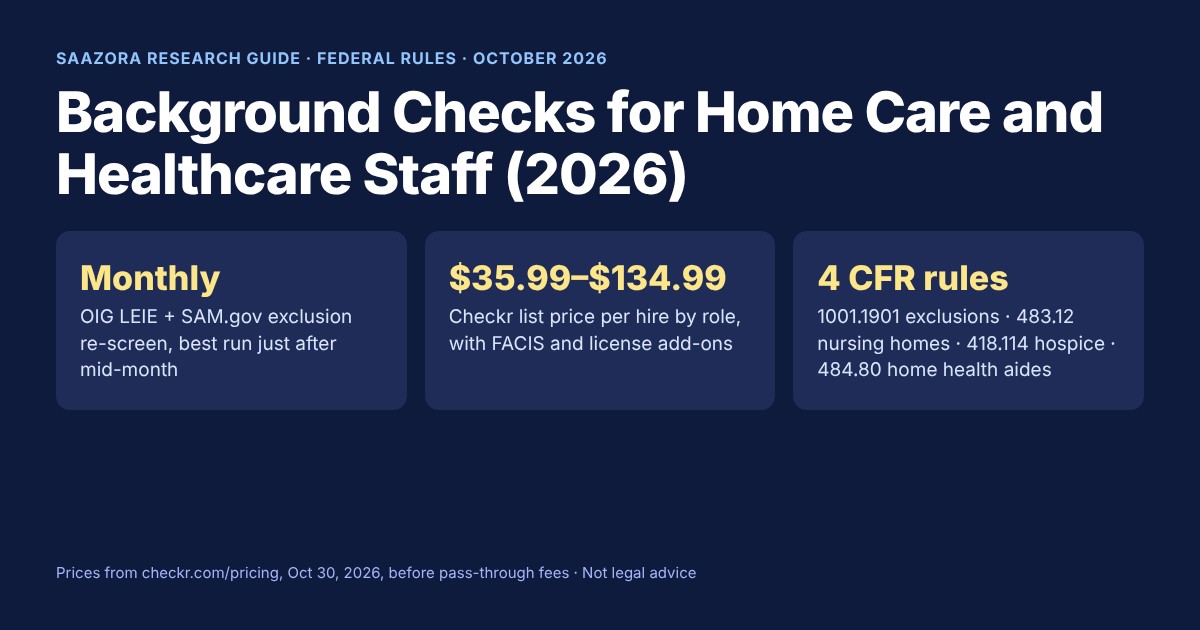
Research guide from public pages, not hands-on testing: Saazora ran no checks for this article · Checkr prices, HHS-OIG, eCFR, NPDB, SAM.gov and FTC pages read October 30, 2026 · Federal rules only; state caregiver laws are not covered and are often stricter · Not legal advice · We may earn a commission if you sign up through links on this page.
Background checks for home care and healthcare staff have one layer that ordinary employers do not: exclusion screening. Any employer paid by Medicare or Medicaid should search the HHS-OIG List of Excluded Individuals/Entities (LEIE) before hiring and, in OIG's words, screen "employees and contractors each month", because no federal health care program payment may be made for services furnished by an excluded person. On top of that, a few federal rules set specific checks for specific settings: hospices must run criminal background checks on staff with patient contact or record access, nursing homes must not employ people with abuse findings on the state nurse aide registry, and hospitals must query the National Practitioner Data Bank. At Checkr list prices on October 30, 2026, a typical package with a FACIS healthcare sanctions search runs from about $36 for office staff to about $135 for a licensed clinician, before court and database fees.
This guide is for owners, administrators and HR leads at home care and home health agencies, hospices, nursing facilities, clinics and staffing firms. It sorts the federal rules by setting, explains what the LEIE and SAM.gov each cover and when in the month to re-screen, shows where license and registry checks fit, prices a package for each common role, and works through a year of screening for a 40-person agency. It covers federal sources only. Your state almost certainly adds its own fingerprint, registry or disqualifying-offense rules for caregivers, and those come first. If you have never ordered a check before, start with our step-by-step guide to running an employee background check; this page builds the healthcare layer on top of it.
Which federal rule applies to your setting
There is no single federal "healthcare background check" law. Instead, several federal rules each cover a slice of the field, and most of them attach to Medicare and Medicaid participation. The table below shows what we found in the current eCFR text and on the HHS-OIG and NPDB sites, read October 30, 2026.
| Setting | Federal source | What it says about screening | What it does not say |
|---|---|---|---|
| Any provider or supplier paid by a federal health care program | Social Security Act §1128; 42 CFR 1001.1901; OIG Special Advisory Bulletin (May 8, 2013) | No federal program payment for items or services furnished by an excluded person, including "administrative and management services". OIG says providers "should check the LEIE prior to employing or contracting with persons" and recommends monthly screening. | OIG: "Providers are not required by statute or regulation to check the LEIE." The risk is the payment ban and penalties, not a stand-alone screening mandate. |
| Nursing homes (long-term care facilities) | 42 CFR 483.12(a)(3)–(4) | The facility must not employ or engage people found guilty of abuse, neglect, exploitation, misappropriation or mistreatment by a court, people with such a finding on the state nurse aide registry, or people whose professional license has a related disciplinary action in effect. | It does not name a specific check product; the facility has to be able to know these facts, which in practice means a criminal search, a registry check and a license check. |
| Hospices | 42 CFR 418.114(d) | Criminal background check on all employees with direct patient contact or access to patient records; contracts must require the same for contracted employees. Where the state sets no rule, the check is due within three months of hire and covers every state the person lived or worked in for the past 3 years. | It defers to state requirements where they exist. |
| Medicare-certified home health agencies | 42 CFR 484.80 | Aide qualification: training and competency evaluation (at least 75 hours of classroom and supervised practical training), a competency program, a state nurse aide program or a state licensure program. | We found no criminal background check requirement in §484.80. Agency checks for aides come from state law and the exclusion rules above. |
| Hospitals | National Practitioner Data Bank (HRSA) | "Hospitals are mandated by federal law to query the NPDB" when reviewing practitioners, including the two-year review of clinical privileges. | The NPDB is not open to the general public, and a home care agency may query only if it is an eligible entity, such as a health care entity with formal peer review. |
Sources: eCFR (42 CFR 1001.1901 up to date as of 7/16/2026; 483.12 as of 10/22/2026; 484.80 as of 10/23/2026; 418.114 as of 10/20/2026); HHS-OIG Special Advisory Bulletin on the Effect of Exclusion (May 8, 2013); NPDB "Who Can Query" page. The eCFR is an editorial compilation, not the official legal edition. Read October 30, 2026. Not legal advice.
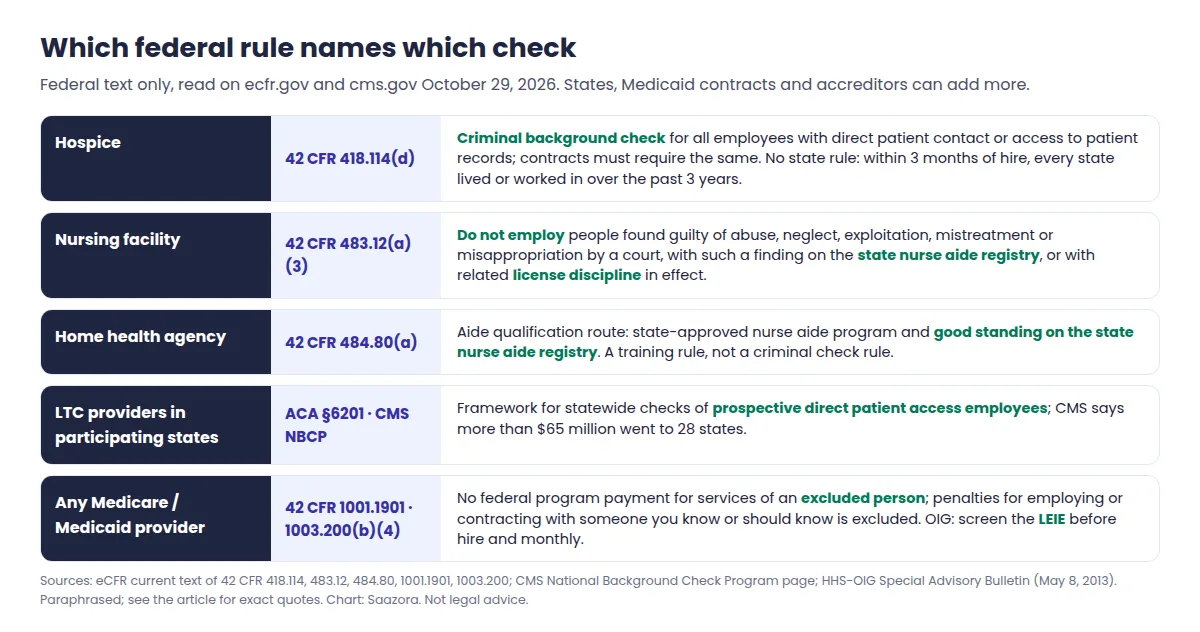
Two things stand out. First, exclusion screening is the only federal layer that reaches almost every healthcare employer, including private-duty home care agencies that bill Medicaid waiver programs. Second, the home health conditions of participation in §484.80 are about training, not criminal history, which is why home health agencies tend to build their criminal check policy around state law and their own risk, not a federal checklist.
OIG and SAM exclusion screening: what each list covers
An exclusion is a federal decision that a person or company may not take part in federal health care programs. OIG takes these actions "pursuant to section 1128 of the Social Security Act". Some are mandatory with a minimum period of 5 years, such as a conviction relating to patient abuse or neglect, a felony conviction relating to health care fraud, or a felony conviction relating to a controlled substance. Others are permissive, including "suspension, revocation, or surrender of a license to provide health care".
The effect on an employer is set out in 42 CFR 1001.1901: no payment by Medicare, including Medicare Advantage and Prescription Drug Plans, Medicaid and the other federal programs for items or services furnished on or after the exclusion's effective date. The 2013 bulletin spells out what that means for staff:
- It is not limited to clinicians. "Excluded persons are prohibited from furnishing administrative and management services" that are paid for by federal programs. A biller, scheduler or office manager counts.
- Job title does not matter. The ban applies "regardless of whether the person is an employee, a contractor, or a volunteer".
- Agency staff count too. "OIG recommends that providers screen nurses provided by staffing agencies".
- The penalty can be large. The bulletin says OIG "may impose CMPs of up to $10,000 for each item or service furnished by the excluded person", plus "an assessment of up to three times the amount claimed". That is the bulletin's 2013 wording; check current penalty amounts with counsel.
Searching the LEIE yourself
OIG publishes the LEIE in two forms: an online searchable database and a downloadable file. The FAQ says the online tool allows "a search of up to five names at one time" and can verify a possible match with a Social Security Number for individuals or an EIN for entities. The download is different: it "does not contain SSNs or EINs", so a name match in the file still has to be confirmed in the online tool. We found no fee for either. Reinstated people are removed: "Individuals and entities who have been reinstated are removed from the LEIE."
Keep a dated record of every search (a screenshot or saved results page per batch), because the point of the search is to show what you knew on a given day.
Where SAM.gov fits
SAM.gov, run by the General Services Administration, holds exclusion records from across the federal government, not only HHS. The 2013 bulletin puts it this way: "SAM includes OIG's exclusions but also includes debarment actions taken by Federal agencies." It still tells providers to use "the LEIE as the primary source of information about OIG exclusions". In practice, healthcare employers search both: the LEIE for OIG actions, SAM for debarments and other federal exclusions. SAM's exclusion records come in several types, such as "Ineligible (Proceedings Pending)", "Ineligible (Proceedings Completed)" and voluntary exclusions agreed in a settlement; when a record's limits are unclear, SAM says, "contact the agency taking the action".
Neither list covers state Medicaid exclusions. Most states publish their own Medicaid exclusion list, and state rules on checking them are outside this guide. Commercial sanctions searches such as the FACIS search below bundle state lists with the federal ones.
Monthly re-screening: pick the right day of the month
OIG's recommendation on frequency is direct: "OIG updates the LEIE monthly, so screening employees and contractors each month best minimizes potential overpayment". The FAQ adds the timing detail most guides leave out: "Both versions of the LEIE are generally updated by the middle of each month", and "the updates include all actions taken during the prior month."
That means the day you run your monthly check matters. An exclusion that takes effect early in one month does not appear in the LEIE until the middle of the next month. If you screen on the 1st, you see that update about two weeks after it was posted. If you screen a few days after mid-month, you see it within days.
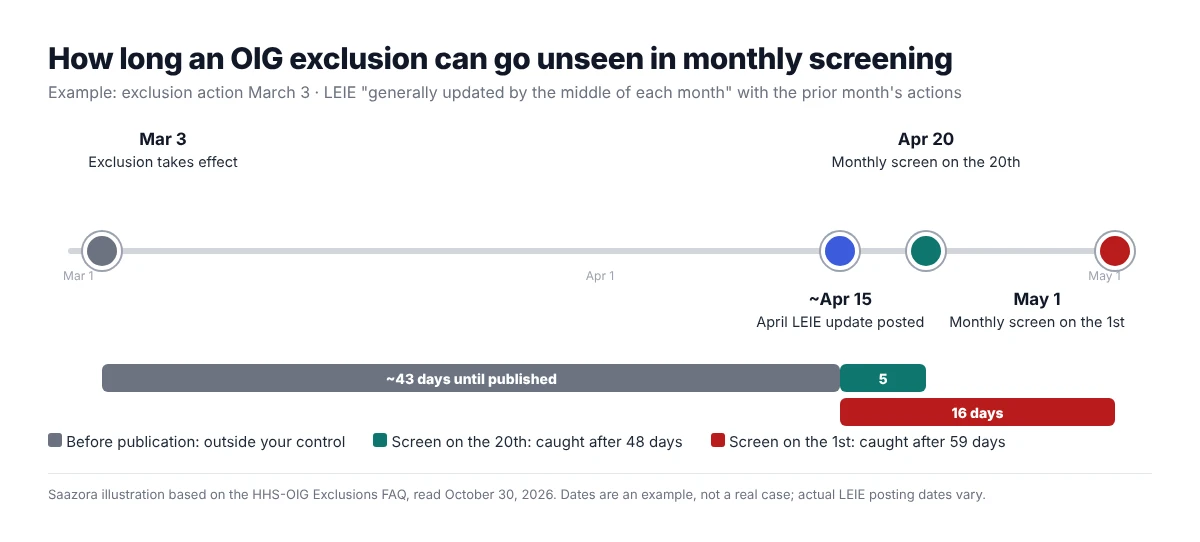
In this example the exclusion is taken on March 3. It is published in the April update, around April 15. An agency that screens on the 20th of each month sees it on April 20, 48 days after the action. An agency that screens on the 1st sees it on May 1, 59 days after the action. Eleven days may look small, but for a home care aide who makes several visits a day, each visit can be a separate service. The gap before publication is outside your control; the gap after it is not.
Three ways to run the monthly check:
- Do it yourself. Search the LEIE online in batches of five names, confirm any hit by SSN, and search SAM.gov. It costs staff time, not money. For 40 people that is eight LEIE batches a month. OIG also offers email notice when the LEIE is updated, which helps you schedule the search.
- Re-order a sanctions search through your screening company. Checkr's pricing page lists FACIS from $6 per check. We found no posted price for a monthly FACIS monitoring plan, so ask Checkr whether FACIS can be ordered on its own each month or enrolled in a recurring check before you budget for it.
- Use a dedicated exclusion-monitoring service. These exist, but they are outside the scope of this Checkr-based guide.
If your searches run through a consumer reporting company, the FTC says the original authorization must say so "clearly and conspicuously" if you want to get consumer reports "throughout the person's employment". Put that sentence in your onboarding authorization now, not when you decide to re-screen.
License, certification and registry verification
Exclusion screening tells you whether federal programs will pay for someone's work. It does not tell you whether that person is licensed to do it. Hospices, for example, must ensure that professionals furnishing services "must be legally authorized (licensed, certified or registered) in accordance with applicable Federal, State and local laws" and act within that license (42 CFR 418.114(a)). Nursing homes must screen out people with a related "disciplinary action in effect against his or her professional license by a state licensure body" (42 CFR 483.12(a)(3)(iii)).
Three tools cover this layer:
- Professional license verification. Checkr lists it at $12 per check. Its product page says it "validates that your candidate's license is active (i.e., not expired)", shows status, expiration date and derogatory remarks, and names CNA, NP and RN among example licenses. Checkr says "most licenses are verified instantly, or completed within 1-2 business days".
- The state nurse aide registry. For nursing homes, §483.12 turns on findings "entered into the State nurse aide registry". Each state runs its own registry, so confirm whether a license verification ordered through your screening company actually searches the aide registry in your state, or whether you need to search it directly.
- The National Practitioner Data Bank. The NPDB collects "medical malpractice payments and certain adverse actions" on practitioners. A query costs $2.50 ("a single One-Time Query response or one-year enrollment in Continuous Query is $2.50"), but only eligible organizations may query, and it is "not available to the general public". Hospitals must query. A home care agency should check whether it qualifies as a health care entity with formal peer review before registering.
Employment history matters more for clinicians than for most roles, because gaps and short stints can line up with license actions. Our guide to employment verification checks covers what a verification confirms and how long it takes.
Background checks for home care agencies and clinics: a package for each role
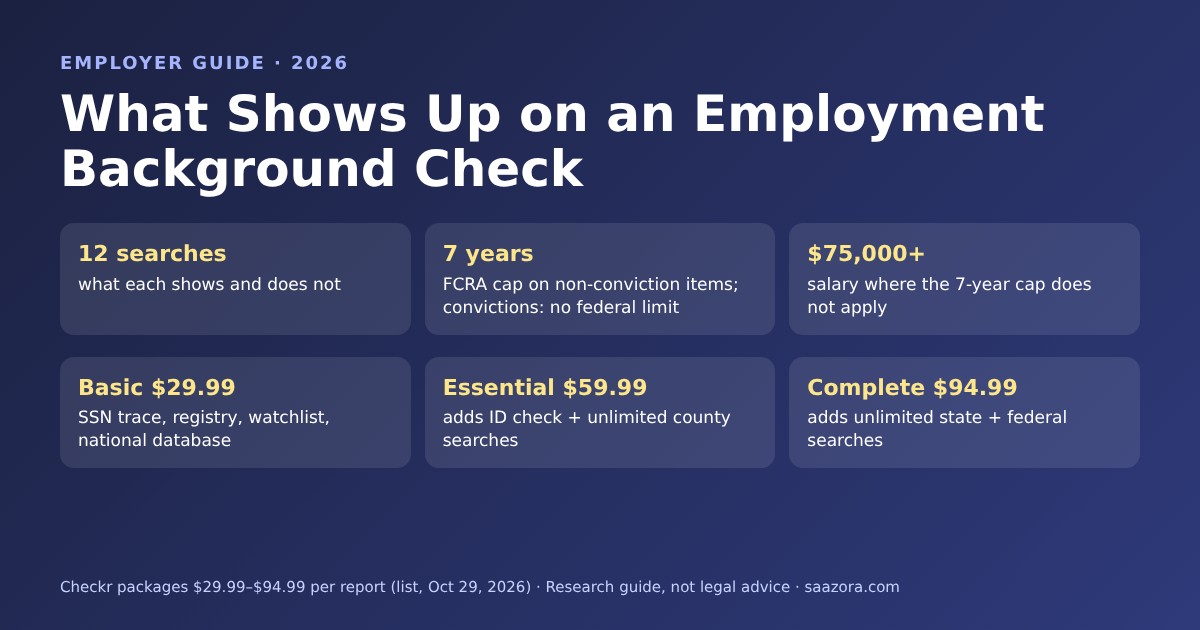
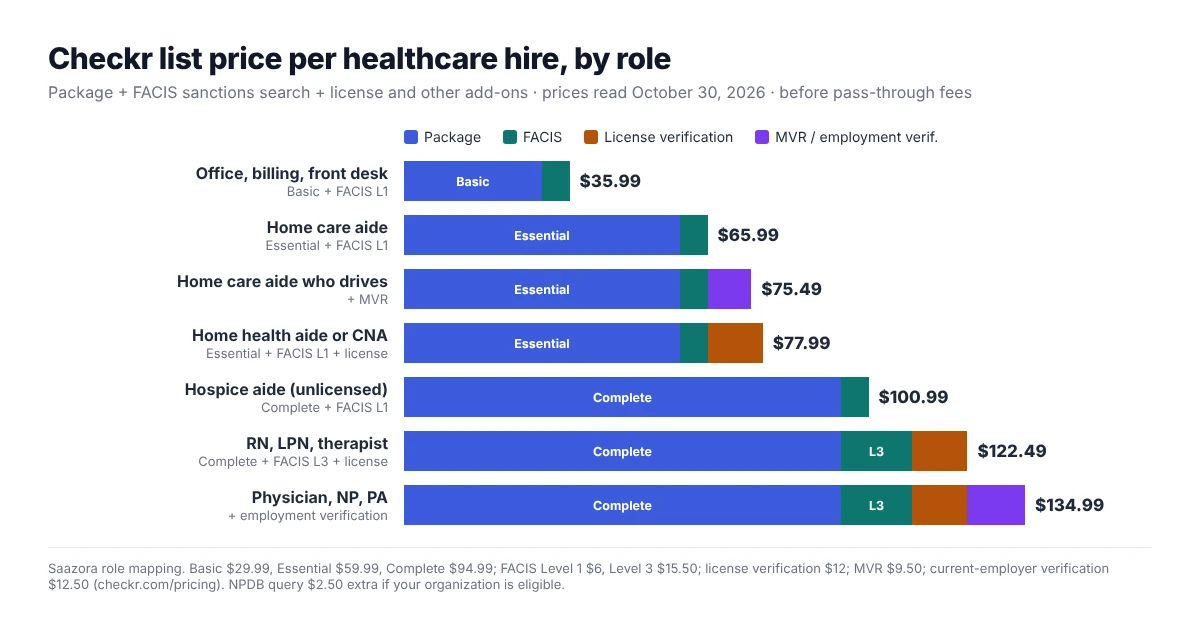
Checkr uses the same three packages in every industry. At list price on October 30, 2026: Basic at $29.99 per report (SSN trace, sex offender registry, global watchlist and national criminal search), Essential at $59.99 (adds identity verification and unlimited county criminal searches) and Complete at $94.99 (adds unlimited state criminal searches and a federal criminal search). The healthcare add-ons are the FACIS search ("Starting from $6/check": Level 1 at $6 and Level 3 at $15.50) and professional license verification at $12. Court and database fees are passed through "at cost with no markup" on top.
Checkr describes FACIS Level 1 as meeting the "requirements of the Office of Inspector General (OIG) Compliance Program Guidance", covering SAM, the OIG LEIE and state Medicare and Medicaid data where available. Level 3 adds sanctioning boards from all 56 U.S. jurisdictions across provider types, which is why it fits licensed clinicians better than aides.
The table is Saazora's suggested starting point, not a rule. State law for caregivers, your payer contracts and your accreditor come first.
| Role | Why this mix | Package + add-ons | List price before pass-through fees |
|---|---|---|---|
| Billing, scheduling, front desk, office manager | Exclusion ban covers administrative and management services; no patient contact | Basic + FACIS Level 1 | $29.99 + $6 = $35.99 |
| Non-medical home care or personal care aide | Alone in a client's home; county court records matter | Essential + FACIS Level 1 | $59.99 + $6 = $65.99 |
| Home care aide who drives clients or runs errands | Adds driving on the job | Essential + FACIS Level 1 + MVR | $65.99 + $9.50 = $75.49 |
| Home health aide or CNA (home health agency or nursing home) | Certification or registry status, plus §483.12 in nursing homes | Essential + FACIS Level 1 + license verification | $59.99 + $6 + $12 = $77.99 |
| Hospice aide or other unlicensed hospice staff with patient contact | §418.114(d) can reach every state lived or worked in for 3 years | Complete + FACIS Level 1 | $94.99 + $6 = $100.99 |
| RN, LPN, therapist (any setting) | License status and board sanctions across states | Complete + FACIS Level 3 + license verification | $94.99 + $15.50 + $12 = $122.49 |
| Physician, NP, PA, clinical director | Adds work history; NPDB query if your organization is eligible | Complete + FACIS Level 3 + license + current-employer verification | $122.49 + $12.50 = $134.99 (+ $2.50 NPDB if eligible) |
Checkr list prices from checkr.com/pricing, October 30, 2026; NPDB fee from npdb.hrsa.gov. Employment verification is "starting from $12.50" for the current employer and up to $50 for a 10-year lookback. Pass-through court, database and DMV fees are extra. Role mapping and totals are Saazora's.
Why Complete for hospice staff: §418.114(d)(2) says that where the state sets no rule, the check covers "all states that the individual has lived or worked in the past 3 years". Complete is the Checkr package that adds unlimited state criminal searches. If your state sets its own hospice check rule, that rule controls instead, and it may point to fingerprints through a state agency rather than a commercial report.
Why MVR only for drivers: the same logic as in any other industry. Order it when the job puts the person behind the wheel for you; our MVR guide for driving roles covers state fees and continuous monitoring. The role-by-role approach mirrors the one in our restaurant and hotel screening guide, but healthcare adds the sanctions search to every row, including the office.
If you want to set packages up by role, you can open a Checkr account for healthcare hiring (affiliate link).
A year of screening for a 40-person home care agency
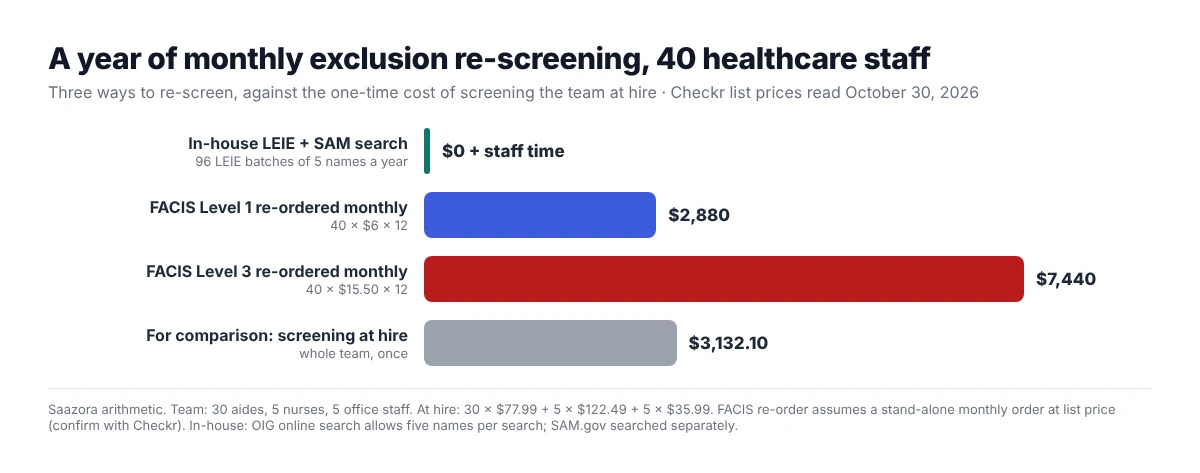
Here is an illustrative budget for an agency with 30 home health aides, 5 nurses and 5 office staff, screened once at hire with the packages above and then re-screened for exclusions every month. It does not model turnover: multiply the hiring rows by your own number of new hires each year.
| Item | Calculation | Cost |
|---|---|---|
| Aides at hire (Essential + FACIS L1 + license) | 30 × $77.99 | $2,339.70 |
| Nurses at hire (Complete + FACIS L3 + license) | 5 × $122.49 | $612.45 |
| Office staff at hire (Basic + FACIS L1) | 5 × $35.99 | $179.95 |
| Screening at hire, whole team | $3,132.10 | |
| Monthly exclusion check, option A: LEIE and SAM searched in-house | 40 names × 12 months = 480 name checks (96 LEIE batches of five) | $0 + staff time |
| Monthly exclusion check, option B: FACIS Level 1 re-ordered each month | 40 × $6 × 12 | $2,880.00 |
| Optional: continuous criminal search for the 35 patient-facing staff | 35 × $1.70 × 12 | $714.00 |
Checkr list prices, October 30, 2026, before pass-through fees. Option B assumes FACIS can be re-ordered as a stand-alone monthly check at the $6 list price; confirm with Checkr. Staffing mix is an example. Calculations: Saazora.
What the numbers show:
- Re-screening can cost almost as much as hiring. At $6 a name, a year of monthly FACIS checks ($2,880) comes close to the cost of screening the whole team once ($3,132). With Level 3 for everyone it would be $7,440, which is hard to justify for aides.
- The in-house option is free but has to be done. 96 LEIE batch searches a year, plus SAM, plus a dated record of each. Put it on a calendar for a few days after mid-month and name a backup person.
- A mixed approach is common. Use FACIS at hire, when you need the state lists and a consumer report anyway, then search the LEIE and SAM in-house every month and re-run FACIS only when a name needs a closer look.
- Pass-through fees vary by county and state. Our Checkr pricing breakdown shows how court and DMV fees add to each order.
The FCRA steps still apply, and so does the payment ban
A healthcare background check ordered from a screening company is a consumer report, so the usual Fair Credit Reporting Act steps apply. The FTC's employer guide lists them: a disclosure that "must be in writing and in a stand-alone format", written permission, a certification to the screening company, a pre-adverse action notice with a copy of the report and "A Summary of Your Rights Under the Fair Credit Reporting Act", and then a final adverse action notice that names the screening company and states that it "did not make the decision".
Healthcare adds a twist. If a FACIS search shows a confirmed OIG exclusion, the decision itself may feel automatic, because federal programs will not pay for that person's work. The notice steps still apply when the finding came from a consumer report. A finding from your own search of the LEIE website is a different situation, since you did not get a report from a consumer reporting company; how the FCRA treats it is a question for your lawyer, and a fair process (tell the person, let them show it is a name mix-up) is good practice either way.
If you discover that someone you already employ is excluded, the OIG FAQ points you to the next step: "If you have already employed the individual, check the Self-Disclosure Protocol." Talk to counsel before you do anything else.
Edge cases healthcare employers ask about
- Nurses from a staffing agency. OIG recommends screening them. Either search the names yourself each month or require the agency, in writing, to screen and to send you proof.
- Hospice contractors. §418.114(d)(1) says hospice contracts "must require that all contracted entities obtain criminal background checks on contracted employees" with patient contact or record access. Put that clause in every contract and ask for confirmation.
- 1099 caregivers and per-diem clinicians. Exclusion rules do not care about tax status. If you use independent contractors, our guide to screening 1099 workers covers the FCRA side.
- Volunteers. The exclusion bulletin names volunteers. §418.114(d) speaks of employees and contracted employees; whether hospice volunteers need a criminal check depends on your state and your policy.
- An excluded person in a back-office job. Not a safe workaround. The bulletin says excluded persons may not furnish administrative and management services paid for by federal programs, and the OIG FAQ says the exclusion "applies to all administrative and management services furnished by the excluded person."
- A name match with no SSN. The downloadable LEIE has no SSNs. Confirm in the online search before you act, and keep the record.
- Someone who was excluded and reinstated. Reinstated people are removed from the LEIE, so a past exclusion may no longer show. If the person discloses one, ask for the reinstatement letter.
For a checklist view, this one-page list covers the healthcare layer:
- ☐ Written screening policy per role (office, aide, licensed clinician, contractor, volunteer), reviewed by a healthcare lawyer, including your state's caregiver rules.
- ☐ FCRA disclosure and authorization that covers checks "throughout the person's employment".
- ☐ LEIE and SAM search before every hire and every contract, with a dated record.
- ☐ Monthly LEIE and SAM re-screen scheduled for a few days after mid-month.
- ☐ License or certification verification at hire and before each expiration date.
- ☐ Nurse aide registry search for nursing home staff.
- ☐ Hospice: criminal checks for patient-facing and record-access staff, and a matching clause in every contract.
- ☐ NPDB registration if your organization is eligible.
- ☐ Pre-adverse and adverse action notices for any decision based on a consumer report.
All our hiring guides are collected in the HR and hiring tools hub, and the Checkr offers page keeps the current sign-up terms in one place. When your role policy is ready, you can set up Checkr packages with FACIS and license checks (affiliate link).
Quick answers on healthcare staff screening
Is OIG exclusion screening required by law?
OIG's 2013 bulletin says "Providers are not required by statute or regulation to check the LEIE." But federal programs will not pay for items or services furnished by an excluded person, and OIG can impose civil money penalties, so OIG says providers should check before hiring and recommends screening every month.
How often should a home care agency re-check the OIG list?
OIG recommends monthly, because it updates the LEIE monthly. The update is generally posted by the middle of each month, so a search a few days after mid-month picks up the newest actions soonest.
What is a FACIS search?
FACIS (Fraud Abuse Control Information System) is a healthcare sanctions database search. On Checkr it starts at $6 per check for Level 1, which covers the OIG LEIE, SAM and available state Medicare and Medicaid data, and costs $15.50 for Level 3, which adds sanctioning boards across all 56 U.S. jurisdictions.
Do home health aides need a criminal background check under federal rules?
The federal home health aide rule, 42 CFR 484.80, covers training and competency; we found no criminal check requirement in it. Most states set their own rules for aides, and exclusion screening still applies if the agency bills Medicare or Medicaid. Hospices are different: 42 CFR 418.114(d) requires criminal checks for patient-facing staff.
Can a home care agency query the NPDB?
Only if it is eligible. The NPDB is not open to the general public; hospitals must query, and other health care entities with formal peer review may. Each organization determines its own eligibility when it registers. A query costs $2.50.
How this healthcare guide was put together
On October 30, 2026 we read checkr.com/pricing and Checkr's healthcare sanctions and professional license verification pages; the HHS-OIG Special Advisory Bulletin on the Effect of Exclusion (May 8, 2013), the OIG Exclusions FAQ and its exclusion authorities page; the eCFR text of 42 CFR 1001.1901, 483.12, 484.80 and 418.114; the NPDB querying and "who can query" pages; SAM.gov's entity information and exclusion types pages and GSA's Exclusions API page; and the FTC's guide for employers using consumer reports. The direct oig.hhs.gov/exclusions landing page and Checkr's FACIS help article did not load for our text tool, so the facts above come from the bulletin, the FAQ and Checkr's product page instead. Federal rules only: we did not research state caregiver laws, state Medicaid exclusion lists, fingerprinting programs or accreditor standards. The role map, timeline and cost tables are Saazora's own analysis; Saazora did not order any check for this article.
Sources (checked October 30, 2026): HHS-OIG, Special Advisory Bulletin on the Effect of Exclusion (May 8, 2013); HHS-OIG, Exclusions FAQs; HHS-OIG, Exclusion Authorities; 42 CFR 1001.1901; 42 CFR 483.12; 42 CFR 484.80; 42 CFR 418.114; NPDB, Querying the NPDB; NPDB, Who Can Query or Report; SAM.gov, Exclusion Types; FTC, Using Consumer Reports: What Employers Need to Know; Checkr pricing, healthcare sanctions and professional license verification pages.
Research guide, not hands-on testing and not legal advice. Checkr did not pay for or review this article.