
Research guide built from public pages: Saazora did not order a background check for this article · Florida Statutes (2026 edition on leg.state.fl.us and flsenate.gov), AHCA, FDLE and City of Gainesville pages and Checkr list prices read October 30, 2026 · Not legal advice; a Florida employment lawyer should review your policy before you rely on it · We may earn a commission if you sign up through links on this page.
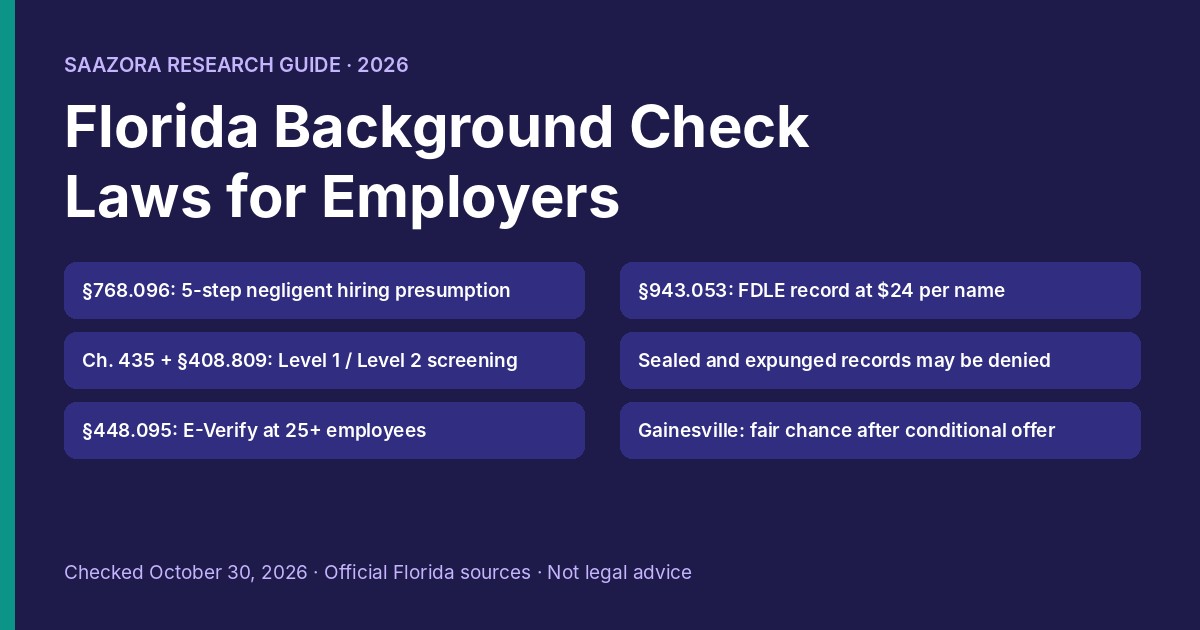
Florida background check laws do not give private employers a state disclosure form, a state seven-year rule or a statewide ban-the-box law. Their pull is quieter. Section 768.096 of the Florida Statutes offers a legal presumption that you were not negligent in hiring if, before the hire, you ran a five-part background investigation that includes a criminal check obtained from the Florida Department of Law Enforcement (FDLE). Section 943.053 sets the state fee for that record at $24 per name. Chapter 435 imposes Level 1 or Level 2 screening only on jobs another statute names, such as health care roles under §408.809. Sealed and expunged records may lawfully be left off most applications. Private employers with 25 or more employees must use E-Verify. And Gainesville has a fair chance ordinance that reaches private employers, reported in 2022 as the first of its kind in Florida.
This guide is written for private employers hiring in Florida. It walks through the §768.096 elements one by one, notes two places where the statute's wording leaves room for argument, sorts out which jobs fall under chapter 435, lays out what sealed, expunged and automatically sealed records mean for an application, works through dated E-Verify deadlines around the November 2026 holidays, and prices 20 hires through FDLE and through Checkr. The federal Fair Credit Reporting Act (FCRA) sits under everything here. If you have not set up screening before, our step-by-step guide to running an employee background check covers the consent and notice basics this page builds on.
Where Florida background check laws come from: seven statutes and one city
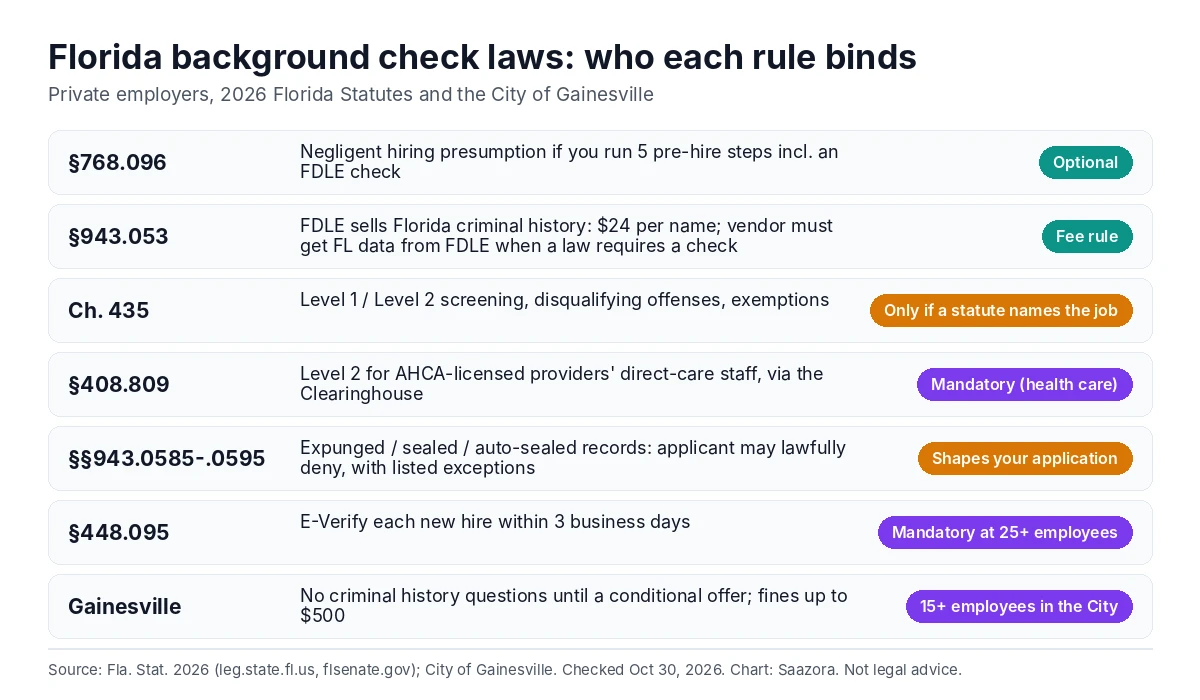
Florida's screening rules are spread across tort law, the FDLE records chapter, a screening chapter for regulated jobs, an immigration statute and one local ordinance. Few of them order a private employer to do anything. Most of them change what happens if you do, or do not, screen.
| Source | Plain-language effect | Mandatory for a typical private employer? |
|---|---|---|
| Fla. Stat. §768.096 | A five-part pre-hire investigation earns a presumption that you were not negligent in hiring, in suits over an employee's intentional tort | No. It is an option; skipping it creates no presumption against you |
| Fla. Stat. §943.053 | Private parties may buy Florida criminal history from FDLE; the fee is $24 per name; when a law requires a check, the Florida part must come from FDLE | Only the fee and sourcing rules; buying a record is your choice |
| Fla. Stat. ch. 435 | Defines Level 1 and Level 2 screening, disqualifying offenses and exemptions | Only where another statute requires it for the job |
| Fla. Stat. §408.809 | Level 2 screening for people seeking work with AHCA-licensed providers who will serve clients directly | Yes, for those health care employers |
| Fla. Stat. §§943.0585, 943.059, 943.0595 | Expunged and sealed records: the applicant may lawfully deny the arrest, except for listed jobs | Shapes what you can expect an applicant to disclose |
| Fla. Stat. §448.095 | Private employers with 25 or more employees must run new hires through E-Verify within 3 business days | Yes, at 25 or more employees |
| City of Gainesville Fair Chance Hiring ordinance | No criminal history questions until after a conditional offer, for employers with 15 or more employees working mainly in the City | Only inside Gainesville |
Built from the 2026 Florida Statutes on leg.state.fl.us and flsenate.gov and the City of Gainesville's Fair Chance Hiring page, read October 30, 2026. A condensed view; each source has exceptions this table leaves out. Not legal advice.
The FCRA's consent and adverse action steps apply whenever a consumer reporting agency such as Checkr prepares the report. We found no Florida statute that adds a second disclosure form, a state summary of rights or a state waiting period for private employers. That is our reading of the statutes listed in the sources, not a promise that none exists, so ask counsel before you drop a form someone already uses.
The §768.096 presumption: what a five-part investigation buys you
Section 768.096 was added in 1999 (ch. 99-225) and is titled "Employer presumption against negligent hiring." It covers a civil action over death, injury or damage "caused by the intentional tort of an employee". If the employer ran the investigation before hiring and it "did not reveal any information that reasonably demonstrated the unsuitability" of the person "for the particular work to be performed" or "for the employment in general", the employer is "presumed not to have been negligent in hiring such employee".
Two limits are worth saying out loud. The presumption is about hiring, not about supervising or keeping an employee after warning signs appear. And it is a presumption, which a plaintiff can try to rebut; the statute does not make an employer immune.
The five elements, and the evidence to keep for each
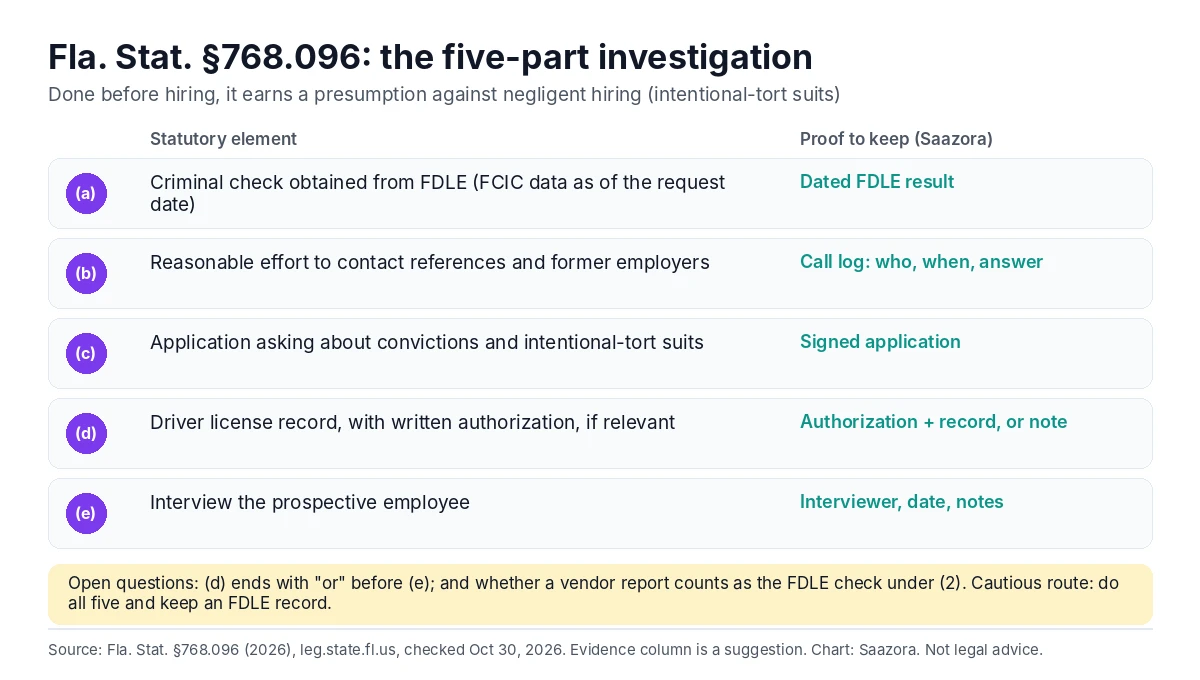
The statute says "A background investigation under this section must include:" and then lists five items. Here they are with a suggestion for the record that would show each one later. The evidence column is Saazora's suggestion, not statutory text.
| Element in §768.096(1) | Statutory wording (excerpt) | Proof to keep in the hiring file |
|---|---|---|
| (a) Criminal background investigation | "Obtaining a criminal background investigation on the prospective employee under subsection (2)" | The FDLE result, dated before the start date |
| (b) References | "Making a reasonable effort to contact references and former employers" | A call log: who was contacted, when, and what they said or that they declined |
| (c) Application questions | "Requiring the prospective employee to complete a job application form" asking about criminal convictions, with "the type of crime, the date of conviction and the penalty imposed", and about being "a defendant in a civil action for intentional tort" | The signed application with both questions answered |
| (d) Driver license record | "with written authorization from the prospective employee, a check of the driver license record" "if such a check is relevant to the work the employee will be performing" | The signed authorization and the record, or a note on why driving is not part of the job |
| (e) Interview | "Interviewing the prospective employee." | Interviewer name, date and notes |
Statutory wording from Fla. Stat. §768.096 (2026), leg.state.fl.us, read October 30, 2026. Short excerpts only. Evidence column: Saazora's suggestion.
For element (d), a motor vehicle record from a screening company is the usual route; our guide to MVR checks for drivers covers how those records are pulled and what they show. For element (b), the reference and past-employer step overlaps with an employment verification check, although a verification confirms dates and titles and may not count as contacting references in every case.
Two wording questions the statute does not settle
The "or" before item (e). The list opens with "must include", yet item (d) ends "if the record can reasonably be obtained; or" before the interview item. Read literally, the "or" could mean an employer may pick between (d) and (e). Read with "must include", it looks like all five are expected. We found no Florida appellate ruling on this point while researching this guide. The cautious course is to do all five, which costs little: the interview happens anyway, and the driver record is only expected when driving is relevant.
Does a screening company's report count as the FDLE check? Subsection (2) says that to satisfy the criminal-check element "an employer must request" "and obtain from the Department of Law Enforcement a check of the information as reported and reflected" "in the Florida Crime Information Center system as of the date of the request." A national report from a consumer reporting agency is not, on its face, a request to FDLE. Section 943.053(12) adds that when a criminal history check is required by law, the Florida part "may be provided by a private vendor only if that information is directly obtained" "from the department for each request". Section 768.096 does not require a check, so it is not clear that (12) applies to it at all. If you want the presumption, the plain-text route is to obtain the FDLE record yourself, or to get written confirmation from your vendor that it pulls the Florida record directly from FDLE for each order, and then let counsel decide whether that is enough.
Last, subsection (3): "The election by an employer not to conduct the investigation" "does not raise any presumption that the employer failed to use reasonable care in hiring an employee." Skipping the steps does not make you negligent. It only means you start a lawsuit without the head start.
Ordering a Florida criminal record from FDLE: $24 per name, and what a name search can miss
Section 943.053(3)(a) is the gateway: "persons in the private sector and noncriminal justice agencies may be provided criminal history information" "upon tender of fees". Paragraph (3)(e) sets the fee: it "is $24 per name submitted". Lower fees apply to some public and nonprofit requesters, for example "$8 for each name submitted" for certain child-welfare and disability agencies and their vendors, and "$18 for each volunteer name submitted" under the National Child Protection Act. A private business hiring staff pays the $24 rate.
FDLE's own Florida Checks page was readable on October 30, 2026. It describes the online option as "Internet searches conducted by customers, with results available immediately." and confirms that "The fee for public requests is $24.00". FDLE's page also lists payment terms; check them there before you budget, because this guide does not repeat them. The search help page carries the warning that matters most for employers: "Do not assume that the possible match will always be the first or second candidate." A name search returns candidates. Someone still has to compare dates of birth and other identifiers before treating a hit as your applicant.
Three limits of the FDLE record, as we read the statute:
- Florida only. It reflects what is in the Florida system. Convictions from Georgia, New York or a federal court need other searches.
- Juvenile records are mostly closed. Under §943.053(3)(b), juvenile criminal history "is confidential and exempt from s. 119.07(1)" unless the juvenile was, among other things, "Taken into custody by a law enforcement officer for a violation of law" for an act that "would be a felony" for an adult.
- A self-run DIY search is not an FCRA report. If you buy the record from FDLE yourself, no consumer reporting agency prepares it. Whether the FCRA's notice steps still apply to how you use it is a question for counsel; many employers follow the same notices anyway for consistency.
For jobs where a statute does require fingerprints, §943.053 also says "Fingerprints taken by the subject of the criminal history check may not be accepted". Applicants for those roles go to an approved Livescan provider.
Chapter 435 screening: who needs Level 1 or Level 2, and how exemptions work
Chapter 435 is where Florida's "Level 1" and "Level 2" terms come from. It does not apply to every employer. Section 435.01 says it applies "whenever a background screening for employment or a background security check is required by law" to be done under the chapter. Health care, child care, schools, guardianship and services for elders or people with disabilities are the usual triggers, through their own statutes.
| Level 1 (§435.03) | Level 2 (§435.04) | |
|---|---|---|
| How the record is searched | "employment history checks and statewide criminal correspondence checks through the Department of Law Enforcement" | "fingerprinting for statewide criminal history records checks through the Department of Law Enforcement" |
| National coverage | A check of the "Dru Sjodin National Sex Offender Public Website" | "national criminal history records checks through the Federal Bureau of Investigation" |
| Fingerprints | Not required | "must be submitted electronically" |
| Typical roles | Set by the statute that calls for screening | Direct-care health workers under §408.809 and other roles their statutes name |
From Fla. Stat. ch. 435 (2026), leg.state.fl.us, read October 30, 2026. Short excerpts; see each section for the full list of disqualifying offenses.
The hiring rule with the most bite is §435.06(2)(a): "An employer may not hire, select, or otherwise allow an employee to have contact with any vulnerable person" "that would place the employee in a role that requires background screening until the screening process" is complete and clear. A covered employer cannot let a new aide start on a shift while the fingerprints are still processing.
A disqualifying offense is not always the end. Under §435.07, "The head of the appropriate agency or qualified entity may grant" an exemption. For a disqualifying felony, the applicant becomes eligible to ask when "Felonies for which at least 2 years have elapsed since the applicant for the exemption has completed" "or been lawfully released from confinement, supervision, or nonmonetary condition imposed by the court" "for the disqualifying felony." The employer does not grant the exemption; the agency does. Section 435.07 was last amended in 2026 (ch. 2026-20), so check the current text and your agency's guidance before you rely on a waiting period from an older checklist.
Health care employers: §408.809 and the AHCA Clearinghouse
For providers licensed by the Agency for Health Care Administration, §408.809 applies Level 2 screening to persons "seeking employment with a licensee or provider who is expected to" provide personal care or services directly to clients, among others. The fingerprints go to FDLE and, under subsection (2), the agency will "forward the person's fingerprints to the Federal Bureau of Investigation" for the national check. Subsection (4) adds offenses "In addition to the offenses listed in s. 435.04,", including Medicaid fraud and theft-related crimes, and rescreening is a condition of "continuing in such employment or contractual status".
The screening runs through the Care Provider Background Screening Clearinghouse, which AHCA's Background Screening Unit "is also responsible for maintaining and administering". AHCA's screening page states that "All screenings must be initiated in the Clearinghouse by an approved provider." and that the process involves "Submitting fingerprints and having a photo taken by an approved Livescan service provider". Chapter 435 lets the Clearinghouse share results: it "must allow the results of criminal history checks provided to the specified agencies" to be used by other participating agencies, with fingerprints "Subject to retention on a 5-year renewal basis with fees collected at the time of initial submission". Two practical points from AHCA's page: "A copy of the Florida Public Rap Sheet is available to all providers who initiate a screening through the Clearinghouse." and "Evidence of screening must be retained in the personnel files for those screened."
A commercial report from Checkr or any other vendor does not replace this process for a covered health care role. It can sit alongside it, for example to add employment or education verification, but the Level 2 result has to come through the Clearinghouse.
Sealed, expunged and automatically sealed records: what an applicant may leave off
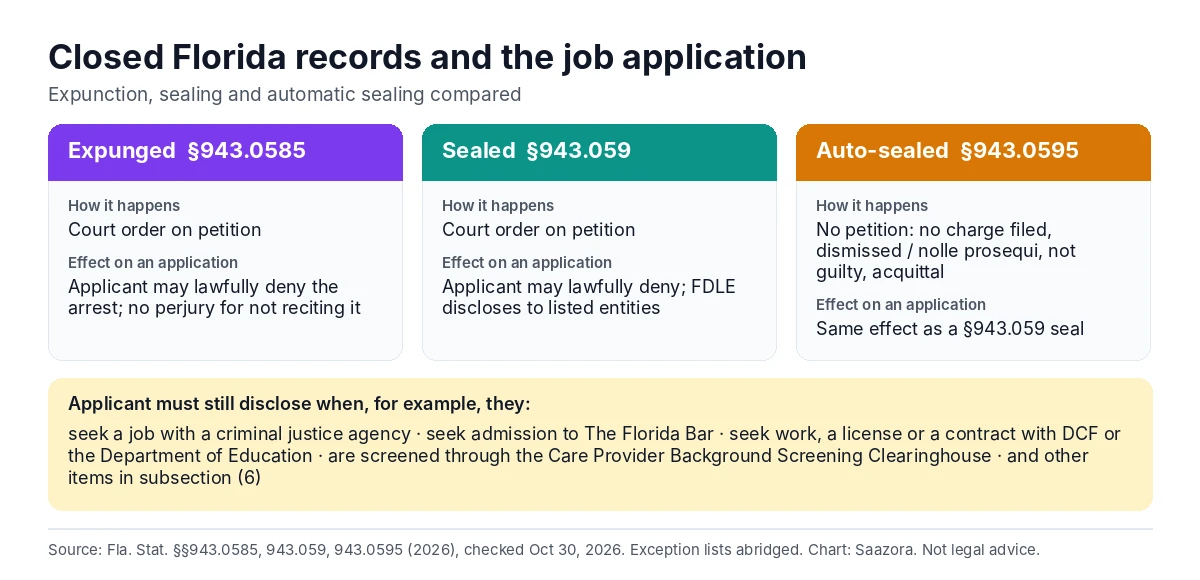
Florida gives people three ways to close an old arrest record, and each one changes what an employer can expect to hear. Under both §943.0585 (expunction) and §943.059 (sealing), the subject "may lawfully deny or fail to acknowledge the arrests" covered by the order. A person who leaves an expunged record off an application "may not be held under any provision of law of this state to commit perjury" for it. Section 943.0595 seals some records automatically, without a petition, and that sealing "shall have the same effect" as "a record sealed under s. 943.059", subject to its own terms.
| Record type | How it happens | Applicant may deny it on a private-sector application? | Main exceptions (applicant must disclose) |
|---|---|---|---|
| Expunged (§943.0585) | Court order on petition | Yes | "Is a candidate for employment with a criminal justice agency"; "Is a candidate for admission to The Florida Bar"; jobs or contracts with the Department of Children and Families or the Department of Education; "Is a person screened through the Care Provider Background Screening Clearinghouse"; and others listed in (6) |
| Sealed by court order (§943.059) | Court order on petition | Yes | The same core list, plus items such as "Is seeking to be licensed by the Bureau of License Issuance of the Division of Licensing"; FDLE "shall disclose the sealed criminal history record to the entities" listed |
| Automatically sealed (§943.0595) | No petition; when "An indictment, information, or other charging document was not filed or issued", the case "was dismissed or nolle prosequi by the state attorney or statewide prosecutor", "A not guilty verdict was rendered by a judge or jury as to all counts." or "A judgment of acquittal was rendered by a judge as to all counts." | Yes, with the same effect as a §943.059 seal | As for sealed records, subject to §943.0595's own terms |
From Fla. Stat. §§943.0585, 943.059 and 943.0595 (2026), flsenate.gov and leg.state.fl.us, read October 30, 2026. Sections 943.0585 and 943.059 were last amended by ch. 2026-114, which added the Care Provider Background Screening Clearinghouse exception to both lists (it is not in the 2024 and 2025 texts). Not legal advice; the exception lists are longer than shown.
What this means for your application form: a question like "Have you ever been arrested?" invites an answer that the law lets the applicant give as "no" for a sealed or expunged arrest. If your form asks about convictions, add a line telling applicants they need not include records that were sealed or expunged, unless the job is on one of the statutory exception lists. And if a screening report somehow shows a record you later learn was sealed, ask your vendor to recheck it before you act.
No statewide ban-the-box for private employers, but Gainesville has one
Florida has no statute telling private employers when they may ask about criminal history. The state rule on conviction-based disqualification, §112.011, is aimed at public employment: "a person may not be disqualified from employment by the state" and the public bodies the section lists "solely because of a prior conviction for a crime" unless it is a felony or first-degree misdemeanor "directly related to the position of employment sought." It does not bind a private company.
Gainesville is different. The City's Fair Chance Hiring page, read October 30, 2026, says the ordinance covers employers "with fifteen (15) or more employees whose primary work location is in the City" "for each working day in each of the four (4) or more calendar weeks" in the current or preceding year. It bars "asking about or considering information about an individual's criminal history" "until after the employer has made a conditional employment offer to the individual." It also "prohibits employers from making statements related to criminal history in job postings". After the offer, the page describes an individualized assessment, "An individualized assessment is an evaluation of the criminal history of an individual", and says an employer that takes adverse action because of the history "must inform the individual in writing that" it did so.
Penalties are civil: "Only civil fines (not criminal) up to $500 will be imposed for a violation and any subsequent violation." "Half of any fine recovered under this ordinance will be awarded to the Complainant." And "For a first-time violation, an employer can attend a compliance training session to avoid the civil fine." The page exempts government bodies and lists other exemptions, including "Any other entity who is excluded by operation of State or Federal law." Local press (WUFT, December 16, 2022) reported the commission's final vote under the headline "Gainesville becomes first city in Florida to apply 'fair chance hiring' to private employers". The City page itself gives no effective date.
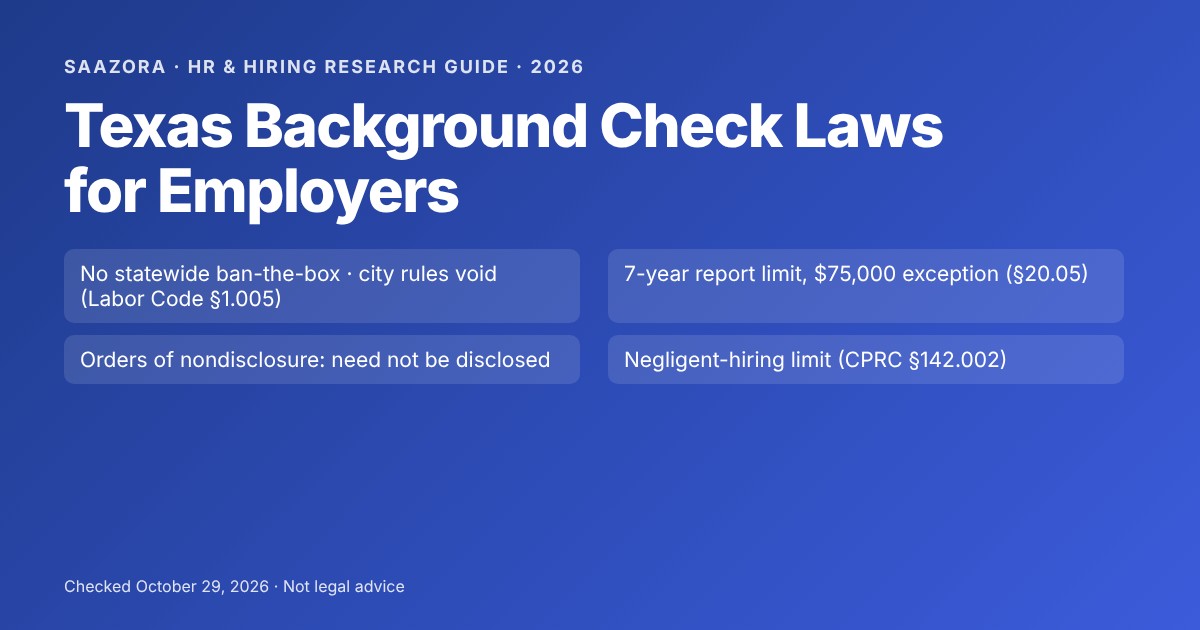
Could Tallahassee override it the way Texas did? We looked at the 2024 state law on local employment rules, H.B. 433. Its final bill analysis covers heat exposure, vendor wages and "regulating scheduling, including predictive scheduling, by a private employer", and does not mention hiring or criminal history. We found no Florida statute that voids Gainesville's ordinance, but this is the line to recheck each legislative session.
E-Verify for Florida employers with 25 or more employees
E-Verify is not a criminal background check, but it lands in the same week of onboarding and Florida makes it mandatory for many private employers. Section 448.095 says "Beginning on July 1, 2023," "a private employer with 25 or more employees shall use the E-Verify system" and "shall verify each new employee's employment eligibility" "within 3 business days after the first day that the new employee begins working for pay". The employer "must retain a copy of the documentation provided" "for at least 3 years." Using E-Verify "has established a rebuttable presumption that the employer has not violated" the section.
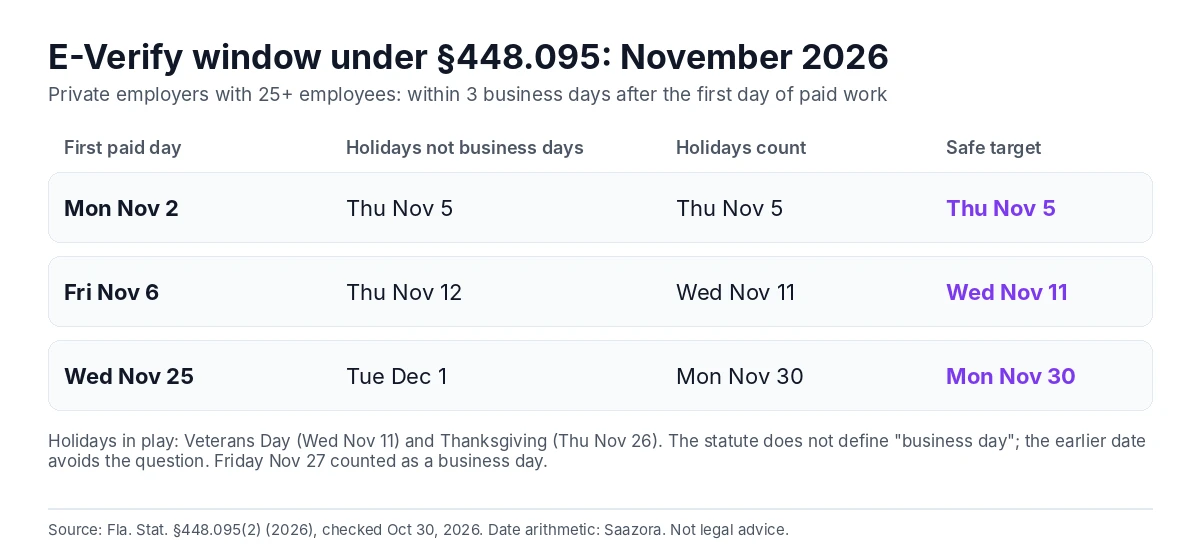
Enforcement sits with the Department of Commerce. If it finds noncompliance "three times in any 24-month period", it "must impose a fine of $1,000 per day" "until the employer provides sufficient proof to the department that the noncompliance is cured". The statute does not define "business day", which matters around holidays. Here is how the 3-business-day window plays out for three November 2026 start dates.
| First day working for pay | Deadline if federal holidays are not business days | Deadline if they are | Safe target |
|---|---|---|---|
| Monday, Nov 2, 2026 | Thursday, Nov 5 | Thursday, Nov 5 | Thursday, Nov 5 |
| Friday, Nov 6, 2026 | Thursday, Nov 12 (skips Veterans Day, Wed Nov 11) | Wednesday, Nov 11 | Wednesday, Nov 11 |
| Wednesday, Nov 25, 2026 | Tuesday, Dec 1 (skips Thanksgiving, Thu Nov 26) | Monday, Nov 30 | Monday, Nov 30 |
Saazora's date arithmetic from the "within 3 business days after the first day" wording of Fla. Stat. §448.095(2)(a) (2026). The day after Thanksgiving is counted as a business day in both columns. Not legal advice.
How far back can a Florida background check go?
Because Florida has no state reporting limit for screening companies that we could find, the federal limits are the ones that apply to a report from a consumer reporting agency. Under 15 U.S.C. §1681c, arrest records, civil suits and most other adverse items may not "antedate the report by more than seven years", while the catch-all limit expressly excludes items "other than records of convictions of crimes". In practice:
- Convictions: no federal time limit on reporting.
- Arrests that did not lead to a conviction: seven years, unless the job's annual salary is $75,000 or more, where §1681c(b) lifts the limit for "employment of any individual at an annual salary" at that level.
- Sealed or expunged Florida records: a vendor should not report them, but the safe step is to tell your vendor about any order the applicant shows you.
The FDLE record you buy directly is not limited this way, since FDLE is not a consumer reporting agency. That is one more reason to have a written policy on how the age of an offense is weighed. For how long the reports themselves take to come back, see our guide to background check turnaround times.
Budgeting 20 Florida hires: FDLE name searches vs Checkr packages
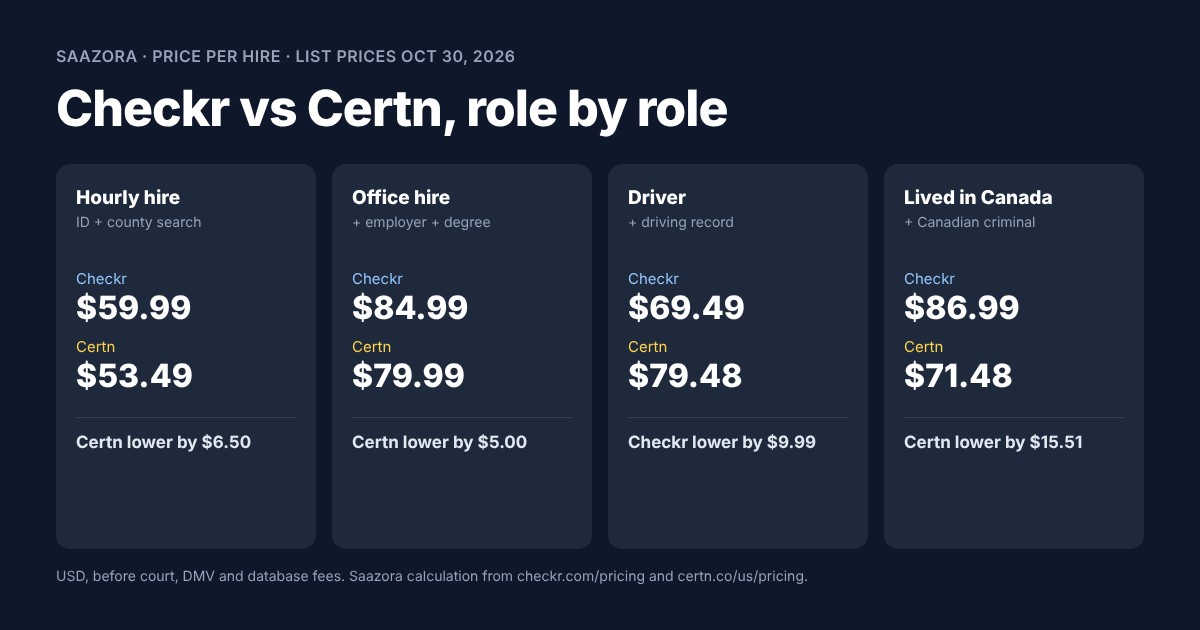
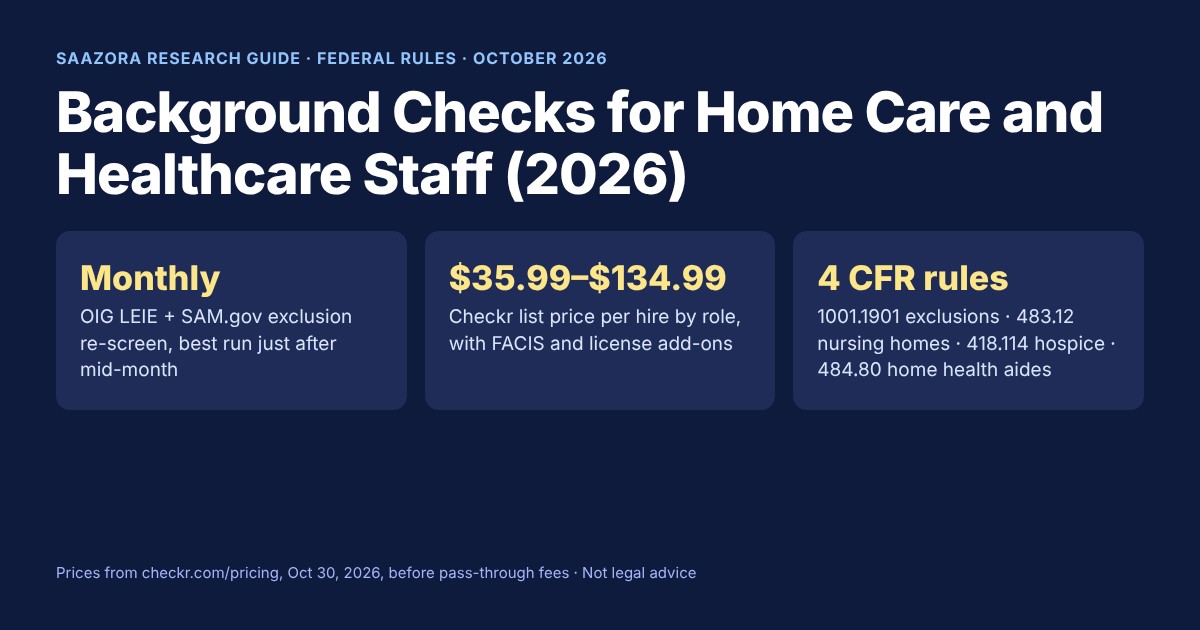
Checkr's list prices on checkr.com/pricing, read October 30, 2026: Basic "$29.99 / report*" ("SSN trace", "Sex offender registry", "Global watchlist search", "National criminal search"), Essential "$59.99 / report*" (adds "Identity verification" and "Unlimited county criminal search") and Complete "$94.99 / report*" (adds "Unlimited state criminal search" and "Federal criminal search"). A state criminal search add-on is "Starting from $10/check***" and an MVR is "$9.50/check***". The asterisk note reads "*Standard third-party court and database access fees may apply, passed through at cost with no markup." Checkr's passthrough fees help page loaded only as a script shell for us, so the Florida pass-through amounts are not in this table.
| Option for 20 hires | Per hire | 20 hires | What it covers | Fits §768.096(2) on its face? |
|---|---|---|---|---|
| FDLE name search only (statutory fee) | $24.00 | $480.00 | Florida records, name-matched | Yes, it is the FDLE check the statute names |
| Checkr Basic | $29.99 | $599.80 | SSN trace, sex offender registry, watchlists, national criminal database | Unclear; see the vendor question above |
| Checkr Basic + state search (from $10) | from $39.99 | from $799.80 | Basic plus one state criminal search | Ask Checkr whether the Florida search is pulled directly from FDLE |
| Checkr Essential | $59.99 | $1,199.80 | Basic plus identity verification and unlimited county searches | Unclear |
| Checkr Essential + MVR (drivers) | $69.49 | $1,389.80 | Essential plus driving record for element (d) | Covers (d); the FDLE question remains |
| Checkr Complete | $94.99 | $1,899.80 | Essential plus unlimited state and federal searches | Unclear |
FDLE fee from Fla. Stat. §943.053(3)(e) (2026); Checkr list prices from checkr.com/pricing, October 30, 2026, before pass-through court, database and DMV fees and before any FDLE payment charges. Arithmetic: Saazora. The last column is our reading, not legal advice.
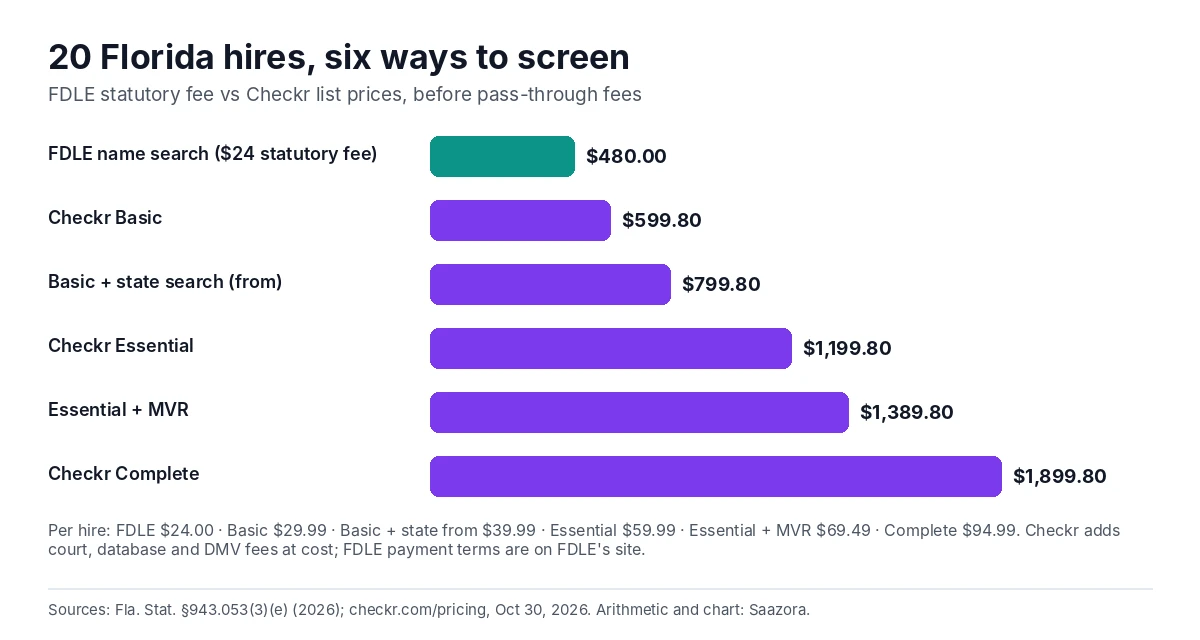
Many Florida employers end up with both: a multi-state vendor report for the screening decision, and a $24 FDLE record in the file for anyone in a role where an intentional-tort claim is a realistic risk, such as in-home services or night security. That pairing costs about $24 more per hire than the vendor report alone. Our Checkr pricing breakdown explains each package and add-on, and our small-business background check cost guide compares vendors at different hiring volumes. If the Checkr route fits, compare Checkr's packages for your Florida roles (affiliate link).
The Florida hiring file: what to keep for each new employee
If a negligent-hiring claim, an E-Verify audit or a Gainesville complaint arrives, the file is your evidence. A checklist built from the statutes above:
- Application with the §768.096(1)(c) conviction and intentional-tort questions, worded so sealed and expunged records are excluded. Gainesville employers: no criminal history questions on it at all, and none in the posting.
- Conditional offer letter, dated, if you are in Gainesville or follow its timing as a best practice.
- FCRA disclosure and authorization, "in a document that consists solely of the disclosure", signed so the applicant has "authorized in writing".
- Criminal record results: the vendor report, and the FDLE result if you want the §768.096 presumption. Both should be dated before the start date.
- Reference log for §768.096(1)(b).
- Driver record and its signed authorization, or a note that driving is not part of the job.
- Interview notes, with names and dates.
- Adverse action records, if any: the pre-adverse notice with "a copy of the report" and "a description in writing of the rights of the consumer", your waiting period, and the final notice. Gainesville employers add the written individualized assessment.
- E-Verify case result and copies of the documents provided, kept at least 3 years, for employers with 25 or more employees.
- Chapter 435 or Clearinghouse evidence for regulated roles, which AHCA says must be kept in personnel files.
More hiring and screening guides are collected in Saazora's HR and hiring tools section, and current Checkr offer terms are on our Checkr store page. When your forms and policy are settled, you can open a Checkr account and order a first report (affiliate link).
FAQ: Florida background checks for private employers
Is a background check required for every job in Florida?
No. A private employer is required to screen only when a statute requires it for the role, usually through chapter 435 (for example, direct-care health workers under §408.809). For other jobs, screening is a choice. Section 768.096 rewards that choice with a presumption against negligent hiring if you follow its five steps.
Does Florida have a seven-year rule for criminal records?
We found no Florida statute that sets one for private employers. The federal FCRA limits screening companies to seven years for arrests that did not lead to a conviction, with no limit for convictions and an exception for jobs paying $75,000 a year or more.
Can I ask a Florida applicant about criminal history on the application?
Statewide, yes, and §768.096 actually expects a conviction question. Inside Gainesville, employers with 15 or more employees working mainly in the City must wait until after a conditional offer. Anywhere in the state, applicants may lawfully deny sealed or expunged arrests unless the job is on a statutory exception list.
How much does an FDLE background check cost?
Section 943.053(3)(e) sets the fee at $24 per name for private requesters. FDLE's website describes its payment terms; check that page before you order.
Do Florida employers have to use E-Verify?
Private employers with 25 or more employees must, under §448.095, for each new employee within 3 business days after the first day of paid work. Smaller private employers are not covered by that subsection.
How we researched Florida's screening rules
On October 30, 2026 we read the 2026 Florida Statutes for §§768.096, 943.053, 943.059, 943.0595, 408.809, 448.095 and chapter 435 on the Florida Legislature's Online Sunshine site (leg.state.fl.us), and §§943.0585 and 112.011 on the Florida Senate site (flsenate.gov). Our reading tool returns short verbatim excerpts rather than whole pages, so every quotation above is a short excerpt, and longer passages are joined from consecutive excerpts. We also read AHCA's background screening pages, FDLE's Florida Checks page and its name-search help page, the City of Gainesville's Fair Chance Hiring page and information sheet, a WUFT news report on the 2022 vote, the final bill analysis of H.B. 433 (2024), 15 U.S.C. §§1681b and 1681c on Cornell's Legal Information Institute, and Checkr's pricing page. Checkr's passthrough fees article did not load. Saazora did not order any background check for this article, and no court decision is cited because we did not research case law.
Sources (checked October 30, 2026): Florida Legislature, Online Sunshine: §768.096, §943.053, §943.059, §943.0595, chapter 435, §408.809, §448.095; The Florida Senate: §943.0585, §112.011, CS/CS/HB 433 (2024) final bill analysis; Agency for Health Care Administration, Background Screening and Screening Information; FDLE, Florida Criminal History Record Check and name search help; City of Gainesville, Fair Chance Hiring and information sheet; WUFT, December 16, 2022; Cornell LII, 15 U.S. Code §1681b and §1681c; Checkr, pricing page.
Research guide based on public sources, not legal advice. Checkr did not pay for or review this article.