
Research guide built from statutes and official city pages, not a hands-on test: Saazora did not run a background check on anyone for this article · California statute text read via california.public.law, which republishes the official text from leginfo.legislature.ca.gov, and via law.justia.com (2025 California Code), October 29, 2026; Gov. Code §12952, Civ. Code §1786.16, Civ. Code §1786.18 and Labor Code §432.7 spot-checked on leginfo.legislature.ca.gov Oct 29, 2026 · Los Angeles and San Francisco pages read October 29, 2026 · Checkr list prices read on checkr.com/pricing October 29, 2026 · This is not legal advice; talk to a California employment lawyer before you set a screening policy · We may earn a commission if you sign up through links on this page.
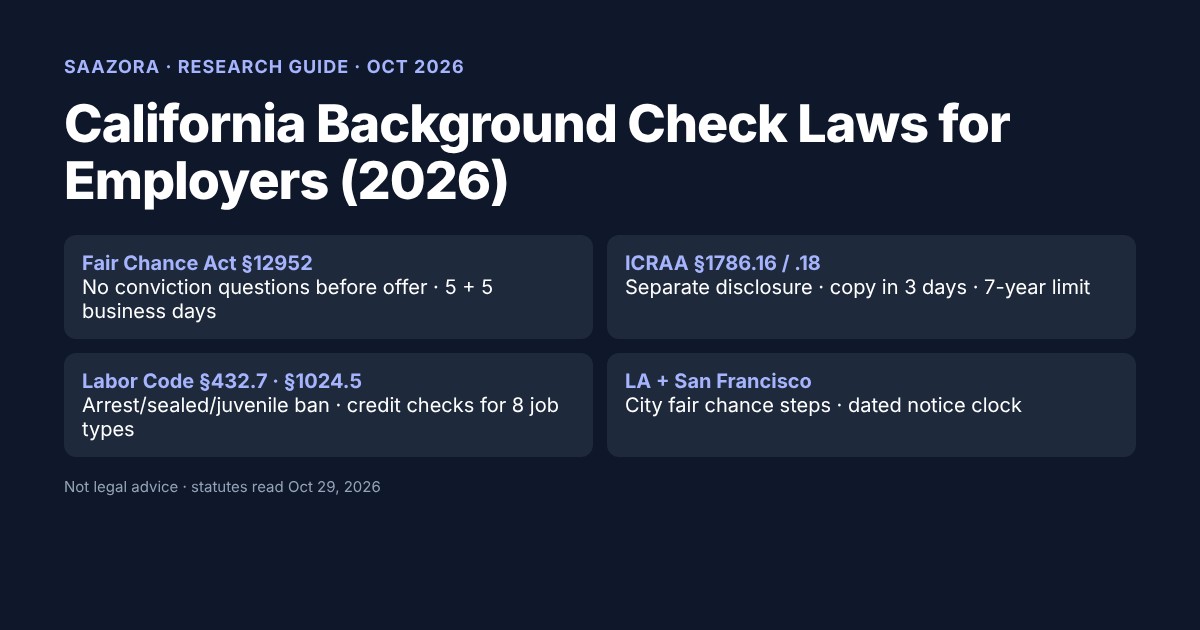
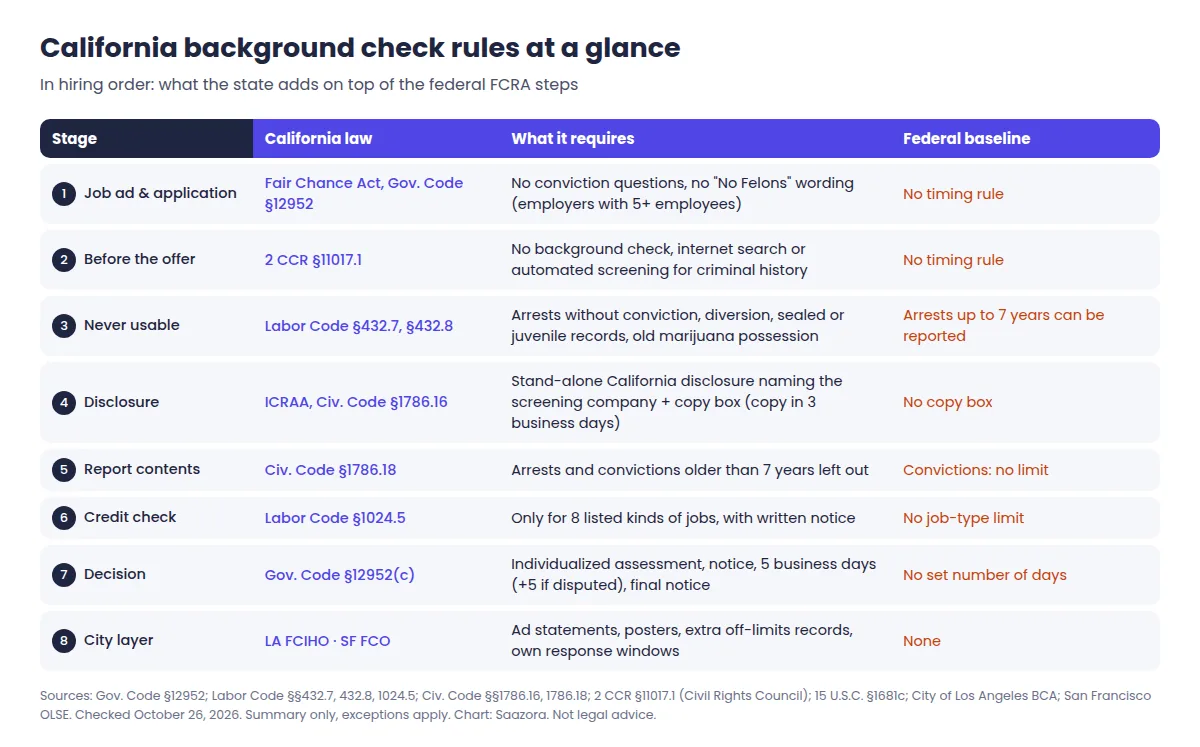
The California background check laws employers must follow stack four state rules on top of the federal Fair Credit Reporting Act (FCRA). The Fair Chance Act (Gov. Code §12952) bars employers with five or more employees from asking about conviction history before a conditional offer and requires an individualized assessment, a written notice and at least five business days for the applicant to respond (five more if they dispute the report). The ICRAA (Civ. Code §1786.16) requires its own stand-alone disclosure with a box the candidate can check to get a copy, which must be sent within three business days. Civ. Code §1786.18 keeps convictions older than seven years out of the report, with no salary exception. Labor Code §432.7 bans using arrests that did not end in a conviction, diversion, sealed and juvenile records. Los Angeles and San Francisco add their own steps.
This guide is the California layer only. If you have never ordered a check, the federal steps (disclosure, authorization, pre-adverse and adverse action notices) are in our walkthrough of a first employee background check; this page shows what California changes at each of those steps, runs one hire through a dated notice clock, puts the statutory damages in one table, and prices a California check at Checkr's list prices.
California background check laws at a glance, by hiring stage
The simplest way to see the state rules is in the order a hire happens. The left column is the federal baseline every US employer follows; the other columns are what California and its two largest cities add. A blank cell means that layer adds nothing at that stage.
| Hiring stage | Federal FCRA baseline | California statewide | City of Los Angeles | San Francisco |
|---|---|---|---|---|
| Job ad and application | No rule on conviction questions | No conviction question on the application before a conditional offer (5+ employees, §12952(a)(1)) | Ads must say the employer will consider qualified applicants with criminal histories (10+ employees) | No arrest or conviction questions before a conditional offer (5+ employees) |
| Consent before ordering | Stand-alone disclosure + written authorization | A separate ICRAA disclosure with specific contents and a copy checkbox (§1786.16) | Give the official FCO notice before the background check | |
| What the report may contain | Arrests capped at seven years; convictions have no time limit | Convictions also capped at seven years; no salary exception (§1786.18) | Employer may not consider convictions more than 7 years old (some exceptions) | |
| Records the employer may not use | Arrests without conviction, diversion, sealed or dismissed convictions, juvenile records (§12952, §432.7) | Adds infractions, juvenile convictions and decriminalized conduct | ||
| Before rejecting | Pre-adverse action notice with a copy of the report | Individualized assessment; written notice; at least 5 business days, +5 if disputed (§12952(c)) | Written individualized assessment; hold the job open at least 5 business days | 7 days to respond after the notice |
| After rejecting | Adverse action notice | Final written notice, including the right to complain to the Civil Rights Department | Reassessment before the final decision | Notify of the final decision |
Gov. Code §12952, Civ. Code §§1786.16 and 1786.18, Labor Code §432.7 (statute text read via california.public.law, which republishes the official text); 15 U.S.C. §1681c (govinfo.gov); City of Los Angeles Bureau of Contract Administration FCIHO rules and FAQ; San Francisco OLSE Fair Chance Ordinance page and August 2026 poster. Read October 29, 2026. Summary, not legal advice.
No conviction questions until the conditional offer
The Fair Chance Act applies to "an employer with five or more employees". Such an employer may not put on any application, "before the employer makes a conditional offer of employment to the applicant," a question that seeks "the disclosure of an applicant’s conviction history", and may not "inquire into or consider the conviction history of the applicant" until after that offer. In practice, that means three things for your process:
- Strip the checkbox from every form. That includes paper applications, applicant tracking screening questions and interview scripts.
- Order the criminal search only after the offer. A combined offer-and-screening packet works well: offer letter first, then the disclosures and authorization.
- Some records are off-limits even after the offer. The statute bars you from considering, distributing or disseminating an "Arrest not followed by conviction", a "Referral to or participation in a pretrial or posttrial diversion program." and "Convictions that have been sealed, dismissed, expunged, or statutorily eradicated pursuant to law".
Two edge cases come from the Civil Rights Council's regulation on criminal history (2 CCR §11017.1). We could not fetch the final codified text, so these come from the Council's last published modified text (version 3/24/2023) on calcivilrights.ca.gov. First, the rule covers "individuals who have been conditionally offered employment, even if they have commenced employment", so letting someone start before the report comes back does not let you skip the steps below. Second, "applicant" includes "existing employees who have applied or indicated a specific desire to be considered for a different position", so an internal promotion that triggers a new check follows the same process.
The Fair Chance Act does not apply to every job. Subdivision (d) exempts positions where "a state or local agency is otherwise required by law to conduct a conviction history background check", jobs "with a criminal justice agency", Farm Labor Contractor positions, and positions where an employer "is required by any state, federal, or local law" to run a criminal background check or restrict hiring based on criminal history. Read the exemption narrowly: it covers the specific role the law names, not the whole company.
The ICRAA disclosure is its own form
California's Investigative Consumer Reporting Agencies Act (ICRAA) applies when an employer orders an "investigative consumer report" from a screening company; ask your vendor whether its California report is one. Before you order one, Civ. Code §1786.16 requires a written disclosure "in a document that consists solely of the disclosure". It has to tell the candidate that "An investigative consumer report may be obtained." and that "The permissible purpose of the report is identified." It must also give the "name, address, and telephone number of the investigative consumer reporting agency", the "Internet Web site address of the investigative consumer reporting agency" with "information about the investigative reporting agency’s privacy practices", including "whether the consumer’s personal information will be sent outside the United States". Then: "The consumer has authorized in writing the procurement of the report."
The copy rule is what employers most often miss. The disclosure must let the candidate ask for a copy of the report "by means of a box to check", and if they check it, the copy goes out "within three business days of the date that the report is provided to the recipient". The employer is the one responsible, but the statute lets it use a vendor: the person "who may contract with any other entity to send a copy". If your screening company sends candidate copies, get that in writing. There is one carve-out in §1786.16(c): investigations "due to suspicion held by an employer of wrongdoing or misconduct by the subject of the investigation", which is a workplace-investigation rule, not a hiring one.
Can the FCRA and ICRAA disclosures share a page? The ICRAA text says "solely of the disclosure", and the FCRA has its own stand-alone rule. The cautious reading is two separate documents. Ask your vendor to show you its California form before your first order.
What a California report may not contain: the seven-year rule and its two exceptions
Civ. Code §1786.18(a)(7) bars an investigative consumer reporting agency from reporting "Records of arrest, indictment, information, misdemeanor complaint, or conviction of a crime" "that, from the date of disposition, release, or parole, antedate the report by more than seven years." Note the word conviction. Under the federal FCRA, the seven-year cap reaches "records of arrest", while the catch-all for other old items carves out "records of convictions of crimes", so a federal report may list a 20-year-old conviction. A California report may not.
The seven years run from the date of disposition, release or parole, not from the offense date, so a sentence that ended recently can keep an older conviction reportable. And once it is learned "in the case of a conviction, a full pardon has been granted", the item "shall no longer be reported". The agency also has to verify public-record items "during the 30-day period ending on the date on which the report is furnished."
The exceptions are where many guides go wrong. The federal FCRA lifts its limits for a job with a salary that "may reasonably be expected to equal $75,000" or more. The current §1786.18(b) has no salary exception at all. It lists exactly two situations where subdivision (a) does not apply:
- a report used "in the underwriting of life insurance involving, or that may reasonably be expected to involve, an amount of two hundred fifty thousand dollars ($250,000) or more." That is an insurance rule, not an employment rule; and
- a report used "by an employer who is explicitly required by a governmental regulatory agency to check for records that are prohibited by subdivision (a) when the employer is reviewing a consumer’s qualification for employment."
At least one high-ranking California guide we read on October 29, 2026 still describes a $125,000 salary exception. We did not find that in the current text; if a vendor or template tells you a senior hire unlocks older convictions in California, ask which subdivision they rely on.
Arrests, diversion, sealed and juvenile records under Labor Code §432.7
Labor Code §432.7 covers more ground than the Fair Chance Act because it applies to every employer, not just those with five or more employees, and to current employees too. An employer "shall not ask an applicant for employment to disclose, through any written form or verbally" certain records, and "also shall not seek from any source whatsoever, or utilize, as a factor in determining any condition of employment including hiring, promotion, termination" the same records:
- "information concerning an arrest or detention that did not result in conviction";
- "information concerning a referral to, and participation in, any pretrial or posttrial diversion program";
- a conviction "that has been judicially dismissed or ordered sealed pursuant to law";
- juvenile matters: information related to an arrest or detention while the person was "subject to the process and jurisdiction of the juvenile court."
There is one narrow opening for a pending case: the section does not stop an employer from asking "about an arrest for which the employee or applicant is out on bail or on their own recognizance pending trial." For Fair Chance Act employers, that question still has to wait until after the conditional offer. And "conviction" here "includes a plea, verdict, or finding of guilt, regardless of whether a sentence is imposed by the court", which matters for a plea entered while sentencing is still pending.
Individualized assessment, then two written notices
If a conviction that you are allowed to consider shows up, you may not reject the candidate automatically. The employer "shall make an individualized assessment of whether the applicant's conviction history" "has a direct and adverse relationship with the specific duties of the job". The statute names three factors:
- "The nature and gravity of the offense or conduct."
- "The time that has passed since the offense or conduct and completion of the sentence."
- "The nature of the job held or sought."
Statewide, "An employer may, but is not required to, commit the results of this individualized assessment to writing." That is where Los Angeles differs: its rules require that "an Employer prepare written documentation including an Individualized Assessment of the Applicant". If you hire in both places, write it down everywhere. The Council's modified text also lists the kinds of mitigating evidence a candidate may send, such as "The applicant's community service and engagement since the conviction or completion of sentence".
If the assessment leans toward no, "the employer shall notify the applicant of this preliminary decision in writing." The notice must contain:
- "Notice of the disqualifying conviction or convictions that are the basis for the preliminary decision";
- "A copy of the conviction history report, if any.";
- "An explanation of the applicant’s right to respond to the notice of the employer’s preliminary decision", including the deadline.
"The applicant shall have at least five business days to respond to the notice". If within that time the applicant says in writing that they "disputes the accuracy of the conviction history report" and that "the applicant is taking specific steps to obtain evidence supporting that assertion", "then the applicant shall have five additional business days to respond to the notice." You must consider what they send. A final rejection then needs a second written notice with "The final denial or disqualification.", "Any existing procedure the employer has for the applicant to challenge the decision or request reconsideration." and "The right to file a complaint with the department." The federal pre-adverse and adverse action notices still apply; if you send them together with these two, check that each notice carries every item both laws require.
A dated notice clock: one California hire in November 2026
Here is one hire run through the state clock. The receipt rules come from the Civil Rights Council's modified text of 2 CCR §11017.1: a mailed notice is "deemed received five calendar days after the mailing is deposited for delivery for California addresses", an emailed notice "two business days after it is sent", and the response deadline "must be at least five business days from the date of receipt of the notice." The texts we read do not say how to treat state holidays, so this example skips Veterans Day (Wednesday, November 11, 2026) when counting business days. That is the cautious choice: counting it would let you decide one day sooner.
| Date (2026) | Event | Rule and count |
|---|---|---|
| Mon Nov 2 | Conditional offer sent; ICRAA and FCRA disclosures signed; candidate checks the copy box | §12952(a): no criminal history inquiry before this point |
| Wed Nov 4 | Report delivered to the employer | ICRAA copy due within 3 business days: Thu 5, Fri 6, Mon 9 |
| Thu Nov 5 | Individualized assessment done; preliminary notice emailed with a copy of the report | The same email also meets the ICRAA copy deadline (Mon Nov 9) |
| Mon Nov 9 | Email notice deemed received | +2 business days: Fri 6, Mon 9 |
| Tue Nov 17 | Last day of the first response window | 5 business days from receipt: Tue 10, Thu 12, Fri 13, Mon 16, Tue 17 (Nov 11 skipped) |
| Thu Nov 12 | Candidate emails that the report is wrong and they have requested court records | Dispute plus specific steps, within the window: +5 business days |
| Tue Nov 24 | Last day of the extended window | Wed 18, Thu 19, Fri 20, Mon 23, Tue 24 |
| Wed Nov 25 or later | Consider the response; send the final notice if still rejecting | §12952(c)(5): three required items, plus the FCRA adverse action notice |
Saazora's worked example. Day counts follow Gov. Code §12952(c)(3) and the receipt rules in the Civil Rights Council's modified text of 2 CCR §11017.1 (version 3/24/2023); the final codified text was not read. Not legal advice.
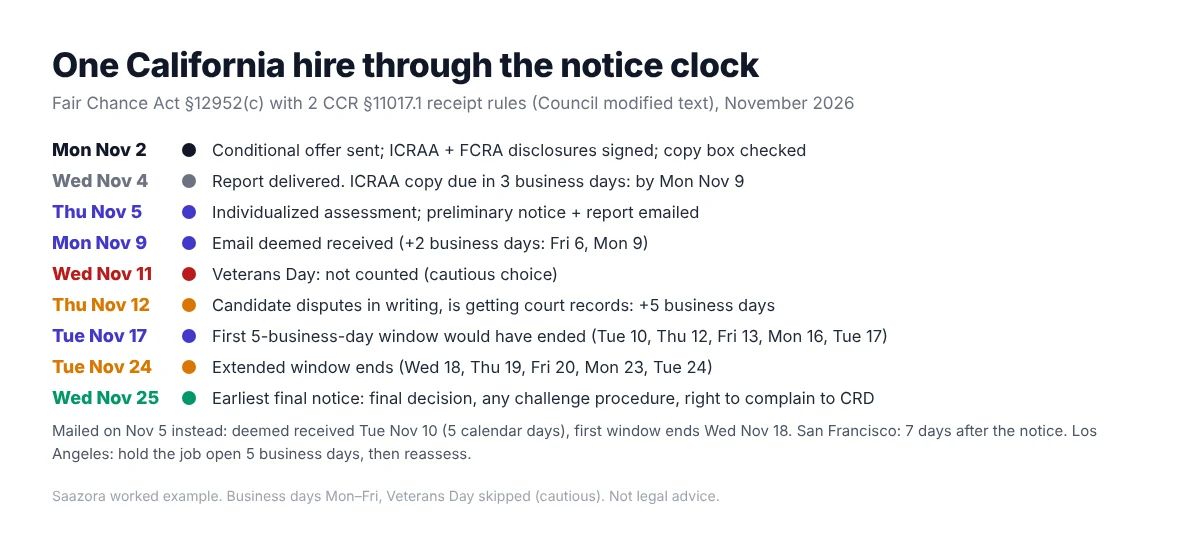
Three things change the dates. Mail instead of email: mailed on Thursday, November 5, the notice is deemed received Tuesday, November 10, and the first window runs to Wednesday, November 18. A San Francisco job: the city page gives the applicant seven days to respond ("within seven days of the date that the notice of Adverse Action is provided") and does not say business days, so in the example the safe plan is to wait for whichever of the state and city deadlines ends later. A Los Angeles job: the city rules say to "hold the Employment position(s) open for at least five (5) business days" and then "perform a Reassessment" before the final decision, so don't fill the seat during the window. For how long the report itself usually takes to come back, see our guide to background check turnaround.
Los Angeles and San Francisco: the city layer
Both cities had fair-chance laws before the state did, and both still apply on top of §12952; the state statute says its remedies are "in addition to and not in derogation of all other rights and remedies", including local ordinances. Here is how the two compare on the points that change your process.
| City of Los Angeles (FCIHO) | San Francisco (Fair Chance Ordinance) | |
|---|---|---|
| Covered employers | "employs ten (10) or more Employees" | "5 or more employees located or doing business in the City"; the poster says employees are counted worldwide |
| Covered workers | At least two hours of work a week on average inside the city | "at least eight hours per week in San Francisco" |
| Job ads | Must state the employer "will consider for employment qualified Applicants with Criminal Histories." | Post the official FCO notice; give a copy to applicants before the background check |
| Extra records off-limits | None beyond state law named in the rules we read | Juvenile convictions, infractions, decriminalized conduct, convictions more than 7 years old (with exceptions) |
| Assessment | Written individualized assessment required | Consider the applicant's evidence before a final decision |
| Response window | Hold the job open at least 5 business days, then reassess | 7 days after the notice of adverse action |
| Records | Keep records "for a period of three (3) years" after the application | Not stated on the city page we read |
| Recent change | Posted rules file is marked "rev 4-13-26" | "Effective August 10, 2026: Amendments to the Fair Chance Ordinance"; updated poster dated August 2026 |
City of Los Angeles Bureau of Contract Administration, FCIHO Rules and Regulations and FAQ; San Francisco OLSE, Fair Chance Ordinance page and FCO poster (August 2026). Read October 29, 2026. Penalty amounts are in LAMC §189.10 and in the amended San Francisco Police Code Article 49, which we did not read; check them with counsel.
The San Francisco amendments that took effect August 10, 2026 are the newest change on this page. The city's own page links the amendment and asks employers to post the updated notice, but it does not summarize what changed. Law-firm summaries describe new protections and higher penalties; because we could not read the ordinance text itself, we are not listing those details here. If you have San Francisco staff, re-read the ordinance and swap in the August 2026 poster.
Credit checks: the eight job types in Labor Code §1024.5
A credit report is a separate product from a criminal background check, and California limits it more than most states. Under Labor Code §1024.5, "An employer or prospective employer shall not use a consumer credit report for employment purposes" "unless the position of the person for whom the report is sought is any of the following":
- "A managerial position." (defined by the executive exemption in IWC Wage Order 4, not by job title);
- "A position in the state Department of Justice.";
- "That of a sworn peace officer or other law enforcement position.";
- "A position for which the information contained in the report is required by law to be disclosed or obtained.";
- a position with regular access to all three of a person's "Bank or credit card account information.", "Social security number." and "Date of birth." (routine retail credit-card applications don't count);
- a position as "A named signatory on the bank or credit card account of the employer.", or one "Authorized to transfer money on behalf of the employer." or "Authorized to enter into financial contracts on behalf of the employer.";
- a position with access to confidential or proprietary information such as trade secrets;
- "A position that involves regular access to cash totaling ten thousand dollars ($10,000) or more" "of the employer, a customer, or client, during the workday."
Businesses subject to the federal Gramm-Leach-Bliley privacy sections and overseen by a regulator are carved out by §1024.5(b). If a role does qualify, Civ. Code §1785.20.5 (as amended by AB 22, Chapter 724 of 2011) requires that "the user of the report shall provide written notice to the person involved" and that the notice "shall identify the specific basis under subdivision (a) of Section 1024.5 of the Labor Code for use of the report." Put the paragraph number in the notice, for example §1024.5(a)(8), regular access to $10,000 or more in cash.
What a mistake can cost: statutory damages by law
Each of the California background check laws employers deal with sets its own remedy. The amounts below are the minimums or caps written into each statute, per violation. They are not predictions of what a court would award, and class actions and attorney fees can change the total.
| Law | Who can sue or enforce | Amount in the statute | Extras |
|---|---|---|---|
| Labor Code §432.7(c), arrest, diversion or sealed records | The applicant | "actual damages or two hundred dollars ($200), whichever is greater" | Costs and reasonable attorney's fees |
| Labor Code §432.7(c), intentional violation | The applicant | "treble actual damages" "or five hundred dollars ($500), whichever is greater" | Also "a misdemeanor punishable by a fine not to exceed five hundred dollars ($500)." |
| ICRAA, Civ. Code §1786.50(a) | The consumer, against an agency or "user of information" (the employer) | Actual damages or, "except in the case of class actions, ten thousand dollars ($10,000)", whichever is greater | Costs and attorney's fees; punitive damages if "grossly negligent or willful"; filed "within two years from the date of discovery" (§1786.52) |
| Fair Chance Act, Gov. Code §12952 | Complaint to the Civil Rights Department | No fixed amount in §12952 | The final notice must tell the applicant of "The right to file a complaint with the department." |
| Los Angeles FCIHO | Bureau of Contract Administration | Fine schedule in LAMC §189.10 (not read for this guide) | Administrative penalties |
| San Francisco FCO | Office of Labor Standards Enforcement | Penalties in Police Code Article 49 as amended August 10, 2026 (not read) | "Failure to post this notice may result in penalties." |
Statute text read via california.public.law, which republishes the official text (Labor Code §432.7 updated Jan. 1, 2022; Civ. Code §1786.50 updated Jan. 1, 2004; §1786.52 updated Jan. 1, 2002), October 29, 2026. Not legal advice.
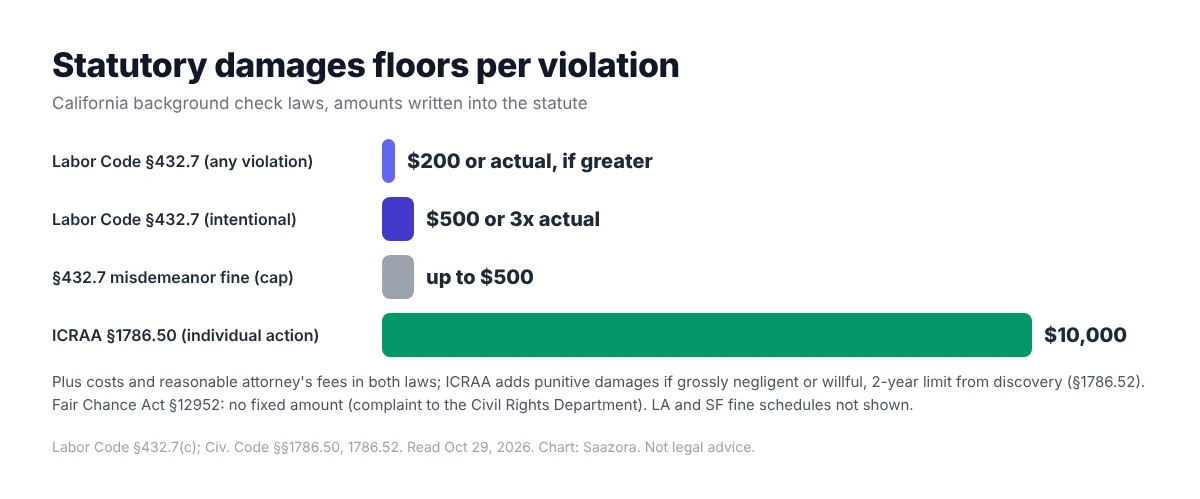
The ICRAA's $10,000 floor applies in individual actions, which is why a disclosure form with extra language, a missing copy checkbox or a copy sent late is the error to fix first. It is a paperwork mistake, it repeats on every hire, and each one is a separate potential claim.
Running a California check through Checkr: list prices and the fee you can't see yet
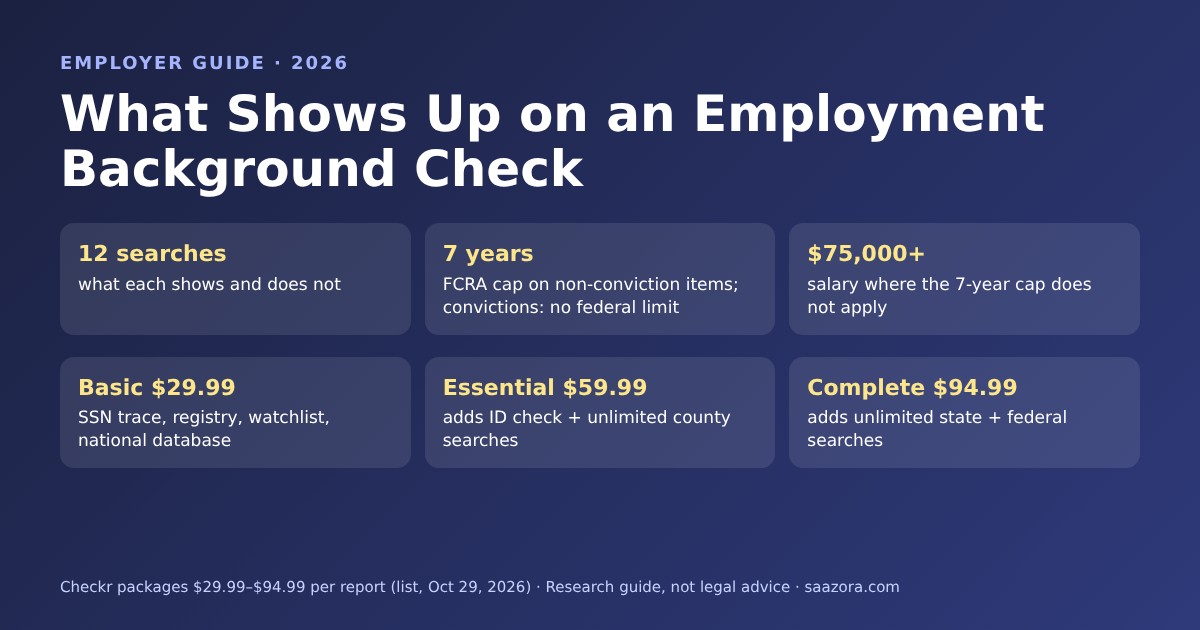
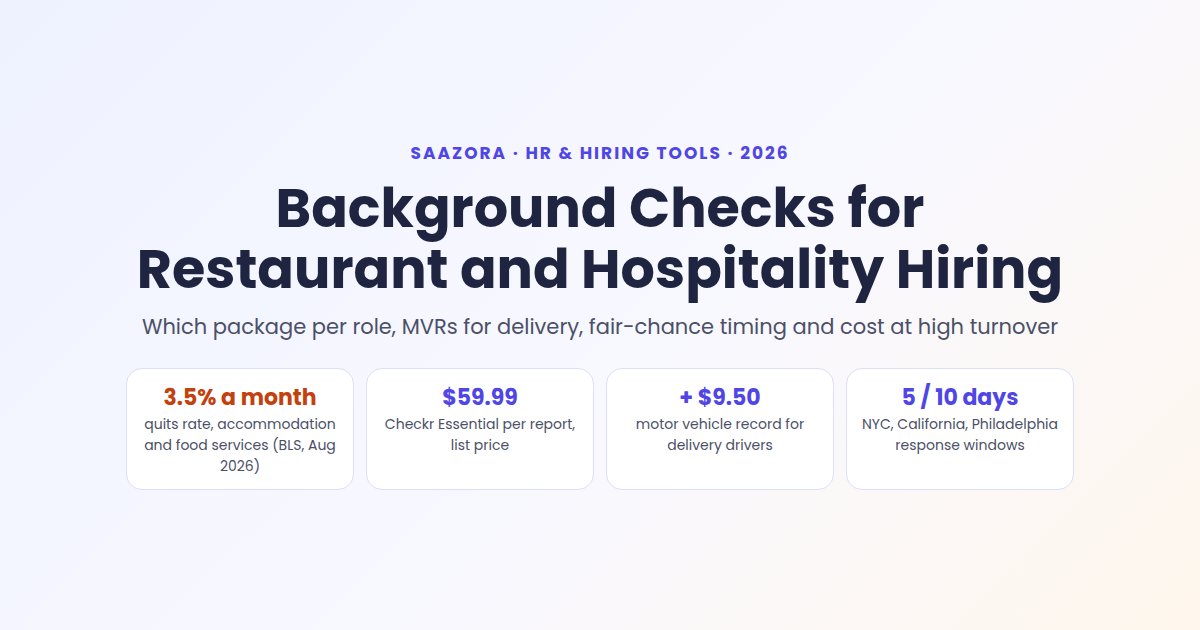
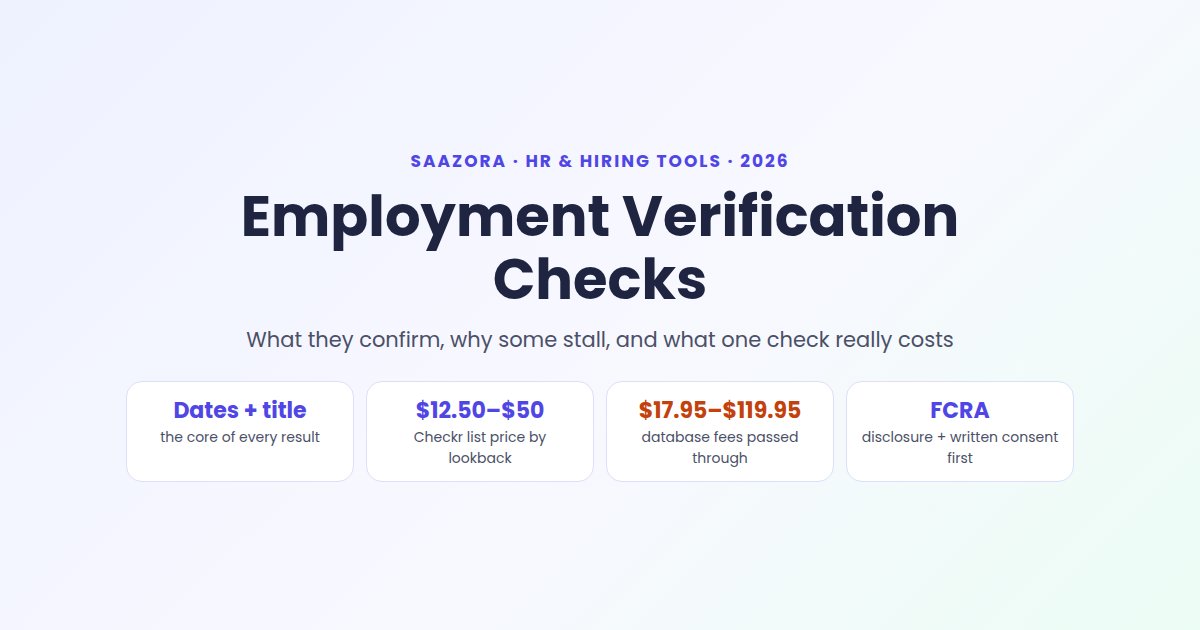
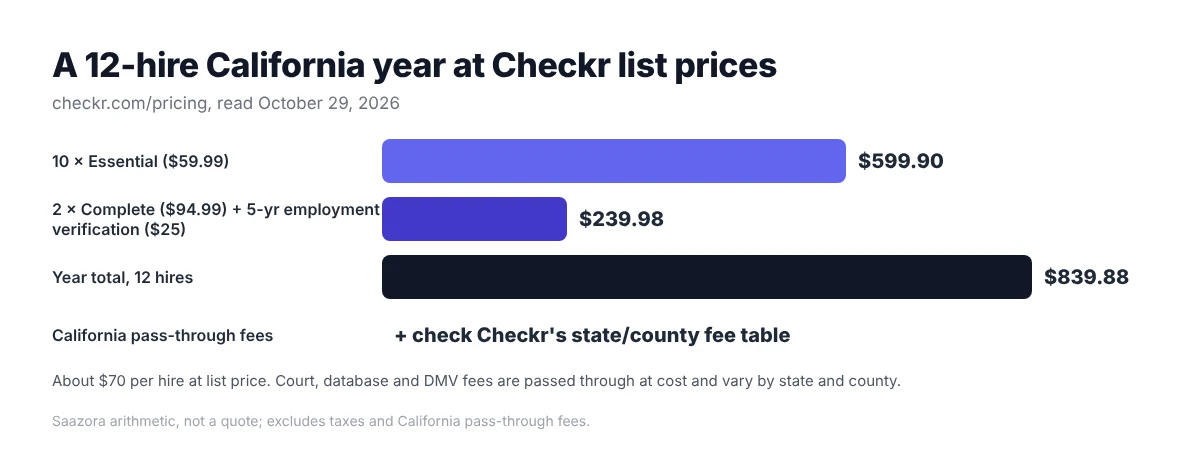
Checkr's pricing page, read October 29, 2026, lists three self-serve packages: Basic from "$29.99 / report*" (SSN trace, sex offender registry, global watchlist and national criminal search), Essential from "$59.99 / report*" (adds identity verification and "Unlimited county criminal search"), and Complete from "$94.99 / report*" (adds "Unlimited state criminal search" and "Federal criminal search"). Add-ons include an MVR at "$9.50/check*" and employment verification "Starting from $12.50/check*". Our full Checkr pricing breakdown covers the rest of the list.
The asterisk is the California-specific part. Checkr says "Standard third-party court and database access fees may apply, passed through at cost with no markup", and for driving records, "Standard state DMV access fees apply and vary by location". The pricing page does not name any California fee, and the state and county table on Checkr's pass-through fee page loads interactively, so we could not read the California rows. Before your first order, open that table, pick California and the counties where your candidates have lived, and add the fees to your budget.
A worked example at list price: a 25-person café group in Los Angeles hires 12 people a year. Ten counter and kitchen hires on Essential cost 10 × $59.99 = $599.90. Two shift managers on Complete plus a five-year employment verification ($25 on Checkr's lookback tiers) cost 2 × ($94.99 + $25.00) = $239.98. The year comes to $839.88 before California court and database fees and tax. That is about $70 per hire, and the compliance steps above cost staff time, not vendor fees. For a wider look at budgets, see what background checks cost a small business; for driving roles, our MVR guide for drivers.
Whatever vendor you use, ask three California questions before you sign: does its ICRAA disclosure stand alone and include the copy checkbox, who sends the candidate copy within three business days, and does its report filter out convictions older than seven years from disposition, release or parole. If those answers fit your process, you can set up Checkr for California hiring (affiliate link) or read Saazora's Checkr page first.
Bills that would have changed this in 2026
Two 2026 bills would have changed these rules: AB 2095, which would have added steps before an employer could look at criminal history, and AB 2064, which would have made criminal history a protected characteristic under FEHA. Neither became law this session. LegiScan's bill history shows AB 2095 "Ordered to inactive file" on May 28, 2026 and AB 2064 "Held under submission" in committee on May 14, 2026. The rules above are the ones in force on October 29, 2026.
A California pre-hire checklist
- Remove conviction questions from applications, screening questions and interview scripts (5+ employees statewide; LA ads need the fair-chance statement).
- Make the conditional offer in writing and date it.
- Give the FCRA disclosure and a separate ICRAA disclosure with the copy checkbox; collect written authorization. In San Francisco, hand over the FCO notice too.
- Order the check. Confirm the report leaves out convictions older than seven years and any arrest without conviction.
- If the copy box is checked, send the report within three business days of receiving it.
- Do the individualized assessment with the three statutory factors; write it down (required in LA).
- Send the preliminary notice with the convictions, the report and the deadline; count at least five business days from receipt, longer in SF.
- If the candidate disputes the report in writing and is getting evidence, add five business days.
- Consider the response, then send the final notice with the three required items plus the FCRA adverse action content.
- For credit checks, confirm the job fits one of the eight §1024.5 categories and name it in the notice.
- Keep the file; LA requires three years.
Once your forms and notice templates are ready, you can open a Checkr account and price your first California order (affiliate link).
California screening questions from employers
Does the Fair Chance Act apply to a business with four employees?
No. §12952 applies to "an employer with five or more employees". Labor Code §432.7 still applies, so even a four-person business may not ask about or use arrests without conviction, diversion or sealed records. In San Francisco, the five-employee count includes employees outside the city.
Can a California background check show a conviction from ten years ago?
Not in a report from a screening company, in most cases. Civ. Code §1786.18(a)(7) bars convictions that, "from the date of disposition, release, or parole, antedate the report by more than seven years." The only exceptions are life insurance underwriting of $250,000 or more and employers a regulator "explicitly" requires to check. A recent release date can keep an older conviction inside the window.
Is there a California exception for high-salary jobs?
Not in the current §1786.18(b) text we read. The $75,000 salary exception is federal (15 U.S.C. §1681c(b)). Treat any guide quoting a California salary threshold with caution.
How long must I wait before rejecting a California applicant?
At least five business days after the applicant receives your preliminary notice, plus five more if they dispute the report and are getting evidence. Under the Council's text, an emailed notice counts as received two business days after it is sent and a mailed one five calendar days after mailing. See the dated example above.
Can I ask about a pending arrest?
Labor Code §432.7 allows asking about an arrest for which the person is "out on bail or on their own recognizance pending trial." If you have five or more employees, wait until after the conditional offer.
How this guide was researched
On October 29, 2026 we read Gov. Code §12952, Civ. Code §§1786.16, 1786.18, 1786.40, 1786.50 and 1786.52, and Labor Code §432.7 via california.public.law, which republishes the official text from leginfo.legislature.ca.gov with the source link and update date. leginfo.legislature.ca.gov blocks our research tools, so we could not read it directly; §12952, §1786.16, §1786.18 and §432.7 were spot-checked on leginfo.legislature.ca.gov Oct 29, 2026. Labor Code §1024.5 came from law.justia.com (2025 California Code), cross-checked against the chaptered text of AB 22 (2011) on the Legislature's archive site, which also supplied Civ. Code §1785.20.5. The federal comparison uses 15 U.S.C. §1681c on govinfo.gov. Criminal-history regulation details come from the Civil Rights Council's modified text of 2 CCR §11017.1 (version 3/24/2023); the final codified version was not available to us. Los Angeles rules come from the Bureau of Contract Administration's FCIHO rules, procedures and FAQ; San Francisco rules from the OLSE Fair Chance Ordinance page and the August 2026 poster. Bill status comes from LegiScan's record of legislative actions. Checkr prices come from checkr.com/pricing. The notice clock, damages table and budget are Saazora's own work; Saazora did not order any background check for this article and does not rate any vendor's accuracy. We did not research Los Angeles County's or other California cities' ordinances, industry licensing checks, or drug testing rules.
Sources (checked October 29, 2026): Gov. Code §12952; Civ. Code §1786.16; Civ. Code §1786.18; Civ. Code §1786.50; Civ. Code §1786.52; Labor Code §432.7; Labor Code §1024.5; AB 22 (2011), chaptered; 15 U.S.C. §1681c; Civil Rights Council, modified text of 2 CCR §11017.1; Los Angeles FCIHO Rules and Regulations; Los Angeles FCIHO FAQ; San Francisco Fair Chance Ordinance; San Francisco FCO poster (August 2026); LegiScan, AB 2095; LegiScan, AB 2064; Checkr pricing page and pass-through fee page.
Research guide, not hands-on testing and not legal advice. Checkr did not pay for or review this article.