
Research guide built from public pages: Saazora did not order a background check for this article · Checkr package prices, add-on prices and turnaround wording read on checkr.com on October 29, 2026 · The Fair Credit Reporting Act text (15 U.S.C. §1681c, U.S. Code on GovInfo), FTC and EEOC employer guidance and the California Civil Rights Department's Fair Chance Act fact sheet checked the same day · This is not legal advice; reporting and hiring rules differ by state and city, so ask an employment lawyer before you set a screening policy · We may earn a commission if you sign up through links on this page.
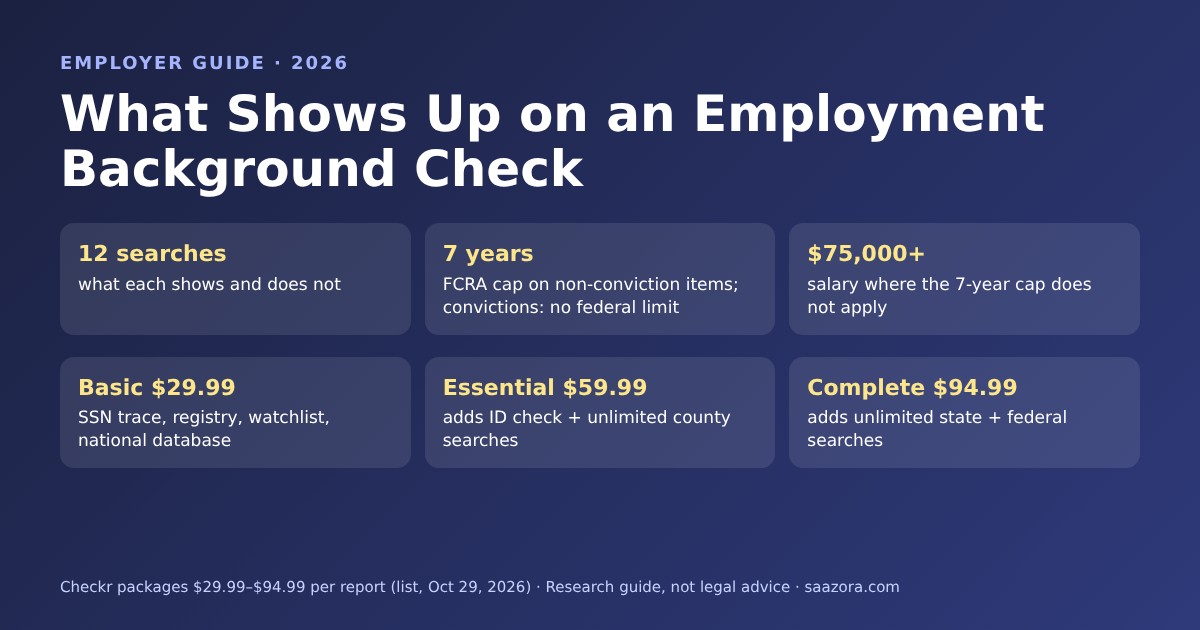
What shows up on an employment background check is decided by the searches the employer orders, not by one master file. An SSN trace returns names and past addresses; county, state and federal searches return court cases from those courts; registry and watchlist searches return listings; and add-ons return a driving record, job and degree confirmations, a drug test result or a credit report without a score. Under federal law, a screening company generally cannot report arrests, civil judgments and most other negative items older than seven years, but convictions have no federal time limit, and the seven-year cap does not apply to a job expected to pay $75,000 a year or more. At Checkr's list prices on October 29, 2026, a package runs $29.99 to $94.99 per report before court and database fees.
This guide goes search by search: what each one returns, what it leaves out, and how long Checkr's own pages say it takes. Then it covers the time limits in the Fair Credit Reporting Act (FCRA), one state that goes further, and what a real order costs once you add the searches a job needs. If you are the candidate and want to see your own report first, our guide to running a background check on yourself covers that side.
What shows up on an employment background check, search by search
A background check report is a bundle of separate results. If a search was not ordered, nothing from it appears, which is why two people can both "pass a background check" and have very different reports. The table below lines up the common searches with the exact turnaround wording from Checkr's own pages. Where Checkr does not state a time for a search, the table says so rather than filling the gap.
| Search | What it shows | What it does not show | Typical turnaround (Checkr's own page) |
|---|---|---|---|
| SSN trace | Names, aliases and past addresses linked to the Social Security number, and whether the number "appears legitimate and in use" | Any criminal record; it "doesn't confirm a candidate's identity" | Not stated; Checkr says results "generally go back three to ten years" |
| National criminal database | Possible records from "over 2,500 databases sourced from state and county agencies" | A complete history: it "may not include the most recent filings or all local records" | "usually only takes a few seconds" |
| Sex offender registry | Registry listings from all 50 states, DC and tribal territories, including the "sex offender level designation" | Offenses that do not require registration; details differ by registry | Database searches "may yield results in minutes" |
| Global watchlist | Names on government and regulatory lists "including OIG and SAM" | Court cases | Not stated |
| County criminal | Felony, misdemeanor and pending cases filed in that county's court, with dispositions | Cases in any other county; each county lived in is its own search | "usually take 1-5 business days" |
| State criminal | Records in a state's criminal record database, run "in tandem with county criminal search" | Cases the state database does not hold; it is not a substitute for the county search | "typically faster due to digitized records" (no number given) |
| Federal criminal | Cases in the 94 federal district courts, searched through PACER (fraud, embezzlement, crimes crossing state lines) | State and county cases; "in most cases, expunged or sealed records will not show up" | "typically return results within one to three business days" |
| Motor vehicle record (MVR) | License status and class, accidents, violations and driving-related convictions | Anything older than that state's lookback (three to ten years); out-of-state violations unless the DMV transferred them | "typically return within 24-48 hours"; Checkr's guide table says ">1 hour to 1-3 business days" |
| Employment verification | "Dates of employment", "Job title or position", "Salary (if legal in that jurisdiction)" | Opinions on performance (that is a reference check); salary where local law bars it | "1-3 minutes (quick verification) to 2-7 days (manual entry)" |
| Education verification | "School name, degree earned, and graduation date" | GPA, which is "generally not included" | "typically take only a few minutes" when the record is already in the system |
| Drug test | A result for each substance on the panel ordered (urine 4 to 10 panels, hair 4 to 18) | Substances outside the panel; a breath alcohol test shows only intoxication "at the time of the test" | "usually available within 2-10 business days; on average, you can expect results in three days" |
| Pre-employment credit report | Past employers, open credit lines, inquiries, payment history, collections, bankruptcies | A credit score: it "does not include credit scores" | Not stated for results |
Sources: Checkr pricing page; Checkr resource articles on SSN traces, national, federal and sex offender searches and turnaround; Checkr product pages for criminal checks, MVR, employment and education verification, drug testing and credit checks; Checkr small business page. All read October 29, 2026. Quotes are Checkr's wording; turnarounds are Checkr's typical figures, not a promise for any one order.
Two patterns are worth knowing before you read any report. First, the fast searches are the shallow ones. The national database and registry searches finish in seconds or minutes because they query collected data, and Checkr itself calls the national search "not necessarily comprehensive: Results point to potential records so you can investigate further." Second, the slow searches are the ones that reach the source. A county court search waits on that court, and a drug test waits on a lab. Our guide to how long each part of a background check takes walks through those delays.
Identity first: the SSN trace is a map, not a verdict
Almost every package starts with an SSN trace, and it is the most misread line on a report. Checkr lists what it returns as "Address history", "Associated names" and "SSN validity". It does not search a single court. Its job, in Checkr's words, is to help "identify specific jurisdictions, like counties or states, for criminal background searches." In practice, the counties that appear in the trace decide where the county searches are run.
That has two consequences. A candidate who lived somewhere the trace does not show may have a county left unsearched, and a name variation the trace finds (a maiden name, for example) is what lets the court search catch records filed under it. Checkr also states plainly that the trace "doesn't confirm a candidate's identity". That is why its Essential and Complete packages add a separate identity verification step, listed on its own at $4.99 per check.
Criminal records: four searches that cover different courts
"Criminal background check" sounds like one search. In a US report it is up to four, and each one looks at a different place:
- National criminal database. A broad first pass over collected state and county data. Its value is in pointing to places worth a closer look. Any hit should be confirmed at the court before an employer relies on it.
- County criminal. The search that reaches the court where most cases are filed. Checkr calls county records "often the most complete source of criminal histories". The report shows the charge, the level (felony or misdemeanor), pending status and the disposition, such as conviction, acquittal or dismissal.
- State criminal. A state repository search that Checkr runs alongside the county search, not instead of it. It can catch a case in a county the SSN trace did not list.
- Federal criminal. Federal crimes go to federal court, so they do not appear in county or state results. Checkr's federal article lists examples such as "Fraud, embezzlement, bank robbery, counterfeiting" and "crimes crossing state lines".
The sex offender registry and global watchlist searches sit next to these but are not court searches. A registry search returns what each jurisdiction publishes, and Checkr notes that "the results of an NSOR search may vary" because "each jurisdiction's registry reports different information". The watchlist covers sanctions and exclusion lists, which matter most in healthcare and finance.
What a criminal search returns is still limited by law. Expunged and sealed records generally do not appear, and the FCRA time limits below decide how far back non-conviction items can go.
How far back a background check goes: the FCRA seven-year rule
The federal limit is in 15 U.S.C. §1681c, "Requirements relating to information contained in consumer reports". A screening company such as Checkr is a consumer reporting agency, so the section applies to the reports it sells. Read on the U.S. Code on GovInfo, subsection (a) bars these items once they are older than the limit:
- Arrests, civil suits and civil judgments: "Civil suits, civil judgments, and records of arrest that, from date of entry, antedate the report by more than seven years", "or until the governing statute of limitations has expired, whichever is the longer period."
- Bankruptcies: cases under title 11 that "antedate the report by more than 10 years".
- Paid tax liens and accounts in collection: "Paid tax liens which, from date of payment, antedate the report by more than seven years", and "Accounts placed for collection or charged to profit and loss which antedate the report by more than seven years."
- Everything else negative: "Any other adverse item of information, other than records of convictions of crimes which antedates the report by more than seven years."
The phrase "other than records of convictions of crimes" is the key one. The FCRA puts no time limit on convictions. A conviction from 20 years ago can lawfully appear on a federal-law basis, while an arrest that never led to a conviction drops off after seven years from its date of entry.
Then comes the exception that many guides leave out. Subsection (b) says "The provisions of paragraphs (1) through (5) of subsection (a) are not applicable" to a report used in connection with "the employment of any individual at an annual salary which equals, or which may reasonably be expected to equal $75,000", or more. The $75,000 figure is a fixed number in the statute's text. So for a role expected to pay $75,000 or more, the federal seven-year and ten-year caps fall away, and older arrests or bankruptcies can be reported unless a state law says otherwise.
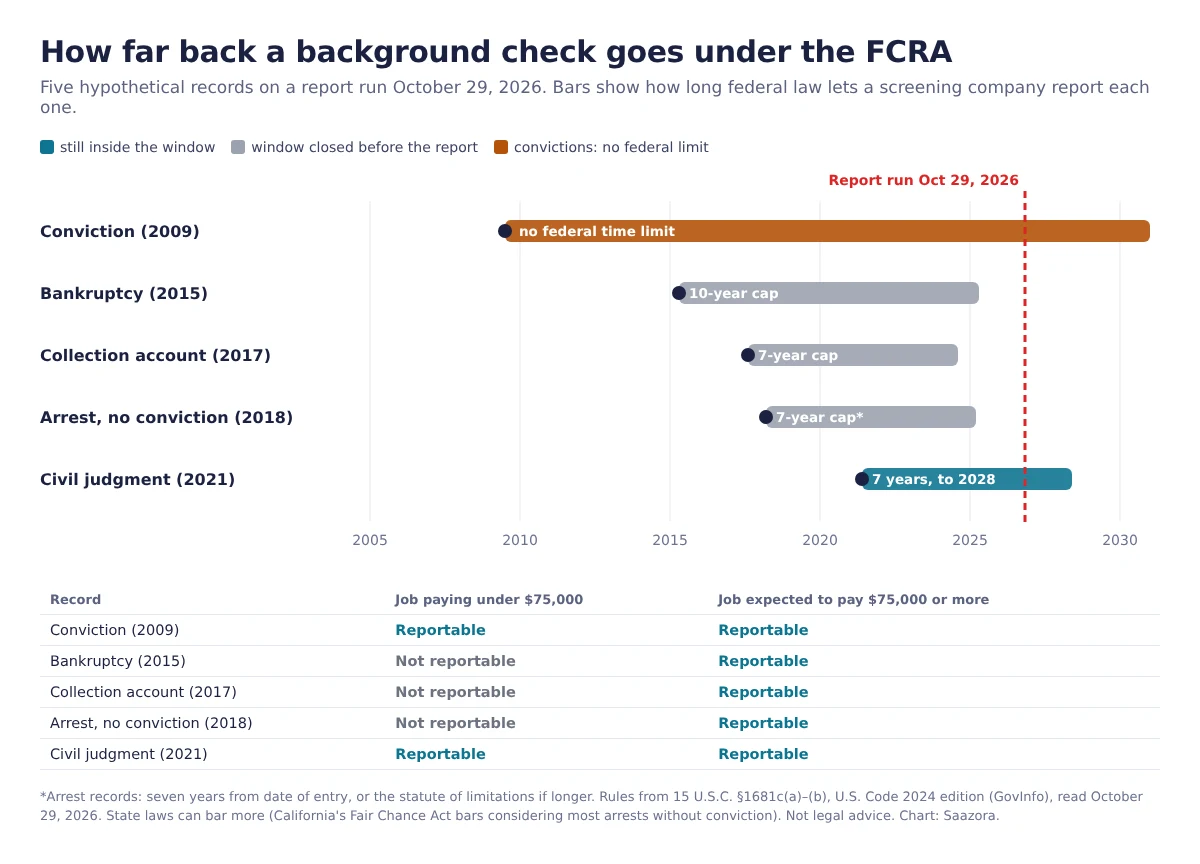
Two cautions on reading the chart. The arrest row assumes the statute of limitations is shorter than seven years; where it is longer, the longer period applies. And "reportable" is not the same as "usable": an employer still has to follow anti-discrimination law. The EEOC tells employers to "limit inquiries to records for which exclusion would be job related for the position in question", and warns that using criminal history "may, in some instances, violate Title VII."
State limits that cut deeper than federal law: a California example
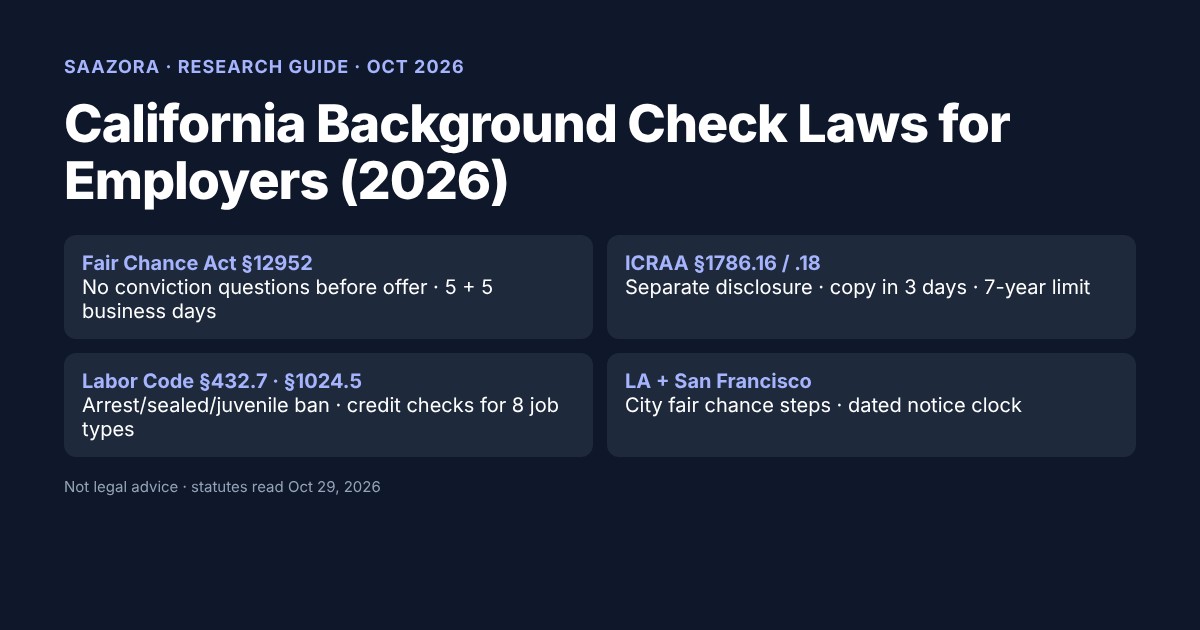
The FCRA is a floor. Many states and cities add their own limits on what can be reported or considered, and they vary widely. We only describe rules here that we could read on an official government page. California is one example. Its Civil Rights Department fact sheet (June 2025) says the Fair Chance Act "applies to public employers and private employers that have five or more employees", and that employers generally may not "ask about or consider a job seeker's conviction history before offering them a job." It lists information employers can never consider, including:
- "Arrests that did not result in convictions (with limited exceptions)"
- Cases where the person "successfully completed pretrial or posttrial diversion programs"
- "Convictions that have been sealed, dismissed, expunged or statutorily eradicated"
The fact sheet adds that if a check raises concerns, "the employer must do an individualized assessment before deciding not to move forward with hiring." So in California, an old arrest that federal law would let a screening company report for a $90,000 job is still, with limited exceptions, off limits as a hiring factor. California's consumer reporting statutes on the legislature's site would not load for us on October 29, 2026, so we do not quote them here. If you hire in more than one state, check each state's own labor or civil rights agency, or ask a lawyer.
The add-on searches: driving, verifications, drug tests and credit
These searches are not in Checkr's standard packages. They appear on a report only when an employer adds them, usually because the job calls for them.
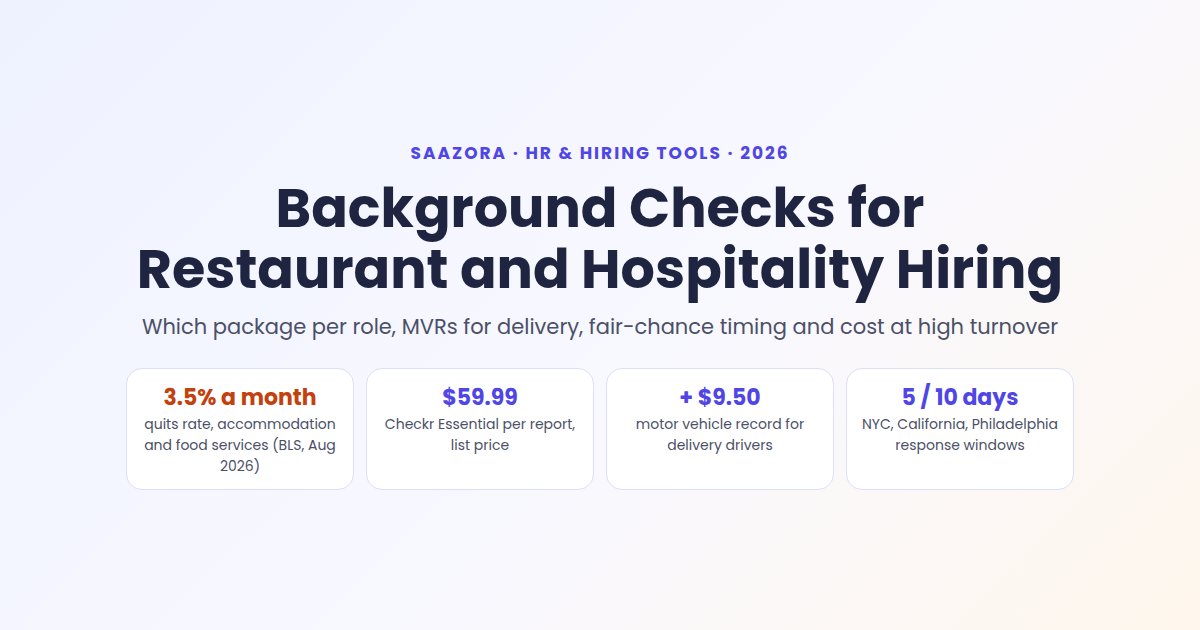
Driving record. An MVR shows "the status of the driver's license (such as valid, restricted, suspended, revoked, or expired)", plus accidents, violations and "driving-related felony and misdemeanor convictions" such as DUIs. How far back it goes depends on the state: Checkr says "most states return driving records from the past seven years" and others return "three years to as far as ten years." Our guide to MVR checks for hiring drivers covers state DMV fees and commercial drivers.
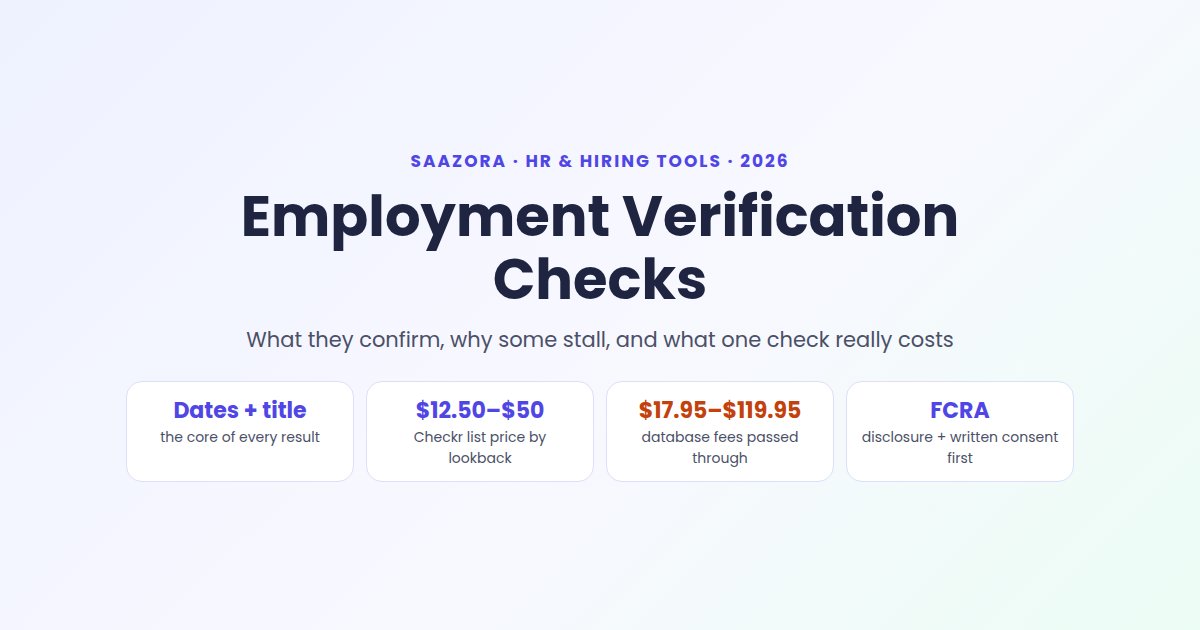
Employment and education verification. These confirm facts the candidate claimed. Employment checks return dates, title and salary only where legal. Education checks return the school, the degree and the graduation date, but not GPA. Our employment verification check guide explains why some come back "unable to verify" and where salary questions are banned.
Drug test. A drug test result covers only the panel ordered. Checkr's drug testing page says a 5-panel test "tests for the presence of amphetamines, cannabinoids (THC), cocaine, opiates, and phencyclidine (PCP)", and Checkr says "a certified Medical Review Officer (MRO) reviews any drug test results that may need clarification." For panel choices and who pays, see our pre-employment drug test cost breakdown.
Credit report. An employment credit report is not the report a lender sees. Checkr calls it "a modified credit report" that "does not include credit scores". It lists past employers, credit lines, inquiries, payment history, collections and public records such as bankruptcies. Checkr also says "employer credit checks are considered soft inquiries", so they do not lower the candidate's score. Checkr positions the report for roles with "financial or fiduciary responsibilities" and warns that "several states have very specific requirements" for running one. The FCRA time limits above apply to it too.
What Checkr's packages include, and what a real order costs
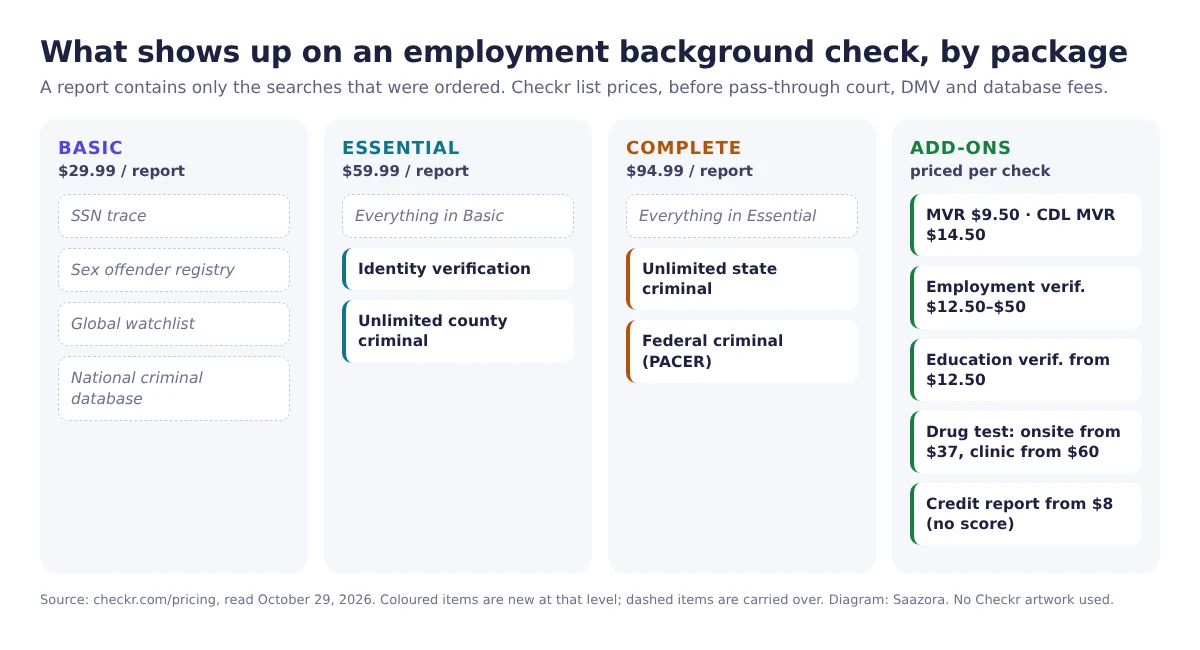
Checkr sells three standard business packages and prices everything else as add-ons. List prices read on checkr.com/pricing on October 29, 2026:
| Package | List price | What shows up on the report |
|---|---|---|
| Basic | $29.99 per report | SSN trace, sex offender registry, global watchlist, national criminal search |
| Essential | $59.99 per report | Everything in Basic, plus identity verification and unlimited county criminal searches |
| Complete | $94.99 per report | Everything in Essential, plus unlimited state criminal searches and a federal criminal search |
Source: checkr.com/pricing, October 29, 2026. Checkr notes under each package: "Pricing does not include pass-through fees." Court and database fees are "passed through at cost with no markup."
Add-on list prices on the same page: MVR $9.50, commercial MVR with CDLIS $14.50, onsite drug test from $37, clinic-based drug test from $60, credit report from $8, education verification from $12.50, and employment verification from $12.50 for the current employer to $50 for ten years. A standalone county search is $25, a federal search $10, and a state search from $10.
Here is what five common orders add up to. These are Saazora sums of Checkr list prices, not quotes. Court, DMV and database fees come on top and depend on where the candidate lived.
| Example role | Order | List total before pass-through fees |
|---|---|---|
| Part-time retail, low-risk role | Basic | $29.99 |
| Delivery driver | Essential + MVR ($9.50) | $69.49 |
| Warehouse hire with a drug test | Essential + onsite drug test (from $37) | from $96.99 |
| Bookkeeper | Complete + credit (from $8) + 7-year employment verification ($35) + education (from $12.50) | from $150.49 |
| Senior manager over $75,000 | Complete + 10-year employment verification ($50) + education (from $12.50) + credit (from $8) | from $165.49 |
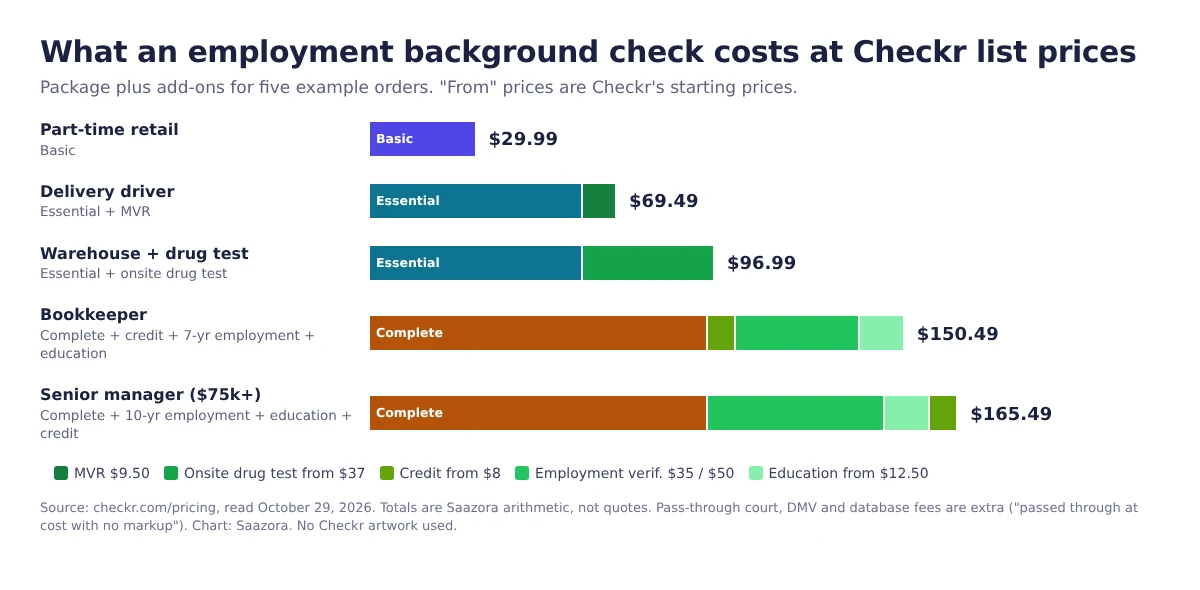
The table shows something the package names hide. The jump from Essential to Complete ($35) buys the state and federal searches. That matters most for the higher-paid roles, where the $75,000 exception also lets older records come back. For a low-risk hourly role, the cheapest package returns only database results, and Checkr's own wording says those need confirming at the county level. Our full Checkr pricing breakdown lists every add-on and the pass-through fees. When you know which searches the job needs, you can build a package on Checkr (affiliate link).
Things people expect to see that usually do not show up
Most surprises on a report, for employers and candidates alike, come from the gap between what people expect and what was searched. From the sources above:
- A credit score. Not on an employment credit report.
- GPA. Not in a standard education verification; ask for a transcript.
- A boss's opinion. An employment verification confirms facts. Opinions come from a reference check, which Checkr sells as a separate add-on.
- Expunged or sealed cases. Generally not returned, and in California they cannot be considered.
- An old arrest without a conviction. Federally barred after seven years for jobs under $75,000.
- A case in a county nobody searched. County results cover only the counties ordered, usually those from the SSN trace.
- Federal cases in a county search, or county cases in a federal search. Each court system needs its own search.
- A drug the panel did not include. A test reports only what it tested for.
On the other side, a conviction has no federal age limit, and for a role paying $75,000 or more, older non-conviction items can lawfully return too, subject to state law.
Questions about what a background check shows
Does a background check show arrests?
It can, if the arrest is in the courts searched and is within the federal limit: seven years from the date of entry, or longer if the statute of limitations is longer. For a job expected to pay $75,000 or more, that limit does not apply under federal law. Some states go further. California, for example, bars employers from considering arrests that did not result in a conviction, with limited exceptions.
How far back does an employment background check go?
For convictions, the FCRA sets no limit. For most other negative items, the limit is seven years (ten for bankruptcies), unless the job pays $75,000 or more. Separately, the searches themselves have practical ranges. Checkr says SSN trace results "generally go back three to ten years", and MVR lookbacks run three to ten years depending on the state.
Will a background check show my credit score?
No. Checkr's employment credit report "does not include credit scores", and Checkr says employer credit checks count as soft inquiries. A credit report also only appears if the employer adds it.
Does the employer need my permission?
Yes, when the employer uses a screening company. The FTC's guidance tells employers to "Get the applicant's or employee's written permission to do the background check". Before rejecting someone because of the report, the employer must send "a notice that includes a copy of the consumer report you relied on to make your decision."
What if something on my report is wrong?
You can dispute it with the screening company that produced it. Per the FTC, the adverse action notice must give "the name, address, and phone number of the company that sold the report" and say "that he or she has a right to dispute the accuracy or completeness of the report". Our guide to checking your own background report covers how to see it before an employer does.
Method and sources for this guide
On October 29, 2026 we read Checkr's pricing page, its product pages for criminal background checks, MVR, employment verification, education verification, employment drug testing and credit checks, its resource articles on SSN traces, national, federal and sex offender searches and how long background checks take, and its small business page. We also read 15 U.S.C. §1681c in the 2024 edition of the U.S. Code on GovInfo, the FTC's "Background Checks: What Employers Need to Know", the EEOC's brochure on arrest and conviction records, and the California Civil Rights Department's Fair Chance Act fact sheet. California's legislature site returned an error for the state's consumer reporting statutes, so none of that text is used. Saazora did not order any check. Turnarounds are Checkr's own stated figures, not our measurements, and Checkr's company-wide speed percentages are left out. The sample records in the timeline chart are hypothetical.
The Checkr store page lists current offer terms, and all of our screening guides are in the HR and hiring tools section. To compare packages before ordering, see Checkr's business pricing (affiliate link).
Sources (checked October 29, 2026): Checkr, Pricing and Packages; Checkr, Criminal Background Checks; Checkr, SSN trace; Checkr, National Background Checks; Checkr, Federal Background Checks; Checkr, Sex Offender Registry; Checkr, How Long Do Background Checks Take?; Checkr, Small Business Background Checks; Checkr, MVR Checks; Checkr, Employment Verification; Checkr, Education Verification; Checkr, Employment Drug Testing; Checkr, Credit Checks; 15 U.S. Code §1681c (GovInfo); FTC, Background Checks: What Employers Need to Know; EEOC, Arrest and Conviction Records in Employment; California Civil Rights Department, Criminal History and Employment Fact Sheet.
Research guide based on public sources, not legal advice. Checkr did not pay for or review this article.