
Research guide from public pages, not a hands-on test: Saazora ran no background check for this article · Texas statutes, TWC, DPS and City of Austin pages and Checkr prices read October 29, 2026 · Not legal advice; ask a Texas employment lawyer before you set a policy · We may earn a commission if you sign up through links on this page.
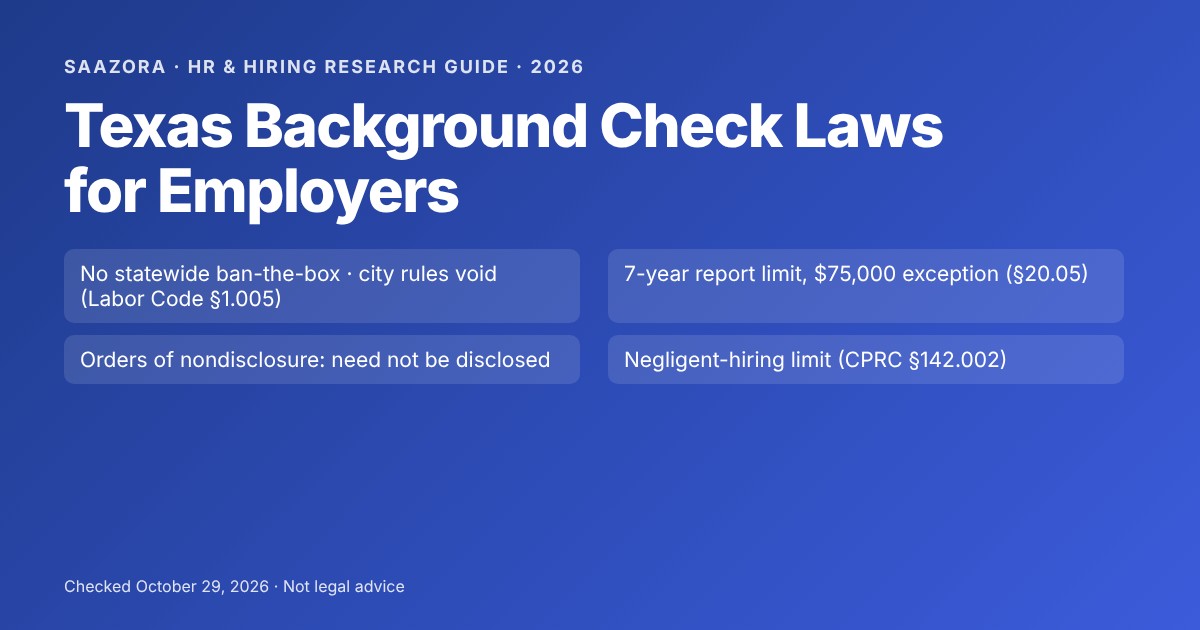
Texas background check laws leave private employers more room than many states, but the room has edges. There is no statewide ban-the-box rule, and since September 1, 2023, Labor Code §1.005 has voided city ordinances that regulate "hiring practices", which the Texas Workforce Commission says "essentially nullified" ordinances like Austin's fair chance rule. What Texas does regulate is the report: Business & Commerce Code §20.05 bars a screening company from reporting arrests, indictments and convictions whose disposition, release or parole is more than seven years old, unless the job pays $75,000 a year or more. Records sealed by an order of nondisclosure need not be mentioned on any application. And Civil Practice and Remedies Code §142.002, in force since 2013, blocks most negligent-hiring suits that rest only on a worker's past conviction.
This guide covers private employers hiring in Texas. It explains what each rule does, where an employer's choices still matter, and how the federal Fair Credit Reporting Act (FCRA) fits around them. It also runs the seven-year rule against six sample records, compares a do-it-yourself Department of Public Safety (DPS) search with Checkr's packages for 25 hires, and ends with a hiring sequence and a short FAQ. If this is your first screening program anywhere, start with our walkthrough of ordering a first employee background check, then come back for the Texas layer.
Texas background check laws in one table: the five rules a private employer meets
Most of Texas law here is about three things: what a report may contain, what an applicant may leave out, and who can be sued. Very little of it tells an employer when to ask. The table puts each rule next to the stage of hiring where it applies.
| Rule | Where it is | What it does | Who it binds |
|---|---|---|---|
| No local hiring rules beyond state and federal law | Labor Code §1.005 (H.B. 2127, eff. Sept. 1, 2023) | A city or county ordinance on "hiring practices" that goes beyond federal or state law is "void, unenforceable" | Cities and counties; it frees private employers from local ban-the-box rules |
| Seven-year limit on criminal records in reports | Bus. & Com. Code §20.05(a)(4) and (b)(3) | No arrest, indictment or conviction whose disposition, release or parole is more than seven years before the report, unless the salary is $75,000 or more | Consumer reporting agencies (screening companies) |
| Orders of nondisclosure | Gov. Code ch. 411, subch. E-1 (§411.0755) and §§411.0851, 552.1425; Bus. & Com. Code §109.005 | The applicant need not state the sealed proceeding on "any application for employment"; data sellers with notice must stop disseminating it | Applicants (a right), screening companies and data publishers (a duty) |
| Limit on negligent-hiring suits | Civ. Prac. & Rem. Code §142.002 (eff. Sept. 1, 2013) | No suit "solely" for negligent hiring based on a worker's conviction, with exceptions for job-related, aggravated and sexual offenses | Plaintiffs suing employers, contractors and premises owners |
| In-home service and delivery companies | Civ. Prac. & Rem. Code ch. 145 (the "Sue Weaver Act") | Must get a DPS or vendor criminal history check (or confirm a license) before sending a worker into homes; a clean 20-year felony / 10-year misdemeanor record gives a presumption of no negligence | Companies whose workers enter customers' homes |
Built from Labor Code ch. 1 (Texas Legislature, tcss.legis.texas.gov), H.B. 1188 (2013), S.B. 1902 (2015), H.B. 705 (2003), S.B. 627 (2009) and bill texts from 2015 and 2025 that quote §20.05 as in force, all read October 29, 2026 on official Texas Legislature sites. A condensed view; the statutes carry exceptions this table leaves out. Not legal advice.
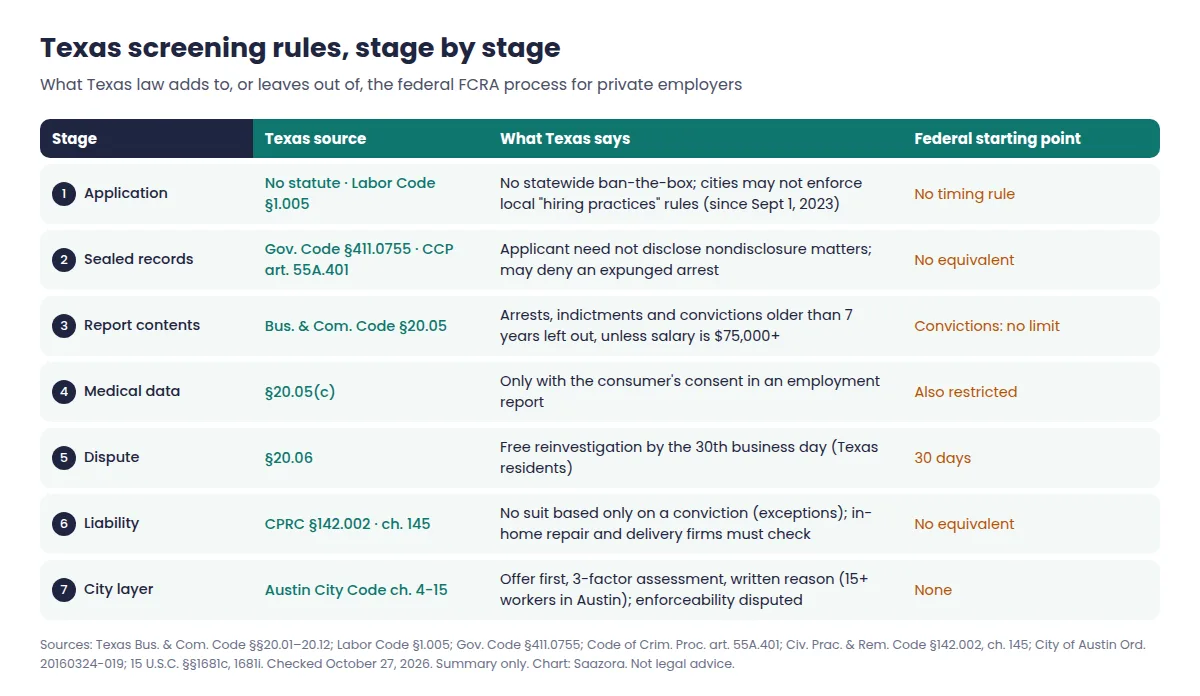
Federal law sits on top of all of this. The FCRA consent and notice steps apply whenever a screening company prepares the report, and federal employment discrimination law still applies to how criminal history is used. Texas adds nothing to the FCRA's paperwork, which is one reason the state's rules are easy to underestimate: the work is in the report content and the application wording, not in extra forms.
No ban-the-box in Texas, and city ordinances voided since 2023
Texas has no statewide law telling private employers when they may ask about criminal history. The Texas Workforce Commission's Texas Guidebook for Employers says so plainly after describing the federal rule for federal agencies and contractors: "As of 2021, Texas has no such statute."
Austin was the exception. Its Fair Chance Hiring Ordinance, which the City says "took effect April 4, 2016", "places restrictions on certain private employers on when they can ask about a job applicant's criminal history". Then the Legislature passed H.B. 2127 in 2023, which added a preemption section to the Labor Code. Section 1.005(a) reads, in part:
"Unless expressly authorized by another statute, a municipality or county may not adopt, enforce, or maintain an ordinance, order, or rule regulating conduct in a field of regulation that is occupied by a provision of this code. An ordinance, order, or rule that violates this section is void, unenforceable, and inconsistent with this code."
Subsection (b) names the fields, and the second item is exactly what a fair chance ordinance regulates: "employment leave, hiring practices, breaks, employment benefits, scheduling practices, and any other terms of employment that exceed or conflict with federal or state law for employers other than a municipality or county." The section took effect September 1, 2023.
How settled is that for Austin? Here is what each source we checked says, as of October 29, 2026:
- The state's own employer guide says, after naming Austin: "Labor Code Section 1.005 essentially nullified those ordinances effective September 1, 2023."
- The City of Austin's enforcement page still describes the ordinance and still links a complaint form "alleging Fair Chance Hiring violations". It does not mention H.B. 2127 or say whether the City still enforces the ordinance against private employers.
- The court challenge did not revive local rules. The Texas Tribune reported that on July 18, 2025, the Third Court of Appeals overturned a 2023 Travis County ruling that had struck the law down, finding that Houston, San Antonio and El Paso had not shown "sufficient concreteness" of harm. That is press reporting, not the opinion itself, which we did not read.
Note the carve-out at the end of §1.005(b): the field is defined for "employers other than a municipality or county." A city can still set rules for its own hiring. What the statute removes is a city's power to set those rules for private businesses.
What this means in practice. A Texas private employer may lawfully put a criminal history question on the application. Two things still argue for waiting. First, the TWC guidebook itself recommends it: "if possible, do not ask about criminal history until the tentative offer of employment has been made". Second, multistate employers usually keep one application, and many states and cities outside Texas do restrict the question. Waiting also lets you do the job-relatedness review that federal guidance expects, which TWC describes as "treating each applicant as an individual".
The TWC guide draws one line firmly: "Unless a law requires such a question, do not ask about arrests". It lists "Have you ever been arrested?" among impermissible application questions. Asking about convictions is different: "a company can ask about convictions and pleas of guilty or no contest".
Business & Commerce Code §20.05: Texas's seven-year limit and the $75,000 exception
Texas regulates screening companies directly. Chapter 20 of the Business & Commerce Code, added in 1997, says a consumer reporting agency "may not furnish a consumer report containing information related to" a list of old items. For criminal records, item (a)(4) covers:
"a record of arrest, indictment, or conviction of a crime in which the date of disposition, release, or parole predates the consumer report by more than seven years."
Subsection (b) lifts the limit when the report is used for "the employment of a consumer at an annual salary that is or may reasonably be expected to be $75,000 or more". The other two exceptions are for credit and life insurance of $150,000 or more.
The difference from federal law is the word "conviction". The FCRA's seven-year limit in 15 U.S.C. §1681c covers "records of arrest" and other adverse items "other than records of convictions of crimes." Under federal law alone, a 20-year-old conviction can appear on a report. Texas puts convictions under the seven-year clock as well. The federal law shares the salary exception: it does not apply to a job paying "$75,000, or more."
Three caveats a Texas employer should know about:
- The clock date is not one date. The statute counts from "disposition, release, or parole". For a person who was sentenced, released and then paroled, those are three different dates. The text does not say which one controls. A cautious reading uses the latest, so a conviction from 2012 with parole ending in 2021 is still inside the window in 2026.
- Federal preemption is an open question. The FCRA's preemption clause, 15 U.S.C. §1681t(b)(1)(E), covers state laws on "information contained in consumer reports," "except that this subparagraph shall not apply to any State law in effect on September 30, 1996". The Senate bill analysis for S.B. 27 says it "Amends Title 2 of the Business and Commerce Code by adding Chapter 20", and the section's history note dates it to October 1, 1997. We found no Texas court or agency ruling on whether §20.05's limit survives preemption. Screening companies' Texas pages still describe a seven-year rule. Ask counsel before relying on either reading.
- Changes have been proposed. Two 2025 bills proposed amending §20.05. S.B. 696 would have barred reports of "a record of arrest, charge, or indictment for an alleged crime" that did not lead to a conviction or deferred adjudication, at any age. H.B. 2478 would have barred medically necessary debt. Bill trackers show both stopped in committee: S.B. 696 was "Referred to Business & Commerce" on February 3, 2025, and H.B. 2478 was "Referred to Trade, Workforce & Economic Development" on March 17, 2025. Neither shows a later vote, and neither became law. The wording quoted above comes from these 2025 bills, which reprint the section as it stood.
Six sample Texas records run through the seven-year rule
To make the rule concrete, here are six made-up records, each checked against a report dated October 30, 2026. The seven-year cutoff for that report is October 30, 2019.
| # | Record (illustrative) | Job pays | FCRA alone | With Texas §20.05 |
|---|---|---|---|---|
| 1 | Misdemeanor theft conviction, probation completed March 2018 | $52,000 | May be reported (no federal limit on convictions) | May not be reported: disposition is more than seven years old |
| 2 | Same record as #1 | $80,000 | May be reported | May be reported: §20.05(b)(3) salary exception |
| 3 | Arrest June 2018, charge dismissed | $52,000 | May not be reported: arrest older than seven years | May not be reported |
| 4 | Felony conviction 2012, released 2016, parole ended February 2021 | $52,000 | May be reported | Likely reportable if the latest date (parole, 2021) controls; the statute does not say |
| 5 | Misdemeanor deferred adjudication completed 2022; order of nondisclosure granted 2024 | Any | No specific federal rule on sealed records | A screening company with notice of the order must not disseminate it; the applicant need not mention it |
| 6 | DWI conviction, sentence completed 2021 | $52,000 | May be reported | May be reported: inside seven years |
Illustrative records, not real cases. Applies 15 U.S.C. §1681c, Bus. & Com. Code §20.05 and Gov. Code §§411.0755 and 411.0851 as read October 29, 2026. Assumes the screening company follows Texas law despite the preemption question in caveat 2. Not legal advice.
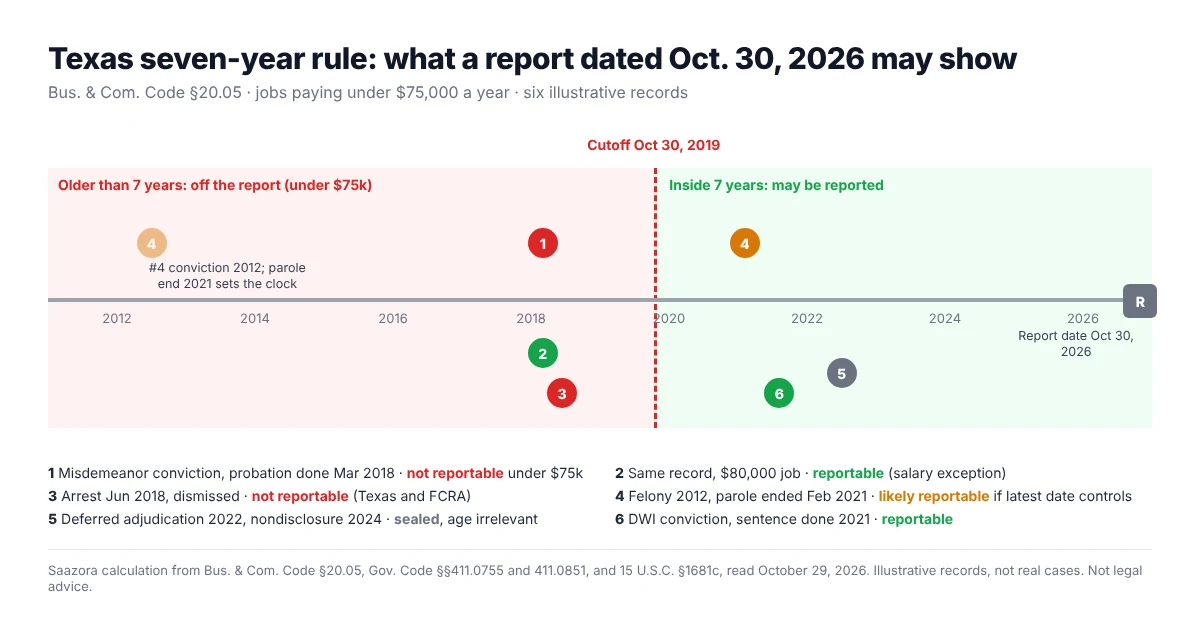
Row 1 is where Texas changes the outcome most. A national employer that set its screening packages for federal law may expect an old conviction to appear, and in Texas it should not, below the salary line. Row 2 shows the salary line matters for the report, not only for credit checks. If you hire for a role near $75,000, state the expected salary to your screening company accurately when you order. For more on what each search normally returns, see our guide to how long each part of a background check takes, which also explains why county searches add days.
Sealed records: what an order of nondisclosure means for your application
Texas lets many people who completed deferred adjudication, among others, ask a court to seal their record from the public. Subchapter E-1 of Government Code chapter 411, created by S.B. 1902 in 2015, governs these orders of nondisclosure. For some first-time misdemeanor deferred adjudications, §411.072 says the court "shall issue an order of nondisclosure". Some records never qualify: §411.074 excludes, among others, "an offense requiring registration as a sex offender" and "any other offense involving family violence".
For employers, the key section is §411.0755, titled "Statement in Application for Employment, Information, or Licensing". A person with an order of nondisclosure "is not required in any application for employment, information, or licensing to state that the person has been the subject of any criminal proceeding related to the information that is the subject of the order."
Three practical results follow:
- Word your question so a truthful "no" is truthful. If you ask about convictions, say that applicants need not disclose records sealed by an order of nondisclosure or expunged. Otherwise you may treat a legally permitted omission as a lie.
- Screening companies have their own duties. Under §411.0851(a), a private entity that compiles and sells criminal history "shall destroy and may not disseminate" information once it has notice of the order. Under §552.1425, it "may not compile or disseminate" such information. Business & Commerce Code §109.005(a) adds that "A business entity may not publish any criminal record information" it holds if it has notice of the order.
- Some employers still see sealed records. Section 411.0765(b) lets DPS and other criminal justice agencies release sealed information to listed agencies. The list includes "the State Board for Educator Certification", "the Texas Medical Board", "a school district, charter school, private school", and "the Texas Board of Nursing". A private office or retail employer is not on the list.
Deferred adjudication is a separate trap, even without an order. The TWC guidebook notes that after a successfully completed deferred adjudication, "no final conviction is entered on their record". A question limited to convictions does not reach it. DPS still treats deferred adjudication as public: "deferred adjudication and conviction records are considered public information". Decide in writing how your policy treats it, and phrase the application to match.
Checking Texas records yourself through the DPS Crime Records Service
Texas sells its own conviction database to the public. On the DPS Crime Records Service public site, credits paid by card "cost $3.00 each, plus a convenience fee of 2.25% per credit", plus "a transaction fee of $0.25 for each purchase". Credits paid by check are $3.00. You need "a CRS Public Website Account and purchase credits" before you search, and a search with no match still uses a credit.
DPS is direct about the limits:
- A name search "will not provide a definitive match or no-match."
- "Searches based on names, date of birth and other alphanumeric identifiers are not always accurate."
- "The only way to positively link someone to a criminal record is through fingerprint identification."
- The site "will only find public criminal record information", so it covers Texas records only.
DPS's FAQ lists a fingerprint-based check at $15.00, with "an additional $10 fingerprinting fee when utilizing FAST", its fingerprint service for "authorized entities". Check whether your industry counts as one before you plan around fingerprints.
Two cautions on doing it yourself. First, a DPS name search covers Texas only. Someone who lived in Oklahoma or Louisiana until last year will look clean. Second, the FCRA's consent and adverse action steps are written for reports bought from a consumer reporting agency. A search you run yourself on a state site generally falls outside them (confirm this with counsel for your setup), but discrimination law still governs how you use the result, and Texas's §20.05 seven-year filter does not apply to you. You may see older convictions on the DPS site that a screening company could not report. If your policy follows the seven-year line anyway, write that down and apply it the same way to everyone.
For driving roles, DPS also sells driving records. Its mail schedule lists a Type 2 three-year history at $6.00 and a certified abstract of the complete record, Type AR, at $20.00. Our explainer on MVR checks for drivers covers what those records show and how often to re-run them.
Negligent hiring in Texas: what Civ. Prac. & Rem. Code §142.002 protects, and what it does not
The fear behind most Texas screening programs is a lawsuit after a worker hurts someone. In 2013, H.B. 1188 added chapter 142 to the Civil Practice and Remedies Code to narrow that risk for people with records. Section 142.002(a) says "A cause of action may not be brought against an employer, general contractor, premises owner, or other third party" solely for "negligently hiring or failing to adequately supervise an employee" "based on evidence that the employee has been convicted of an offense".
The protection has three limits, and they decide most real cases:
| The shield does not apply when | Statute text | What it means for screening |
|---|---|---|
| The employer "knew or should have known" of the conviction and it was for an offense committed in duties or conditions substantially similar to the job | §142.002(b)(2)(A), which points to Occupations Code §§53.022 and 53.023(a) for the comparison | A related conviction you saw, or would have seen with reasonable checking, takes you outside the protection. Screening does not create the exposure; ignoring a related result does |
| Same knowledge test, for an aggravated offense | "an offense listed in Article 42A.054" of the Code of Criminal Procedure (the 2013 text said "Section 3g, Article 42.12"; H.B. 2299 updated the reference effective January 1, 2017) | Serious violent offenses keep the old negligent-hiring rules whatever the job |
| Same knowledge test, for a sexually violent offense | "as defined by Article 62.001, Code of Criminal Procedure" | Same |
| The suit is about "misuse of funds or property of a person other than the employer" | §142.002(c): the conviction involved fraud or misuse of funds, and handling others' money or property was foreseeable | For bookkeepers, property managers and similar roles, fraud convictions remain a live risk |
From H.B. 1188, 83rd Legislature, enrolled text on capitol.texas.gov, read October 29, 2026. The official codified page did not load in our reading tool, so the 2013 bill text is quoted, except for the aggravated-offense cross-reference, which we took from the current code as reproduced by Texas.Public.Law and RulesofCivilProcedure.com on October 30, 2026 (both list the 2015 amendment by H.B. 2299). Not legal advice.
Two more details matter. Chapter 142 defines an employee as "a person other than an independent contractor who, for compensation, performs services", so the shield does not cover 1099 workers. The bill says it applies only to claims that accrued on or after its effective date, September 1, 2013. Subsection (d) adds that it does not create any new cause of action.
Companies that send workers into homes have a separate statute. Chapter 145, known as the Sue Weaver Act, says that "Before associating with or hiring" someone "whose duties include entry into another person's residence", an in-home service company or residential delivery company shall "obtain from the Department of Public Safety or a private vendor" the person's criminal history, or "ascertain that the person holds in good standing an occupational license" that required a check. A company that did the check is "rebuttably presumed to have not acted negligently" if the record shows no conviction or deferred adjudication in the prior "20 years" for a felony or "10 years" for a Class A or B misdemeanor in three groups: offenses against the person or family, against property, or public indecency. That 20-year look-back does not line up with the §20.05 seven-year limit on what a screening company may report for jobs under $75,000. Ask counsel how to document the presumption; DPS records are one route the statute names. If you run a crew of technicians, our guide to screening contractors and home service techs covers package choice for that work.
What a Texas check costs on Checkr, and how Texas pass-through fees are billed
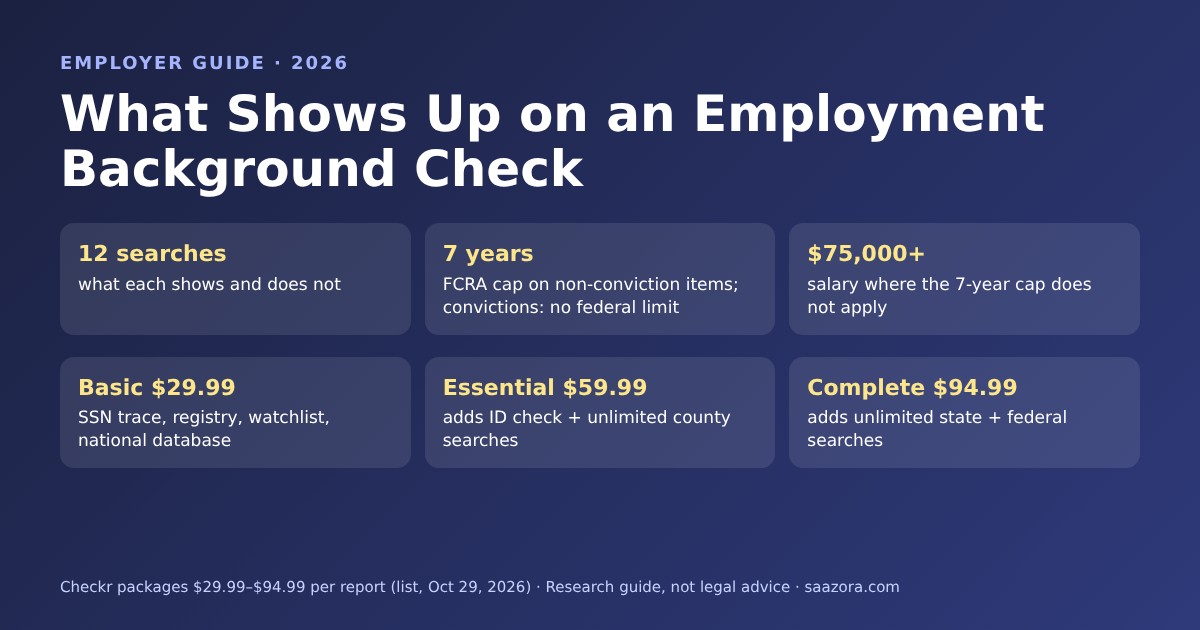
Checkr's pricing page, read October 29, 2026, lists three self-serve packages and per-search add-ons. All prices are "Simple, pay-as-you-go pricing", with this footnote: "Standard third-party court and database access fees may apply, passed through at cost with no markup."
| Checkr item | List price | Texas relevance |
|---|---|---|
| Basic | $29.99 / report | SSN trace, sex offender registry, global watchlist and national criminal search; "limited criminal search" |
| Essential | $59.99 / report | Adds identity verification and unlimited county criminal search. Texas county court fees, where a county charges one, are passed through |
| Complete | $94.99 / report | Adds unlimited state criminal search and federal criminal search |
| State criminal search add-on | Starting from $10 / check | A state-level search on top of Basic or Essential |
| County criminal search add-on | $25 / check | For a specific county |
| MVR | $9.50 / check | "Standard state DMV access fees apply and vary by location", passed through at cost |
Checkr list prices from checkr.com/pricing, October 29, 2026, before pass-through fees. Enterprise pricing is by quote.
About the Texas pass-through fees. Checkr publishes its court and DMV fees on a separate passthrough fees page with a state picker. When we read it on October 29, 2026, the table loaded only in a browser ("Loading fee data..."), so we could not record Texas's rows as text. Before you budget, open that page, pick Texas and note the state repository fee, any county fees for the counties where your applicants lived, and the DMV fee. For comparison only, the State's own public name search costs $3.00 per credit; we did not see what Checkr is charged for Texas.
Here is the arithmetic for a business making 25 Texas hires a year, before any pass-through fees:
| Option | Arithmetic | Total for 25 hires | What you get |
|---|---|---|---|
| DPS public name search, do it yourself | 25 × ($3.00 + 2.25%) + $0.25 | about $76.94 | Texas public convictions and deferred adjudications by name only; no identity check, no other states, no seven-year filter |
| Checkr Basic | 25 × $29.99 | $749.75 | National database search, SSN trace, registries |
| Checkr Basic + state criminal search | 25 × ($29.99 + $10.00) | from $999.75 | Adds a state-level search; the add-on is "starting from" $10 |
| Checkr Essential | 25 × $59.99 | $1,499.75 | Adds county searches where the person lived, plus identity verification |
| Checkr Complete | 25 × $94.99 | $2,374.75 | Adds state and federal searches |
Saazora arithmetic from DPS Crime Records Service fees and Checkr list prices, both read October 29, 2026. DPS card fee rounding may differ by a cent. Pass-through fees are extra on every Checkr row.
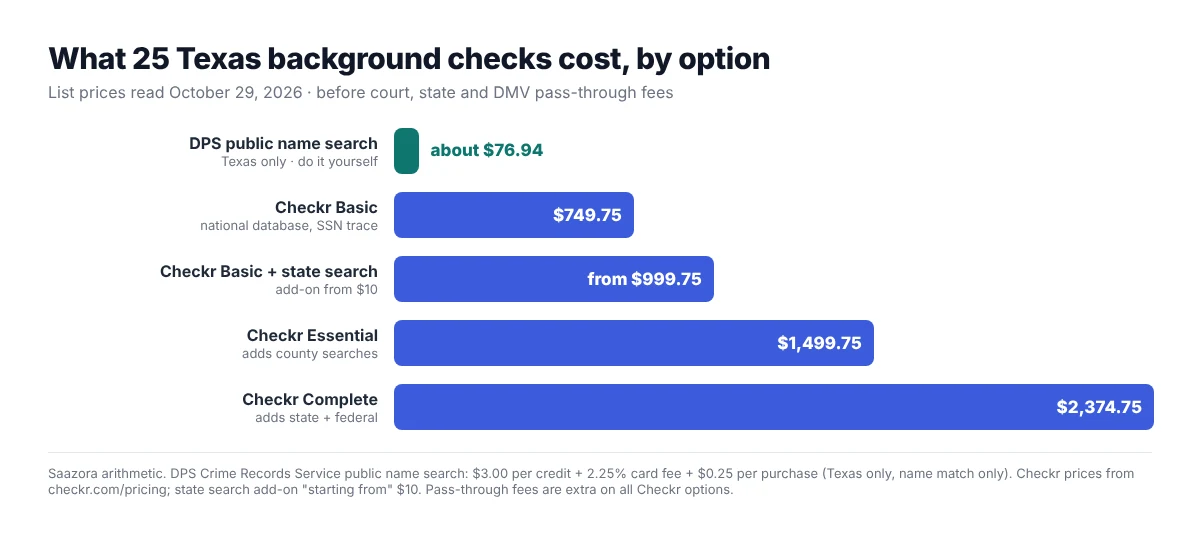
The gap between the first row and the rest is mostly what you pay to cover other states, to match records to the right person and to get FCRA-compliant handling, including the Texas seven-year filter. For a Texas-only workforce of long-time residents, a DPS search can be a cheap first look. For anyone who has moved, or a role where a missed record would hurt, a county-level package is the safer floor. Our breakdown of every Checkr package and add-on price explains the tiers in more detail, and what a full background check costs a small business per hire compares vendors.
If Essential fits your Texas roles, you can start a Checkr account for Texas hiring (affiliate link). Because pricing is per report, a business that hires a few people a year pays only for the checks it orders.
A Texas hiring sequence, from job post to final decision
Putting the federal and Texas pieces in the order a hire meets them:
- Write the policy first. Say which roles get which package, how you treat deferred adjudication and how you weigh the age and nature of an offense. TWC notes that "the remoteness of an offense is a factor in the job-relatedness determination."
- Application. No arrest questions. If you ask about convictions, exclude sealed and expunged records. Consider waiting until the tentative offer, as TWC suggests. If you once built Austin's timing rules into your forms, have your lawyer confirm TWC's reading of §1.005 before you drop them.
- Disclosure and consent. The FCRA disclosure must be "in a document that consists solely of the disclosure", and the applicant must have "authorized in writing".
- Order the right package and state the salary. The $75,000 line in §20.05 changes what the report may include. In-home service companies add the ch. 145 check.
- Review the result against the job. This is where §142.002 matters: a related conviction you knew about is the main exception to the negligent-hiring shield, so decide it deliberately and record why.
- Pre-adverse action. Before you reject someone, send "a copy of the report" and "a description in writing of the rights of the consumer". Then wait a set number of business days from your written policy.
- Final notice and records. Send the final adverse action notice and keep consent forms, reports and decisions together.
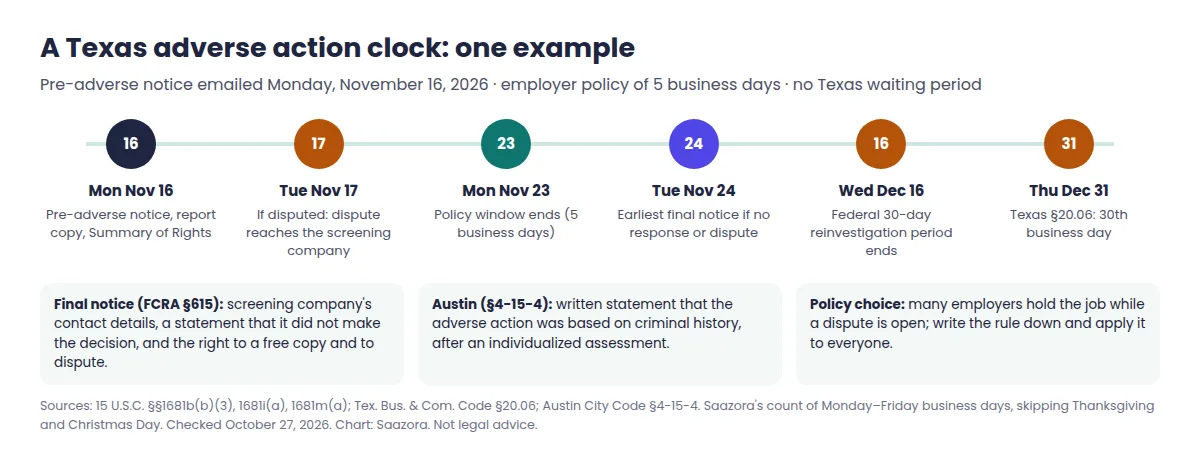
All of our hiring guides are collected in Saazora's HR and hiring tools section, and the Checkr store page lists current offer terms. When the policy and forms are ready, see Checkr's business packages (affiliate link).
Quick answers for Texas employers
Does Texas have a ban-the-box law for private employers?
No. No state statute limits when a private employer may ask about criminal history. Since September 1, 2023, Labor Code §1.005 has voided city and county rules on "hiring practices" that go beyond state or federal law, which TWC says nullified ordinances like Austin's.
How far back does a background check go in Texas?
For a report from a screening company, seven years for arrests, indictments and convictions, counted from the date of disposition, release or parole, under Business & Commerce Code §20.05. The limit does not apply when the salary is or is expected to be $75,000 a year or more. Whether federal law preempts the Texas limit for convictions is unsettled, so ask counsel.
Can I ask about deferred adjudication in Texas?
You can ask, but think about the wording. A completed deferred adjudication is not a final conviction, so a "conviction" question does not reach it. If the person has an order of nondisclosure, §411.0755 says they need not state it on any application for employment.
Am I liable in Texas if I hire someone with a record?
Not for that reason alone, in most cases. Civil Practice and Remedies Code §142.002 bars negligent-hiring suits based only on an employee's conviction. The exceptions are when you knew or should have known of a related, aggravated or sexually violent offense, or of a fraud conviction for a job handling others' money or property. Independent contractors are outside the chapter's definition of employee.
Is the DPS public website enough for a Texas background check?
It covers Texas public records only, matches by name, and DPS itself says a name search "will not provide a definitive match or no-match." It is a low-cost first look, not a substitute for a multi-state, identity-matched report.
How we researched this Texas guide
On October 29, 2026 we read Labor Code ch. 1 on the Texas Legislature's statutes site (tcss.legis.texas.gov). The statutes.capitol.texas.gov code pages returned only the site shell to our reading tool. For Business & Commerce Code §20.05 we therefore relied on official bill texts on capitol.texas.gov that reprint the section as in force: H.B. 1320 (2015), H.B. 2478 and S.B. 696 (2025), and the 1997 analysis of S.B. 27. We cross-checked the wording against a third-party code reproduction. Civil Practice and Remedies Code chapters 142 and 145 were read in their enrolled bills, H.B. 1188 (2013), H.B. 705 (2003) and S.B. 627 (2009), and Government Code subchapter E-1 in S.B. 1902 (2015). We also read the TWC Texas Guidebook for Employers, the DPS Crime Records Service search instructions and FAQ, the DPS driver record page, the City of Austin's Civil Rights enforcement page, 15 U.S.C. §§1681b, 1681c and 1681t, a Texas Tribune report on the 2025 appeals ruling, Checkr's pricing and passthrough fees pages, and Checkr's Texas guide. Saazora did not order any background check for this article.
Sources (checked October 29, 2026): Texas Legislature, Labor Code ch. 1, §1.005; capitol.texas.gov bill texts H.B. 1188 (83R, enrolled), S.B. 1902 (84R), H.B. 1320 (84R), H.B. 2478 (89R), S.B. 696 (89R), H.B. 705 (78R), S.B. 627 (81R) and the S.B. 27 bill analysis (75R); Texas Workforce Commission, Texas Guidebook for Employers; Texas DPS, Crime Records Service public site, How to Search, Crime Records Services FAQ and How to Order a Driver Record; City of Austin, Civil Rights enforcement page; Cornell LII, 15 U.S. Code §1681c and §1681b; GovInfo, 15 U.S.C. §1681t; Texas Tribune, July 18, 2025; Texas.Public.Law, Civ. Prac. & Rem. Code §142.002; FastDemocracy bill histories for S.B. 696 and H.B. 2478 (checked October 30, 2026); Checkr, pricing page and passthrough fees page.
Research guide, not hands-on testing and not legal advice. Checkr did not pay for or review this article.