
Leadfeeder pricing page, help center and product pages read November 4, 2026 · Research-based review built from vendor documentation, not hands-on testing · Prices in euros; Leadfeeder shows the same figures in US dollars to US visitors
Saazora may earn a commission if you sign up for Leadfeeder through links on this page, at no extra cost to you. Links to Leadfeeder's help center and product pages in the sources are plain links.
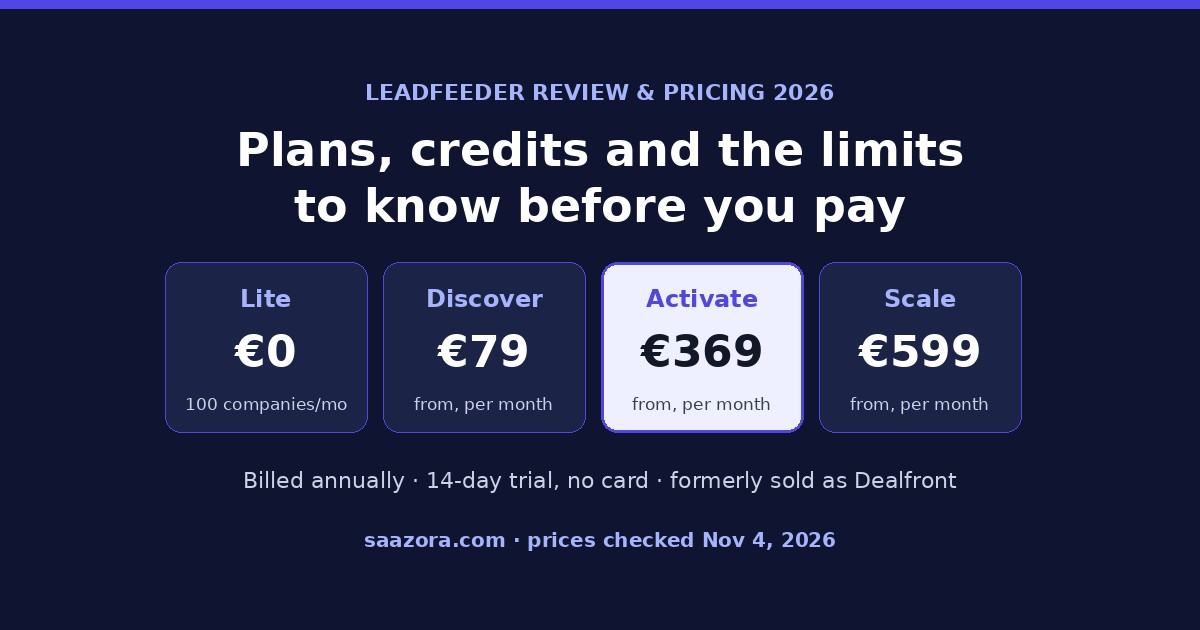
Leadfeeder review in one paragraph: it is a website visitor identification tool that names the companies behind your B2B traffic, and its free Lite plan plus a 14-day trial with no card make it cheap to find out whether your traffic is worth paying for. Paid plans start at €79 a month billed annually for Discover, €369 for Activate and €599 for Scale, and the real price depends on how many companies your site identifies each month. Two things trip buyers up more than the headline price: the plan tier follows your traffic, and verified contacts cost credits on top of the plan.
This review explains what Leadfeeder is called now that the Dealfront name has been retired, what each plan includes, where the price jumps in its company tiers, how far a month of credits goes, and which limits matter before you commit to a year. If you only want to see which companies visit your site for free, our free setup guide for identifying website visitors covers installation step by step, so this page stays on value and cost.
Leadfeeder or Dealfront? What the product is called in 2026
Leadfeeder and Dealfront are the same company. For a period the whole platform was sold under the Dealfront name, with Leadfeeder as one of its modules. Leadfeeder's German product-update FAQ dates the reversal precisely: "Am 24. März 2026 wird Dealfront zu Leadfeeder," meaning Dealfront became Leadfeeder on March 24, 2026. The English help article says "Leadfeeder is the new name for the brand going forward" and that "the company, team, and platform remain the same."
The rename moved some labels around, which is why older reviews can be confusing:
| Name you may see in older articles | Name now |
|---|---|
| Dealfront (the platform and brand) | Leadfeeder |
| Leadfeeder (the visitor identification module) | Web Visitors |
| Promote | Campaigns |
| Dealfront API | Leadfeeder API (the old one is now the Legacy Leadfeeder API) |
| dealfront.com login and emails | leadfeeder.com |
Source: Leadfeeder help center, "Dealfront is now Leadfeeder," and the Leadfeeder product-update FAQ on the rebrand. Read November 4, 2026.
Dealfront still exists as the legal company: the pricing page footer reads "© 2026 Leadfeeder. Dealfront Group GmbH." The help article says "Your plan, features, and pricing remain the same" and that the legal contracting entity did not change. So a contract or invoice that names Dealfront is normal and not a sign of a reseller.
Today's navigation lists five modules: Web Visitors (named companies on your site), Web Insights (a newer, company-based analytics view), Companies (prospect lists from a global database), Lists and Campaigns (display ads aimed at your ideal customer profile), plus an API and an MCP server for AI tools.
What you get for the money: the four plans side by side
All plans include unlimited users, which is the main way Leadfeeder differs from per-seat prospecting tools. What changes between plans is the monthly number of identified companies, the credit allowance and the extras.
Leadfeeder plans, starting prices billed annually (November 2026)
Lite
€0
Last 100 companies a month, 7-day visitor history, 20 credits a month, 3 months of Web Insights history
Discover
€79/mo
50 to 1,000 companies a month, full company profiles, alerts, CRM sync, API and MCP access
Activate · "Most Popular"
€369/mo
1,000 to 4,000 companies, 200 to 1,500 credits, verified emails and phones, intent filters, display campaigns
Scale
€599/mo
2,000 to 10,000 companies, 1,000 to 5,500 credits, free company data export, dedicated CSM, annual or quarterly only
Monthly billing is listed at €113 for Discover and €527 for Activate. Enterprise is custom-priced.
In more detail:
- Lite (free). The pricing page lists "Last 100 companies/mo in Web Visitors" and a "7-day visitor history." The compare table also gives Lite 20 credits a month. Since the Web Insights launch, Lite includes "Three months of history" there for "Up to 50,000 unique visitors a month."
- Discover (from €79). Full company profiles, Google and LinkedIn ad reports, AI reports, real-time alerts, CRM sync, and API and MCP access. Its tier table shows company volume only, with no credit figure next to it.
- Activate (from €369). Everything in Discover plus verified emails and phones, intent-signal filters, B2B display campaigns, CRM automations and AI prospect lists. This is the first plan where you can find people, not just companies.
- Scale (from €599). Adds free company data export, automatic CRM data updates and a dedicated customer success manager. It can only be paid annually upfront or quarterly.
Where the price steps up: cost per identified company
Leadfeeder prices Discover by how many companies it identifies on your site each month. Dividing each tier's price by its ceiling shows how quickly the cost per company falls, and exposes one odd step.
| Plan and tier (companies a month) | Price a month, billed annually | Cost per company at the tier ceiling |
|---|---|---|
| Discover, up to 50 | €79 | €1.58 |
| Discover, 51 to 100 | €109 | €1.09 |
| Discover, 101 to 200 | €139 | €0.70 |
| Discover, 201 to 400 | €179 | €0.45 |
| Discover, 401 to 500 | €249 | €0.50 |
| Discover, 501 to 1,000 | €309 | €0.31 |
| Activate, 1,000 with 200 credits | €369 | €0.37, plus credits |
Source: tier tables on leadfeeder.com/pricing, read November 4, 2026. Cost per company is Saazora arithmetic: tier price divided by the tier's maximum.
Cost per identified company, Discover tiers and Activate entry (€, billed annually)
Orange: the only tier where the unit cost rises. Green: Activate also includes 200 credits a month.
Three practical readings of that table:
- The 401 to 500 band is the worst value. Moving from 400 to 500 companies costs €70 a month, while moving from 500 to 1,000 costs only €60 more. If your trial shows you near 450 companies, the 1,000 tier gives you room to grow for little extra.
- Activate is close to the top of Discover. At 1,000 companies, Activate is €60 a month more than Discover and adds 200 credits plus verified contacts and intent filters. For a team that will look up people anyway, that gap is small.
- Activate and Scale overlap. Activate with 3,000 companies and 1,000 credits is €599, the same as Scale's entry tier of 2,000 companies and 1,000 credits. At 4,000 companies and 1,000 credits, Scale is €749 against Activate's €689. The €60 difference buys the dedicated CSM, free data export and automatic CRM updates, but it removes monthly billing.
Monthly or annual billing: what a year costs
Leadfeeder's help center states that "Annual subscriptions come with a 30% discount over the monthly price," and the published figures match: €79 is about 70% of €113, and €369 is about 70% of €527. Over 12 months the gap is significant.
| Entry tier | 12 months on monthly billing | 12 months on annual billing | Difference |
|---|---|---|---|
| Discover (up to 50 companies) | €1,356 | €948 | €408 |
| Activate (1,000 companies, 200 credits) | €6,324 | €4,428 | €1,896 |
| Scale (2,000 companies, 1,000 credits) | Not offered | €7,188 | Annual or quarterly only |
Source: leadfeeder.com/pricing (€113, €79, €527, €369, €599) and Leadfeeder help center, "Pricing, plans and payment methods." Twelve-month totals are Saazora arithmetic, before VAT or sales tax. Read November 4, 2026.
Leadfeeder publishes monthly prices only for the entry tiers. For higher tiers, assume roughly the annual figure divided by 0.7 and confirm at checkout. On currency, the same help article says "Depending on your company location, we charge in either USD ($) or Euros (€)." The pricing page shows only euros, so a US buyer should read the dollar amount on the checkout screen rather than converting the euro figure.
How far the credits go
Identifying a company never costs credits. Credits pay for finding and moving people. According to the help center article on credit spending, an email-only contact enrichment costs 0.2 credits, an email plus phone enrichment costs 1 credit, and exporting or syncing a record to your CRM costs 1 credit. The same article warns that "enriching a contact does not automatically unlock a free export," so a contact you enrich and then push to your CRM uses both amounts. Once paid, a record stays open to your whole account for 12 months.
What 200 credits a month (Activate entry tier) can buy
1,000
email-only enrichments at 0.2 credits each, kept inside Leadfeeder
166
contacts enriched with email only and synced to your CRM (0.2 + 1 credit)
200
email plus phone enrichments at 1 credit each, not exported
100
contacts enriched with email and phone and synced to your CRM (1 + 1 credit)
Lite's 20 credits cover 100 email-only enrichments or 20 email plus phone enrichments.
Two rules decide whether credits run short. On monthly plans, "Unused monthly credits don't roll over to the next month." On annual plans you get "access to your entire credit quota on day one," which suits a team that wants to enrich a backlog in the first weeks. Extra credits can be bought in blocks of 100 to 5,000. If your process is "see the company, find two people, push both to the CRM," budget about four credits per account on Activate, which means 200 credits covers roughly 50 accounts a month. Teams that need more contacts per account often pair Leadfeeder with a dedicated finder; our FullEnrich pricing breakdown and RocketReach pricing guide show what a verified email or mobile number costs there.
Limits to understand before you sign up
The plan pages are short. The help center adds conditions that affect the bill and the data you see:
- Hitting the monthly cap hides companies. The help article on identified companies says "Once you reach your monthly limit, additional visiting companies will not appear in your feed until the next billing period." There is no overage charge in the text; you simply stop seeing new companies.
- The tier can change itself. Leadfeeder's contract article says tiers are based on companies identified over "the last 12 months (or the longest time frame we have access to)," that Leadfeeder will email you when a plan should be upgraded, and that the new quota and price start "when your new subscription period is starting." On an annual plan, any auto-upgrade happens only after the year ends. Check your identified-company count before each renewal.
- One company can count more than once. An identified company is "a unique company from a specific location," and the help center notes that a company name "may appear multiple times" if employees visit from several locations. Repeat visits from the same location do not add to the count.
- Lite's 100 companies come from a 7-day window. The free plan is useful as a weekly sample, not a full picture of a month.
- Cancellation windows. "Monthly plans can be cancelled at any time before the next billing period," while "Annual plans can be cancelled up to 30 days before the end of the current billing cycle." Put the renewal date in your calendar at least five weeks ahead. The help pages we read do not mention refunds.
- Invoicing is annual only. Card payment works for monthly or annual plans; paying by invoice is available only for annual subscriptions.
How accurate is the data?
Leadfeeder identifies companies from the IP address of each visit, matched "against a continuously updated company database." Its own claim is that it "identifies up to 45% of your B2B visitors," and that "every month around 20% of the database changes," which is why it creates a fresh IP-to-company database every day. Treat 45% as a ceiling, not a forecast: visitors on mobile data, home connections without a company match or VPNs cannot be tied to an employer, and Leadfeeder does not publish an average match rate. The vendor also says it can recognise remote and home workers, but gives no figure for how often.
On privacy, Leadfeeder states that "By default Leadfeeder only shows company visits, not individuals," that it is GDPR compliant, and that it "processes and stores all data within the EU." Individuals appear only when they identify themselves, for example by filling in a form. That is a vendor statement, not legal advice; disclose the tool in your privacy policy and check consent requirements for your EU, UK and California traffic.
Who Leadfeeder fits, and who should skip it
| Your situation | Best starting point | Why |
|---|---|---|
| B2B site, not sure the traffic includes buyers | Lite, then the 14-day trial | Shows real company names at no cost; the trial reveals your monthly volume |
| Marketing team that wants account-level reporting and CRM sync | Discover, sized from the trial | Company names, alerts and CRM sync without paying for contact data |
| Small sales team that will contact visiting accounts | Activate, 1,000 companies | Only €60 a month more than Discover's top tier and adds verified contacts and intent filters |
| High-traffic site, 4,000 or more companies a month | Compare Activate and Scale at the same volume | Scale adds a dedicated CSM and free exports, but no monthly billing |
| Consumer site, or mostly mobile and home traffic | Skip | Few visits come from identifiable company networks |
A worked example shows how to size a plan from the trial. Suppose, as a Saazora assumption, that the 14-day trial identifies 380 companies. Scaled to 30 days, that is about 815 a month, which lands in Discover's 501 to 1,000 tier at €309, or Activate's entry tier at €369 if you also need contacts. Because the tier follows your trailing traffic, a site growing quickly should size for next year's volume, not this month's.
Leadfeeder only names companies; it does not run your outreach. If you still need the rest of the stack, our comparison of sales prospecting tools sets Leadfeeder next to contact finders and a sales CRM; if the CRM is the missing piece, our Close CRM review covers a sales CRM with built-in calling, and more reviews sit in our Sales Prospecting & CRM section.
Verdict
Leadfeeder is worth trying for any B2B company with steady website traffic, because the free plan and the no-card trial answer the only question that matters before paying: how many identifiable companies visit, and are they the right ones. It is good value at the 501 to 1,000 Discover tier and at Activate's entry tier, and weaker value in the 401 to 500 band. The costs to watch are credits for contacts and CRM syncs, the traffic-based tier that can rise at renewal, and the 30-day cancellation window on annual plans. You can start the free Leadfeeder trial or Lite plan (affiliate link), and the current annual-billing saving is listed on our Leadfeeder deals page.
Leadfeeder review FAQ
Is Leadfeeder the same as Dealfront?
Yes. Dealfront renamed its platform and brand to Leadfeeder on March 24, 2026. The legal company is still Dealfront Group GmbH, and Leadfeeder says plans, features and prices did not change with the rename.
How much does Leadfeeder cost per month?
Lite is free. Discover starts at €79 a month billed annually (€113 billed monthly), Activate at €369 (€527 monthly) and Scale at €599, annual or quarterly only. The price rises with the number of companies identified each month, and US companies may be charged in dollars.
Does Leadfeeder have a free trial?
Yes, 14 days with no credit card. When it ends without a purchase, the account moves to the free version of Web Visitors.
What happens if I go over my company limit?
New visiting companies stop appearing in your feed until the next billing period. Leadfeeder may also suggest a higher tier, which on an annual plan takes effect at renewal.
Can Leadfeeder show the names of individual visitors?
Not by default. It shows companies. Contact details for people at those companies come from enrichment on Activate and higher, which costs credits.
How we researched this review
This is a research-based review. Saazora did not use a Leadfeeder account, install the tracker or enrich contacts for this page. Plan names, prices, tiers and credit allowances come from leadfeeder.com/pricing; billing, cancellation, currency, credit and company-limit rules come from Leadfeeder's help center; product names and data claims come from leadfeeder.com, the Web Visitors and Web Insights pages, and Leadfeeder's rebrand FAQ and help article. Everything was read on November 4, 2026. Per-company costs, 12-month totals, credit scenarios and the trial example are Saazora arithmetic on those published figures. See how we review software.
Sources (plain links): Leadfeeder pricing · Dealfront is now Leadfeeder · Rebrand FAQ (German) · Pricing, plans and payment methods · Your Leadfeeder contract · How are credits spent? · What is an identified company? · Web Visitors · Web Insights free