
Research guide built from public pages, not a hands-on test: Saazora did not order a background check, a drug test or a court search for this article · Checkr wording and prices read on checkr.com on October 23, 2026 · FBI, court clerk, drug-lab, National Student Clearinghouse, DMV, FTC and state fair-chance pages checked October 21–23, 2026 · This is not legal advice; for a specific hiring decision, talk to an employment lawyer · We may earn a commission if you sign up through links on this page.
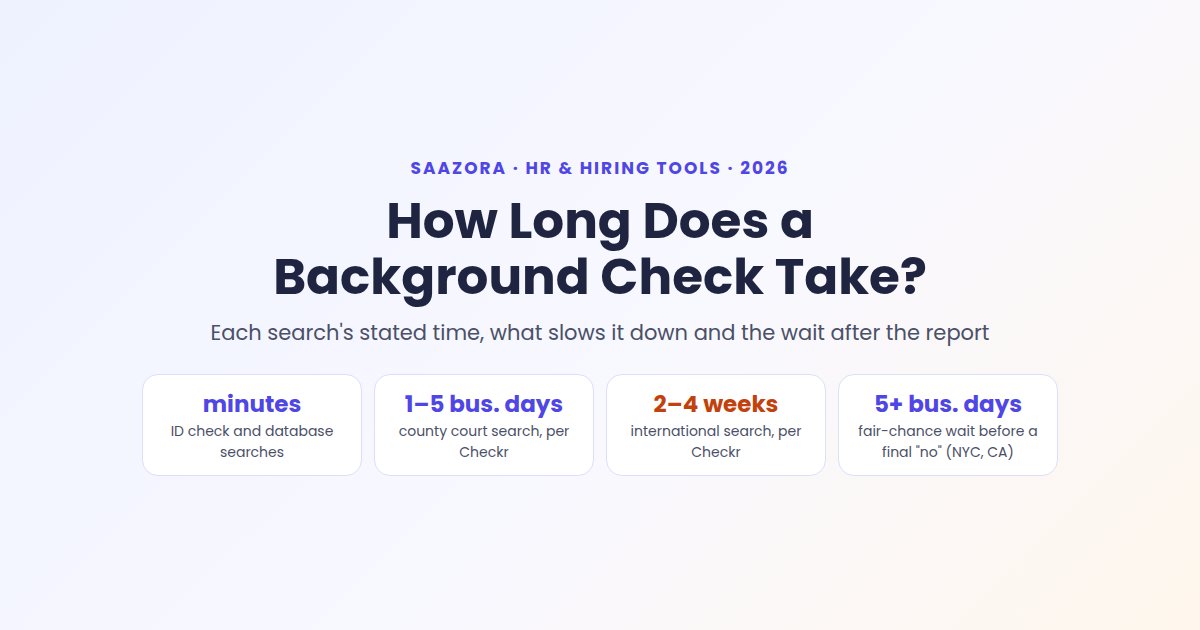
How long does a background check take? There is no single number, and anyone who quotes one without conditions is guessing. Checkr's own guide says employment checks through a screening company "typically take three to five days" on average, its FAQ on the same page says "one to five business days", and its small-business page says "a few minutes to a week, depending on the type and scope of the screenings being conducted". The spread comes from the parts: a database search can finish in minutes, a county court that keeps paper files can take a week or more, a lab drug test adds days, and an international search can take weeks.
This guide breaks the wait into its components and dates every figure to the page that states it. It also covers two clocks most timing articles leave out: the identity check that now runs before the search starts, and the waiting period the law adds after the report if the result might cost the candidate the job. For the full legal sequence, see our step-by-step guide to running an employee background check legally; all of Saazora's screening guides are collected in the HR and hiring tools section.
How long does a background check take? Three Checkr answers and the conditions behind them
We read every Checkr page that states a turnaround. They do not contradict each other so much as answer different questions, and each attaches a condition. Here they are word for word.
| Checkr page (read Oct 23, 2026) | Exact wording | Condition Checkr attaches |
|---|---|---|
| Guide "How Long Do Background Checks Take?" (updated Sept 22, 2026), main text | "On average, employment background checks conducted through a CRA typically take three to five days." | Timing "may depend on the scope of the search, the location, record availability, and whether you're using a consumer reporting agency (CRA), or conducting the search yourself." |
| Same guide, FAQ | "Most employment background checks take one to five business days" | "though timing varies based on the type of screening being conducted" |
| Small business page, FAQ | "typically range from a few minutes to a week" | "depending on the type and scope of the screenings being conducted" |
| Same guide, table for a full employment check | ">1 hour to 1-5 days" | Listed as "Average turnaround time" for "a more comprehensive report that typically includes multiple screenings" |
Source: checkr.com/resources/articles/how-long-does-a-background-check-take (dateModified 2026-09-22) and checkr.com/use-cases/small-business, both read October 23, 2026. ">1 hour" is how Checkr's table prints it.
Two things follow. First, "three to five days" and "one to five business days" are both about a typical package; neither is a promise for your candidate. Second, every version of the answer depends on what is in the package, which is why the rest of this guide works search by search. Checkr also publishes speed percentages for its criminal searches; we leave those out because they are company-wide marketing figures we cannot check, not a turnaround for any one order.
The component timeline: from a two-minute ID check to a four-week international search
A background check is a bundle of separate searches that mostly run side by side, so the slowest one sets the finish date. This table lists each component with the stated time and who stated it.
| Component | Stated time | Who says so (checked) |
|---|---|---|
| Identity verification (ID + live selfie) | "roughly two minutes" for the candidate to complete; runs before the search starts | Checkr IDV page (Oct 23, 2026) |
| Database searches (national criminal, sex offender registry) | "may yield results in minutes" | Checkr guide (Sept 22, 2026 version) |
| County criminal search | "usually take 1-5 business days but can take longer in jurisdictions with slower processing times or manual record-keeping systems" | Checkr small business page (Oct 23, 2026) |
| State criminal search | "typically faster due to digitized records" | Checkr guide |
| Driving record (MVR) | "typically return within 24-48 hours"; the guide's table says ">1 hour to 1-3 business days" | Checkr small business page; Checkr guide |
| Employment verification | "1-3 minutes (quick verification) to 2-7 days (manual entry)"; product page: "Most verifications complete in under 3 days" | Checkr guide; Checkr employment verification page |
| Education verification | "typically take only a few minutes" when the record is already in the National Student Clearinghouse system; longer when the school must be contacted | Checkr education verification page; the Clearinghouse says it verifies degrees "instantly" online |
| Professional license and reference checks | "may take 3-5 business days depending on the responses from licensing boards and references" | Checkr small business page |
| Drug test | "10 minutes (onsite) to 3-10 days (lab-based)"; Quest: negative lab screens "often released within 24 hours", non-negatives "within an additional 24 to 72 hours" | Checkr guide; Quest Diagnostics urine testing FAQ (dated March 2018) |
| International search | "can take 2-4 weeks due to varying processes and regulations in different countries" | Checkr small business page |
| FBI Identity History Summary (your own record) | "within 48 hours" after electronic prints reach the FBI; "currently 10 days" for a mailed card, plus 15 days if results are mailed | FBI CJIS eDO site (Oct 23, 2026) |
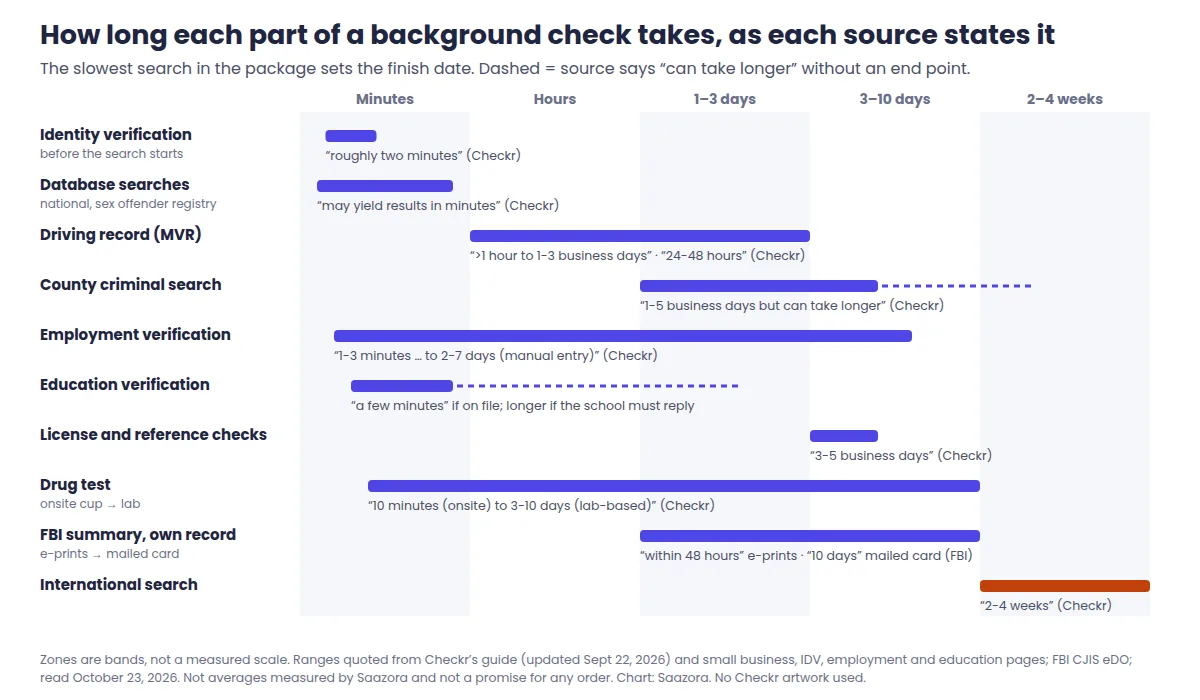
Read the chart from right to left. If a package includes a county search in a slow court, a lab drug test or a candidate who lived abroad, that one item decides the date, and the instant searches do not make up for it. Checkr's own table puts the low end of a full employment check at ">1 hour" and the high end at five days; add a 10-year employment history at small firms that answer by phone and you are waiting on people, not systems.
One point about the FBI row: those times apply when a person requests their own Identity History Summary. Fingerprint checks an employer must run for licensed or regulated roles go through state agencies, and each state sets its own processing time, so do not plan a hire around the FBI's 48 hours.
Why county courthouses set the pace
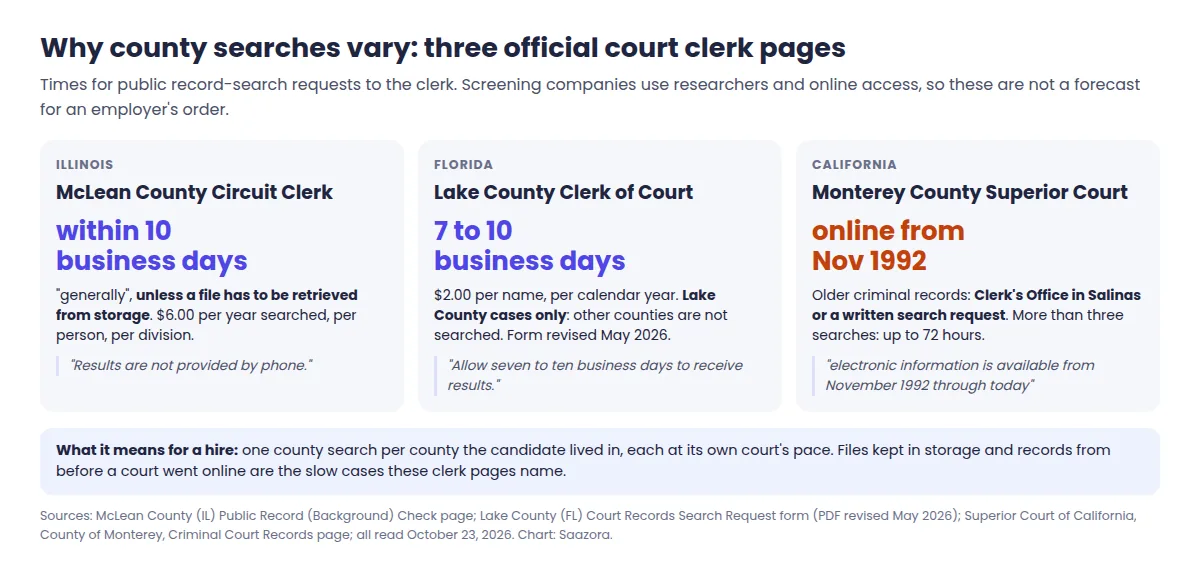
A county criminal search looks at the records of one county's court, and counties do not share one system. Checkr's guide says county searches take longer when "the court required manual retrieval by a court researcher", while state searches are "typically faster due to digitized records." Three official court pages we read on October 23, 2026 show what that means when a member of the public asks:
- McLean County, Illinois (Circuit Clerk): "Record checks are generally completed within 10 business days, unless a file has to be retrieved from storage." The fee is $6.00 per year searched, per person, per division.
- Lake County, Florida (Clerk of Court, request form revised May 2026): "Allow seven to ten business days to receive results," at $2.00 per name per calendar year, and only Lake County cases are searched.
- Monterey County, California (Superior Court): electronic criminal information runs "from November 1992 through today"; anything older means the Clerk's Office in Salinas or a written search request, and more than three searches can take "up to 72 hours".
These are public mail and counter requests, not the route a screening company takes, so they are not a forecast for an employer's order; Checkr's own wording for its county searches is "usually" one to five business days. But the clerk pages explain the "can take longer" part of that sentence: old files in storage, records from before a court went digital, and a search that must be repeated for each name or alias. A candidate who has lived in four counties means four separate searches, and each runs at its own court's speed.
Drug tests, driving records and verifications run on other people's systems
Beyond the court search, most delays sit with a third party the screening company cannot hurry.
Drug tests. The clock starts when the candidate visits the collection site, not when you order. Quest Diagnostics' urine testing FAQ says negative lab screens are "often released within 24 hours" and non-negative screens "typically released within an additional 24 to 72 hours", because those go through confirmation and review by a Medical Review Officer. That FAQ is dated March 2018, so treat it as the lab's own description, not a current guarantee; Checkr's guide gives a wider "3-10 days (lab-based)". Onsite instant cups are faster ("10 minutes (onsite)" per Checkr), and Checkr's pricing page notes a $90 fee for tests at expanded-hours clinics on weekday evenings or weekends. The full fee picture is in what screening costs a small business per hire.
Driving records. State DMVs hold the record. California lets a driver print their own record online with a MyDMV account; employers pull it through a screening company, which Checkr says "typically" returns within 24 to 48 hours. State fees and rules differ widely, which we cover in our state-by-state guide to MVR checks for drivers.
Employment and education verification. Fast when a database already has the answer: payroll connections for jobs, the National Student Clearinghouse for degrees. Slow when a person has to reply. Checkr's education page says that when the Clearinghouse must contact the school, "the volume of pending requests and how promptly the school replies to requests will impact the turnaround time." Small employers, closed businesses and foreign schools are the usual reason a verification sits at "pending".
What slows a background check down, and who can fix it
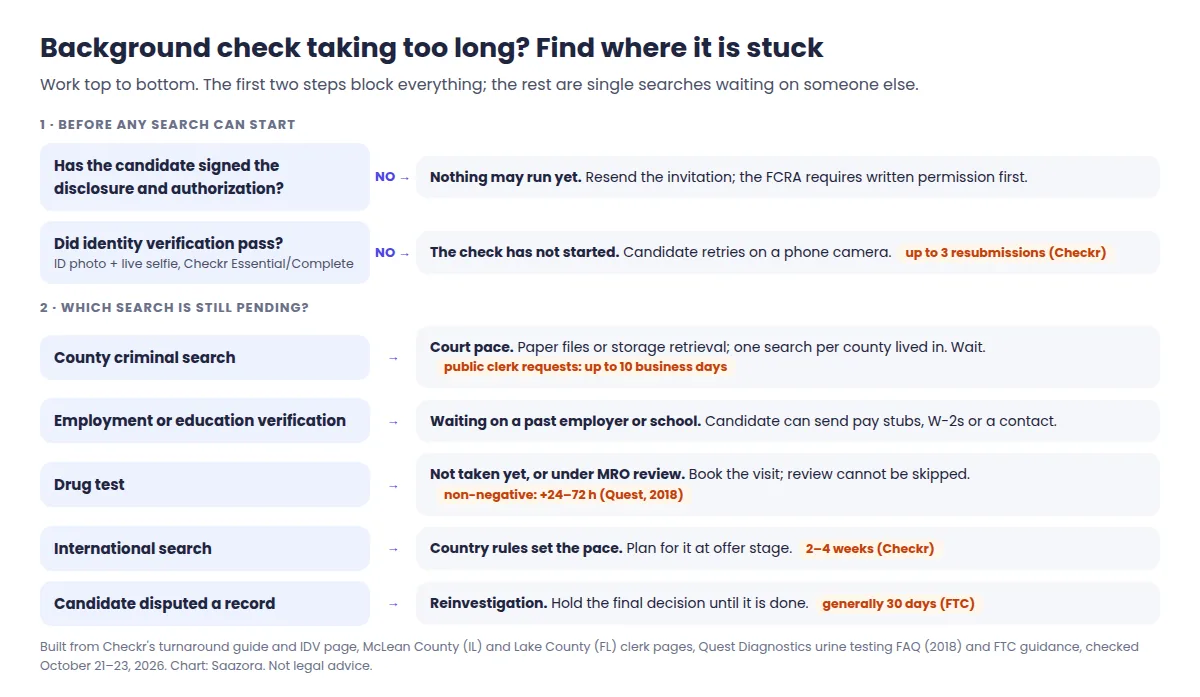
Most delays are one of a short list. The useful question is who can move each one.
| Cause | Step it holds up | Who can fix it | What the sources say |
|---|---|---|---|
| Candidate has not signed the disclosure and authorization | Everything; nothing may start | Candidate, with an employer reminder | FCRA requires written permission first; Checkr lists slow candidate replies as a delay factor |
| Identity verification failed or unfinished | Everything on Essential and Complete | Candidate (up to three resubmissions) | Checkr: "Failed or incomplete verifications prevent a background check from starting" |
| Typo in date of birth, missing alias or maiden name | Criminal searches, verifications | Candidate | Checkr: errors "like transposed digits in your birth date, can lead to mismatches and delays" |
| Court without online records, or file in storage | County criminal search | No one; wait | McLean County: about 10 business days "unless a file has to be retrieved from storage" |
| Many past addresses | County criminal search (one per county) | No one; plan for it | Each county search runs at that court's pace |
| Past employer or school does not reply | Employment / education verification | Candidate can supply pay stubs, W-2s or contact details | Checkr: manual employment checks "2-7 days"; school reply speed affects education checks |
| Drug test not taken yet, or non-negative result | Drug screen | Candidate books the visit; MRO review cannot be skipped | Quest (2018): non-negatives take an additional 24 to 72 hours |
| Candidate lived or studied abroad | International search | No one; plan for it | Checkr: "2-4 weeks" |
| Candidate disputes a record | Final decision | Screening company reinvestigates | FTC: the company generally must investigate and report back "within 30 days" |
The identity check that now comes first
Identity verification changes the order of events. Checkr's pricing page, read October 23, 2026, lists identity verification as included in Essential ($59.99 per report) and Complete ($94.99), and as a $4.99 add-on for Basic ($29.99), all before pass-through fees. Checkr describes it as "a quick document and liveness check before the background check starts": the candidate photographs a government ID and takes a live selfie on a phone.
For timing, that has two effects. On the good side, Checkr says candidates can finish it "in roughly two minutes", with "up to three resubmission attempts" for problems like blurry photos. On the other side, "failed or incomplete verifications prevent a background check from starting." A candidate who opens the invitation on a laptop with no camera, or never finishes the selfie, has a check that has not begun, even though the employer ordered it days ago. If an order looks stuck at the very start, this is the first place to look. Which package includes what is broken down in Checkr's package prices and pass-through fees.
The clock after the report: waiting periods before a final "no"
A report that comes back clean ends the process. A report that may lead you to withdraw an offer starts a second clock, because the FCRA requires a pre-adverse action notice, with a copy of the report and the CFPB's Summary of Rights, before a final decision. The law gives no fixed number of days, so the wait comes from guidance, contract terms and local law:
| Rule or guidance | Minimum wait before final adverse action | Source (checked) |
|---|---|---|
| Federal FCRA | No number in the statute; a 1997 FTC staff letter said "the five day period that you proposed appears reasonable" (staff opinion, "not binding on the Commission") | FTC advisory opinion to Weisberg, June 27, 1997 (read Oct 21, 2026) |
| Checkr's adverse action guide | "7 calendar days is generally considered an adequate waiting period", adding that "some states and jurisdictions impose longer waiting periods" | Checkr blog, basics of adverse action (Oct 21, 2026) |
| New York City Fair Chance Act | "at least five business days from receipt of the inquiry and analysis" | NYC Commission on Human Rights guidance (Oct 21, 2026) |
| California Fair Chance Act | At least five business days from receipt of the notice, and at least ten days if the job seeker is challenging the accuracy of the report; mailed notices count as received five calendar days after mailing | California Civil Rights Department fact sheet, June 2025 (Oct 21, 2026) |
| Massachusetts records (Checkr customer terms) | Customers certify they will wait "at least five (5) business days before taking final adverse action" | Checkr customer agreement, CORI section (Oct 21, 2026) |
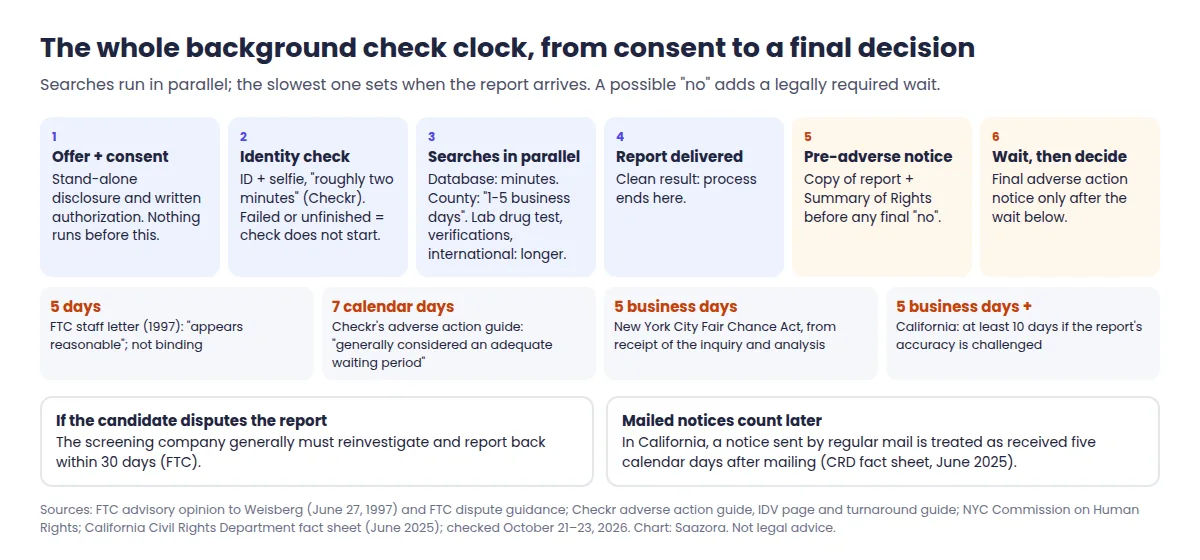
In practice this means a check whose report arrives in three days can turn into two weeks or more when a record is found and the candidate responds. If the candidate disputes the report, the screening company generally has 30 days to reinvestigate, according to the FTC. Build that into start dates for roles where records are common, and never shorten the wait to fill a shift. This is not legal advice; local fair-chance laws change, and a lawyer should confirm the rule where you hire.
Tips for candidates: how to get through faster
- Open the invitation the day it arrives, on a phone. Nothing starts until you sign, and the ID check needs a camera.
- Type your details carefully and list every name you have used: maiden names, nicknames, hyphenated versions. Checkr's guide names transposed birth-date digits as a common cause of delay.
- Have paperwork ready for jobs at small or closed employers (pay stubs, W-2s, an offer letter) and for degrees from schools outside the US.
- Book the drug test right away, during normal clinic hours.
- Check yourself first if you expect a record to come up, so you can correct errors before an employer sees them. Our guide to running a background check on yourself covers the official routes, from FBI fingerprints to state record reviews.
- Use the candidate portal. Checkr says its portal "provides an estimated completion time and status updates", which is a better guide than any general average.
Tips for employers: shortening time-to-clear without skipping steps
- Send the invitation the same day as the conditional offer, and tell the candidate what the ID check needs.
- Order only the searches the role needs. Each extra verification or test adds a possible slow step. A warehouse role and a finance role should not share one package by default.
- Ask about past addresses and foreign study up front, so a long international search is a known date, not a surprise.
- Plan for the adverse action wait before setting a start date, and make sure the notices are ready to send. Checkr can send them on your behalf.
- Do not let someone start while results are pending in a role your own policy says needs a cleared check.
For the compliance tools, contract terms and limits behind those steps, read our Checkr review built from its public terms. Current plans and billing notes are on Saazora's Checkr page with pricing details. If you want to see the candidate status page and package choices yourself, you can open a pay-as-you-go Checkr account (affiliate link); Checkr says it has no contracts or minimums, and your first order still follows the consent steps above.
Background check timing questions
How long does a background check take for a job offer?
It depends on the package. Checkr's own guide says checks through a screening company "typically take three to five days" on average and its FAQ says "one to five business days", with timing depending on the searches, the courts and the candidate's replies. Add a lab drug test, many past addresses or an international search, and expect longer.
Does no news after a week mean I failed?
No. A long wait usually means a search is pending at a court, a past employer or a lab. If an employer plans to reject you because of the report, the FCRA says they must first send you a pre-adverse action notice with a copy of the report and a summary of your rights.
Why is my background check stuck on "pending"?
Most often one county court search, an employment or education verification waiting on a reply, or an unfinished step on your side such as the consent form, identity check or drug test. The candidate portal or the employer can usually tell you which item is still open.
Is a background check faster if I run one on myself first?
Not directly: the employer still has to run its own check with your consent. But knowing your records lets you fix errors early and gives the employer the right names and addresses, which removes common causes of delay.
How this guide was researched
On October 21 to 23, 2026 we read Checkr's turnaround guide (dated modified September 22, 2026), its small business, identity verification, employment verification, education verification, criminal background check and pricing pages, its adverse action guide and its customer agreement; the FBI's eDO site; the McLean County Circuit Clerk, Lake County Clerk of Court and Monterey County Superior Court record-search pages; Quest Diagnostics' urine drug testing FAQ (March 2018); the National Student Clearinghouse business verification page; the California DMV driver record page; the FTC's employer guidance, its 1997 Weisberg staff opinion and its dispute guidance; and the New York City and California fair-chance guidance. We also read the top-ranking pages for this search. Every time in this guide is quoted from the organization that states it, with its conditions; Saazora did not measure any turnaround, and we do not rate any company's speed or accuracy.
Sources (checked October 21–23, 2026): Checkr, How Long Do Background Checks Take? (updated September 22, 2026), small business, identity verification, employment verification, education verification and pricing pages, basics of adverse action, customer agreement; FBI CJIS, Electronic Departmental Order (eDO); McLean County Circuit Clerk, Public Record (Background) Check; Lake County Clerk of Court (FL), Court Records Search Request form; Superior Court of California, County of Monterey, Criminal Court Records; Quest Diagnostics, Frequently Asked Questions: Urine Drug Testing (March 2018); National Student Clearinghouse, Business Verifications; California DMV, Driver's Record Request; FTC, Using Consumer Reports: What Employers Need to Know, and advisory opinion to Weisberg (June 27, 1997); NYC Commission on Human Rights, Fair Chance Act; California Civil Rights Department, Fair Chance Act and fact sheet (June 2025).
Research guide, not hands-on testing and not legal advice. Checkr did not pay for or review this article.