
Research guide built from public pages, not a hands-on test: Saazora did not order a Checkr report, enroll workers in monitoring or run a license lookup for a real hire · Checkr prices read on checkr.com/pricing on October 23, 2026 (unchanged from a copy saved October 22) · FTC, CFPB, EEOC and state licensing board pages checked October 23, 2026 · This is not legal advice; for worker classification or a specific state's screening rules, talk to an employment lawyer · We may earn a commission if you sign up through links on this page.
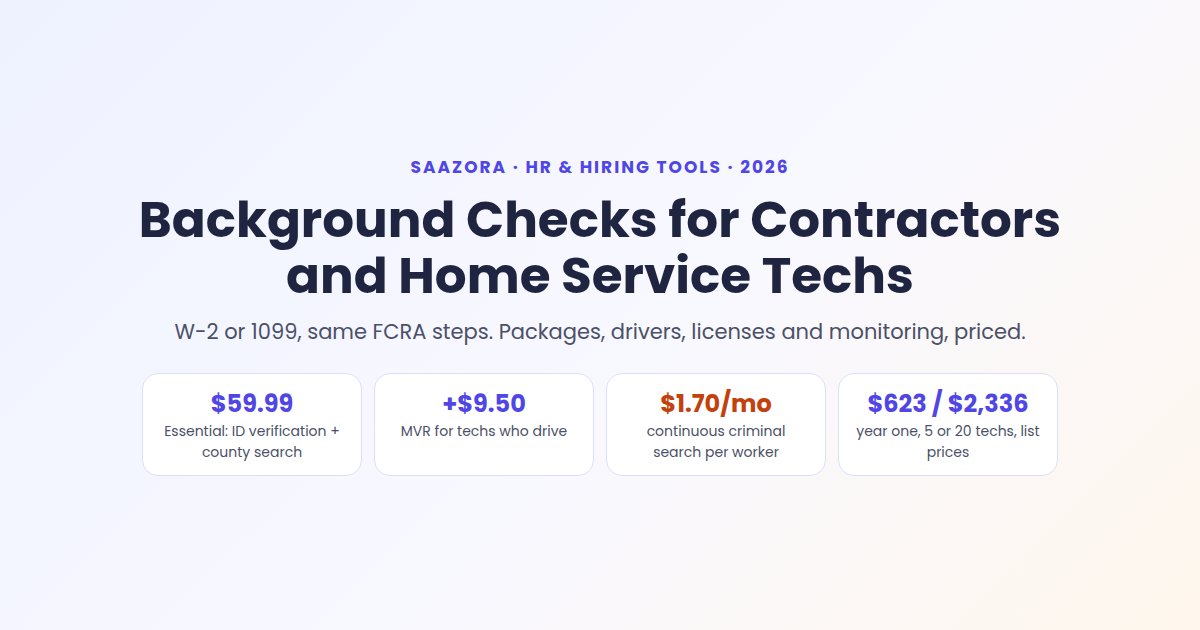
A background check for contractors who go into customers' homes, in short: use the same Fair Credit Reporting Act (FCRA) steps for a 1099 contractor as for a W-2 employee, because the FTC's staff has long treated consumer reports on independent workers as "employment purposes". For most HVAC, plumbing, cleaning, pest and handyman techs, Checkr's Essential package ($59.99 per report, with identity verification and unlimited county criminal searches) is the realistic floor; add a $9.50 motor vehicle record for anyone who drives a company van, verify trade licenses on the state board's free search, and decide whether $1.70 a month per worker for Checkr's continuous criminal search beats a yearly re-run. At list prices, that adds up to about $623 in year one for a 5-tech company and about $2,336 for a 20-tech company, before court and DMV fees.
The stakes are different from office hiring. Your tech is alone in a stranger's kitchen, garage or bedroom, often with the homeowner's kids or an elderly parent nearby, and the customer judges your company by that one visit. This guide is for the owner or office manager who has to set a screening rule for a field crew: what changes (and what does not) when the worker is a 1099 contractor, which package fits which role, how to handle drivers and licensed trades, what monitoring after hire costs, and what the whole program costs at two company sizes. If you have never ordered a check before, read our eight-step guide to the employer side of a background check first; this page builds on it for field crews, and the rest of our screening research lives in Saazora's HR and hiring tools section.
W-2 tech or 1099 contractor: the FCRA steps are the same
The short answer: if a screening company supplies the report, follow the full FCRA process for both. Many home service businesses mix W-2 techs with 1099 subcontractors, especially in cleaning, handyman work and seasonal HVAC. It is tempting to treat the contractor check as a "business" check with fewer steps. The FTC's staff has rejected that reading for a long time:
- The 1998 Allison letter. Asked whether a company with "a bona fide independent contractor relationship" could skip the employment rules, FTC staff concluded that a trucking operation's use of consumer reports on independent drivers was for "employment purposes" under section 603(h) of the FCRA, which "should be interpreted liberally to effectuate the broad remedial purpose of the Act." The letter is an informal staff opinion, not binding on the Commission.
- The FTC's 2011 staff report. In 40 Years of Experience with the Fair Credit Reporting Act (July 2011), the commentary on section 603(h) has a heading for independent contractors, agents and volunteers, and says the term includes "a trucking company that obtains consumer reports on individual drivers who own and operate their own equipment."
Courts have not all agreed. A 2019 summary by the law firm Farella Braun + Martel lists federal district courts in Wisconsin (2012), Ohio (2015) and Iowa (2018) that read the employment rules as covering only employees, and a California court (2014) that did not limit the pre-adverse action notice to employers. For a small service company, that split is a reason to do more, not less: running the same steps for everyone costs nothing extra and removes the question.
What "the same steps" means, in the words of the federal agencies:
- A stand-alone disclosure. The joint EEOC–FTC guide says that when you "run background checks through a company in the business of compiling background information", you must first tell the person you might use the information, and "this notice must be in writing and in a stand-alone format." It cannot sit inside your application or your subcontractor agreement.
- Written permission. The CFPB's A Summary of Your Rights Under the Fair Credit Reporting Act, the form you will hand out later, states it from the worker's side: "A consumer reporting agency may not give out information about you to your employer, or a potential employer, without your written consent given to the employer."
- Pre-adverse action. Before you drop someone because of the report, give "a notice that includes a copy of the consumer report you relied on" and the CFPB summary of rights, and give the person time to respond.
- Adverse action notice. Then send the final notice with the screening company's contact details, a statement that the company did not make the decision, and the person's right to a free copy of the report within 60 days, per the FTC's employer guide.
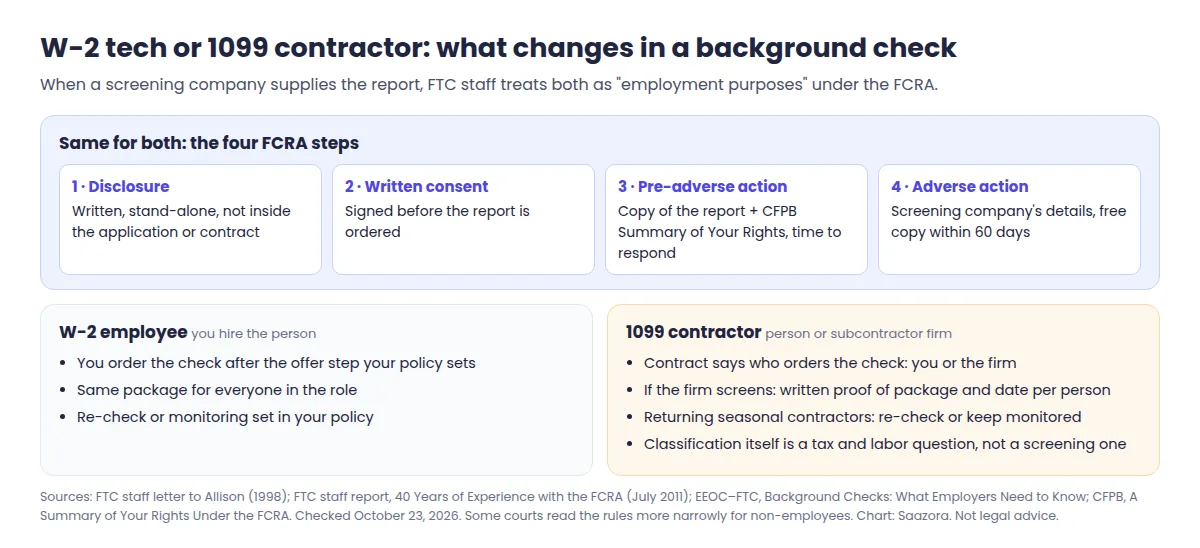
What does change with 1099 workers is the paperwork around the check, not the check itself:
- Who orders it. If you contract with a cleaning or handyman company rather than an individual, decide in the contract whether that company screens its own crew or you screen each person who will enter your customers' homes. If they screen, ask for written confirmation of the package and the date for each person.
- When it is re-run. Contractors come and go between seasons. Write down whether a returning contractor is re-checked or kept under monitoring between jobs.
- Classification is a separate question. Whether someone is truly a contractor is decided by tax and labor rules, not by your screening policy. Treating both groups the same for screening does not decide it either way.
One limit on scope: a free license lookup you run yourself on a state website is not a report from "a company in the business of compiling background information". The EEOC's rule still applies to it, though: "any background information you receive from any source must not be used to discriminate in violation of federal law." Apply the same rule to every applicant for the same role. Some states and cities also have fair-chance or "ban-the-box" laws that limit when you may ask about criminal records; check the rules where you operate before you set the order of your hiring steps.
Matching the check to the job: a role-by-role package map
Start with what the role does, then pick the package. Checkr's three self-serve packages, as listed on its pricing page on October 23, 2026:
| Package | Price per report | Included searches | Fit for in-home techs |
|---|---|---|---|
| Basic | $29.99 | SSN trace, sex offender registry, global watchlist search, national criminal search | Thin for in-home work: no identity verification and no county court search |
| Essential | $59.99 | Identity verification, SSN trace, sex offender registry, global watchlist, national criminal search, unlimited county criminal search | The realistic floor for anyone entering homes |
| Complete | $94.99 | Everything in Essential plus unlimited state criminal search and federal criminal search | Roles with keys, alarm codes or unsupervised long jobs, or where a client contract asks for state and federal searches |
Source: checkr.com/pricing, read October 23, 2026. Prices are "starting from" list prices; court and database access fees are passed through at cost, with no markup, per Checkr. "Fit" column is Saazora's assessment, not Checkr's.
Identity verification is now listed first in both Essential and Complete. Checkr describes it as combining "secure document review, live selfie verification, and device and location validation to reduce impersonation and hiring fraud", and sells it as a $4.99 add-on to Basic. For a business whose tech arrives at a stranger's door, confirming that the person who passed the check is the person in the van matters more than in most office hiring. Basic plus identity verification ($34.98) still has no county court search, which is where many criminal records actually sit; that gap is why we treat Essential as the floor. Saazora's fee-by-fee look at Checkr's packages and passthrough costs covers the court fees in detail.
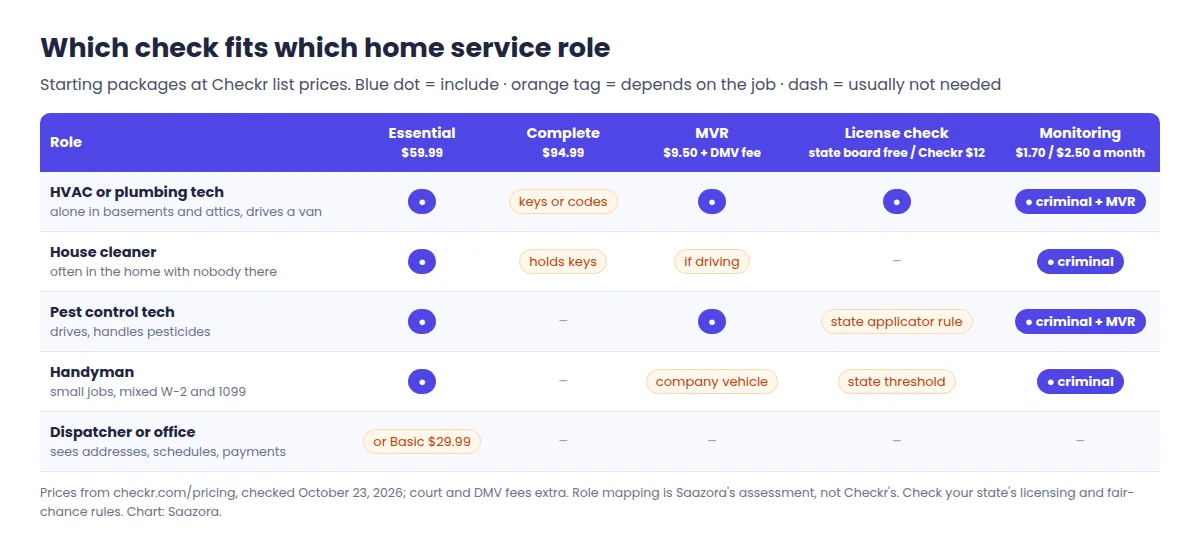
How the map works, role by role:
- HVAC and plumbing techs. Essential, plus an MVR if they drive, plus a license check for anyone working under their own trade license. These techs are often alone in basements and attics for hours.
- House cleaners. Essential. Cleaners are often in the home while nobody is there and may hold keys or door codes; if that is your model, consider Complete.
- Pest control techs. Essential plus an MVR. Pest applicators are commonly licensed by a state agency, but we did not verify a specific state's rule for this guide, so check with your state's agriculture or pesticide regulator.
- Handymen. Essential, plus an MVR if they use a company vehicle. In California, small handyman jobs have a licensing exemption, covered in the license section below.
- Dispatchers and office staff. They never enter homes but may see customer addresses, schedules and payment details. Basic or Essential, depending on that access.
Drug testing is a separate decision. Checkr lists clinic-based tests from $60 and random-program tests from $10 per test plus a $10 per-test fee; whether you test is a policy call that depends on your insurance, client contracts and state law, so it is left out of the cost model below.
Drivers in company vans: adding the motor vehicle record
If the tech drives a company vehicle, the criminal check does not tell you whether they can legally drive it. Checkr's MVR report, $9.50 per check plus state DMV fees passed through at cost, confirms license status and class and shows driving incidents. Our guide to MVR checks, state DMV fees and FMCSA rules for drivers lists the fee in every state and explains when a heavier truck brings federal rules into play.
Two practical points for service fleets:
- Techs who drive their own trucks. If a 1099 contractor drives their own vehicle to jobs, decide whether driving is part of the work you are contracting for. If you require it, screen it the same way, with the same FCRA steps.
- Drivers change after hire. A clean record on day one says nothing about a suspension in month eight. That is what the monitoring section below is for.
Trade licenses: what California, Texas and Florida let you look up for free
A criminal check and a trade license answer different questions: one is about the person's record, the other about whether they may legally do the work. Every state sets its own license rules, and the cheapest check is often the state board's own public search. Three examples, each read on the official state site on October 23, 2026:
| California (CSLB) | Texas (TDLR and TSBPE) | Florida (DBPR) | |
|---|---|---|---|
| Who regulates the trades | Contractors State License Board; HVAC is classification C-20 (Warm-Air Heating, Ventilating and Air-Conditioning), plumbing C-36, electrical C-10 | TDLR licenses air conditioning and refrigeration (ACR) contractors and registers or certifies technicians; the State Board of Plumbing Examiners licenses plumbers | Construction Industry Licensing Board; includes Class A and Class B air conditioning contractors and plumbing contractors |
| Rule worth knowing | Since January 1, 2025, jobs up to $1,000 need no license if no building permit is needed and no employees are involved; any contractor with employees must be licensed regardless of job size | Anyone who installs, repairs or maintains AC, refrigeration or heating systems needs a TDLR license, and ACR companies must employ an ACR contractor at each permanent location | A "certified" contractor (license code starting with C) may work anywhere in the state; a "registered" contractor (code starting with R) only in the local jurisdictions where registered |
| Free lookup | "Check a License or HIS Registration" on cslb.ca.gov | TDLR "Search Licenses" (contractor, registered technician, certified technician); TSBPE "Public License Search" (master, journeyman, tradesman, apprentice) | "Verify a Licensee" on myfloridalicense.com, by name, license number, city or county |
Sources: CSLB "Hire a Licensed Contractor" and License Classifications pages and the CSLB California Licensed Contractor newsletter, Winter 2025 (AB 2622); TDLR Air Conditioning and Refrigeration Contractors homepage; Texas State Board of Plumbing Examiners homepage; Florida DBPR Construction Industry page and License Search. All read October 23, 2026. Rules change; confirm on the board's site.
What this means for screening:
- Look it up yourself first. The state searches above are free and show whether a license is active. Save a dated screenshot or PDF in the worker's file.
- Match the license to the role. In Texas, an apprentice plumber and a responsible master plumber are different licenses; a Florida registered contractor may not be able to pull work in the next county. Check the type and the area, not just "licensed: yes".
- Checkr's option. Checkr sells professional license verification at $12 per check and says it "validates that your candidate's license is active (i.e., not expired), is in good standing, and matches the name of the candidate." The examples it lists for contractors name professional engineers; it does not list HVAC or plumbing licenses by state, so ask Checkr whether your trade and state are covered before you rely on it.
- Cleaning and handyman crews. House cleaning does not appear in the trade classifications we read, so for those crews the criminal check and identity verification carry most of the screening. Check city and county business license rules too.
After the hire: Checkr's Continuous Checks versus a yearly re-run
A background check is a snapshot. Checkr makes the point itself on its Continuous Checks page: "Once a background check is complete, the results are frozen in time." For a crew that keeps going into homes for years, the choice is between re-running the package on a schedule and paying for monitoring.
In Checkr's own words, Continuous Checks "run in the background and notify you of reportable changes to your workers' records in real time", covering both criminal records and driving records. The page describes what the criminal side watches: arrest data that Checkr says is "verified at the county level before reporting"; an electronic county search every 30 days "for workers with a current address in a county with electronic records"; a national database search every 30 days, with new hits verified by a county search; sex offender registries every 30 days; and a monthly global watchlist screen. When a change is found, Checkr "automatically generates a new report" for your review. Checkr describes the service as "designed for FCRA-compliant workflows", so a hit still goes through the same pre-adverse and adverse action steps.
On the driving side, Continuous MVR is $2.50 per enrolled driver per month. Checkr notes that "some states also charge enrollment or annual fees", that a triggered report is billed at standard MVR rates plus state fees, and that it handles state enrollment forms for California, Colorado, New Hampshire and Utah. Its page lists violation monitoring in 49 states, license-status monitoring in 42 and accident monitoring in 24, so coverage depends on where your drivers are licensed.
The list-price comparison, per worker per year:
| Approach | Criminal side | Driving side | What you get |
|---|---|---|---|
| Yearly re-run | Essential again: $59.99 | One MVR: $9.50 + DMV fee | A fresh, complete report once a year; nothing in between |
| Checkr monitoring | Continuous criminal search: $1.70 × 12 = $20.40 | Continuous MVR: $2.50 × 12 = $30.00, plus triggered reports and any state fees | Alerts on reportable changes during the year, on the schedule Checkr describes |
Checkr list prices from checkr.com/pricing and its Continuous Checks page, read October 23, 2026. Checkr prices scheduled rechecks at "the price of the package" plus passthrough fees. Totals are Saazora calculations.
The two sides point in opposite directions. On the criminal side, monitoring costs about a third of a yearly Essential re-run. On the driving side, one yearly MVR pull is cheaper on list price than a year of Continuous MVR; what you pay for is learning about a suspension in month three instead of month twelve. They are also not the same product: monitoring watches for changes against the sources Checkr lists, while a re-run repeats every search in the package. Some owners pair monitoring with a full re-run every few years. For a wider view of the company, see our research review of Checkr for small employers.
What screening costs a 5-tech and a 20-tech company in year one
Two example companies, priced from Checkr's list prices on October 23, 2026. Assumptions: every tech gets Essential; techs who drive get an MVR at hire and Continuous MVR; licensed techs get Checkr's license verification; everyone is enrolled in continuous criminal search for 12 months. Court, DMV and state enrollment fees are extra and vary by location, so they are left out.
| Line item | Unit price | 5-tech company (5 drive, 2 licensed) | 20-tech company (16 drive, 8 licensed) |
|---|---|---|---|
| Essential package at hire | $59.99 | 5 × = $299.95 | 20 × = $1,199.80 |
| MVR report at hire | $9.50 | 5 × = $47.50 | 16 × = $152.00 |
| Professional license verification | $12.00 | 2 × = $24.00 | 8 × = $96.00 |
| Continuous criminal search, 12 months | $1.70/month | 5 × 12 = $102.00 | 20 × 12 = $408.00 |
| Continuous MVR, 12 months | $2.50/month | 5 × 12 = $150.00 | 16 × 12 = $480.00 |
| Year-one total (list prices) | $623.45 | $2,335.80 | |
| Per tech | $124.69 | $116.79 | |
| Same team with a yearly re-run instead of monitoring | $718.90 | $2,799.60 | |
| Each replacement hire (Essential + MVR; + $12 if licensed) | $69.49 / $81.49 | $69.49 / $81.49 |
Unit prices from checkr.com/pricing, checked October 23, 2026. "Yearly re-run" = the at-hire items plus a second Essential and MVR at month 12, in place of 12 months of monitoring. Excludes pass-through court and DMV fees, state Continuous MVR enrollment fees, MVRs triggered by monitoring and drug tests. Totals are Saazora calculations.
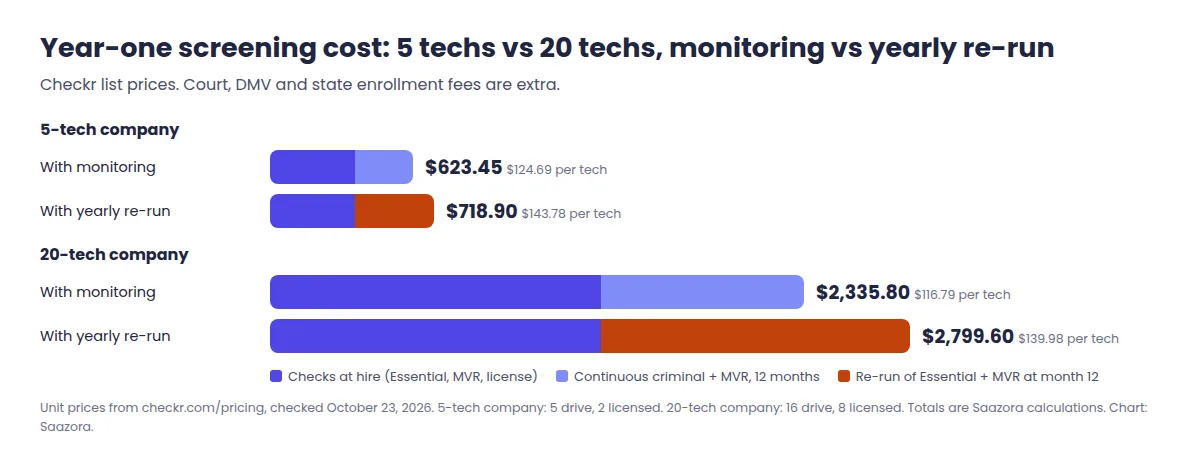
Reading the table:
- Monitoring is the cheaper year-one setup at both sizes, by $95.45 for 5 techs and $463.80 for 20, because the criminal-side saving outweighs the higher driving-side cost.
- Turnover is the hidden line. Field crews turn over, and every replacement adds $69.49 to $81.49 at list price before court fees. Budget for your real turnover, not your headcount.
- Complete instead of Essential adds $35.00 per report: $175 for the 5-tech team and $700 for the 20-tech team at hire.
- Pass-through fees can be real money. Checkr shows a $22 fee for Pennsylvania's PATCH state database as one example; county fees depend on where each tech has lived.
For how these numbers compare with other providers, see small-business background check prices across four providers. When you are ready to price your own crew, you can set up a pay-as-you-go Checkr account for your field team (affiliate link); Checkr's pricing page bills the self-serve packages pay-as-you-go, per report.
Background check for contractors and techs: a ten-step rollout
Here is the order we would put a background check for contractors and W-2 techs into practice at a small service company. It follows the federal steps above; your state may add more.
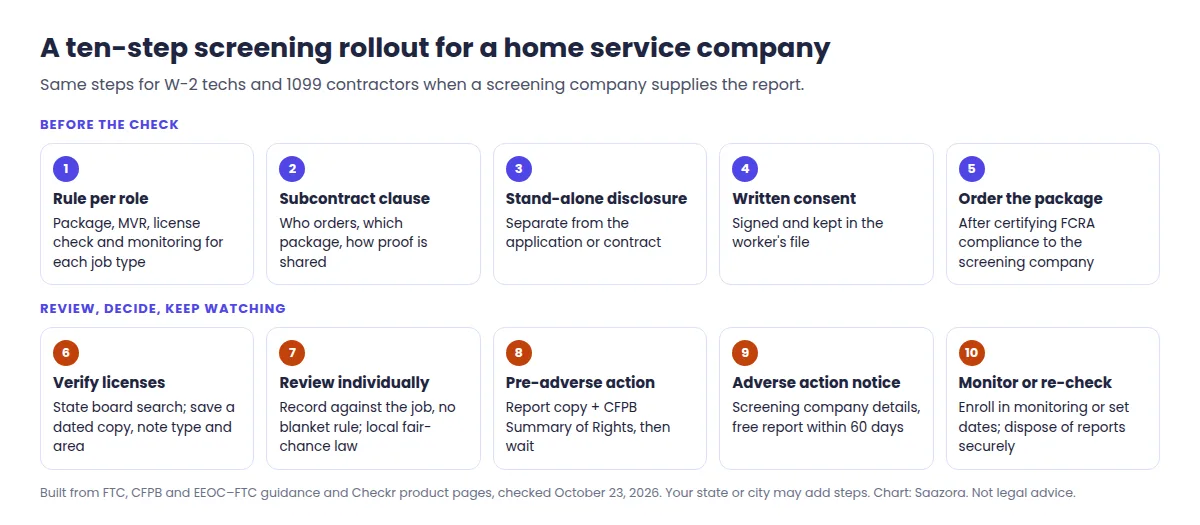
- Write one rule per role (tech who drives, tech who does not, cleaner, office) naming the package, MVR, license check and monitoring. Apply it to every applicant for that role, W-2 or 1099.
- Add a screening clause to subcontractor agreements saying who orders the check, which package, and how proof is shared.
- Send a stand-alone disclosure, separate from the application or contract.
- Get written permission, and keep it with the worker's file.
- Order the package through the screening company after you have certified you followed the FCRA steps.
- Verify trade licenses on the state board's search and save a dated copy; note the license type and area.
- Review each record against the job, not a blanket rule, and in line with any local fair-chance law.
- Pre-adverse action: send the report copy and the CFPB summary of rights, and wait before deciding.
- Adverse action notice with the screening company's details and the 60-day free-report right.
- Enroll in monitoring or set re-check dates, and store reports securely; when you no longer need them, the EEOC–FTC guide says to dispose of them "securely".
Saazora's Checkr page with current billing terms keeps the package list in one place. Keep each tech's screening and re-check dates where the office already plans the week; if you are still choosing field service software for that, our Housecall Pro trial and deals page lists its current terms. The same customers who trust your tech at the door usually found you by phone, which is where call tracking for service companies comes in. To start screening the crew, order your first Checkr report (affiliate link).
Questions home service owners ask about screening techs
Do I need consent to background check a 1099 contractor?
If you buy the report from a screening company, treat the answer as yes. FTC staff has said consumer reports on independent workers are for "employment purposes" under the FCRA, which means a stand-alone disclosure and written permission first. Some courts have read the rule more narrowly, but following it costs you nothing.
Can a subcontractor company's own background check replace mine?
It can, if your contract says which package they run and how they prove it for each person who will enter your customers' homes. Without that clause, you are trusting a check you have never seen.
Is a state license lookup a background check under the FCRA?
A free lookup you run yourself on the state board's site is not a report bought from a company that compiles background information, so the FCRA consent steps for consumer reports do not attach to it. Federal nondiscrimination rules still apply to how you use it. A license verification ordered through Checkr is part of a consumer report, so it follows the FCRA steps.
How often should I re-check techs who are already working?
There is no single federal schedule for home services. The choice is a yearly re-run (about $59.99 per worker for Essential at list price) or monitoring (Checkr's continuous criminal search at $1.70 per worker per month), plus Continuous MVR or a yearly MVR pull for drivers. Client contracts and insurers sometimes set the schedule for you.
How this guide was researched
On October 23, 2026 we read checkr.com/pricing (text identical to a copy saved October 22), Checkr's Continuous Checks, professional license verification and passthrough fee pages; the FTC staff opinion letter to Herman L. Allison (February 23, 1998), the FTC's July 2011 staff report on the FCRA and its employer guide Using Consumer Reports: What Employers Need to Know; the joint EEOC–FTC guide Background Checks: What Employers Need to Know; the CFPB's A Summary of Your Rights Under the Fair Credit Reporting Act; a 2019 Farella Braun + Martel summary of court decisions on contractors; and the licensing pages of California's CSLB, Texas TDLR and TSBPE, and Florida DBPR. We also read the top-ranking pages for this search; none priced a screening program for a service company. Saazora did not order any reports, and we do not rate any company's speed or accuracy.
Sources (checked October 23, 2026): Checkr pricing, Continuous Checks and professional license verification pages; FTC, staff opinion letter to Allison (1998) and 40 Years of Experience with the Fair Credit Reporting Act (July 2011), cited as text; FTC, Using Consumer Reports: What Employers Need to Know; EEOC and FTC, Background Checks: What Employers Need to Know; CFPB, A Summary of Your Rights Under the Fair Credit Reporting Act; Farella Braun + Martel, "Are You Background Checking Your Contractors? If So, Exercise Caution" (June 12, 2019); CSLB, Hire a Licensed Contractor and CSLB newsletter, Winter 2025; TDLR, Air Conditioning and Refrigeration Contractors; Texas State Board of Plumbing Examiners; Florida DBPR, Construction Industry.
Research guide, not hands-on testing and not legal advice. Checkr did not pay for or review this article.