
Prices and vendor pages checked October 21, 2026 · Research-based guide built from CallRail's own pricing page, healthcare pages and help center, plus the WhatConverts and CallTrackingMetrics pricing pages, not hands-on testing · US list prices, local numbers · Not legal advice
Saazora may earn a commission if you sign up for CallRail through links on this page, at no extra cost to you. Links to WhatConverts and CallTrackingMetrics are plain links with no affiliate tag.
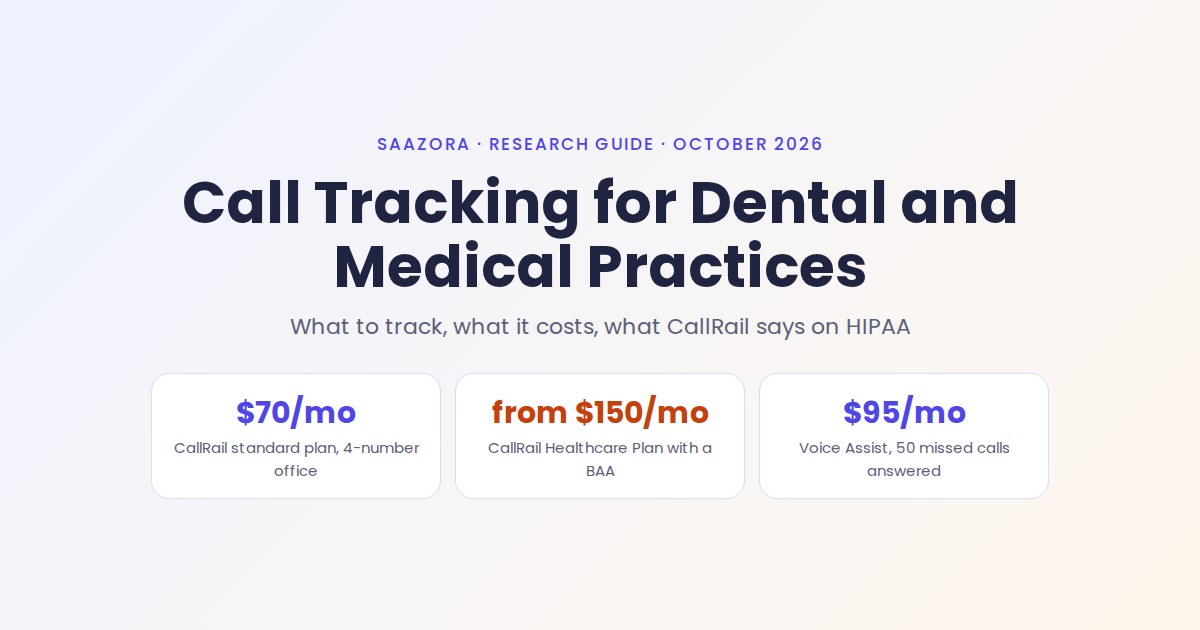
Call tracking for dentists comes down to one question the front desk cannot answer from memory: which ad, listing or mailer made the phone ring for a new patient, and what happened to that call. On CallRail's public price list, a single-location dental office with four tracking numbers and about 500 minutes of calls a month would pay $70 on monthly billing. The catch for healthcare is that CallRail's own pages say it signs a business associate agreement (BAA) only on its Healthcare Plans, and those "start at $150/month." So a practice that will put patient information into the tool should budget from the Healthcare Plan floor, not from the $55 headline.
This guide covers what a dental or medical practice should track (new-patient calls from Google Ads and Google Business Profile, missed calls, front-desk follow-up and booked appointments), what that costs at three practice sizes, the exact HIPAA wording on CallRail's pages, how two alternatives with HIPAA tiers compare, and the setup order that avoids rework. If you are comparing call trackers in general rather than for a practice, start with our ranked list of call tracking tools for small businesses.
What a dental or medical practice should track on every call
A practice needs four facts about each inbound call: the marketing source, whether a person answered, what the caller wanted, and whether an appointment followed. Most practices already know their total call count from the phone system. What they lack is the link between a call and the campaign that paid for it, and the list of calls nobody picked up.
- New-patient calls by source. Separate numbers for Google Ads, the Google Business Profile listing, Local Services Ads, the website's organic traffic and any print or mailer campaign. This is the number that decides next month's ad budget.
- Missed and abandoned calls. CallRail defines a missed call as "any unanswered inbound call that results in an automatically detected voicemail or is detected as abandoned." Its Unanswered Calls report breaks missed calls down by day of week and hour, which is the data a practice manager needs to move a lunch break or add phone cover.
- Front-desk follow-up. Whether someone called back or texted a missed caller, and how quickly. CallRail can send an automatic text when a call is missed (details in the missed-calls section below).
- Booked appointments. A call that books a cleaning is worth more than a call asking for directions. CallRail can match calls to bookings in a practice management system through its NexHealth integration, which comes with conditions covered further down.
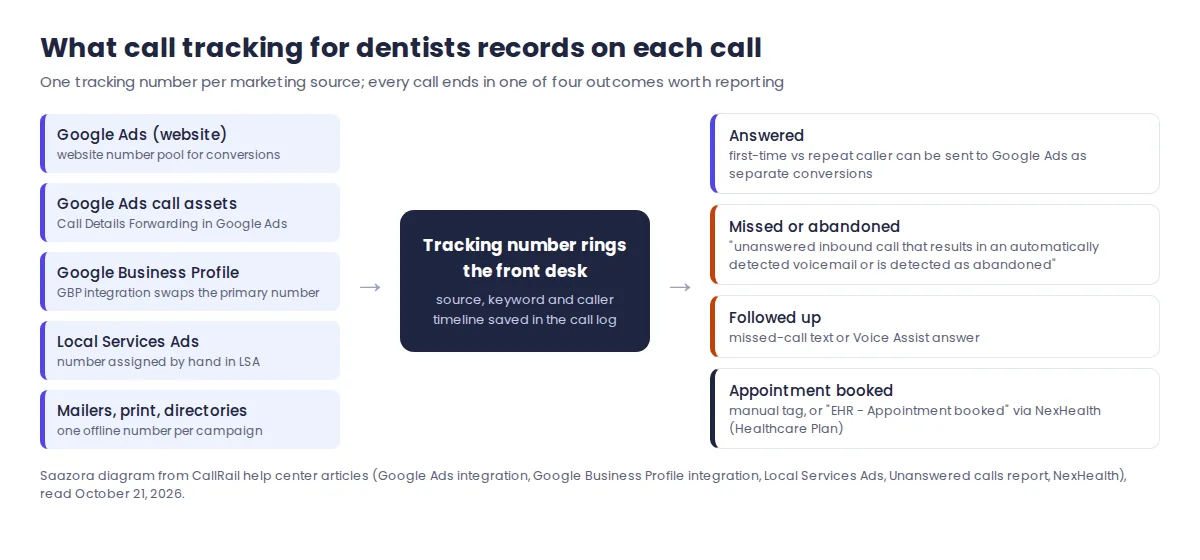
Mapping tracking numbers to a practice's marketing sources
A typical single-location practice needs four to six tracking numbers, one per source it wants to measure, and more only if it wants visitor-level detail for Google Ads keywords. The table maps each common dental marketing source to the way CallRail's help center says to track it.
| Marketing source | How CallRail tracks it (per its help center) | Numbers needed | Watch out for |
|---|---|---|---|
| Google Business Profile (Maps and local results) | The GBP integration "automatically swaps the primary phone number" on the listing with a tracking number and sets the real office number as a secondary number "to maintain NAP consistency." | 1 per location | If you also change the Ads location number, Google Ads must be edited separately; it does not refresh from GBP. |
| Google Ads clicks to the website | Dynamic number insertion on the website. The Google Ads integration reports calls as conversions, but CallRail says "only calls made to the website pool with a source of 'Google Ads' will report as a conversion." | A website pool (a single source number shows calls in CallRail only) | The integration needs CallRail's JavaScript snippet, visitor tracking and Google Ads auto-tagging. |
| Google Ads call assets (calls straight from the ad) | Uses Call Details Forwarding, which CallRail says "is separate from your main Google Ads integration." | Set up in Google Ads | Easy to miss: these calls never touch the website. |
| Local Services Ads | A dedicated number created as "Somewhere else" then "Google Local Services Ads." | 1 per LSA account | CallRail says LSAs "require a direct, manual number assignment" and this "cannot be done via CallRail's API." |
| Mailers, flyers, radio, insurance directories | An offline tracking number printed on that piece only. | 1 per campaign | Keep the number live after the campaign ends, since printed pieces stay in circulation. |
| Organic website visits | Dynamic number insertion shows a separate number to visitors arriving from search. | 1 | Test it with the DNI test steps in CallRail's help center after any website change or caching plugin update. |
Source: CallRail help center articles "Google Business Profile integration" (updated October 15, 2026), "Google Ads integration," "How to set up Google Local Services Ads with CallRail" and "Dynamic number insertion overview," read October 21, 2026.
A visitor-level pool (several numbers that rotate across website visitors) is what lets CallRail tie a call to the exact Google Ads keyword, and it is also what the Google Ads integration needs to send call conversions back: per CallRail, "Calls to source trackers won't report as conversions with this integration." The integration can also create separate "First Time Phone Call" and "Repeat Phone Call" conversion actions, the closest built-in proxy for new-patient calls. That is why the ten-number scenario below includes a pool. Our guide to Google Ads call conversion tracking walks through the Google side of that setup.
What call tracking for dentists costs at three practice sizes
On CallRail's standard Lead Tracking plans, the three practice sizes below cost $70, $105 and $215 a month on monthly billing. Those are the published prices. A practice that needs a BAA has to move to a Healthcare Plan, which CallRail says "start at $150/month," with usage priced by quote. The table puts both next to the two alternatives in this guide that state HIPAA support on their pricing pages.
| Practice size (Saazora assumption) | CallRail standard plan, monthly / yearly billing | CallRail Healthcare Plan | WhatConverts Pro (HIPAA listed) | CallTrackingMetrics Marketing Pro (HIPAA listed) |
|---|---|---|---|---|
| Single-location office: 4 numbers, 500 local minutes | $70 / $65 (Lead Tracking, 250 minutes included) | From $150 + usage by quote | $102.50 ($112.50 with transcription) | $207 ($177 a month yearly) |
| Practice with a Google Ads number pool: 10 numbers, 1,200 minutes | $105 / $95 (Lead Tracking, 1,000-minute tier) | From $150 + usage by quote | $149 ($173 with transcription) | $247 ($217 a month yearly) |
| Three-location group: 18 numbers, 3,000 minutes | $215 / $205 (Lead Tracking, 1,000-minute tier) | From $150 + usage by quote | $250 ($310 with transcription) | $335 ($305 a month yearly) |
Saazora calculation from each vendor's US pricing page, checked October 21, 2026. Local numbers and minutes only; toll-free numbers, texts and taxes excluded. CallRail's minute price "includes transcription." WhatConverts Pro is $100 a month with a $30 usage credit, then $2.50 per number, 4.5¢ per minute and 2¢ per transcribed minute. CTM Marketing Pro is $179 monthly or $149 yearly with no included usage, $2.00 per number and 4.0¢ per minute; its 3,000 included transcribed minutes "do not renew each month," then cost $0.02 a minute.
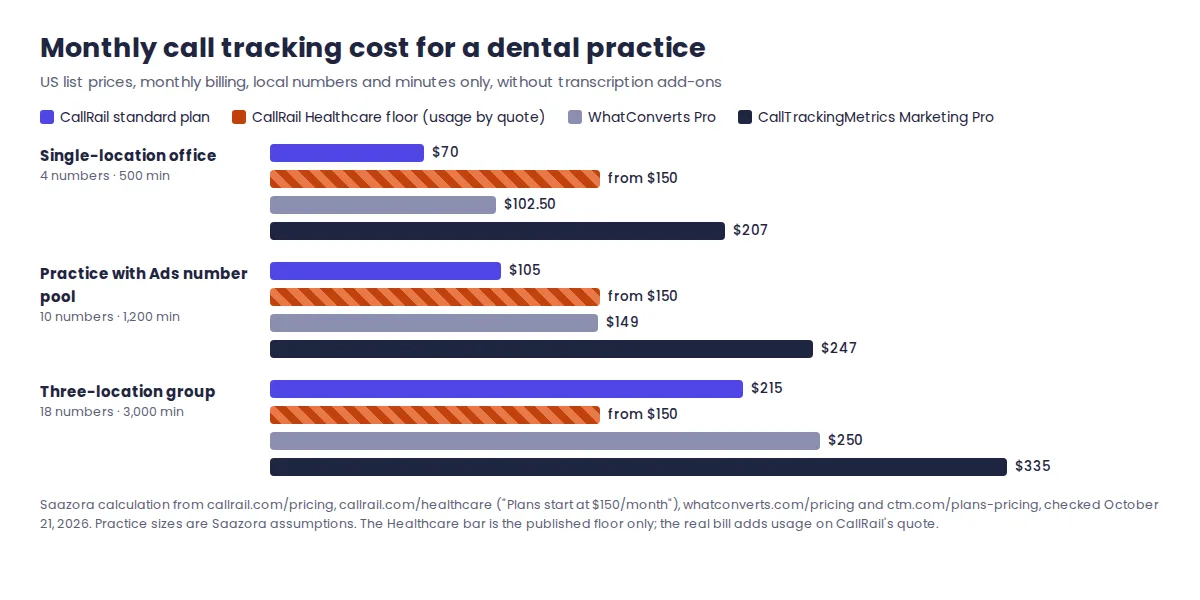
Three things stand out in the numbers:
- The HIPAA route roughly doubles the entry cost for a small office. A four-number office on CallRail's standard plan pays $70; the Healthcare Plan starts at $150 before usage. For a three-location group the standard bill ($215) already exceeds the Healthcare floor, so the gap depends on the usage terms in the quote.
- WhatConverts Pro has the lowest fully published HIPAA-tier bill at every size here (CallRail's Healthcare usage is by quote, so only its floor can be compared). For a single office it costs less than CallRail's $150 floor even before usage, and with transcription it stays below CTM Marketing Pro.
- CTM's free transcription does not last. The 3,000 included transcribed minutes are a one-time allowance per sub-account, so a 1,200-minute practice uses them up in about 2.5 months, after which its bill rises from $247 to $271.
Usage on CallRail is billed after the fact: the pricing FAQ says extra minutes and numbers "will be billed in addition to your base fee," that these fees "are not refundable under any circumstances," and that minutes are counted "by rounding each call up to the nearest minute." The full plan-by-plan math, including the volume tiers, is in our breakdown of CallRail's plan prices and usage rates.
HIPAA and CallRail: what its own pages say, word for word
CallRail does not describe its standard plans as suitable for protected health information. Its pages tie HIPAA support, the BAA and the extra security settings to a separate Healthcare Plan. Everything in this section is quoted or closely paraphrased from CallRail's pages as read on October 21, 2026; it is not legal advice, and whether a given workflow involves PHI is a question for the practice's own compliance adviser.
- On the BAA and the price floor (CallRail for Healthcare page): "Every Healthcare Plan includes a Business Associate Agreement (BAA) for your peace of mind. Plans start at $150/month."
- On using standard plans with PHI (same page, FAQ): "using it with PHI without a BAA is strictly prohibited by our Terms of Service," and "The extra security measures enabled for HIPAA-supported customers cannot be activated without a BAA and a Healthcare Plan."
- On why calls can carry health information (help article "CallRail Healthcare accounts," updated September 11, 2026): "Even without an audio recording of the call, the fact that the call happened at all may create health information that links an individual to a medical practice and the types of services they provide."
- On what the plans support (same article): CallRail's Healthcare plans "help Covered Entities and the marketing agencies that serve them maintain compliance with" HIPAA and HITECH.
- On the pricing page FAQ: "we also sign a business associate agreement (BAA) with each of our Healthcare clients. Contact us today to get your BAA set up and learn about our specific Healthcare plans."
The same help article lists how a healthcare account behaves differently from a standard one. These are the changes a front desk will notice on day one:
- "Users will be logged out every 30 minutes."
- Recording links require each person's own login.
- Caller ID "will not be included in the Call Notification email but will be available upon logging into CallRail."
- Form and text alerts show only the phone number, not the message.
- Healthcare accounts are created as a separate CallRail account with separate billing, set up through a support ticket, and existing integrations must be re-authorized after a move. CallRail adds that "All integrations in CallRail's integrations library are usable on a Healthcare plan."
- Support staff can see the account only after an admin grants temporary access, which "expires after five days."
CallRail's "HIPAA and compliance settings for Healthcare plans" article (updated June 10, 2026) adds two defaults worth knowing before go-live. On a Healthcare plan with the base Call Tracking Intelligence package, "Recording and transcripts are OFF by default"; on plans with Premium Conversation Intelligence and Convert Assist they are on by default. When transcripts are on, PHI redaction is on by default and can remove medical details such as "Conditions, diagnoses, medications, treatments, procedures, and tests." CallRail states that redaction "currently achieves a 95% accuracy rate," so it is a safeguard, not a guarantee, and transcription works for "English-language calls only."
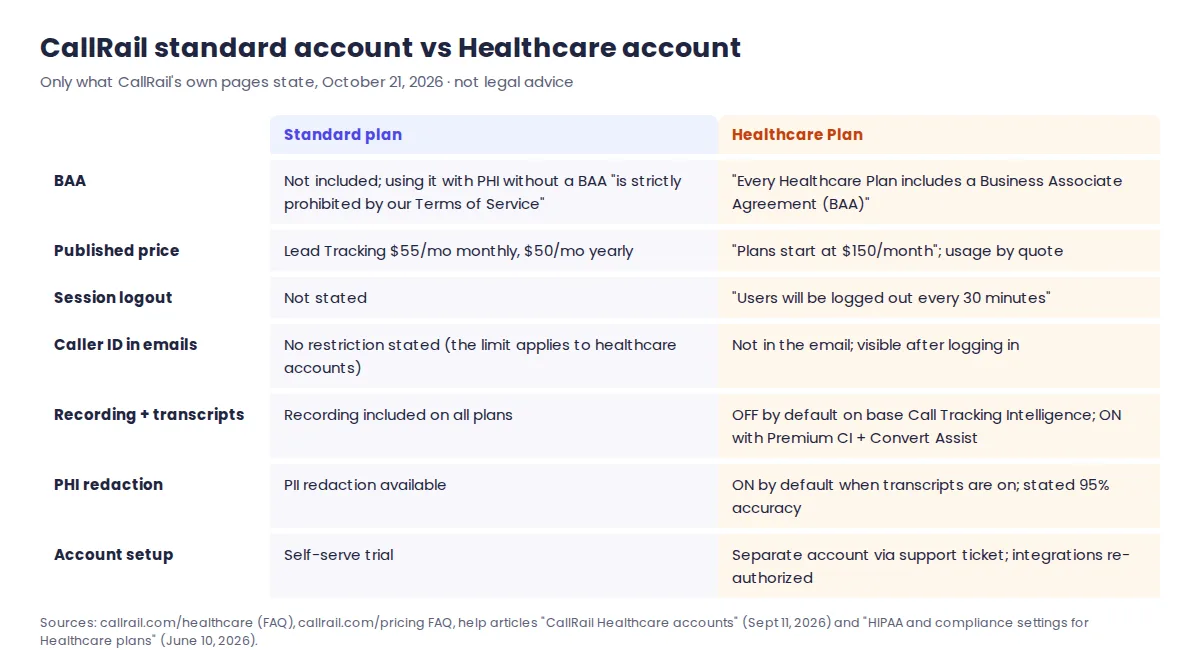
Two practical points follow. Recording laws still apply: CallRail's help article says "Some require all-party consent; others require only one" and lets you add a recorded greeting. And because the Healthcare Plan is a separate account, it is simpler to start the trial and the BAA conversation at the same time than to build on a standard account and migrate later.
Missed calls and front-desk follow-up
CallRail gives a practice three tools for missed calls, at three price points: a free report, a text-back rule billed at texting rates, and Voice Assist from $95 a month.
- Find the gaps (included). The Unanswered Calls report shows missed calls by day of week and hour of day. A call answered by a phone system outside CallRail counts as answered, so if your practice phone system has its own auto-attendant, check its logs too.
- Text back automatically (texting rates). The Automated Response setting sends a text "to someone whose call you missed." CallRail notes three limits: the business must first register for text messaging compliance, US and Canadian numbers only, and a caller who hangs up within 15 seconds is classed as abandoned and gets no text. CallRail's standard plans include 25 texts a month, then $0.03 each.
- Answer with AI (from $95 a month). Voice Assist answers when nobody picks up and saves the intake answers in the call log. CallRail's help center prices it at "$95 per month and includes up to 50 answered calls," then $1.00 per call; a call counts only if Voice Assist handles it for more than fifteen seconds. CallRail says Voice Assist "is also available for customers on a CallRail healthcare plan, supporting full HIPAA compliance."
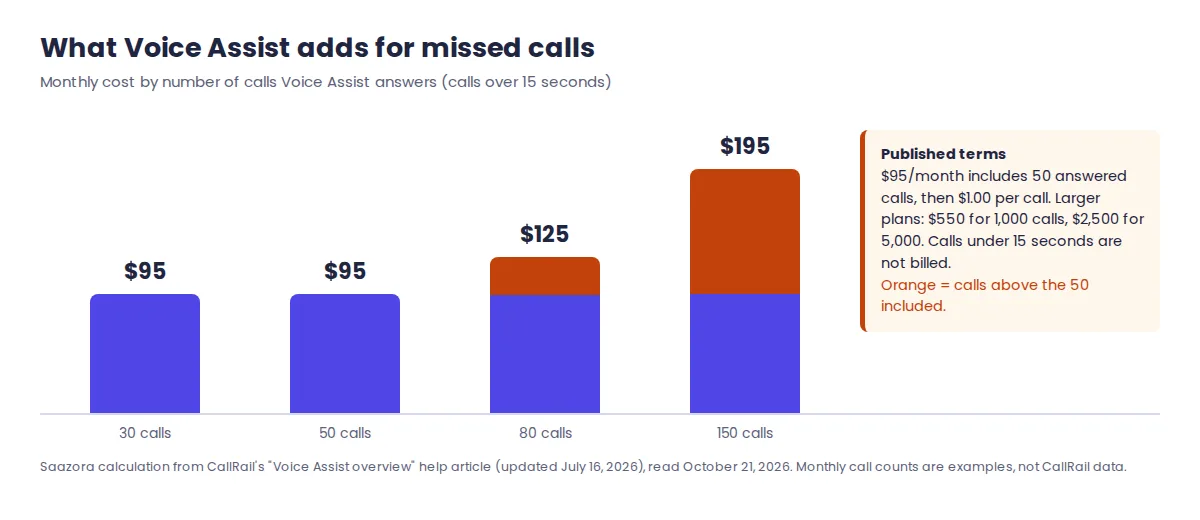
At 80 answered calls a month Voice Assist costs $125; at 150 it costs $195. Before adding it, compare that with what one booked new patient is worth to the practice and how many after-hours calls the Unanswered Calls report actually shows. If most misses happen during lunch, a schedule change may solve the problem for free.
Connecting calls to booked appointments
CallRail can mark which calls turned into real appointments through a NexHealth connection to the practice's scheduling system. After each inbound call, it looks for a patient record with a matching phone number and a new appointment booked "during or shortly after that call," then tags the call "EHR - Appointment booked." Supported systems listed in the help article (updated October 8, 2026) include Dentrix (G6.2+), Dentrix Ascend, Eaglesoft (18+), Open Dental (V17+), Denticon, Curve Hero, Athena, eClinicalWorks, ModMed and NextGen Office.
The conditions are strict, and they are the reason this feature changes the budget:
- You "must be on a Healthcare Plan with the premium healthcare integrations" and have a signed BAA.
- Setup "is not self-serve at this time" and "each practice location requires its own integration setup."
- Billing: an "Attribution Sync" line where "your first 5 companies are free of charge," then $25 for each additional company, and a "Scheduling Sync" charge of $60 per company when Voice Assist books straight into the scheduling system.
- Attribution uses the landing page URL only; "UTM parameters, call IDs, source, and medium are not passed." Recordings and transcripts "stay in CallRail."
- Shared phone numbers, "common in family or pediatric practices, may result in ambiguous matches."
Without the integration, a practice has two simpler signals: the Google Ads integration's separate "First Time Phone Call" conversion for first-time callers, and custom call tags the front desk applies by hand (CallRail lists "Custom call tagging" on every Lead Tracking plan). Manual tags are only as complete as the team's habit of tagging every call.
CallRail against two alternatives with a HIPAA tier
WhatConverts and CallTrackingMetrics both name HIPAA on their pricing pages, so they are the most direct comparison for a practice. Neither page mentions a BAA, which is the first question to put to their sales teams.
| CallRail Healthcare Plan | WhatConverts Pro | CallTrackingMetrics Marketing Pro | |
|---|---|---|---|
| Published starting price | "Plans start at $150/month" | $100/month + usage after $30 credit | $179 monthly, $149 yearly, + usage |
| HIPAA wording on the vendor's page | "Every Healthcare Plan includes a Business Associate Agreement (BAA)" | "HIPAA compliant call, form and chat tracking" (listed on Pro and above) | "Our HIPAA compliant features are included in the Marketing Pro plan and above" |
| BAA mentioned on that page | Yes | No | No |
| Extra local number / minute | By quote (standard plans: $3.00 / $0.06) | $2.50 / 4.5¢ | $2.00 / 4.0¢ |
| Transcription | Included in the minute on standard plans | 2¢ a minute | 3,000 minutes included once, then $0.02 |
| Practice-system link | NexHealth (Dentrix, Open Dental, Eaglesoft and others), Healthcare Plan only | Not listed on the pricing page | Not listed on the pricing page |
| Missed-call answering | Voice Assist from $95/month | Not on the pricing page | Not listed on the pricing page |
| Trial | 14 days, "We don't require a credit card" | 14-day free trial | "Pay $0 in Plan Fees for the First Month" |
Sources: callrail.com/healthcare and callrail.com/pricing; WhatConverts' pricing page; CallTrackingMetrics plans and pricing and its pricing FAQ. All read October 21, 2026.
Pick CallRail when the BAA in writing, appointment matching inside Dentrix or Open Dental, and missed-call answering matter more than the lowest bill. Pick WhatConverts Pro when the budget is tight and forms and chat need tracking too, and get its BAA terms confirmed first. CTM fits larger groups that want its automation and agency sub-accounts; our CallRail vs CallTrackingMetrics comparison goes through the two head to head. AvidTrak runs a dental landing page, but that page does not mention HIPAA. Outside healthcare, our CallRail alternatives priced per number compares six other trackers. For everything else CallRail does outside healthcare, see our CallRail review.
If CallRail fits, you can start a CallRail trial and ask about its Healthcare Plan (affiliate link). Current offer details are also on our CallRail offer page.
Setting up call tracking in a dental office, in order
When setting up call tracking for dentists, the order matters more than the speed: settle the HIPAA question before any real patient calls flow in, then add sources one at a time so each number can be tested.
- Decide on the account type first. If the practice will handle PHI in CallRail, contact CallRail about a Healthcare Plan and BAA before go-live; its help center says healthcare accounts are created through a support ticket and kept separate from standard accounts.
- List your sources and assign numbers. Use the mapping table above: one number for GBP, one for each paid channel, one per offline campaign, plus a pool only if you need Google Ads keyword detail.
- Connect Google Business Profile. Integrations, then Google Business Profile, Authorize, pick the location and the tracking number. CallRail keeps your real number as the secondary number.
- Install the website snippet and connect Google Ads. The Google Ads integration needs the JavaScript snippet, visitor tracking (a website pool) and auto-tagging, and is set up per company. Choose separate conversion actions for first-time and repeat callers. Add Call Details Forwarding in Google Ads for calls placed from the ad itself.
- Add Local Services Ads by hand. Create the LSA number in CallRail, then paste it into your LSA account.
- Set the recording greeting and AI settings. Check your state's consent rule, add a greeting if needed, and on a healthcare account review which AI features and redaction categories are on.
- Cover missed calls. Register for text messaging compliance, turn on the missed-call text, and decide later whether Voice Assist is worth it from a month of Unanswered Calls data.
- Test every number. Call each one from a mobile phone, check that it rings the front desk, appears in the call log with the right source, and that the website shows the swapped number.
Questions practices ask about call tracking
Is CallRail HIPAA compliant for a dental office?
CallRail's own wording is that its Healthcare Plans are a "HIPAA-supported platform" and that every Healthcare Plan "includes a Business Associate Agreement (BAA)." It also says using CallRail with PHI without a BAA "is strictly prohibited by our Terms of Service." Saazora cannot confirm compliance for any specific practice; that depends on your own policies and your adviser's review.
How much does call tracking cost for a dental practice?
On CallRail's standard plans, $70 a month for a four-number office with about 500 minutes, $105 for a ten-number setup with 1,200 minutes, and $215 for 18 numbers and 3,000 minutes (monthly billing, October 21, 2026). CallRail's Healthcare Plans start at $150 a month plus usage by quote.
Can a dental office put a tracking number on its Google Business Profile?
Yes. CallRail's GBP integration puts the tracking number in the primary slot and keeps the real office number as a secondary number "to maintain NAP consistency." Keep the real office number on directory listings so the business details stay consistent everywhere.
Can call tracking tell me which calls booked an appointment?
Yes, two ways. Staff can tag calls by hand with custom call tags, or a Healthcare Plan with the premium healthcare integrations can match calls to bookings in systems such as Dentrix, Open Dental and Eaglesoft through NexHealth. The automatic route needs a signed BAA and CallRail's team to set it up.
Sources and how this guide was researched
On October 21, 2026, Saazora read CallRail's pricing page (yearly and monthly views and the expanded Lead Tracking table), its CallRail for Healthcare page with all five FAQ answers, its Dental page, and these CallRail help center articles: "CallRail Healthcare accounts," "HIPAA and compliance settings for Healthcare plans," "Granting temporary access for healthcare accounts," "Connecting CallRail to your Electronic Health Record (EHR) via Nexhealth," "Voice Assist overview," "Automated responses for missed calls," "Unanswered calls report," "Google Business Profile integration," "Google Ads integration" and "How to set up Google Local Services Ads with CallRail." Alternative prices come from the WhatConverts pricing page and the CallTrackingMetrics plans page (US rate table) and FAQ, read the same day. The three practice sizes are Saazora assumptions, and the bills are Saazora's own calculations from list prices. No vendor account was opened and no calls were placed, so this is a research guide, not hands-on testing. Your bill will differ with toll-free numbers, texts, taxes, call length and any Healthcare Plan quote. More CallRail and sales-tool coverage sits in our sales outreach tools hub, and our research and review process explains how prices are checked.