
CallRail pricing page and help center articles, Zillow and Realtor.com program pages, state statutes and the National Do Not Call Registry business FAQ read October 29, 2026 · Research guide based on published documentation, not hands-on testing · US list prices
Saazora may earn a commission if you sign up for CallRail through links on this page, at no extra cost to you. Links to Zillow, Realtor.com, state legislatures and government sites are plain links.
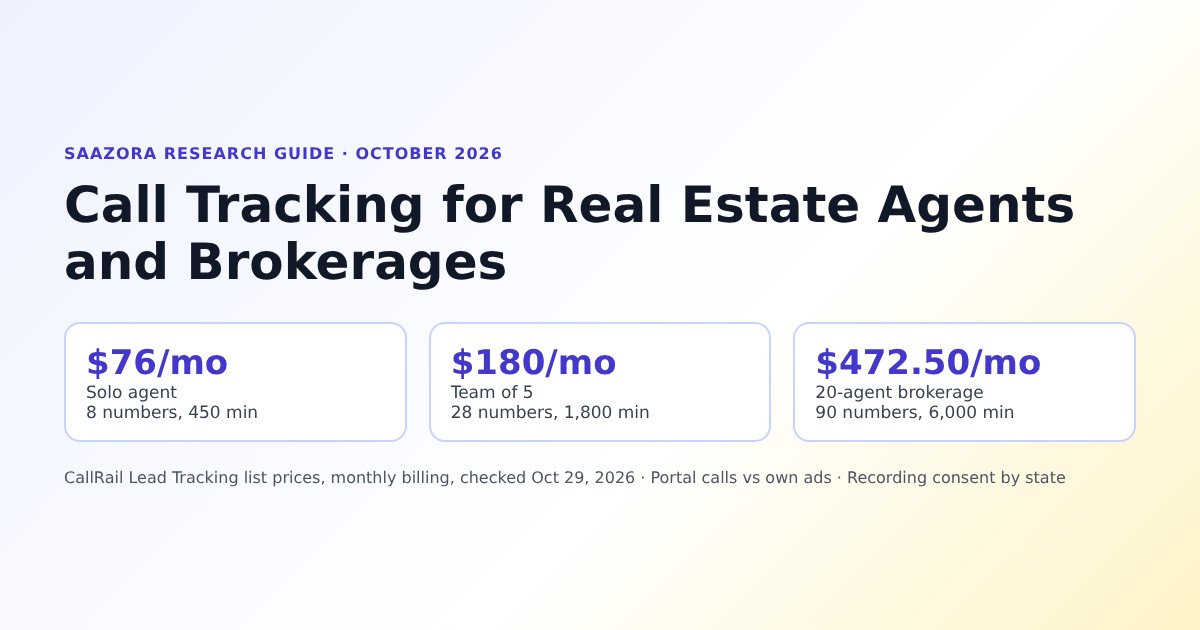
Call tracking for real estate works best on the calls you pay to create yourself: yard signs, postcards, your own website, Google Business Profile and paid social ads. Portal leads from Zillow Premier Agent and Realtor.com's concierge service arrive as calls the portal places to you, so the portal's own records are the better count for those. At CallRail's list prices on October 29, 2026, a solo agent with eight tracking numbers comes to about $76 a month, a five-agent team with a number per agent and per listing sign about $180, and a 20-agent brokerage with 90 numbers about $473, or under $24 per agent (Saazora arithmetic on callrail.com/pricing). This guide maps real estate call sources to tracking numbers, compares portal calls with your own marketing, works out those three bills, and covers the call recording rules that matter when buyers call from other states.
If you have not picked a vendor yet, the CallRail alternatives compared by price per number lay out the other options. This page assumes CallRail is on the shortlist and looks only at how agents, teams and brokerages would set it up.
Which real estate calls a tracking number can see
CallRail uses two kinds of tracking number. A website pool swaps a different number for each visitor through dynamic number insertion, so a call from your IDX site can be tied to the search, ad or social post that brought the visitor. A source number is one fixed number for one campaign. CallRail's help center says it can go on offline marketing such as billboards and recommends "one source tracking number for per campaign" to avoid muddled reports. Its list of common offline sources includes, by name, the yard sign, the bandit sign, the flyer, the brochure, the door hanger, the business card and the billboard, each "configured as offline."
That covers most of what an agent pays for. The gap is the calls that never dial a number you chose. Here is how the usual sources sort out:
| Where the call starts | What to put there | Who dials whom | What CallRail records |
|---|---|---|---|
| Your own website or IDX pages | Website pool (minimum 4 numbers) | Buyer dials the swapped number | Call, plus the visitor's source, landing page and keyword |
| Google Business Profile | Source number set up for Google Business Profile | Buyer or seller dials it from Maps or Search | Call, tagged to the profile |
| Yard sign rider, open house flyer, brochure | Offline source number | Passer-by dials the printed number | Call, tagged to that sign or print piece |
| Farm postcards and other mailers | Offline source number per mailing | Homeowner dials the printed number | Call, tagged to that mailing |
| Facebook and Instagram ads | Source number for the campaign, or the website pool on the landing page | Lead dials from the ad or the page | Call, tagged to the campaign |
| Zillow Premier Agent connection | Nothing you place on the listing | Zillow calls the buyer and the agent and joins them | Only if the agent's receiving line is itself a tracking number (see below) |
| Realtor.com ReadyConnect Concierge | Nothing you place on the listing | A Realtor.com rep calls the agent, then transfers the client | Same as above |
Sources: CallRail help center, "Types of call tracking," "Source tracking basics," "Common marketing sources to use with call tracking" and "How to calculate the size of your website pool"; Zillow, "What Happens When a Buyer Contacts a Premier Agent Partner?"; Realtor.com, "ReadyConnect Concierge." Read October 29, 2026.
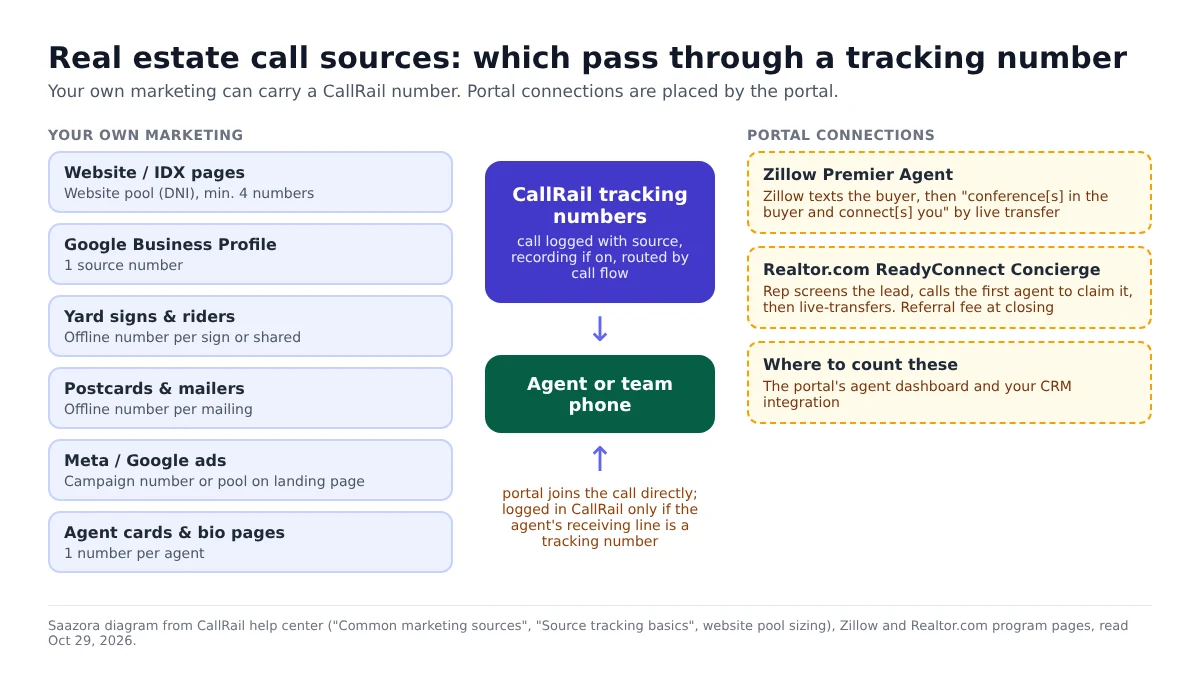
Visitor-level tracking matters for one reason in real estate: CallRail's feature table marks the Google Ads integration and the visitor timeline as available with visitor tracking only. If you run Google search ads for "homes for sale in" plus a town name, the website pool is what lets call conversions show against those keywords. Our guide to how many numbers a DNI pool needs covers the sizing math; CallRail's own rule is peak hourly visitors divided by four, with four numbers as the floor.
Zillow and Realtor.com lead calls versus calls from your own ads
The two big portals do not hand you a phone call the way a yard sign does. They run the connection themselves, and both describe the process in their own words.
Zillow Premier Agent. Zillow's page for partner agents says that when a buyer is ready to talk, Zillow sends the buyer a text and then "That triggers a live transfer call when we conference in the buyer and connect you so you can introduce yourself and start helping them." It adds that "if you can't take the call, you still keep your place in line." The buyer's follow-up messages "include your contact info and a link to your agent profile on Zillow."
Realtor.com ReadyConnect Concierge. Realtor.com's concierge page says its reps screen online leads and that "the first agent to claim the lead alert will receive a phone call from a Realtor.com Rep," who then live-transfers the client. Pricing is "only pay a referral fee on closed transactions." An older NAR-hosted Realtor.com deck (copyright 2021) says the same thing in other words: "ReadyConnect only gets paid when your referral closes."
Put side by side with the calls you generate, the differences are practical, not technical:
| Question | Portal connection (Zillow, Realtor.com concierge) | Your own marketing (signs, mail, site, ads) |
|---|---|---|
| Who starts the phone call | The portal, after the consumer submits a request | The consumer, by dialing your number |
| Can you swap in a tracking number | Not on the listing or the inquiry form | Yes, one per source or a website pool |
| Where the count of leads lives | The portal's agent dashboard and its CRM integrations | CallRail's call log, by source |
| How you pay for the lead | Concierge: referral fee at closing. Zillow: terms not published on the page read | Ad spend or print cost, which you divide by tracked calls |
| Who else is on the call | A portal rep may be on the line at the start | Usually only the caller and the agent |
Sources: Zillow Premier Agent page and Realtor.com ReadyConnect Concierge page (both read October 29, 2026); NAR-hosted Realtor.com ReadyConnect deck, © 2021 Move, Inc.
There is one edge case worth knowing. Zillow joins the call to "you," which in practice means the phone number on the agent's Premier Agent account. If that receiving number is a CallRail number labeled "Zillow" that forwards to the agent's mobile, the transferred call would show up in CallRail's log like any other inbound call, with a recording if recording is on. Neither portal page says whether a forwarding number is acceptable as the agent's contact line, and a live transfer can include a portal rep as a third party on the recording. Ask your Zillow or Realtor.com representative before you try it, and read the recording section below first. For most agents the simpler answer is to keep portal leads in the portal's report and their CRM, and point CallRail at the marketing they buy directly.
Lead CRMs help close that gap from the other side. Follow Up Boss's help center, for example, describes a Zillow integration that "sends new Zillow leads and agent assignments from Zillow to Follow Up Boss." That gives a team portal leads and tracked calls in the same CRM, even though CallRail never saw the portal call.
A number per listing, per agent, or per channel
The biggest cost decision in real estate call tracking is how finely you split numbers. Every split is one more number on the bill, and every merge is a question you can no longer answer.
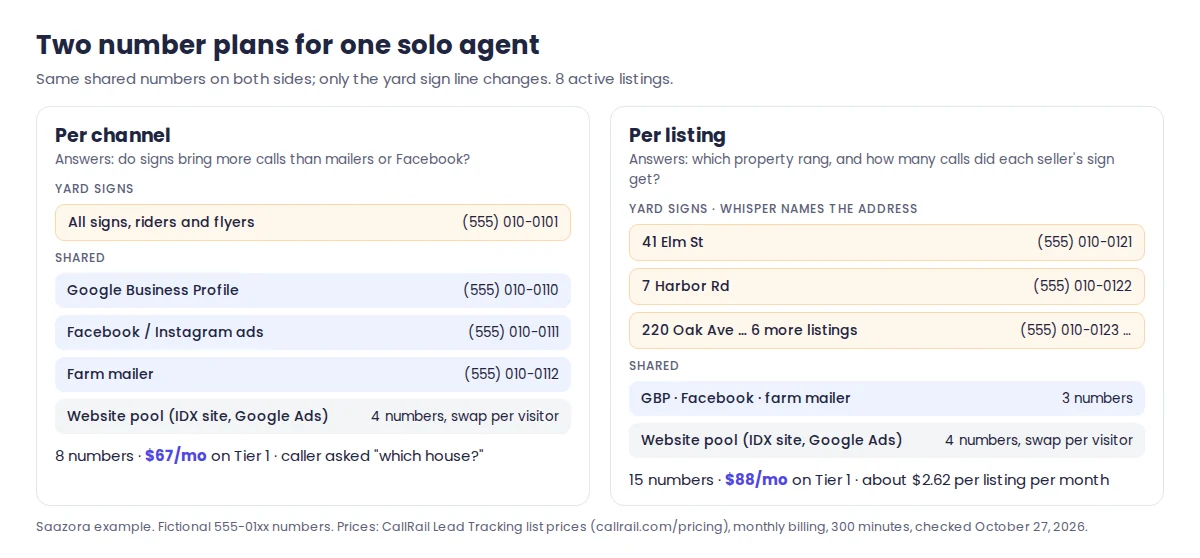
- Per channel. One number for all yard signs, one for postcards, one for the website pool, one for Meta ads. Cheapest, and it answers "do signs still produce calls?" It cannot tell you which listing's sign rang.
- Per listing. A separate sign-rider number for each active listing. You see which properties generate drive-by calls, which helps when a seller asks what the sign is doing for them. Riders get reused, though: once a listing closes, the rider and its number move to the next property, so rename the number in CallRail when the sign moves or the reports mix two addresses.
- Per agent. One number on each agent's business cards, email signature and bio page, forwarding to that agent. On a team this shows whose personal marketing works, and it keeps a caller's history with the agent who answered.
Routing is where team setups differ from a solo agent's. CallRail's Round Robin step rings destination numbers "sequentially" in a queue, with an optional weighted split, and "all future calls from the same customer/telephone number will route to the same destination that originally answered the call." That stickiness suits shared numbers such as the office line or a sign for a team listing: a buyer who calls back reaches the same agent. The Simulcall step rings several phones at once and connects "the first destination number to answer." Routing by caller location to the nearest office needs the advanced call routing add-on, which CallRail prices at "15$ per company."
CallRail's own real estate tips add one warning that changes the minute budget: use tracking numbers "for inbound calls, not outbound cold calling." Its rule of thumb for a 250-minute plan is that "more than four calls a day at about three minutes each will exceed" the included minutes. CallRail also notes it bills minutes "by rounding each call up to the nearest minute." Prospecting from a tracking number burns minutes fast and blurs the inbound report, so keep dialing sessions on a separate line.
What call tracking for real estate costs at three office sizes
All three examples below use CallRail's Lead Tracking plan family, the call and text tracking plans shown under "See all Lead Tracking plans" on callrail.com/pricing. Each tier includes 25 text messages; the tiers differ in numbers, minutes and the price of extras.
| Lead Tracking tier | Monthly billing | Yearly billing (per month) | Local numbers included | Local minutes included | Each extra local number | Each extra local minute |
|---|---|---|---|---|---|---|
| Tier 1 | $55 | $50 | 5 | 250 | $3.00 | $0.06 |
| Tier 2 | $75 | $68 | 5 | 750 | $3.00 | $0.06 |
| Tier 3 | $95 | $85 | 10 | 1,000 | $2.50 | $0.05 |
| Tier 4 | $295 | $265 | 40 | 4,000 | $1.75 | $0.045 |
Source: callrail.com/pricing, "See all Lead Tracking plans," monthly and yearly views, checked October 29, 2026. Toll-free numbers cost $5.00 to $3.00 each depending on tier. Lead Tracking Complete, which adds form tracking, lists at $105 a month on monthly billing ($95 yearly). Every account starts with a 14-day free trial and CallRail says "We don't require a credit card to get started."
The three offices are assumptions, built from the source list above. The solo agent uses one shared number on all sign riders. The team and the brokerage put a separate number on every active listing sign and give each agent a personal number.
| Setup | Tracking numbers | Minutes a month | Cheapest tier | Monthly bill | Yearly billing | Per agent |
|---|---|---|---|---|---|---|
| Solo agent: website pool 4, Google Business Profile 1, sign riders 1, farm postcards 1, Meta lead ads 1 | 8 | 450 | $55 + 3 numbers + 200 minutes | $76.00 | $71.00 | $76.00 |
| Team of 5: website pool 6, Business Profile 1, agent numbers 5, listing signs 12, mailers 2, paid ads 2 | 28 | 1,800 | $95 + 18 numbers + 800 minutes | $180.00 | $170.00 | $36.00 |
| Brokerage, 20 agents, 2 offices: website pool 10, Business Profiles 2, agent numbers 20, listing signs 45, print 5, paid ads 4, development and open-house lines 4 | 90 | 6,000 | $295 + 50 numbers + 2,000 minutes | $472.50 | $442.50 | $23.63 |
Saazora arithmetic on callrail.com/pricing (October 29, 2026), US local numbers and minutes. Number counts and minutes are assumptions. Not included: taxes, the $1.50 monthly text registration fee if you text from CallRail, and add-ons such as advanced call routing ($15 per company).
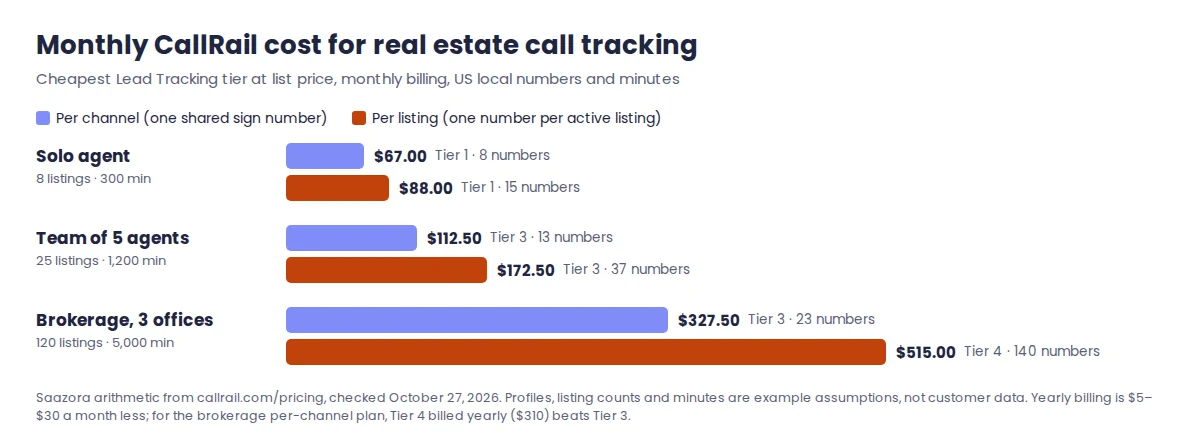
A few results are worth spelling out:
- The solo agent stays on the entry tier. Moving to the $75 tier for its 750 minutes would cost $84 with the same eight numbers, $8 more than paying for 200 extra minutes on the $55 plan. The crossover arrives at about 583 minutes a month.
- Per-listing signs cost a solo agent about $12 more. With five active listings on their own numbers instead of one shared rider number, the count rises to 12 and the $55 tier comes to $88. The $95 tier, with ten numbers included, would be $100.
- The team is better off on the $95 tier than on the $55 one. Same 28 numbers and 1,800 minutes, but the cheaper extras on Tier 3 save $37 a month against Tier 1 ($217) and $27 against Tier 2 ($207).
- The brokerage crosses into the $295 tier. At 90 numbers, Tier 3 would be $545; Tier 4's 40 included numbers and $1.75 extras bring it to $472.50. Adding geo-routing to the nearest office would put it at $487.50.
For the complete plan list, including the bundles with form tracking and conversation intelligence, see our breakdown of CallRail's plans and hidden tiers.
Recording calls when the buyer may be in an all-party consent state
This section summarizes public statutes and a legal research guide. It is not legal advice; ask a lawyer or your broker's counsel about your own calls.
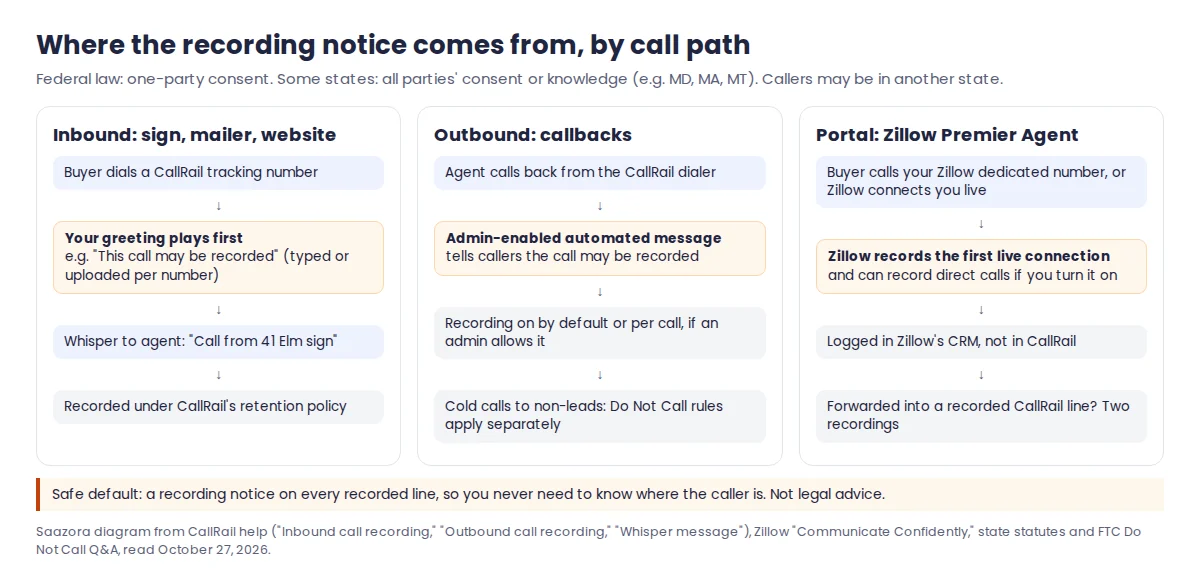
CallRail includes recording at no extra cost and leaves the legal question to you. Its inbound recording article says "Some states require both parties to consent to any recorded conversation," and offers "automated verbal greetings" that "can alert callers that the line is being recorded." Its outbound article has a matching toggle for "an automated message informing callers that their call may be recorded."
The Reporters Committee for Freedom of the Press, whose state-by-state recording guide is a widely used legal summary, lists about 11 states that "primarily have all-party consent requirements": California, Delaware, Florida, Illinois, Maryland, Massachusetts, Michigan (it adds "at least for recordings made by a third party"), Montana, New Hampshire, Pennsylvania and Washington. Four more split by type: "Connecticut and Nevada require all parties' consent with respect to phone calls," while Missouri and Oregon require it for in-person talks but not phone calls.
What the statutes say, read on official legislature sites:
- Washington (RCW 9.73.030) requires "the consent of all the participants" for a private phone communication, and then gives a practical route: consent "shall be considered obtained whenever one party has announced to all other parties" in "any reasonably effective manner" that the call is about to be recorded, provided the announcement "shall also be recorded."
- Florida (§ 934.03) makes interception lawful "when all of the parties to the communication have given prior consent to such interception."
- Maryland (Courts and Judicial Proceedings § 10-402) allows it "where the person is a party to the communication and where all of the parties to the communication have given prior consent."
- California: the state's code site blocks automated reads, so we rely on the Reporters Committee's California page, which says that "all parties to any confidential conversation must give their consent to be recorded" and that for cellular or cordless calls "all parties must consent before a person can record, regardless of confidentiality."
Real estate adds two twists. First, buyers relocate: an agent in a one-party state still takes calls from people with a California or Florida mobile number, and the Reporters Committee tells journalists that when a call involves participants from different states, they should "assume that the stricter state law will apply." Second, a portal live transfer can put three people on one recording. A short greeting on every recorded tracking number, such as "This call may be recorded for quality and training," avoids sorting callers by state. Note that CallRail says recording cannot be paused mid-call; you either record a number or you don't.
Prospecting calls, texts and the Do Not Call Registry
Inbound call tracking and outbound prospecting fall under different rules. Calling expired listings or for-sale-by-owner sellers is telemarketing for most purposes, and the National Do Not Call Registry's business FAQ says "it is illegal for most telemarketers or sellers to call a number listed on the National Do Not Call Registry." The same FAQ sets out the points agents ask about most:
- Sellers and telemarketers must "search the registry at least once every 31 days."
- An existing customer can be called for "up to 18 months after the consumer's last purchase, delivery, or payment," and someone who asked about your services for "up to three months after the consumer makes an inquiry or submits an application." A request to be put on your own do-not-call list overrides both.
- Access is priced per area code, with five area codes at no cost per organization.
Other federal and state rules on automated calls and texts also apply to prospecting. They are outside the scope of this page; ask counsel before you run an auto-dialer campaign.
Texting from tracking numbers has its own step. CallRail says "All businesses who want to respond to incoming text leads are required to register for texting," that registration itself is free, and that once confirmed it "includes a monthly fee ($1.50)." Its registration checklist asks for your legal business name, an EIN and, if your website collects phone numbers, "an explicit text message opt-in statement" on that form. For a brokerage, that means checking the IDX contact forms before registering, not after.
Setting it up in a brokerage, in order
- List what you print and what you pay for. Signs, riders, mailers, Business Profiles, ad accounts, agent cards. Decide per channel or per listing before buying numbers.
- Start the 14-day trial and build one company. Install the website snippet and size the pool from your peak hourly visitors divided by four, never under four numbers.
- Turn on inbound recording at the account level so new numbers and call flows default to it, add the recording greeting on each number, and decide whether outbound recording and its automated message are on by default.
- Build the call flows. Agent numbers forward to that agent; office and team-listing numbers use Round Robin or Simulcall, with business hours and voicemail after hours.
- Swap numbers onto print as it is reordered, starting with sign riders, then mailers. Name each number after the property or the campaign.
- Keep portal leads in the portal and your CRM. Compare cost per lead side by side each month rather than forcing both into one report.
- Register for texting after the trial if agents will reply to leads from CallRail numbers.
If your paid traffic is mostly Meta lead ads, the guide to tracking calls from Facebook and Instagram ads goes deeper on campaign numbers and landing pages. Marketing agencies that run call tracking for several brokerages should read how agencies structure CallRail accounts and billing first. When you are ready, you can start a 14-day CallRail trial (affiliate link) or check the current CallRail deals and offers.
Real estate call tracking questions
Can I put a CallRail number on my Zillow listing?
Not in a way that captures Premier Agent connections, because Zillow places those calls itself and conferences you in. You can track the line Zillow calls you on only if that line is a tracking number, and you should confirm with Zillow that a forwarding number is allowed. Check your MLS's rules before adding any phone number to listing remarks.
How many tracking numbers does a real estate agent need?
For a solo agent, about eight covers a four-number website pool plus one number each for the Business Profile, sign riders, mailers and social ads. A team that tracks every listing sign and every agent separately needs far more; our five-agent example uses 28.
Do I have to tell callers I am recording?
In the all-party consent states listed above, the statutes require everyone's consent, and Washington's says an announcement that is itself recorded counts. Because buyers call from everywhere, a greeting on every recorded number is the simple route. This is not legal advice.
Should agents make prospecting calls from tracking numbers?
CallRail's own tips say no: use tracking numbers for inbound calls and do extensive outbound calling through a separate line, so cold calls do not eat into plan minutes or skew the source reports.
Is CallRail worth it for one agent?
At about $76 a month for eight numbers, it pays off if it changes one spending decision, such as dropping a mailer that never rings. If you only want to know whether calls come from Google, Google's own free tools may be enough; our walkthrough of Google Ads call tracking shows where those stop.
How we researched this
This is a research guide. Saazora did not open a CallRail account, a Zillow Premier Agent account or a Realtor.com concierge account for this page, and did not place or record calls. CallRail prices come from callrail.com/pricing, monthly and yearly views and the expanded "See all Lead Tracking plans" table, checked October 29, 2026. CallRail behaviour comes from its help center articles on types of call tracking, source tracking, common marketing sources, website pool sizing, inbound and outbound recording, the Call Flow Builder, Round Robin and Simulcall steps, texting registration and its FAQ, and its tips for real estate users. Portal behaviour comes only from Zillow's and Realtor.com's own program pages and a NAR-hosted Realtor.com deck; Zillow's page was read through a text extraction because it blocks automated browsers. Consent rules come from the Reporters Committee for Freedom of the Press recording guide and the Washington, Florida and Maryland legislatures' statute pages. The office sizes, number counts and minutes are Saazora assumptions; the dollar figures are arithmetic on published list prices.
Sources (plain links): CallRail pricing · Common marketing sources to use with call tracking · Tips for our real estate users · Inbound call recording · Round Robin step · Zillow: when buyers contact a Premier Agent partner · Reporters Committee recording guide · RCW 9.73.030 · Fla. Stat. § 934.03 · Md. Cts. & Jud. Proc. § 10-402 · National Do Not Call Registry: information for business